state official

Death Valley is the latest battleground in fight over national park signage

“These are our homelands.”

“We are still here.”

The statements are objectively true: The Timbisha Shoshone have lived in what’s now popularly known as Death Valley for thousands of years. And they still live there, in a small village inside the national park that has about 30 full-time inhabitants.

In 2000, Congress officially recognized these two facts in the text of the hard-fought Homeland Act, which transferred nearly 7,800 acres of land, including the village site, back to the Timbisha Shoshone.

You’re reading Boiling Point

The L.A. Times climate team gets you up to speed on climate change, energy and the environment. Sign up to get it in your inbox every week.

By continuing, you agree to our Terms of Service and our Privacy Policy.

But federal officials have now taken issue with those seemingly innocuous sentences, according to Mandi Campbell, tribal historic preservation officer for the Timbisha Shoshone and a resident of the village.

The rationale? Orders from President Trump and Interior Secretary Doug Burgum directing the National Park Service to review interpretive materials for content that the administration feels “inappropriately disparages Americans.”

Only certain types of Americans, as it turns out: The executive order also has been cited in a lawsuit by the city of Philadelphia as the presumptive reason the NPS removed an exhibit on enslaved people from Independence National Historical Park.

Participants take time out during a march organized by the Timbisha Shoshone to mark the 25th anniversary of Homeland Act.

Participants take time out for a photo during a march organized by the Timbisha Shoshone to mark the 25th anniversary of the Homeland Act.

(Kim Stringfellow)

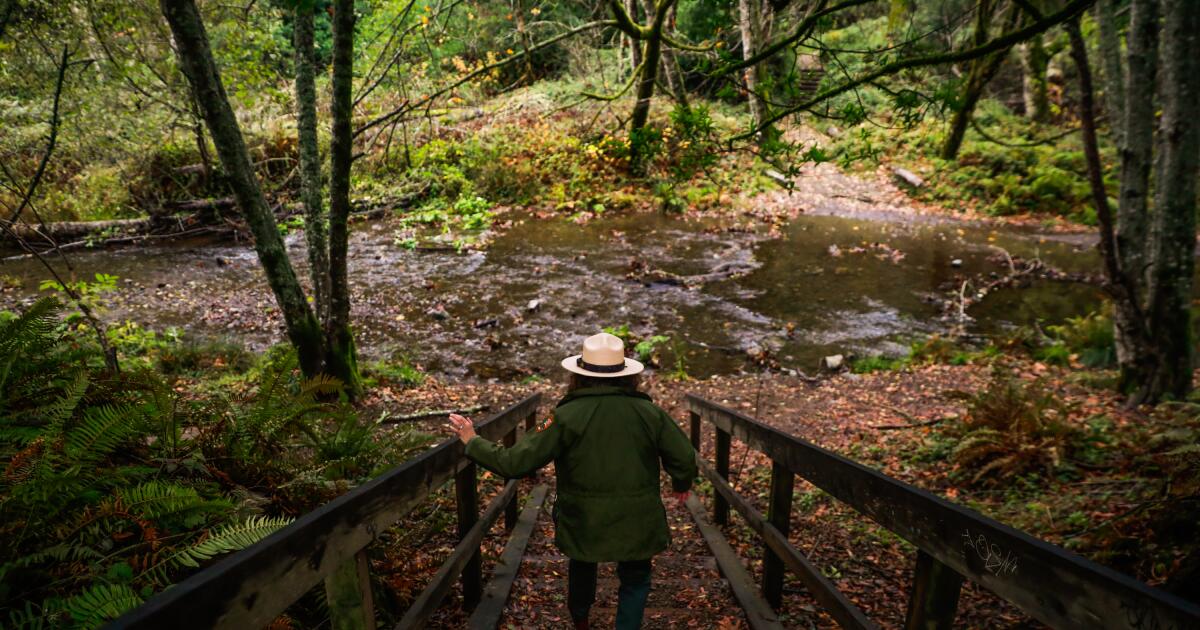
And it’s prompted Lowell National Historical Park in Massachusetts to stop showing films about women and immigrant textile mill workers, according to the New York Times, which also reported that plaques referencing climate change have been removed from Muir Woods National Monument in California and Fort Sumter and Fort Moultrie National Historical Park in South Carolina.

On top of that, Trump officials recently ordered the removal or editing of signs and other materials in at least 17 national parks in Arizona, Texas, Colorado, Utah, Montana and Wyoming, The Washington Post reports.

Back to Death Valley — a name that, by the way, members of the Timbisha Shoshone have never liked. Campbell told me that a celebration of the Homeland Act’s 25th anniversary that took place Friday at the national park’s Furnace Creek Visitor Center was supposed to include the unveiling of updates to its interpretive exhibit. The tribe had planned to place in a display case earrings and a medallion that members once gifted to former park Superintendent J.T. Reynolds to mark the passage of the act, along with some descriptive language, she said.

Ahead of the event, the Park Service submitted the additions to its parent agency, the Interior Department, for review. Campbell said that agency officials replied that not only could the new exhibit not include the new phrases “these are our homelands” or “we are still here,” but that similar language that’s been on display since 2012 would also be placed under review.

Interior Department spokesperson Elizabeth Peace said this is not true. “The Department has a long-standing history of working closely with tribal partners as part of exhibit development and review, and the park was never told they could not use that specific language or phrases,” she wrote in an email.

Peace went on to explain that although the new exhibit is under review pursuant to the executive and secretarial orders — both titled “restoring truth and sanity to American history” — the department hasn’t made any final decisions.

The review, according to Peace, is meant to ensure that parks tell “the full and accurate story of American history,” which includes addressing enslaved and Indigenous people, “informed by current scholarship and expert review, not through a narrow ideological lens.”

So, the 25th anniversary celebration went ahead without acknowledging the ongoing debate about the new exhibit.

There was a march from the village to the visitor center in which tribal members walked behind a banner that read, “We are still here,” which, Campbell said, was meant to echo a protest staged on Memorial Day in 1996 in which the Timbisha Shoshone demanded the restoration of their homelands after negotiations with the federal government broke down. That rally was widely credited with restarting the talks that eventually led to the passage of the Homeland Act.

Three decades later, the struggle continues. “Why do we still have to fight to be heard?” Campbell wondered earlier this week. “We weren’t even in history books. And we still can‘t tell our story. When do we get our chance?”

Despite the recent controversy, the tribe has a good relationship with the Death Valley-based NPS officials, Campbell said, and she’s confident they’ll be able to work through whatever happens next together.

After Friday’s march, tribal council members and park officials gave a series of speeches at the visitor center saluting their strong partnership and all the work that it’s taken to get to this point. Then they took pictures and ate cake.

More recent land news

If you’re a regular reader of this newsletter, you probably are aware of how lawmakers have been using the Congressional Review Act, which enables Congress to overturn recent federal rules with a majority vote, to revoke specific Bureau of Land Management plans that limit mining and drilling in specific places. This was unprecedented until last year but has since been used to throw out BLM plans in Alaska, Montana, North Dakota and Wyoming.

Now, a decision by the Government Accountability Office has cleared the way for Congress to throw out the BLM plan for Utah’s Grand Staircase-Escalante National Monument, which protects the land from mineral extraction, limits grazing and prioritizes conservation. Experts expect Republican Rep. Celeste Maloy or another Utah member of Congress to introduce a bill to do so this year, according to Caroline Llanes of Rocky Mountain Community Radio. If it passes, it would mark the first time the act has been used to roll back protections in a national monument.

Four former U.S. Forest Service chiefs are speaking out against the agency’s move to repeal the Roadless Area Conservation Rule. The 2001 rule protecting 58 million acres of national forests from road building and logging was supported by both political parties, and is needed to protect sensitive wildlife and maintain clean drinking water, argues an op-ed published in the Hill.

The Forest Service has revised its oil and gas leasing rules to “streamline” the permitting process by replacing parcel-by-parcel environmental reviews with a broader review that can sometimes cover millions of acres, reports Jake Bolster of Inside Climate News. Environmental groups told Bolster that the move will increase the likelihood that the agency misses sensitive habitat when deciding where to allow drilling.

Some environmental advocates are concerned about a new order from Interior Secretary Burgum that seeks to expand hunting and fishing access on federal public lands. “It flips conservation on its head and treats wildlife protection as the exception,” said Michelle Lute, executive director of nonprofit Wildlife for All. Others say the directive is more of a statement of values than something that will result in drastic changes on the ground. “It’s a nice nod to the hunting and angling community that acknowledges ‘we know these areas mean a lot to you,’” said Ryan Callaghan, president and chief executive of Backcountry Hunters & Anglers.

A few last things in climate news

Much has been made of a record-setting rainy season that’s helped lift California out of drought. But an extraordinarily warm January has left the snowpack across the Sierra Nevada and much of the Western U.S. far smaller than usual, Times water and climate change reporter Ian James writes. That means more hard times for the snowmelt-fed Colorado River, which provides water for farms and cities across seven states.

A federal judge recently ruled that a wind project off the coast of New York state can go forward — the fifth time a court has ruled against the Trump administration’s efforts to halt major offshore wind projects, write Jennifer McDermott and Alexa St. John of the Associated Press. Meanwhile, the administration has also been stymieing solar and wind energy projects on land by halting or delaying once-routine federal approvals, find Brad Plumer and Rebecca F. Elliott of the New York Times.

Peninsular bighorn sheep seeking to migrate back and forth across the California-Mexico border, as they’ve long done, are now being hampered by razor wire installed by U.S. Customs and Border Protection in the Jacumba Wilderness, according to our wildlife and outdoors reporter Lila Seidman. Similar scenarios are playing out across the Southwest, where the 1,954-mile border cuts through the habitat of more than 80 threatened and endangered species.

This is the latest edition of Boiling Point, a newsletter about climate change and the environment in the American West. Sign up here to get it in your inbox. And listen to our Boiling Point podcast here.

For more land news, follow @phila_lex on X and alex-wigglesworth.bsky.socialon Bluesky.

Source link

Newsom walks thin line on immigrant health as he eyes presidential bid

California Gov. Gavin Newsom, who has acknowledged he is eyeing a presidential bid, has incensed both Democrats and Republicans over immigrant healthcare, underscoring the delicate political path ahead.

For a second straight year, the Democrat has asked state lawmakers to roll back coverage for some immigrants in the face of federal Medicaid spending cuts and a roughly $3-billion budget deficit that analysts warn could worsen if the AI bubble bursts. Newsom has proposed that the state not step in when, starting in October, the federal government stops providing health coverage to an estimated 200,000 legal residents — comprising asylees, refugees and others.

Progressive legislators and activists said the cost-saving measures are a departure from Newsom’s “health for all” pledge, and Republicans continue to skewer Newsom for using public funds to cover any noncitizens.

Newsom’s latest move would save an estimated $786 million this fiscal year and $1.1 billion annually in future years in a proposed budget of $349 billion, according to the Department of Finance.

State Sen. Caroline Menjivar, one of two Senate Democrats who voted against Newsom’s immigrant health cuts last year, said she worried the governor’s political ambition could be getting in the way of doing what’s best for Californians.

“You’re clouded by what Arkansas is going to think, or Tennessee is going to think, when what California thinks is something completely different,” said Menjivar, who said previous criticism got her temporarily removed from a key budget subcommittee. “That’s my perspective on what’s happening here.”

Meanwhile, Republican state Sen. Tony Strickland criticized Newsom for glossing over the state’s structural deficit, which state officials say could balloon to $27 billion the following year. And he slammed Newsom for continuing to cover California residents in the U.S. without authorization. “He just wants to reinvent himself,” Strickland said.

It’s a political tightrope that will continue to grow thinner as federal support shrinks amid ever-rising healthcare expenses, said Guian McKee, a co-chair of the Health Care Policy Project at the University of Virginia’s Miller Center of Public Affairs.

“It’s not just threading one needle but threading three or four of them right in a row,” McKee said. Should Newsom run for president, McKee added, the priorities of Democratic primary voters — who largely mirror blue states like California — look very different from those in a far more divided general electorate.

Americans are deeply divided on whether the government should provide health coverage to immigrants without legal status. In a KFF poll last year, a slim majority — 54% — were against a provision that would have penalized states that use their own funds to pay for immigrant healthcare, with wide variation by party. The provision was left out of the final version of the bill passed by Congress and signed by President Trump.

Even in California, support for the idea has waned amid ongoing budget problems. In a May survey by the Public Policy Institute of California, 41% of adults in the state said they supported providing health coverage to immigrants without authorization, a sharp drop from the 55% who supported it in 2023.

Trump, Vice President JD Vance, other administration officials, and congressional Republicans have repeatedly accused California and other Democrat-led states of using taxpayer funds on immigrant healthcare, a red-meat issue for their GOP base. Centers for Medicare & Medicaid Services Administrator Mehmet Oz has accused California of “gaming the system” to receive more federal funds, freeing up state coffers for its Medicaid program, known as Medi-Cal, which has enrolled roughly 1.6 million immigrants without legal status.

“If you are a taxpayer in Texas or Florida, your tax dollars could’ve been used to fund the care of illegal immigrants in California,” he said in October.

California state officials have denied the charges, noting that only state funds are used to pay for general health services to those without legal status because the law prohibits using federal funds. Instead, Newsom has made it a “point of pride” that California has opened up coverage to immigrants, which his administration has noted keeps people healthier and helps them avoid costly emergency room care often covered at taxpayer expense.

“No administration has done more to expand full coverage under Medicaid than this administration for our diverse communities, documented and undocumented,” Newsom told reporters in January. “People have built careers out of criticizing my advocacy.”

Newsom warns the federal government’s “carnival of chaos” passed Trump’s One Big Beautiful Bill Act, which he said puts 1.8 million Californians at risk of losing their health coverage with the implementation of work requirements, other eligibility rules, and limits to federal funding to states.

Nationally, 10 million people could lose coverage by 2034, according to the Congressional Budget Office. Health economists have said higher numbers of uninsured patients — particularly those who are relatively healthy — could concentrate coverage among sicker patients, potentially increasing premium costs and hospital prices overall.

Immigrant advocates say it’s especially callous to leave residents who may have fled violence or survived trafficking or abuse without access to healthcare. Federal rules currently require state Medicaid programs to cover “qualified noncitizens” including asylees and refugees, according to Tanya Broder with the National Immigration Law Center. But the Republican tax-and-spending law ends the coverage, affecting an estimated 1.4 million legal immigrants nationwide.

With many state governors yet to release budget proposals, it’s unclear how they might handle the funding gaps, Broder said.

For instance, Colorado state officials estimate roughly 7,000 legal immigrants could lose coverage due to the law’s changes. And Washington state officials estimate 3,000 refugees, asylees, and other lawfully present immigrants will lose Medicaid.

Both states, like California, expanded full coverage to all income-eligible residents regardless of immigration status. Their elected officials are now in the awkward position of explaining why some legal immigrants may lose their healthcare coverage while those without legal status could keep theirs.

Last year, spiraling healthcare costs and state budget constraints prompted the Democratic governors of Illinois and Minnesota, potential presidential contenders JB Pritzker and Tim Walz, to pause or end coverage of immigrants without legal status.

California lawmakers last year voted to eliminate dental coverage and freeze new enrollment for immigrants without legal status and, starting next year, will charge monthly premiums to those who remain. Even so, the state is slated to spend $13.8 billion from its general fund on immigrants not covered by the federal government, according to Department of Finance spokesperson H.D. Palmer.

At a news conference in San Francisco in January, Newsom defended those moves, saying they were necessary for “fiscal prudence.” He sidestepped questions about coverage for asylees and refugees and downplayed the significance of his proposal, saying he could revise it when he gets a chance to update his budget in May.

Kiran Savage-Sangwan, executive director of the California Pan-Ethnic Health Network, pointed out that California passed a law in the 1990s requiring the state to cover Medi-Cal for legal immigrants when federal Medicaid dollars won’t. This includes green-card holders who haven’t yet met the five-year waiting period for enrolling in Medicaid.

Calling the governor’s proposal “arbitrary and cruel,” Savage-Sangwan criticized his choice to prioritize rainy-day fund deposits over maintaining coverage and said blaming the federal government was misleading.

It’s also a major departure from what she had hoped California could achieve on Newsom’s first day in office seven years ago, when he declared his support for single-payer healthcare and proposed extending health insurance subsidies to middle-class Californians.

“I absolutely did have hope, and we celebrated advances that the governor led,” Savage-Sangwan said. “Which makes me all the more disappointed.”

KFF Health News is a national newsroom that produces in-depth journalism about health issues and is one of the core operating programs at KFF — the independent source for health policy research, polling and journalism.

Source link

Advocates want $15M to help us coexist with wolves, bears and mountain lions

California once had specialists dedicated to resolving conflict between people and wolves, mountains lions and coyotes. But after funding ran dry in 2024, the state let all but one of them go.

The move came as clashes between us and our wild neighbors are increasing, as climate change and sprawl drive us closer together.

Now, a coalition of wildlife advocates is calling for the state to bring back, expand and fund the coexistence program, at roughly $15 million annually.

Sen. Catherine Blakespear (D-Encinitas) will soon introduce legislation that would create the program, her office confirmed. Nonprofits Defenders of Wildlife and the National Wildlife Federation are co-sponsors.

You’re reading Boiling Point

The L.A. Times climate team gets you up to speed on climate change, energy and the environment. Sign up to get it in your inbox every week.

By continuing, you agree to our Terms of Service and our Privacy Policy.

The money supporters want would be used to pay 50 to 60 staffers to focus on the Herculean task of balancing the needs of people and wildlife, as well as buy equipment like “unwelcome mats” to shock bears or fencing to protect alpacas from hungry lions.

Wildlife agencies acknowledge that education is key for coexistence, said Pamela Flick, California program director for Defenders of Wildlife, at a hearing Tuesday at the state Capitol dedicated to human-wildlife conflict. “But then staff time and resources don’t get allocated by agencies that are already chronically understaffed and underfunded.”

The hearing gave floor time to local law enforcement, representatives of affected regions and academics.

Since the funding expired, “I want to make it clear, the Department [of Fish and Wildlife] recognizes that we have potentially seen a gap in service, and folks have felt that,” Chad Dibble, deputy director of the department’s wildlife and fisheries division, said at the hearing.

Some aspects of the program live on — notably, a system that allows people to report run-ins with wildlife that may prompt the state to take action.

The same year the program fizzled, a mountain lion killed a young man and the state confirmed its first fatal black bear attack on an older woman. (Such attacks are very rare.)

Both tragedies unfolded in rural Northern California, with the fatal lion mauling occurring in El Dorado County.

Assemblymember Heather Hadwick — a Republican who represents El Dorado, as well as Lake Tahoe, which is ground zero for bear problems — called conflicts with predators her district’s biggest issue. “We’re at a tipping point,” she said.

Along with El Dorado, Los Angeles County, at the opposite end of the rural-urban continuum, leads the state for the highest number of reported wildlife “incidents.” These range from just spotting an animal to witnessing property damage.

Debates over how to manage predators can be fierce, but beefing up the state’s ability to respond is uniting groups that are often at odds.

A coalition that includes ranchers, farmers and rural representatives supports bringing back the conflict program, and also wants $31 million to address the state’s expanding population of gray wolves.

Most of that money would go to compensate ranchers for cattle eaten by wolves and for guard dogs, scaring devices or other means to keep them away from livestock.

The wildlife advocates support funding wolf efforts, but believe ranchers should be compensated only if they’ve taken steps to ward off the predators.

Asked his thoughts on it at the hearing, Kirk Wilbur, vice president of government affairs for the California Cattlemen’s Assn., a trade group, called it “a complicated question.”

“Ranchers should be doing something in the realm of nonlethal deterrence, and they are, but we have to be careful to make sure that our nonlethal solutions are not overly prescriptive,” he said.

The elephant in the room: The state’s budget is strained, and many are clamoring for a piece of the pie.

More recent wildlife news

Twenty starving wild horses stranded in deep snow near Mammoth Lakes recently survived an emergency rescue by the Forest Service, I wrote last week. Several died, including one after the rescue, from starvation and exposure. Some, beyond saving, were euthanized.

For some, the Forest Service acted exceptionally, but others questioned the handling of the situation. It’s the latest controversy for these horses. Wildlife advocates have long opposed relocating a large portion of the herd, which the feds say is necessary to protect the landscape.

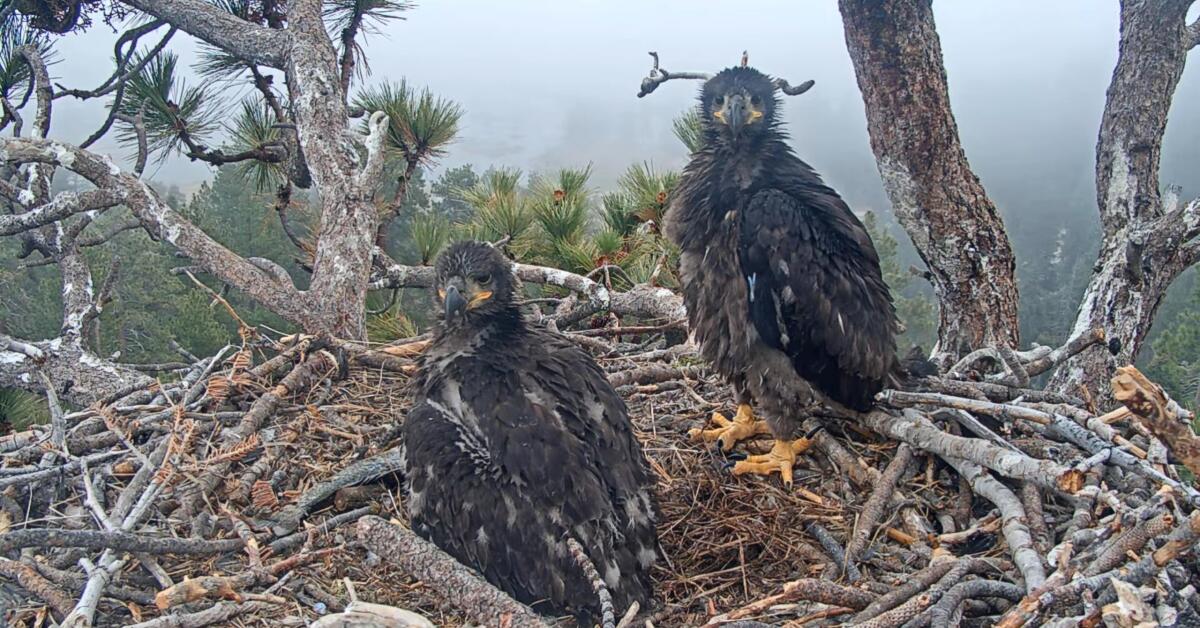
Beloved bald eagle couple Jackie and Shadow welcomed not one but two eggs in their Big Bear nest in recent days. One arrived on Jan. 23, The Times reported, and, according to the Desert Sun, the second followed three days later.

If you need a pick-me-up, take a gander at a video of an Austrian cow using a long brush to scratch herself. It’s not just adorable; as noted by the Washington Post’s Dino Grandoni, it’s the first documented case of a cow using a tool.

Need even more awww? Read about sea turtle Porkchop’s recovery journey at Long Beach’s aquarium. She had a flipper amputated and a fishing hook removed from her throat, and could return to the wild in a matter of weeks.

Coyote mating season is here and that means you are likely to see more of the animals in your neighborhood, per my colleague Karen Garcia.

A few last things in climate news

More than a year after the Palisades and Eaton wildfires, contamination remains a top concern. A state bill introduced this week aims to enforce science-based guidelines for testing and removing contamination in still-standing homes, schools and nearby soil, my colleagues Noah Haggerty and Tony Briscoe report.

Highway 1 through Big Sur (finally) fully reopened after a three-year closure from landslides. As fellow Times staffer Grace Toohey writes, the iconic route is expected to face more challenges from the effects of climate change: stronger storms, higher seas and more intense wildfires.

Per Inside Climate News’ Blanca Begert, the Bureau of Land Management has revived an effort to open more of California’s public lands to oil extraction. Will it be successful this time?

This is the latest edition of Boiling Point, a newsletter about climate change and the environment in the American West. Sign up here to get it in your inbox. And listen to our Boiling Point podcast here.

For more wildlife and outdoors news, follow Lila Seidman at @lilaseidman.bsky.social on Bluesky and @lila_seidman on X.

Source link