Trump’s vaccine plan would require millions of individual shots last used decades ago
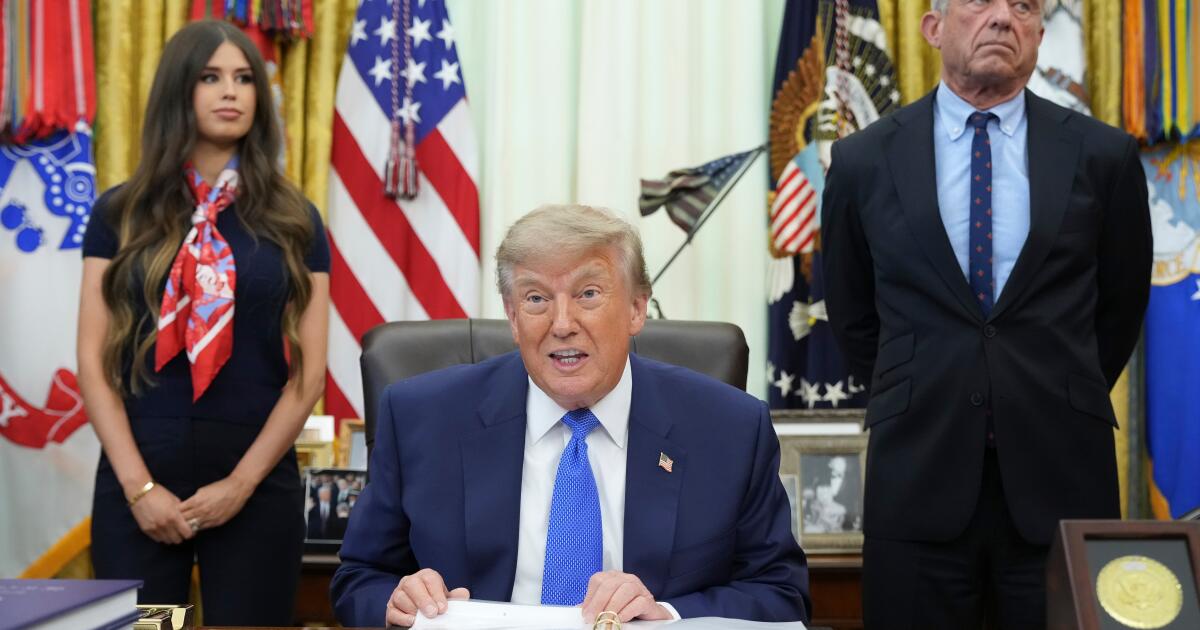
WASHINGTON — Public health experts have been quick to condemn an executive order from President Trump aimed at upending childhood vaccinations in the U.S., but the biggest obstacles may be the unprecedented financial and logistical challenges it would impose on parents, health providers and drugmakers.
Monday’s announcement by the Republican president calls for separating combination shots — including the measles, mumps and rubella, or MMR, vaccine — into separate injections. Appointments for that and other vaccinations should be spaced out whenever possible, the order states.
To accomplish that, drugmakers would need to revive a slate of individual vaccines that have not been marketed separately in the U.S. for decades. They would also have to build new manufacturing plants capable of producing millions more vaccine doses than the nation currently uses.
For parents, unbundling the MMR vaccine and spacing out the shots would mean returning to the doctor’s office many more times than is currently needed. Those appointments could also strain pediatricians who typically administer the shots, while driving up costs tied to syringes and other medical supplies.
Studies in the U.S. and other countries have shown that combination vaccines increase the likelihood that children will be fully protected from infectious diseases before starting school.
Health experts say there is no scientific basis for changing course.
“We do things that are less convenient and more expensive if there’s a good reason to do it,” said Dr. Anna Durbin, of the Johns Hopkins Bloomberg School of Public Health. “There is no good justification for this. I think it’s very bad public health policy.”
Trump’s plan would require vaccine manufacturing overhaul
Under Trump’s executive order, federal officials are instructed to develop within 90 days plans for breaking up the MMR shot and spacing out other vaccines.
But pharmaceutical scientists and former regulators say those changes would likely take years and require drugmakers to spend tens of millions of dollars on new studies and manufacturing facilities.
Currently, there are no individual vaccines in the U.S. for measles, mumps or rubella. All the vaccines approved for those viruses by the Food and Drug Administration are combination shots. That three-in-one approach has been the standard in the U.S. since the early 1970s.
Dr. Jesse Goodman, a former FDA vaccine chief, said companies would have to conduct large studies showing new individual shots produced immune system-boosting reactions in children similar to the current versions.
Companies might also have to demonstrate the safety of new manufacturing facilities and procedures, given that individual measles shots haven’t been widely produced in the U.S. for roughly a half-century.
“The question is how much has changed since then and how comfortable will the FDA and the companies be relying on those comparisons?” said Goodman, who is now a professor at Georgetown University.
Designing, constructing and getting federal sign-off for new vaccine plants typically takes about five years, according to industry experts.
Additionally, Goodman said the FDA would have to review and license each unbundled vaccine separately, a process with no precedent.
“I don’t think there’s any comparable example of removing hugely effective public health measures that protect babies for no documented scientific reason,” he said.
Individual shots for measles and related diseases tend to be used by lower-income countries that can’t afford the MMR shot. Merck, GSK and the handful of other companies that supply U.S. childhood vaccines make only the combination shot.
In separate statements, Merck and GSK said they stand by the safety and effectiveness of their products. Neither discussed plans to unbundle their shots.
“To date, there has been no published scientific evidence that shows any benefit in separating the combination MMR vaccine into three individual shots,” Merck said in an emailed statement.
Parents would need to make many more trips to the doctor
The MMR shot is currently delivered in two doses — the first at the age of 1 and the second dose after age 4. Splitting up the shot into its three separate components would mean six office visits. Spacing out other shots for pertussis and other infectious diseases could multiply the number of visits many more times.
As the number of visits goes up, parents are more likely to miss appointments or stop making them, according to Durbin.
“It’s going to be less convenient, more expensive and you’re going to have fewer people getting vaccinated,” she said.
Since last year, Trump has repeatedly expressed concern about the number of vaccinations U.S. children are receiving and called on Health Secretary Robert F. Kennedy Jr. to reduce the number. Kennedy and other officials have pointed to smaller countries, such as Denmark, that recommended slightly fewer vaccines than the U.S.
But breaking up combination shots will result in kids receiving many more individual shots than other comparable nations, Durbin notes.
White House spokesman Kush Desai said the Trump administration’s efforts on the MMR vaccine “will give parents more options on timing and frequency for their children, which ultimately will increase vaccination rates for all three diseases.”
Vaccine order is not legally binding
Despite the precedent-breaking nature of Trump’s order, some experts are skeptical it will result in meaningful changes.
Neither the White House nor the FDA can compel drugmakers to develop and seek approval for new vaccines. And from a business perspective, companies have little incentive to develop individual versions of vaccines they already sell in combination shots.
“They’d be competing against themselves, and there’s no reason to do that,” said Dr. Paul Offit, a Children’s Hospital of Philadelphia vaccine researcher and former government adviser.
While Trump’s order calls for more federal research and recommendations, only state governments have the legal authority to require vaccinations for schoolchildren. The order simply advises states to consider updating their laws to reflect the Trump administration’s approach.
“I think states will ignore this,” Offit said. “I think that bottom line is that we don’t need to look to Donald Trump for our medical advice.”
Perrone writes for the Associated Press. AP videojournalist Mary Conlon in New York contributed to this report.