Starlink

Russia Eyes Balloon Communications System To Fill Massive Gap Left After Losing Starlink

Russia is developing a new balloon-borne system that could provide battlefield access to high-speed data communications at a time when its forces are desperate to keep connected. The testing of the Barrage-1 balloon comes as Ukrainian troops are taking advantage of Russia’s loss of access to the SpaceX Starlink satellite constellation network. Both sides have become dependent on the SpaceX system for daily wartime operations, but the restrictions on Russia’s use of Starlink are allowing Kyiv’s forces to fend off attacks in some areas while advancing in others. You can read more about Russia’s Starlink troubles in our initial story here.

As we previously noted, the introduction of Starlink to the battlefield in Ukraine revolutionized how war is waged, giving users high bandwidth, relatively secure communications basically anywhere, all in a small, off-the-shelf package. Though Elon Musk’s SpaceX company provided them to Ukraine, Russians soon came to rely on them as well. However, earlier this month, the company created a list of verified users, cutting Russia off from the system and throwing its troops into disarray. We will talk more about that later in this story.

#Russia
🇷🇺🛰 War challenges create new demands – Barrage 1
Is Barrage 1 a counterpart to Starlink? Essentially yes, but the concept is a bit different.
The project is being developed jointly by Aerodrommash and MSTU-Moscow State Technical University.
Concept: An autonomous… pic.twitter.com/yZP7jmRk65

— Nenad Vasiljevic🇷🇸 (@Epsa_Media) February 16, 2026

The Barrage-1 balloon recently underwent its first test flight, according to Russia’s Foundation for Advanced Studies (FFAS), which is developing the system. It “is designed to carry up to 100 kilograms (about 220 pounds) of payload at an altitude of up to 20 kilometers (about 12 miles),” FFAS recently announced on Telegram. One of the payloads being considered is “a promising 5G NTN terrestrial communication equipment, the testing of which is planned for the near future,” the organization claimed.

While not reaching anywhere near the low earth orbit (LEO) altitudes as the Starlink constellation – between 341 miles to 298 miles – Barrage-1 could still serve as an alternative access point for high-speed data transfer for troops on ground below. 

Regardless of FFAS intentions, however, even if it is perfected, the Barrage-1 system will not provide the same level of coverage as Starlink, which is made up of thousands of laser datalink-connected satellites covering the globe. In contrast, Barrage-1 will be guided by “a pneumatic ballast system, which allows changing the flight altitude to utilize wind currents and move in the desired direction.”

“Due to this, the platform can maneuver and stay in a specified area or move along the trajectory required for the payload,” FFAS claimed, despite being in the very earliest stages of testing. 

Russia has launched an aerostat with a 5G communication platform, designed to remain in the stratosphere at an altitude of 20–30 km.
The “Barrage-1” can apparently adjust its altitude using a pneumatic ballast system, enabling it to use different winds to maintain its position.
1 https://t.co/MCFKyTIskv pic.twitter.com/MzQIKnvNWg

— Roy🇨🇦 (@GrandpaRoy2) February 14, 2026

You can read all about how high-altitude balloons can stay on station even in the presence of prevailing winds in this past story of ours. 

Even though it wouldn’t be a direct match to Starlink, at 12 miles high, it could provide wide-area connectivity similar to that offered by Starlink, albeit over a much more limited area. A mini ‘constellation’ of these systems spread over a region and mesh-networked together, could help solve the line of sight limitations of a single balloon.

Ukrainian Defense Ministry (MoD) advisor on defense technology and drone and electronic warfare (EW) expert Serhiy “Flash” Beskrestnov sees potential in this system.

“The platform is seen as an accessible and efficient alternative to expensive satellite constellations in LEO,” Beskrestnov explained on Telegram. “One of the priority tasks for ‘Barrage’ will be to test 5G NTN communication. Placing transmitters at an altitude of 20 km will allow providing high-speed internet and communication to vast territories where the construction of ground towers is impossible.”

“In theory and in practice, by controlling the altitude of an aerostat, it can be steered, not precisely, but enough to stay over any territory,” he added.

However, the Barrage-1’s comparatively low altitudes could make them targets for Ukrainian air defense systems and other countermeasures. 

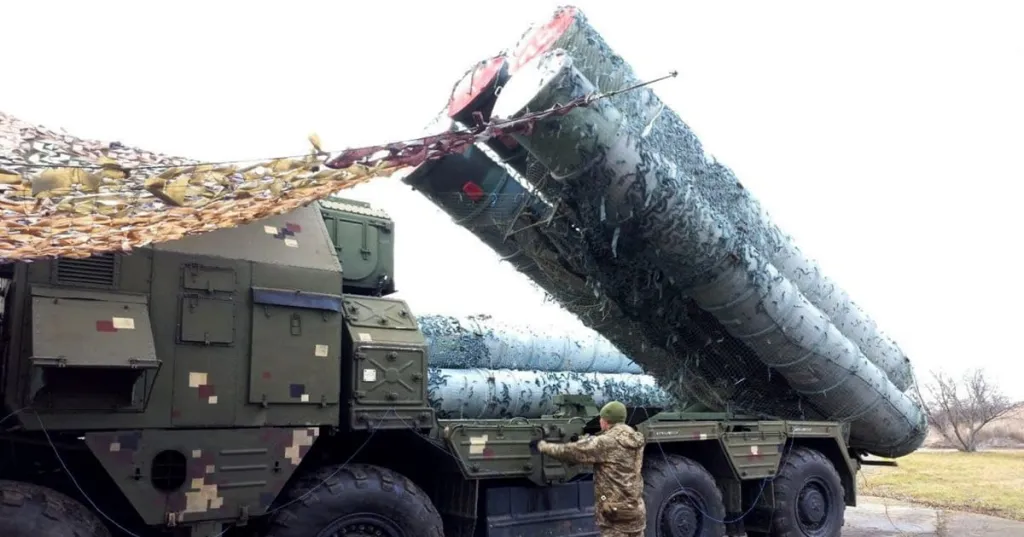
“And what’s most important for us? To have the means that can detect such objects over our territory,” Beskrestnov suggested. “And to have the ability to shoot down such targets if they pose a threat. As far as I remember, the S-300 [surface to air missile system] can engage targets at an altitude of 20-30 km (about 12 to 19 miles).”

Still, successfully targeting and engaging a balloon with a small radar signature using SAMs are two different things. Russia worked on this exact problem extensively during the Cold War, which you can read about here.

A Ukrainian S-300 surface-to-air missile system. (Ukraine Defense Ministry)

The balloons could also fall victim to other forms of attack. It isn’t hard to imagine Ukraine producing a drone to specifically hunt for these systems at longer ranges. Their emissions would make them hard to hide. Also, the electronic warfare aspect is worth noting for the same reasons.

The concept of using balloons as communications nodes is far from new. It has been around for many years. The U.S. military continues to eye using balloons to lug communications relays and gateways aloft as well. As we previously noted, the U.S. once even considered sending balloons over Cuba with equipment that would allow citizens to have access after the government cut it off. For homeland applications, high altitude balloons have been eyed to replace cellular towers, especially after natural disasters have wiped-out ground-based communications.

Concept art from a Raven Aerostar promotional video demonstrating how only a few balloons can establish a wide-area communications network. (Raven Aerostar via YouTube)

The SpaceX restrictions have impacted everything from Russia’s high-level command and control, to basic communications and data exchange between troops across the entire battlespace. It has also affected Russia’s drone warfare, including interfering with long-range aerial weapons and uncrewed ground vehicles (UGV). The Kyiv Post article claims that some Russian UGVs have relied on Starlink to operate.

“The loss of Starlink has now forced Russian military logistics troops to return to the use of manned trucks, cars, motorcycles or quad-cycle vehicles,” noted Mick Ryan, a retired Australian major general now serving as a military analyst. “These have proven to be more vulnerable to drone strikes.”

“Eventually shock wears off, responses are developed & counterpunches delivered. This will be the case with the Starlink shutdown. Ukraine will have limited time to exploit the opportunities of the degraded C2 environment now endured by Russian ground forces.”… pic.twitter.com/zytWvgdtFw

— Mick Ryan, AM (@WarintheFuture) February 17, 2026

Losing Starlink has slowed down Russian offensive actions and increased their casualties while opening up opportunities for Ukraine to advance, Ukrainian military officials have claimed.

“For three to four days after the shutdown, they really reduced the assault operations,”  Lt. Denis Yaroslavsky, who commands a special reconnaissance unit for the Ukraine Armed Forces, told the New York Post.

“The disruption comes as Russia suffers its worst death rate since the start of the four-year-old war,” U.S. and Ukrainian intelligence officials told the publication.

Russian sources concurred that restrictions on Starlink use are having major negative effects on the frontlines.

“As a result” of the SpaceX action, “instead of a planned strike against the enemy, where their (meaning ours) communications are instantly cut off while theirs remains operational, we have a hellish mess,” Andrey Medvedev, Deputy Chairman of the Moscow City Duma and Deputy Director General for Radio Broadcasting of the VGTRK television and radio company, stated on Telegram

Compounding problems created for Russia by the restrictions on Starlink, the launch of its own satellite constellation system has reportedly been delayed by about a year.

“The Russian aerospace company Bureau 1440 announced the postponement of its initial deployment of 16 high-speed internet satellites,” the SatNews media outlet recently reported. “Originally scheduled for late 2025, the launch of the first batch for the ‘Rassvet’ (Dawn) Low Earth Orbit (LEO) constellation has been rescheduled for 2026.”

Seen as a domestic alternative to Starlink, the program has been plagued by manufacturing shortfalls.

“While Roscosmos Chief Dmitry Bakanov stated in September 2025 that deployment of the first 300 satellites would begin by the end of that year, industry sources now indicate that the production line has failed to meet the necessary volume,” SatNews noted. “Despite the delay, Deputy Minister of Digital Development Dmitry Ugnivenko had claimed as recently as December 2025 that all 16 initial satellites were complete. Bureau 1440 currently has only six experimental satellites in orbit, launched during the Rassvet-1 and Rassvet-2 missions to test laser inter-satellite links and 5G signal compatibility.”

Even if it is launched, the Rassvet satellite constellation, which will take years to become operational, is very unlikely to have the same capabilities as Starlink.

17/ “This is the Rassvet project from Bureau 1440. According to the announced plans, the launch of the first 16 low-orbit broadband internet satellites was supposed to take place in 2025 , but this never happened. pic.twitter.com/Ro2iWyAEtd

— ChrisO_wiki (@ChrisO_wiki) February 1, 2026

Amid all these issues, Russia is struggling to find more immediate ways to overcome the Starlink restrictions.

“There are no alternatives [to Starlink] right now – at least not at the level of today,” the Russian Colonelcassad Telegram channel explained. It added that Russia is looking for workarounds, but nothing appears to be imminent.

The Russian Gazprom Space Systems satellite array is not a viable alternative at the moment, Colonelcassad rightfully noted.

“There is Gazprom’s dish, it works, but, to put it mildly, it lags behind in connection speed and needs development or refinement,” he stated. “Of course, it is technically possible to provide high-speed internet in the fields by other methods, which many are currently working on.”

The long-term effect of the SpaceX decision on Starlink remains to be seen. This war has shown that both sides advance quickly when it comes to battlefield technology and Russia will have to find some kind of a workaround. However, for Moscow, the timing of the Starlink restrictions is not good, considering that the latest round of peace talks are currently underway in Switzerland. Russian President Vladimir Putin is sticking to his stance that Ukraine turn over territory in the eastern part of the country it still holds, something Ukrainian President Volodymyr Zelensky told Axios that the public won’t allow. Losing ground on the battlefield takes away an important bargaining chip for Russia.

Contact the author: howard@thewarzone.com

Howard is a Senior Staff Writer for The War Zone, and a former Senior Managing Editor for Military Times. Prior to this, he covered military affairs for the Tampa Bay Times as a Senior Writer. Howard’s work has appeared in various publications including Yahoo News, RealClearDefense, and Air Force Times.


Source link

How does the cutoff of Starlink terminals affect Russia’s moves in Ukraine? | Russia-Ukraine war News

Kyiv, Ukraine – A heavy Russian Geran drone struck a fast-moving train in northern Ukraine on January 27, killing five, wounding two and starting a fire that disfigured the railway carriage.

Such an attack was impossible back in 2022, when Russia started dispatching roaring swarms of Shaheds, the Geran-2’s Iranian prototypes.

Recommended Stories

list of 4 itemsend of list

Ukrainian servicemen ridiculed them for their slow speed and low effectiveness – and shot them down with their assault rifles and machineguns.

But the Geran kamikaze drones have undergone countless modifications, becoming faster and deadlier – and some were equipped with Starlink satellite internet terminals.

The terminals made them immune to Ukrainian jamming and even allowed their Russian operators to navigate their movement in real time.

Western sanctions prohibit the import of the notebook-sized terminals operated by Elon Musk’s SpaceX company to Russia.

But Moscow has allegedly smuggled thousands of them via ex-Soviet republics and the Middle East, notably Dubai, using falsified documents and activation in nations where the use of Starlink is legal, according to Russian war correspondents and media reports.


Russian forces were able to counter the use of Starlink by Ukrainian forces as the terminals linked to SpaceX’s satellite armada orbiting the Earth allowed faster communication and data exchange, as well as greater precision.

In early February, SpaceX blocked the use of every Starlink geolocated on Ukrainian territory, including the ones used by Ukrainian forces.

Only after a verification and inclusion into “white lists” that are updated every 24 hours can they be back online.

But any terminal will be shut down if moving faster than 90km/h (56mph) to prevent drone attacks.

“Looks like the steps we took to stop the unauthorized use of Starlink by Russia have worked,” Musk wrote on X on February 1.

The step is ascribed to Ukraine’s new defence minister, Mykhailo Fedorov, a 35-year-old who had served as the minister of digital transformation. He introduced dozens of innovations that simplified bureaucracy and business, according to a four-star general.

“Fedorov managed to sort it out with Musk – somehow, because we couldn’t do it earlier,” Lieutenant General Ihor Romanenko, a former deputy head of Ukrainian armed forces, told Al Jazeera.

He said the shut-off “significantly lowered” the effectiveness of Russia’s drone attacks and disrupted the communication of small groups of Russian soldiers trying to infiltrate Ukrainian positions.

The effect was so devastating that it made Russian forces “howl” with despair, said Andriy Pronin, one of the pioneers of military drone use in Ukraine.

“They’re like blind kittens now,” he told Al Jazeera.

Russian servicemen in places like the contested eastern town of Kupiansk are now “deprived of any way of getting in touch with mainland”, one of them complained on Telegram on February 4.

Other servicemen and war correspondents decried the shortsightedness of Russian generals who built communications around Starlink and did not create an alternative based on Russian technologies and devices.

However, the shutdown affected Ukrainian users of Starlink that were not supplied to the Defence Ministry but were procured by civilians and charities.

“The communications were down for two days until we figured out the white list procedure,” Kyrylo, a serviceman in the northern Kharkiv region, told Al Jazeera. He withheld his last name in accordance with the wartime protocol.

The effect, however, is short-term and is unlikely to turn the tables in the conflict that is about to enter another year.

“It’s not a panacea, it’s not like we’re winning the war,” Pronin said. “It will be hard [for Russians], but they will restore their communications.”

According to Romanenko, “it’ll take them several weeks to switch to older” communication devices such as radio, wi-fi, fibre optic or mobile phone internet.

Source link

Ukraine pulls plug on Russian Starlink, beefs up drone defence | Russia-Ukraine war News

Ukraine braced for more attacks on its energy infrastructure this week as winter temperatures continued to fall to -20 degrees Celsius (-4 degrees Fahrenheit), and sought to adapt its defences against Russian drones.

On Thursday, Ukraine’s energy minister, Denys Shmyal, warned Ukrainians to prepare for more power blackouts in the coming days as Russian air attacks continued.

Prime Minister Yulia Svyrydenko said Russia had struck energy infrastructure 217 times this year. Shmyal said 200 emergency crews were working to restore power to 1,100 buildings in Kyiv alone.

Russia has been targeting Ukrainian power stations, gas pipelines and power cables since mid-January, leaving hundreds of thousands of people without heat or electricity at various points.

On January 29, US President Donald Trump told a cabinet meeting that Russian President Vladimir Putin had agreed to halt strikes on Ukraine’s energy infrastructure for a week, something the Kremlin confirmed.

“I personally asked President Putin not to fire into Kyiv and various towns for a week, and he agreed to do that,” Trump said.

It was unclear when that conversation happened, exactly, but on Tuesday this week, Russia unleashed one of its biggest strikes ever on energy infrastructure in Kyiv and Kharkiv, deploying 71 missiles and 450 drones.

Ukraine’s Air Force spokesperson Yurii Ihnat said Ukraine had only managed to shoot down 38 of the missiles because a very high proportion of them were ballistic.

Russia’s defence ministry claimed it was targeting storage sites for unmanned aerial vehicles, defence enterprises and their energy supply.

The strike coincided with a visit to Kyiv by NATO Secretary-General Mark Rutte, and came a day before tripartite talks among Russia, Ukraine and the US resumed in Abu Dhabi.

“Last night, in our view, the Russians broke their promise,” Ukrainian President Volodymyr Zelenskyy said in his news conference with Rutte. “So, either Russia now thinks that a week is less than four days instead of seven, or they are genuinely betting only on war.”

The strike also came just as Kyiv had managed to reduce the number of apartment buildings without heat from 3,500 three days earlier, to about 500.

At least two people, both aged 18, were killed as they walked on a street in Zaporizhzhia, southeast Ukraine.

Even on relatively quiet days, Russia causes civilian deaths. On Sunday, February 1, Russia killed a dozen miners when a drone struck the bus that was taking them to work in Ukraine’s central Dnipro region.

INTERACTIVE-WHO CONTROLS WHAT IN UKRAINE-1770213849
[Al Jazeera]

Evolving drone tactics

During the few days in which it did observe the moratorium on energy-related strikes, Russia focused on striking Ukrainian logistics instead and made attempts to extend the reach of its drones.

Ukrainian Defence Ministry Adviser on Technology and Drone Warfare Serhiy “Flash” Beskrestnov reported that Russian drones were striking Ukrainian trucks 50km (31 miles) from the front line. He also said Russia had adapted its Geran drone to act “as a carrier” for smaller, first-person view (FPV) drones, doubling up two relatively cheap systems for greater range.

Ukrainian broadcaster Suspilne said Russia had begun these new tactics in mid-January.

Ukraine’s Air Force has managed to down about 90 percent of Russia’s long-range drones, and a high proportion of its missiles – almost 22,000 targets in January alone.

Zelenskyy recently demanded better results, however, and one of the Ukrainian responses to Russian tactics has been a new, short-range “small air defence” force that uses drones to counter drones.

“Hundreds of UAV [unmanned aerial vehicle] crews have already been transferred to the operational control of the Air Force grouping – they are performing tasks in the first and second echelons of interception,” wrote Ukrainian commander-in-chief Oleksandr Syrskii on Wednesday this week.

Ukraine’s second response has been to disable Russian Starlink terminals, which Russia uses extensively on the battlefield, and has recently begun mounting on UAVs.

Starlink uses low-orbit satellites and is impervious to jamming, allowing Russia to change a drone’s intended target while it is in mid-flight.

Ukraine’s newly installed defence minister, Mykhailo Fedorov, has been creating a “white list” of Starlink terminals used by the armed forces of Ukraine, and sent them to Starlink owner Elon Musk, asking him to keep these operational while shutting down all others in the Ukraine theatre.

“Soon, only verified and registered terminals will operate in Ukraine. Everything else will be disconnected,” Fedorov wrote on Telegram.

“Looks like the steps we took to stop the unauthorized use of Starlink by Russia have worked. Let us know if more needs to be done,” Musk wrote on Twitter on Sunday.

Fedorov and Beskrestnov have been asking Ukrainian soldiers and civilians to register any Starlink terminals they acquire privately on the white list.

INTERACTIVE-WHO CONTROLS WHAT IN EASTERN UKRAINE copy-1770213840
[Al Jazeera]

More sanctions on the way

On the day of Russia’s large strike, Zelenskyy appealed to the US to pass a bill long in the making that would impose more sanctions on buyers of Russian oil. China is the biggest, followed by India.

The previous day, Trump said Indian Prime Minister Narendra Modi had agreed to stop buying Russian oil. “He agreed to stop buying Russian Oil, and to buy much more from the United States and, potentially, Venezuela. This will help END THE WAR in Ukraine,” he wrote on his social media platform.

A Russian government source told Reuters that an assumed 30 percent drop in oil sales to India, and lower sales to other customers, could triple Moscow’s planned budget deficit this year from 1.6 percent of GDP to 3.5 percent or 4.4 percent. Government data released on Wednesday showed the Kremlin’s revenues from energy at $5.13bn in January, half the level of January 2025.

Zelenskyy also discussed a 20th sanctions package under preparation with European Commission President Ursula von der Leyen. “We can already see what is happening to the Russian economy and what could follow if the pressure is applied effectively,” he said.

Russia has made little headway in its ground war in the past three years, a fact repeatedly documented, most recently by a CSIS report. Despite this, its top officials continued to insist last week on terms of peace that would force Ukraine to give up control of four of its southeastern regions, cut down its armed forces and agree not to join NATO – terms Ukraine refuses.

The resumed talks in Abu Dhabi on Wednesday and Thursday yielded only a prisoner-of-war exchange of 157 a side.

INTERACTIVE-WHO CONTROLS WHAT IN SOUTHERN UKRAINE-1770213844
[Al Jazeera]

Source link