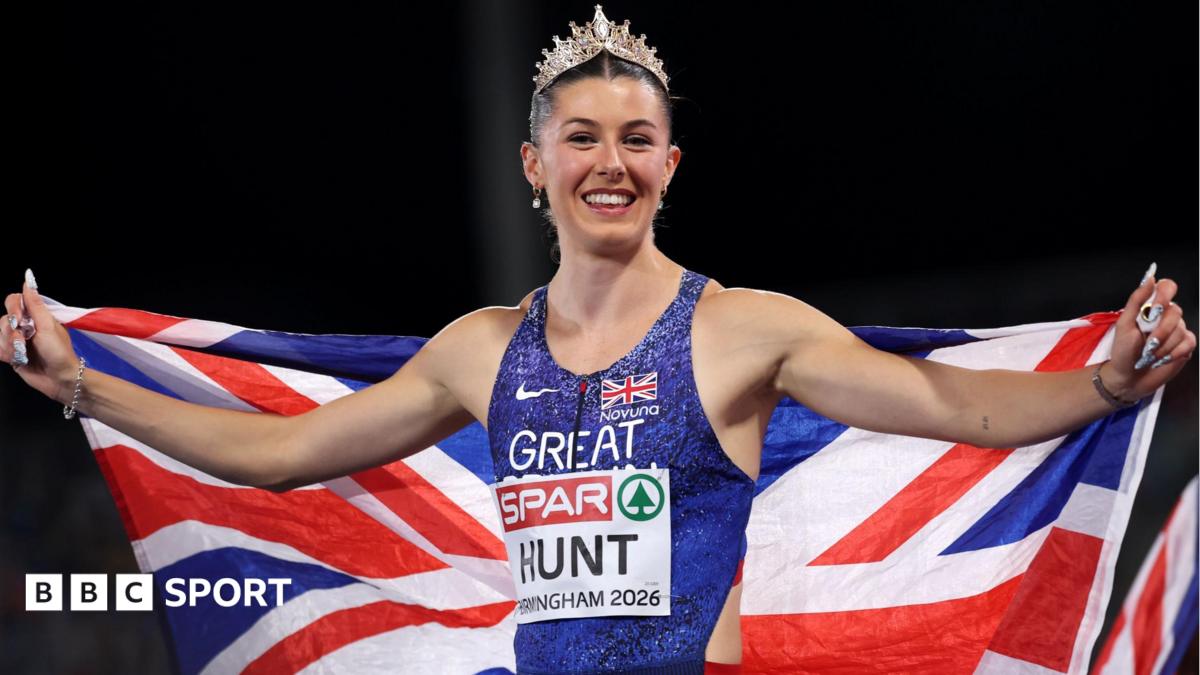
Announcing that she “wants it all” before these championships, Hunt, even in these early stages of her senior career, has demonstrated a propensity to thrive on major stages, and under ever-increasing expectation.
“Four golds was the dream and perhaps dreams do come true,” said Hunt.
“It’s so beyond the bounds of my dreams that I’m just euphoric. I can’t believe it’s happening.
“I think it will sink in later, maybe on the podium. I’m just so proud of myself and the way I’ve handled this week.”
The Briton has already spoken about the big goal: repeating her sweep of the sprint golds at the Los Angeles Olympics in 2028.
Her playlist – she creates one for every major event – is already being built as she begins to visualise how that might feel.
She will be well aware how much work there is to do. So far this year, she ranks 14th-fastest worldwide in the 200m, and 25th in the 100m. Asher-Smith’s British records, at 21.88 and 10.83 seconds respectively, remain untouched since 2019.
The next opportunity for global honours, beyond the inaugural World Ultimate Championships in September, will arrive at next year’s World Championships in Beijing.
And, once the dust has settled on a momentous week, Hunt will set about translating continental domination to glory on the sport’s biggest stages – just as British team-mate Asher-Smith achieved following her European treble in 2018.
“Amy has already won world silver, but she was not a favourite then,” Jackson said.
“Now, it’s a big change. She is a champion and she has to go and take on the best in the world.
“Is it going to be easy? No. But this will fill Amy with confidence. She will be on start lines trusting her ability is great, and I’m hoping that she will go from strength and strength.”
The only thing you might have in common with a World Cup football player is posting on Instagram as soon as you’re back home from a social gathering. Or, in the case of Erling Haaland, while you’re still in the dressing room after a win.
Football’s biggest stars are giving an insider look into the World Cup, their training, and personal lives at the six-week tournament through social media, and for some of them, their following has grown by tens of millions. Their on-pitch heroics, popularity, and personal stories have led them to overnight social media stardom during the World Cup.
Of course, football icons like Cristiano Ronaldo, Lionel Messi, and Neymar have seen an exponential rise in their Instagram following as well. But the 2026 World Cup wasn’t the first rodeo for these veterans, who have an evergreen social media boom outside the tournament.
Al Jazeera Sport takes a look at some of the biggest social media stars from this World Cup:
Erling Haaland — Netherlands
The goofy, witty and relatable six-foot-five-inch (195cm) Viking has been one of the World Cup’s most loveable personalities on the pitch and online.
The 25-year-old Norwegian striker, like many Gen Z social media users, seems to be chronically online when he’s not leading his country to new World Cup heights.
From candid Snapchat stories to Instagram posts right after winning to taking a taxidermied raccoon on the plane ride home, Haaland has become a social media phenomenon this World Cup.
It’s all thanks to his authentic posting style, compared with more carefully curated accounts that PR firms manage for similar high-profile personalities.
Of Haaland’s Instagram following of more than 70 million, 29 million were added in the past 30 days, according to analytics tool Social Blade. He is projected to reach 75 million after the World Cup final and nearly 322 million by the end of the year.
Vozinha — Cape Verde
One of the best feel-good stories of the tournament belongs to Vozinha, the Cape Verde goalkeeper whose heroics kept some of the world’s best teams from scoring a single goal against the island nation — all of which his mother eventually saw in person after she finally received a US visa to attend the World Cup.
He leapt, dived and executed a string of saves in Cape Verde’s tournament opener against Spain to end the match in a shock 0-0 draw. By the time he opened his Instagram a few hours later, his following surged from 500,000 to nearly five million.
It currently sits at 29.3 million followers, and the initial hype around him still stands as his posts garner millions of likes and interactions.
The 40-year-old joked how most people couldn’t even point out Cape Verde on a map before the World Cup, but his team’s standout performance in the group stages and knockout match helped change that.
Jude Bellingham — England
Good looks, loveable personality, Golden Boot contender — is there anything Jude Bellingham isn’t great at? And a massive 50 million Instagram following, of course.
The English midfielder’s World Cup journey may have ended in disappointment earlier this week, but there’s a lot to be said about a player whose fans sing “Hey Jude” for him after leading his team to victory at previous World Cup stages before the semifinal loss.
Bellingham, 23, has gained nearly nine million followers in the past 30 days, according to Social Blade, but his online popularity spiked by three million in October, when he opened up about his struggles with mental health.
Lamine Yamal — Spain
The teen sensation has been on the up and up since bursting to stardom two summers ago with Spain’s UEFA 2024 win, and his social media reflects the cool, candid, level-headed personality he carries on and off the pitch.
The 19-year-old’s Instagram feed is a mix of post-match photos, brand partnerships, multiple trophy wins and pictures with family members with whom he shares a close relationship.
His younger brother, Keyne, has become something of a celebrity at the World Cup, too, with his endearing antics as Yamal shepherds the three-year-old around the stadium pitch or watches him try — and fail — at golf.
The Barcelona striker could see his popularity gain new heights — and more Instagram followers, which currently number 49.6 million — after this Sunday’s World Cup final as Spain take on Messi’s Argentina.
Social media has already been fawning over the full-circle moment that began with a now-viral photo of Messi and Yamal in 2007 for a UNICEF fundraising shoot.
Keyne, the little brother of Lamine Yamal, is seen on the screen during the FIFA World Cup 2026 quarterfinal match between Spain and Belgium at Los Angeles Stadium on July 10 [David Ramos/Getty Images/AFP]
Tim Payne — New Zealand
Payne’s viral moment may have come before the World Cup, but it was touching nonetheless.
The New Zealand defender’s Instagram following exploded late in May after an Argentinian influencer decided he was the least-known player at the World Cup.
Valen Scarsini, known as “elscarso” on Instagram and TikTok, made a video encouraging his audience to give the Wellington Phoenix and All Whites defender’s account likes, comments and follows.
Payne’s Instagram following grew from fewer than 5,000 before the campaign to about 5.8 million, turning the 32-year-old into one of the tournament’s most unlikely viral stars.
He even addressed the outpouring of love in a video on Instagram, and eventually met up with Scarsini at the team’s hotel in Boca Raton, Florida, ahead of the World Cup.
NO-ONE travelled further to become an international star than Sam Neill, who died today aged 78.
He would leave his home in the South Island of New Zealand to fly thousands of miles to film sets in Britain, Europe and America – but always travel back to his far-flung base the moment they were over to spend time with his family.
Sam Neill has died aged 78Credit: APSam starred as Dr. Alan Grant in the 1993 blockbuster Jurassic ParkCredit: Alamy
They confirmed his death in a statement, writing: “It is with immense sadness that the whānau of Sam Neill share the news of his passing on Monday 13th July, in Sydney, Australia.”
This followed a battle with stage three blood cancer after he was diagnosed in 2022.
Sign up for the Showbiz newsletter
Thank you!
After undertaking an experimental treatment announced a month ago he was in remission.
His family said: “The loss was sudden and unexpected but blessed by the fact that Sam remained cancer- free.”
The legendary actor starred in the hit British show Peaky BlindersCredit: AlamyHis death comes only months after he confirmed he was cancer-freeCredit: instagram / SamNeillTheProp
Sam became famous thanks to his role in Omen III (The Final Conflict) where he played the antichrist who had risen to become a British politician trying to prevent the second coming of Christ.
Before then starring in 1983 British TV series, Reilly, Ace of Spies, in which he played Sidney Reilly, a Russian-born adventurer who became a successful spy during the First World War.
But his entry to the big-time came ten years later in Jurassic Park, directed by Steven Spielberg, which spawned a craze for everything about dinosaurs.
The film, about a theme park where the public could see cloned dinosaurs, caught the public’s imagination – and broke box office records.
The dinosaurs run riot in the film when all safety fences are broken, killing park workers and each other as there is a battle for supremacy.
Neill’s lead role of dinosaur expert Dr Alan Grant escaped the carnage and went on to star in sequels, Jurassic Park III (2001) and Jurassic World Dominion (2022), making a personal fortune in the process.
Yet he was a last minute choice after bigger star names like William Hurt, Kurt Russell, Harrison Ford and Tim Robbins all turned it down.
His character in Jurassic Park was a paleontologist with a particular interest in velociraptorsCredit: AlamyNeill in the 1981 horror flick The Omen IIICredit: Alamy
“It was a warning never to become too big or too expensive,” he said.
“You can lose a lot of good parts in that way. I preferred quiet progress.”
Neill did precisely that throughout his career of over 100 movies in nearly 50 years, in which he would turn up in the most unlikely roles.
It included that of Major Chester Campbell in the first two series of the BBC’s hit series Peaky Blinders.
He was born on September 14th, 1947 in Omagh, Northern Ireland to New Zealander father Dermot, an army officer, and mother Priscilla, who was English.
Although he was christened Nigel, he later thought the name ‘prissy’ and changed it to Sam in childhood.
His family continued to call him Nigel.
He is survived by actor son Tim (b 1983) whom he had with actress Lisa Harrow, a fellow New Zealander.
The Kiwi was nominated for several awards throughout his careerCredit: AFPThe actor featured in other films such as Red October (1990) and The Piano (1993)Credit: Getty
Despite reports to the contrary, they never married.
He also has daughter Elena (b 1991) with estranged wife Nariko Watanabe, a Japanese make-up artist whom he met on Dead Calm (1989), which was co-star Nicole Kidman’s breakthrough movie.
He had a stepdaughter with Watanabe, Maiko Spencer (b 1982).
Neill spent virtually his entire life travelling, first with his father’s job moves around Ireland and then, when he retired from the army, to New Zealand, aged seven.
His father joined the family brewing wholesale business near far-flung Dunedin, which was Gaelic for Edinburgh and founded in 1848 as a Scottish Free Church settlement.
“I was an outsider from the start there,” he recalled.
“Bullying at school, mocked for my accent, being called names and beaten up – the lot.
“Cowboy films and TV series were very popular at the time, so I called myself Sam to sound like one. It didn’t do much good.”
Sam Neill appeared on The Graham Norton Show to discuss his upcoming projectsCredit: PASam posed with some Jurassic Park merch in a recent Instagram postCredit: instagram / SamNeillTheProp
He was sent away to boarding school in Christchurch, more than 200 miles north along the coast.
“It was even more lonely,” he said.
“I developed a stutter, although I could talk perfectly up to that point.”
He used the experiences and memories when he became an actor, always being prepared to take on new projects wherever they were in the world.
“I had an ability to pretend to be other people – probably because I had to at school,” he told me.
“I never had any great expectations as an actor.”
He started working in television documentaries and in small acting roles.
He was 30 before he appeared in a movie, Sleeping Dogs (1977), an action thriller made in New Zealand.
“That film was a calling card,” he said.
“It was a critical success and that led to some offers, all thousands of miles away. It was a case of either travel or never leave.”
He had arrived in London when we first met in March, 1989, promoting a film called A Cry in the Dark, with Meryl Streep.
It was an alarming real-life Australian story about a baby girl who disappeared from a campsite.
The baby’s mother, Lindy Chamberlain (played by Streep) insisted that a wild dingo dog had taken her baby, but a disbelieving public felt that she was making up a story to cover up murder.
Neill was playing husband Michael Chamberlain.
“It revealed to me the price of being an international star, like Meryl,” he said.
“She was the most famous actress in the world at that point and the sort of stuff she had to put up every day was incredible.
“One was a story about her leaving her husband for Michael Jackson!
“I thought to myself ‘if this is what real stardom means, I don’t want it.’ So I had to be careful. I wanted recognition, but also want privacy and sanity.”
Neill went on to achieve exactly that.
We met several times over the years. He had a calm, down-to-earth manner, unfussy and unflashy, with a dry self-mocking sense of humour.
“I have always been free of ambition – honestly,” he said.
“I realised, early on, that if I started to desperately want things, then I was going to be disappointed.
“There was always someone whose career was going to better and bigger than mine. There was also someone going to get the parts I wanted.
“So I never had a game plan. If I’d had one, I would have moved to Hollywood and committed to a career in films, going to endless meetings and being a ‘personality.’
“Instead, I have never moved my home from New Zealand. I’ve been fortunate in that enough work has come up – and I’ve travelled to do it.
“I had to get used to the biggest jet-lag, the longest time-changes to the body and being away from home. But that’s been worth it.
“Don’t forget that the first time I went to New Zealand in the early 1950’s it took two months by boat and now it’s only 21 hours by plane.”
He was also cautious about being caught in the trap of other well-known actors.
“I don’t know what it is about us that leads us in to more temptation,” he laughed.
“I think we are sometimes over-celebrated and can have far more fame than is comfortable. So when trouble comes, it’s all over the public domain.
“I once went to a pub’ with English actor Warren Clarke, drank non-stop to keep up, blacked out and woke up in bed with a woman I didn’t know.
“The trick is to keep your trousers on and go to bed early. It’s mostly worked for me up to now.”
He seemed to effortlessly glide into some major roles in films like The Hunt for Red October (1990) and The Piano (1993) and TV series The Tudors (2007), Happy Town (2010) and Alcatraz (2012).
There was a certain irony that when playing his unrelentingly tough Northern Ireland police chief in Peaky Blinders, he couldn’t master the accent.
“I was born in Northern Ireland and had the accent as a kid, but had buried it so deep in my mind that I had the greatest difficulty digging it up again.”
He ended up calling his Irish friend Liam Neeson for some tips and delivered the part pitch-perfect.
“I probably over-did it a bit in the end,” he said.
“I love working in Britain. I feel part British, obviously, and the quality of the acting and the film crews are hard to beat anywhere in the world.”
Between each highly-paid role and movie, he would return home to New Zealand and not work, sometimes for months on end, so would simply slip out of the headlines.
On the last occasion we met, he was more interested in talking about his own wine label in New Zealand.
He had used the old family connection with wine to grow his own and set up a company to produce it.
He lived, very happily he said, among wine-making and animals on a ranch in Central Otago, surrounded by mountains and lakes.
Neill announced in his 2023 autobiography Did I Ever Tell You This? (Penguin) that he had been undergoing chemotherapy since March, 2022 for a type of blood cancer.
He had first noticed swollen glands when travelling to promote Jurassic World Dominion.
He had put a hold on his acting work.
“I have been very fortunate to enjoy the best cities in the world – like London, Paris or Rome – and I have never been too jaded to get a kick out of that,” he said.
“But the thing that pleases me more than anything is to sit still at my home, have a quiet glass of red wine and contemplate life.”
In early June, hundreds of fans dressed to the nines were in attendance at a rock star’s sold-out show at New York’s Beacon Theatre. There was lace everywhere and leather too. Chains dangled from belt loops and wrists. Some attendees arrived with dyed crimson hair, others with orange or pink.
Sheer black outfits that looked pulled from the pages of a gothic romance novel were draped on bodies. If “The Rocky Horror Picture Show” had collided with a modern concert, it might have looked something like this.
Then a man took the stage. Was it Lestat de Lioncourt, the immortal vampire-cum-rock star, or was it actor Sam Reid?
Moments earlier, attendees had watched the first episode of AMC’s “The Vampire Lestat,” the rebranded third season of “Interview With the Vampire” that premiered earlier this month. This season adapts Anne Rice’s novel of the same name, which is told from the perspective of Lestat, played by Reid, and transforms him into a touring musician.
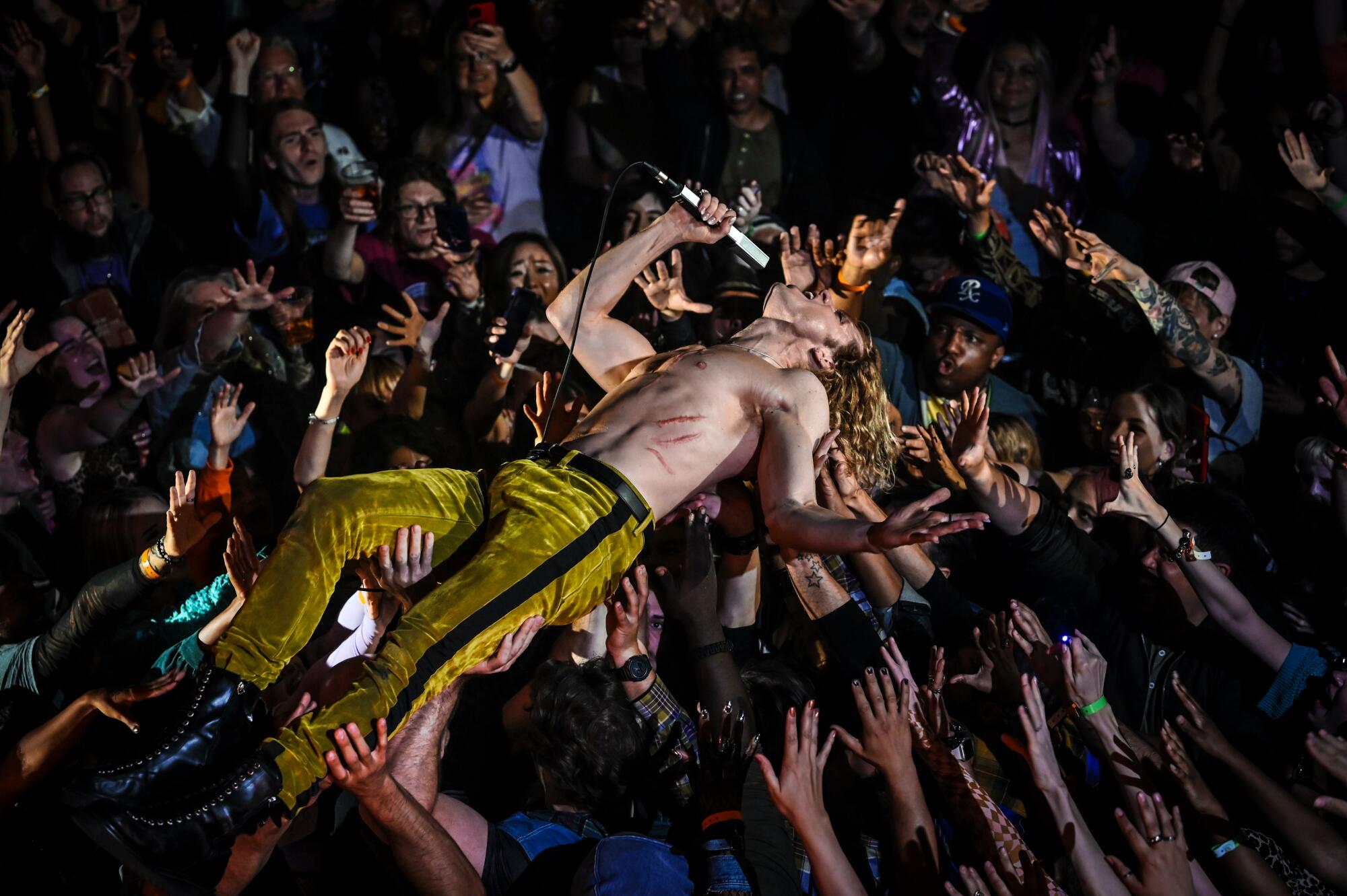
Now Reid, dressed in black with his chest partially exposed beneath an open jacket revealing a scar, stepped on stage and into the role of Lestat in front of the audience. As he moved across the stage, phones shot into the air. Fans screamed. People sang along to a slew of songs, and for a moment, the line between actor and character seemed to disappear.
At first glance, the assignment to turn Lestat into a rock star seemed straightforward. The vampire at the center of Rice’s beloved novels has flirted with music before. In 2002’s “Queen of the Damned,” he emerged as a leather-clad nu-metal frontman capable of commanding massive crowds. But bringing Lestat into the present introduced a different challenge. Rock music no longer occupies the same place in popular culture. Fame is fragmented. Audiences are skeptical of celebrity. Social media can build a star overnight and tear them down just as quickly.
Yet “The Vampire Lestat” asks viewers to believe something as audacious as a centuries-old vampire still being able to captivate people, launch a music career and inspire a movement. Reid thinks part of what drives the character is something surprisingly modern.
“Nobody cares that I exist, nobody cares that I’m not relevant,” Reid said of Lestat’s mindset entering the season. “It’s really fun to see him struggle with that and see him try to find his place in the world and not immediately get world domination.”
Making that fantasy feel believable required far more than putting Lestat in leather and handing him a microphone. To pull it off, the show’s creative team had to build a rock star from the ground up, crafting a visual identity, creating music that could stand on its own outside the series, and transforming Reid into a performer capable of owning a crowd rather than simply acting in front of one.
Sam Reid’s Lestat de Lioncourt crowd-surfs in “The Vampire Lestat.”
(Sophie Giraud / AMC)
“Dropping Lestat down into 2025 and making the decision for him to play rock ‘n’ roll was a really great dramatic switch because while there are many great rock bands that are alive and kicking right now, their hold of the cultural landscape is quite small,” showrunner Rolin Jones said. “You couldn’t think of a worse way to get your message out than going to be a rock star right now.”
That challenge became the foundation of the season.
Step 1: Making the music
A polished aesthetic, marketing and, in Lestat’s case, book buzz can only take a musician so far. It’s the music that had to make diehard fans believe he’s an artistic genius, or at least a star in the making.
That challenge landed with composer Daniel Hart long before a single script was finished. In an unusual twist, many of the songs that would eventually appear throughout the season were written before the writers’ room fully mapped out the story.
“There were so many unknowns when we started,” Hart said. To find a way in, Hart and Jones started with their familiar reference point: David Bowie.
“We settled, I think sort of obviously, on David Bowie as the launch pad for our Lestat,” Hart said. “The way that Bowie was so mercurial, and he was a chameleon. He reinvented himself throughout his career.”
Hart also looked to artists as varied as Kurt Cobain and Chappell Roan, while drawing inspiration from classical music, blues and the old-world sound Lestat would have absorbed over his long life. One early writers’ room exercise even involved breaking down the influences embedded within “Long Face,” the Bowie-coded first single released from Lestat’s fictional album.
“‘Long Face’ feels like a Bowie rip-off to Daniel Molloy [played by Eric Bogosian], and so then Lestat breaks the song down for him and goes into all the other influences that are in there,” Hart said. “ ‘Long Face,’ you could say, was in some way influenced by Bach, and then [he] talked about Willie Dixon, and how the blues had influenced Lestat when he was around the … 1920s and ‘30s.”
“He’s been alive for 250 years,” Hart continued. “He’s seen and heard a lot of music.”
The creative team never set out to replicate the hard-rock sound that defined “Queen of the Damned.” If anything, Jones felt trying to outdo that soundtrack would have been a losing battle.
In “The Vampire Lestat,” Sam Reid sings every song himself, including “Long Face,” “Butterscotch Bitch,” “Your Biggest Fan,” “All Fall Down” and “Black Licorice.”
(Sophie Giraud / AMC)
“I mean, that soundtrack is deservedly very famous,” Jones said. “And I think if we decided to out-Korn Korn, we were going to be in trouble.”
Instead, their Lestat was a musician still searching for his voice. Jones says the season begins in a more performative glam-rock space before gradually evolving into something more personal.
“We thought ‘70s Bowie is where we would start, and that we would musically make a journey with him as we went deeper and deeper,” he said. “He would put his band on one tour, what a normal band would do, over four albums. The music just keeps changing. And as he gets more and more vulnerable, the songs begin to change. They get more raw. They get more exposure, and the music style evolves.”
Reid sang every song himself, including “Long Face,” “Butterscotch Bitch,” “Your Biggest Fan,” “All Fall Down” and “Black Licorice.”
“The more bombastic, the more over-the-top songs — he doesn’t seem to like them by the end of this season,” Hart said. “The more introspective songs that come later on are more in his new wheelhouse.”
That journey also shaped how Reid approached the material. While audiences will ultimately see the songs unfold within the context of the show, Reid encountered many of them before he fully understood where Lestat’s story was heading.
“I think in the beginning, he’s coming from an artificial kind of construct,” Reid says. “As the show goes on, the music becomes more personal, and he becomes less interested in actually finding love through his audience and more about finding who he is as an individual and as an artist.”
When Jones first began adapting “The Vampire Lestat,” he briefly considered making the character the sort of arena-filling superstar audiences might expect, like a Beyoncé or Taylor Swift. But the more the writers discussed it, the less interesting that version felt.
“If we were gonna start chipping away at all the armor that Lestat had, one of the great repetitive ways of a tour is you just can’t seem to break a ceiling,” Jones said. “He’s a niche star. And I think that is part of the gas that fuels this little journey.”
Hart also had the impression that Lestat would be a massive star.
“But it became more apparent that [he might] not exactly have the kind of success that he wanted and desperately felt like he needed — that was a more interesting story to tell,” he said.
Step 2: Getting the rock star look
While the audience has to believe Lestat is a rock star, they also have to believe he’s someone with the look — and worth staring at.
Lex Wood, the show’s costume designer, said that the challenge began long before cameras rolled on Season 3. Jones first floated the idea of rock star Lestat while the team filmed Season 2 in Prague in 2023, giving Wood time to begin imagining what a nearly 300-year-old vampire might wear while reinventing himself as a singer. During a production trip to Paris, she started sourcing pieces and collecting references that would eventually make their way into this season years later.
“The main aim of building costumes for Lestat was to maintain an element of the unachievable,” says show costumer designer Lex Wood. “To emphasize that Lestat is untouchable.”
(Sophie Giraud / AMC)
Being fashionable wasn’t the only goal.
“The main aim of building costumes for Lestat was to maintain an element of the unachievable,” Wood said. “To emphasize that Lestat is untouchable. Hence, building specific costume build shapes and patterns that we adapted throughout the season.”
That idea guided nearly every aspect of the wardrobe. While the first two seasons often presented Lestat through structured tailoring and muted palettes, Season 3 arrives in a much louder world.
“A big thing really was that we wanted to push more color into the season in general,” Wood said.
Wood said the choice reflected where Lestat finds himself emotionally. No longer confined to drawing rooms and period silhouettes, he’s navigating celebrity, performance and self-reinvention. Leather remains. Black remains. But so do bursts of color, softer fabrics and strange patterns.
“We wanted to break Lestat free of the suiting,” Wood said. “Though we wanted to remain true to his roots in the 18th century, we also wanted Lestat’s pieces to feel slightly otherworldly at times.”
That meant weaving in elements of garments from the 18th century and making them feel contemporary. This could look like a very specific cut of a sleeve of a shirt that nods to that time.
Wood also studied the backstage photography of Mick Rock, pulling references of Bowie, Iggy Pop and Freddie Mercury. She blended that with punk-inspired designs from Vivienne Westwood and Jean Paul Gaultier. Goth icon Siouxsie Sioux also became an influence, particularly in the use of layering, texture and attitude.
Wood said the scattered references reflect a character actively trying to figure out who he wants to be.
“He’s investigating social media himself,” she said. “As he’s discovering his presence as a rock star. He’s investigating what it means to be a rock star.”
“He’s finding his persona,” she continued. “And trying on different personas.”
That idea extends all the way down to accessories, with Lestat’s jewelry blending old and new — a custom necklace created by a U.K. silversmith recalls one worn by Mercury during Queen’s early years, while rings featuring sculpted teeth serve as subtle reminders of his vampiric nature.
“We purposefully wanted some of his wardrobe to not be recognizable to any particular brand — at other times, we wanted to celebrate high-end fashion, to explore his playfulness and unpredictable character through his clothing,” Wood said.
Even the shoes became part of the transformation. One of Wood’s earliest conversations with Reid centered on abandoning the heeled footwear that helped define earlier versions of the character. This Lestat needed something heavier for a performer who could pace a stage.
“He wanted something that felt more grounded,” Wood said. “Something he could bounce around more in.”
Wood said the redesigned footwear altered Reid’s posture and movement, helping create a version of Lestat that she noted feels more volatile and more comfortable captivating a crowd than charming one.
Step 3: Becoming the rock star
For all the work that went into the costumes, music and scripts, none of it mattered unless the watchers believed the actor tying it all together.
Reid had already spent two seasons playing Lestat through other characters’ memories and perspectives. This time around required him to carry the character’s story through his own reflections. More importantly, he had to answer a deceptively difficult question: Why would anyone follow Lestat in the first place?
“It’s not fame that he’s after,” says Reid of his character in “The Vampire Lestat.” “Fame is totally temporary for a creature that lives forever.”
(Sophie Giraud / AMC)
The surface answer might be fame. The character launches a music career, records songs and steps into the spotlight. But Reid doesn’t think that’s what drives him.
“It’s not fame that he’s after,” Reid said. “Fame is totally temporary for a creature that lives forever.”
Reid sees Lestat as someone searching for validation.
“Not for the vampire that he is, but for the human being that he was,” he said. “He’s been pretty heavily rejected. From Louis through the book, and then his mother knows exactly how to string him along, when to give him love and when to take it away. So he’s really looking for validation and going into an audience space is where he first experienced that.”
While developing the season, Reid says he became increasingly interested in the gap between the public version of Lestat and the person underneath it.
“His whole life has been performance,” Reid said. “His whole life has been a lot of adversity, and the way that he kind of climbs out of that is to build a construct that he can perform and operate in. It makes a lot of sense for him to do this rock star persona. Through this season you start to see him realize that the music and the art can allow him to access himself as opposed to it just being a performance.”
“He’s trying to discover his sound as a musician,” Reid continued. “But he’s also trying to discover who he is.”
Throughout the season, viewers see a musician struggling to connect.
“Why can’t I sell out 5,000 seats?” Jones says, describing the character’s mindset. “I used to be able to walk into a room and everyone would love me.”
For Jones, that’s ultimately what makes Lestat feel like a contemporary artist. Sure, he may be an immortal vampire, but he’s navigating the same questions that confront plenty of artists: How much of yourself to reveal? How much should one perform? Can admiration ever substitute for genuine connection?
By the time the season reaches its conclusion, Lestat is still larger than life. But he’s also a more complicated performer forced to reckon with the distance between being seen and understood. Jones said none of this would be possible without Reid in the role.
“I think his performance in Season 3 is one of the 10 greatest American TV performances of all time,” Jones says. “I’d put him right next to Carroll O’Connor, Walter White [played by Bryan Cranston] and James Gandolfini.”
“And I’d look at all of them and say, ‘You guys didn’t sing.’ ”
As the noise-rap-electro act Jane Remover shrieked and pleaded through a 90-minute marathon set at the Fonda on Thursday night, one very young couple dressed right out of a conservative‘s nightmare — gender-ambiguous, purple hair, facial piercings — tapped me on the shoulder. They politely asked if I could mind their newly bought vinyl for a bit as they thrashed in the heaving crowd. Of course, this unc obliged them.
Anyone who laments that L.A. crowds don’t dance should go to one of the last sets of Jane Remover’s three-night stand at the Fonda this weekend. It had the most genuinely raucous pit I’ve seen in 2026, made all the more feral for how sweet and earnest it was. After a hotly tipped Coachella set, this Live Exhibit tour affirmed that the subculture Jane Remover built may or may not have wider pop potential, but it’s getting big enough to count for stardom in the fractured music world of today.
Jane Remover is a trans polymath producer and singer-songwriter with influences across rave, shoegaze, trap and beyond. They’ve built up a ferocious elaboration on the hyperpop of predecessors like Sophie, who similarly packed so many good ideas into songs they became talismanic to fans, a tonic to reinvent yourself (new Charli XCX opener Underscores is another fellow traveler).
The music itself sounds like reverse-engineering the moment in the 2000s when metalcore kids discovered EDM. Only now it’s Discord-disaffected youth ramping up hardstyle techno, autotuned girlypop ballads and rage-rap to an explosive fusion point. “Census Designated,” Jane’s brash and dramatic 2023 coming-out LP, tipped them as a force beyond the underground. But they soon eclipsed it with 2025’s “Revengeseekerz,” a deliriously overheated mix of romantic yearning, internet score-settling and virtuosic production prowess.
Backed by just a DJ (Dazedgxd, who opened the set) and a retina-scorching light rig up front, Jane acknowledged on Thursday that the stakes were getting much higher. They joked that they’d played the El Rey like three times before this tour, and to judge by the wild-eyed passions out in the audience, the Fonda will probably be the smallest venue they’ll play for some time. “It gets so cold this high up,” Jane sang on “Turn Up or Die.” “Can’t go to hell but I can drop you off.”
The sentiments driving the music are ultramodern: self-aware, vicious and desperately vulnerable. The hilariously zesty “Angels in Camo” (home to the all-time banger of a line: “Jesus never had it with a freak b—”) wrapped up with a bloodletting plea that “I can’t let you b— win.” Jane wields that word like the flaming sword on the “Revengeseekerz” album cover, with all the casual lustiness of Future but also the wrath of a reclaimed slur.
On “Professional Vengeance,” they grappled with the weird lures of celebrity and intimacy, where no one really knows anyone but desire still courses; “Experimental Skin” found them craving and fighting off God and nihilism and technology and addiction all at once.
The tension in these tracks are the binding agent for Jane’s fan base — the music is full of contradictions and incompatibilities smashing together that just feel like being young right now. Other than a quick affirmation that fans of all identities and backgrounds will always be welcome at their shows, they let the contorting, violent music speak for itself about the way queer fans are feeling about life under siege in the United States.
If the set was a bit too long for the limited setup onstage, it was because Jane simply had that much music to let out — that caliber of emotion to unburden, that much want to acknowledge. It seemed like the set was closing with “In the Dark,” an aching ballad from their Venturing side project, plainly declaring “I still dream of us” through a fog of effects. But instead they ramped it back up for one last cathartic blast to close, sending their faithful out onto Hollywood Boulevard, sweaty and filthy and fundamentally known.