Marvel Unlimited, the company’s digital comics subscription service, is shutting down after 19 years.
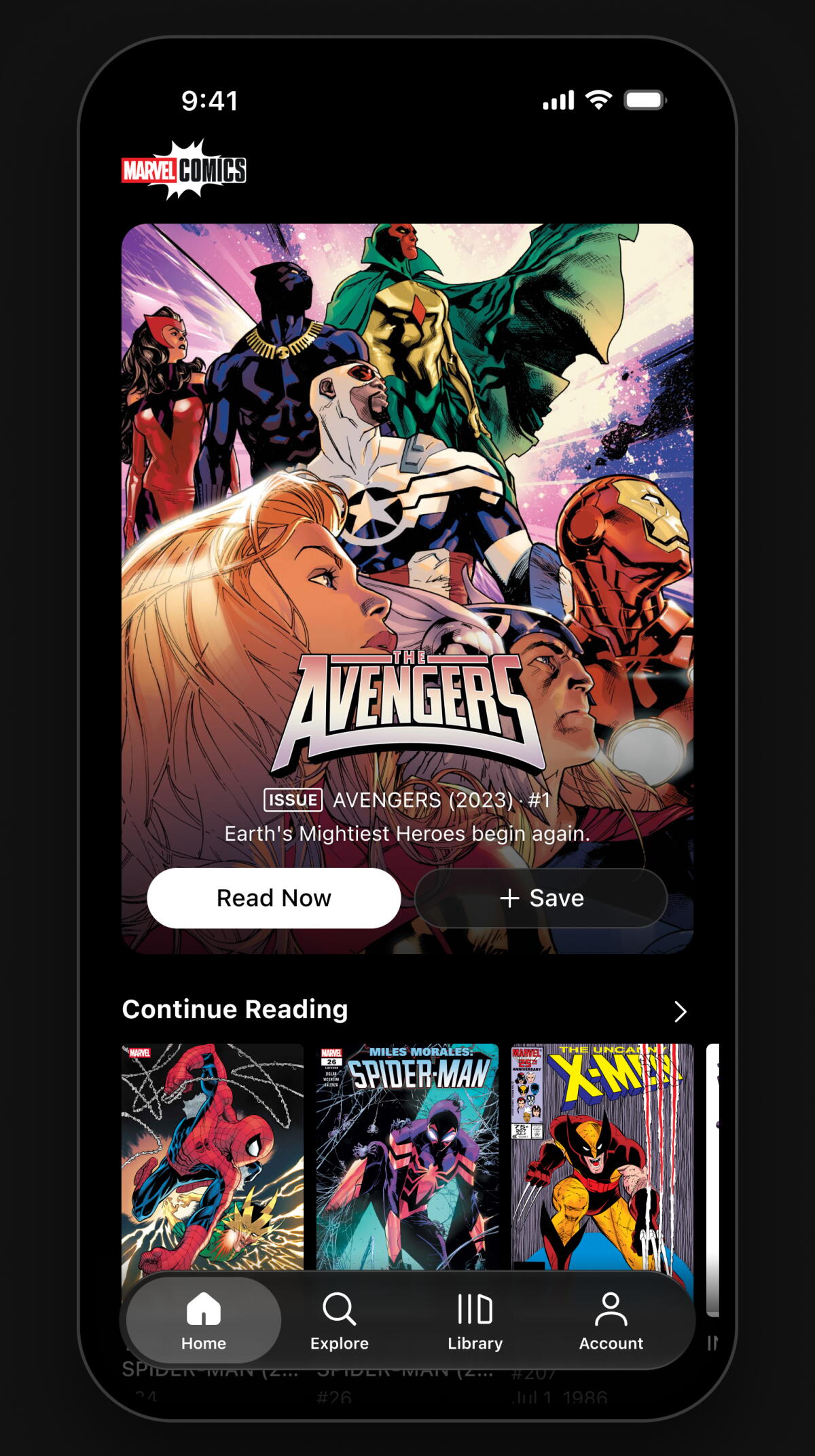
Marvel announced Monday that it is launching Marvel Comics, a new digital comics app that will house more than 35,000 current and classic titles featuring Spider-Man, the X-Men, Captain Marvel and more from its extensive library. The new platform is built and operated by Webtoon and will launch Nov. 16.
The Marvel Comics app library will feature comics spanning Marvel, Star Wars and 20th Century Studios titles at launch, with stories from Disney’s other brands — like Pixar and Disney Animation — expected to follow. The new app will support both the traditional page-based comics format that mirrors physical books and the more mobile-device-friendly vertical-scroll format. (Marvel Unlimited also featured vertical-scroll comics under its Infinity Comics banner.)
A preview of the Marvel Comics app.
(Marvel Comics)
Those attending New York Comic Con this Thursday through Sunday can get an early look at the new app at the Marvel Comics booth (#2435).
With the arrival of the new Marvel Comics app, Marvel Unlimited will “sunset” on Dec. 7. Marvel Unlimited has been the company’s in-house digital hub for its comics since its launch as Marvel Digital Comics in 2007. Subscriptions and payment information from Marvel Unlimited will not automatically carry over into the Webtoon-operated Marvel Comics, and Marvel says those whose paid subscriptions will be cut short because of the shutdown can expect a prorated refund on or around Nov. 16.
Marvel Unlimited members who sign up for Marvel Comics will be able to import their current library and reading history into the new app once it’s launched. The steps required for that process have not yet been detailed, but the company says these members will have until Dec. 21 to access their Marvel Unlimited library to ensure the transfer was successful.
Marvel Comics will offer two subscription tiers: The base-tier membership will run $9.99 per month or $69.99 annually for access to the app’s full catalog, with new issues of ongoing titles added as early as three months after print release. For those who would rather not wait that long to read newer comics, Ultimate-tier members will be able to access new issues as early as a month after its print release. Subscriptions for that tier will run $12.49 a month or $99.99 a year. Marvel is currently offering a special $59.99 “founder member” price for the first year of an annual Ultimate-tier memberships for those that preorder the service.
Several years ago, DreamWorks Animation veterans Joel Crawford and Januel Mercado pitched the studio an original story centered on friendship and steeped in Filipino culture.
That draft became the animated film “Forgotten Island,” which opened in late September and counts singer H.E.R., Liza Soberano and Dave Franco among its voice cast. The movie focuses on best friends Raissa and Jo, who will soon be separated when Raissa goes to college in the U.S., and the final adventure they take to the fantastical island of Nakali.
The movie opened to a softer $13 million in the U.S. and Canada and has so far made $23.6 million at the domestic box office over two weekends. Globally, “Forgotten Island” has brought in $38.5 million on an $80-million production budget.
That opening haul is lower than the average for original animated films from a major studio, which is about $14.6 million, according to the FranchiseRe movie industry newsletter. But the studio is hoping the movie — which has garnered a strong 95% rating on Rotten Tomatoes — will pick up steam and benefit from the relative lack of animated competition at the box office until the early November debut of “The Cat in the Hat,” developed by Warner Bros. Pictures Animation.
You’re reading the Wide Shot
Samantha Masunaga delivers the latest news, analysis and insights on everything from streaming wars to production — and what it all means for the future.
By continuing, you agree to our Terms of Service, which include arbitration and a class action waiver. You agree that we and our third-party vendors may collect and use your information, including through cookies, pixels and similar technologies, for the purposes set forth in our Privacy Policy such as personalizing your experience and ads.
“Forgotten Island” is a big bet for Glendale-based DreamWorks Animation, which like many studios, has largely depended on sequels to drive box office success.
Original animated stories — or original movies at all — have become rarer gambles in Hollywood these days, when sequels and reboots feel like safer options. But Crawford and Mercado knew they wanted to develop a new story together.
The pair, who wrote and directed the film, have been friends for nearly two decades after they met at DreamWorks Animation as storyboard artists. Together, they’ve worked on 2011’s “Kung Fu Panda 2,” 2013’s “The Croods” and 2022’s “Puss in Boots: The Final Wish.” The two bonded over their similar sense of humor and their love for movies, and their longtime friendship was apparent in their easy banter during a joint interview shortly after the “Forgotten Island” premiere last month.
Early on, Crawford and Mercado knew they wanted to tell a story set in the Philippines that celebrated Filipino culture. Mercado is Filipino American and Crawford’s wife is Filipino, so a movie that authentically represented Filipino culture was important to them. In the film, the island of Nakali has many creatures inspired by Filipino folklore, and the characters casually use Tagalog words alongside English.
“There’s a sophistication in terms of respecting that the audience is smart, and doing our part as filmmakers to make sure that the visual storytelling and the context gives everything the audience needs to know,” Mercado told me.
Audiences, too, are more comfortable with content in other languages these days, as I wrote last week about Neon’s Korean-language thriller “Hope.” After all, kids will sing Korean lyrics in K-pop songs, and even “Puss in Boots: The Final Wish” interspersed Spanglish into the story.
“It feels timely to update the way we tell stories, to not treat the audience like, ‘They won’t understand this,’ but really treat them with respect,” Crawford said. “It just felt right to chase authenticity and let go of expectations, especially of what an animated movie should be and has been, and really do something fresh because it’s just coming from who we are.”
In the last few years, animation has been a powerhouse at the box office. Disney and Pixar’s “Toy Story 5” and Universal Pictures, Nintendo and Illumination’s “The Super Mario Galaxy Movie” have each crossed $1 billion at the global box office, two of only five movies to do so this year. In 2024, Disney and Pixar’s “Inside Out 2” was the highest grossing movie in the U.S. and Canadian markets.
Original stories have been tougher. Pixar has recently struggled to match the theatrical success of its prior original films and the slower start for “Forgotten Island” may be a sign of similar hurdles for new stories. But culturally accurate storytelling has paid recent dividends — just look at the success of Netflix’s “KPop Demon Hunters,” which won two Oscars, broke streaming records and sold out theatrical singalongs.
“We believe that there is a platform and space for everyone’s story, for people to feel seen and to know they matter,” Mercado said. “Even when they see a story that is specifically Filipino, if we’ve done our job right, we’ve shown you that you could connect to the story, whether or not you have this experience with the Filipino community or the culture.”
With “Forgotten Island,” Mercado and Crawford also want to push the boundaries of animation beyond its perception as films just for kids. Later this year, films such as Laika’s PG-13 rated “Wildwood” and Brad Bird’s noir film “Ray Gunn” will test the audience appetite for more adult animated and original fare.
“We’re in a time of massive sequels,” Crawford said of stories today. “When you expand where you’re telling them and who is telling them, you naturally get originality. This year has been really exciting for original stories in both animation and live action. You are taking a chance on originality, but it pays off.”
The Warner Bros. film was plagued by very mixed reviews from critics, as well as a challenging marketing campaign. The film stars Cruise as an aging oil tycoon whose drilling operations trigger a catastrophic climate change disaster. Worldwide, the film brought in $20 million on a production budget of $125 million.
It’s been a tough theatrical year for Warner Bros., which has seen a string of disappointments before “Digger.” Beyond the cinema, the company is now in the process of being absorbed by Paramount Skydance, with the merger set to finalize Tuesday.
What I’m watching
It’s been yet another busy week, so about the only thing I was able to watch was a few WNBA playoff games. Since the Sparks were left out of the playoff picture again, I’ve sort of adopted the Golden State Valkyries as the next best California team to root for, and what a wild game that was over the weekend against the Las Vegas Aces.
Director Na Hong-jin’s action movie “Hope” opened in 1,500 U.S. cinemas this month, marking the biggest domestic theatrical footprint for a Korean-language film since the Academy Award-winning “Parasite.”
That’s a big bet, particularly for a foreign film. But after the success of “Parasite,” the growth of Korean shows such as Netflix’s “Squid Game” on streaming and the broader acceptance of subtitles in film and television, it was a bet Neon was willing to make.
The indie studio snapped up North American and English language rights to “Hope” for an undisclosed price before the film’s world premiere in the spring at the Cannes Film Festival.
Right off the bat, Neon knew the film would be positioned in South Korea as a big action thriller and massive event film for director Na, and wanted to match that.
In the film, which includes Alicia Vikander and Michael Fassbender in its cast, a group of people fight back against a creature that rampages through a Korean village.
“The reality is that just because a movie has subtitles, doesn’t make it an art film or a niche film,” Elissa Federoff, Neon’s chief distribution officer, told me this month. “And this, to us, felt like a big action blockbuster.”
You’re reading the Wide Shot
Samantha Masunaga delivers the latest news, analysis and insights on everything from streaming wars to production — and what it all means for the future.
By continuing, you agree to our Terms of Service, which include arbitration and a class action waiver. You agree that we and our third-party vendors may collect and use your information, including through cookies, pixels and similar technologies, for the purposes set forth in our Privacy Policy such as personalizing your experience and ads.
She continued, “To me, it was this movie that certainly cinephiles were going to be curious about. But I also knew that we could cross over to a broader audience if we gave it a shot.”
So far, “Hope” has grossed more than $8 million domestically and $45.6 million worldwide on a reported production budget of at least $45 million.
Neon expected to reach Korean and Korean American audiences with “Hope,” but the film also over-indexed with Latinos, who represented 27% of the audience, according to PostTrak theatrical data.
Such a wide national release is unusual for foreign films, which typically play in specialty theaters on fewer than 100 screens. Though its domestic box office total doesn’t indicate that the film fully crossed over to mainstream audiences, “for a foreign film, it’s very successful” and has done “solid business,” said David A. Gross, who writes the FranchiseRe movie industry newsletter.
Neon, of course, has experience with Korean cinema. It distributed 2019’s “Parasite,” which became the first non-English-language film to win Best Picture. After “Parasite” won the Oscar, it was shown on 2,000 screens, about 17 weeks after its release. The Bong Joon Ho-directed film ended up grossing more than $53 million domestically and brought in more than $263 million worldwide.
The film put Neon on the map in many ways, Federoff said, and also pushed the boundaries for what the industry considered a best picture nominee. Films such as “Parasite” and “Hope” should also expand what studios consider to be mainstream fare.
“Studios and distributors are still boxing things out a little bit and thinking of these as not as accessible or not for a general commercial audience,” Federoff said. “And I would totally disagree with it.”
Though “Hope” is a long way from the domestic box-office success of “Parasite,” these kinds of swings are important to keep the pipeline of original films humming and to vary the types of fare mainstream audiences can see at their local theaters.
Although art house films once skewed toward older audiences, indie films are now popular with younger generations, who have also become accustomed to reading subtitles.
That could bode well for future foreign language films looking to make inroads with mainstream audiences. While giving a wide release to a foreign language film could be seen as risky, it’s a move Federoff believes can help bolster creative filmmaking and keep people engaged at cinemas.
“My hope is that studios start to trust their audience and respect their audiences a little bit more,” she said. “I think we can all do this. I think we can all say that we just have to have more risk taking involved with what we do. There’s a lot of incredible international cinema out there that should be seen by everybody.”
Paramount and the states fight back
Paramount Skydance and the state attorneys general are defending their proposed settlement in the face of skeptical questions from Sen. Cory Booker (D-N.J.), arguing that the judge overseeing the case should approve the agreement without the deeper review the senator has requested.
On Thursday, U.S. District Judge Araceli Martínez-Olguín told both sides to answer Booker’s questions before she ruled on whether to approve the proposed consent decree. She said at the time that she would issue a ruling “in due course.”
On Monday, both sides issued separate filings that argued the terms of the settlement were adequate. In particular, the states pushed back on assertions that the consent decree was too weak, saying it “reflects a reasonable compromise that addresses the competitive issues posed by the proposed merger in the markets alleged in the complaint.”
“The decree’s enforcement provisions have teeth,” the states wrote in their filing.
The proposed legislation would provide a 20% credit on above-the-line and below-the-line U.S. labor costs for eligible productions, including postproduction and visual effects work — two industries that have increasingly moved overseas.
The uncapped credit could increase to 30% with several uplifts, including for independent productions or filming in a federally declared disaster area, such as Los Angeles County.
What I’m watching
It’s fall, which means I’m all in on “Dancing with the Stars,” as I have been since Season 2, when Drew Lachey won with pro partner Cheryl Burke back in 2006.
This season feels like it was made for millennials like me, with contestants such as Julia Stiles, Harry Shum Jr. and Jenna Dewan. But my favorite dance last week was actually Guillermo Rodriguez’s paso doble.
Actor D’Arcy Carden stopped by early, beating the cadre of guests crowding the main plaza beneath the now-famous oculus of the 300,000-square-foot Ma Yansong-designed building. A Stormtrooper drove by on a flatbed truck, shortly before R2-D2 greeted visitors in the courtyard, wearing an official staff badge. (The line for a selfie with the droll droid stretched as far as the eye could see.) Museum leaders have long said that “Star Wars” artifacts account for about 7% of the 100,000 square feet of gallery space, but one worker quipped 90% of opening-day attendees likely had a vested interest in the franchise.
This proved true, for the most part: Many visitors clearly knew and loved “Star Wars,” and Princess Leia buns and Yoda ears abounded. (Two Padmé Amidalas ran into each other, and according to a restaurant worker, one brave soul showed up in “Star Trek” gear.)
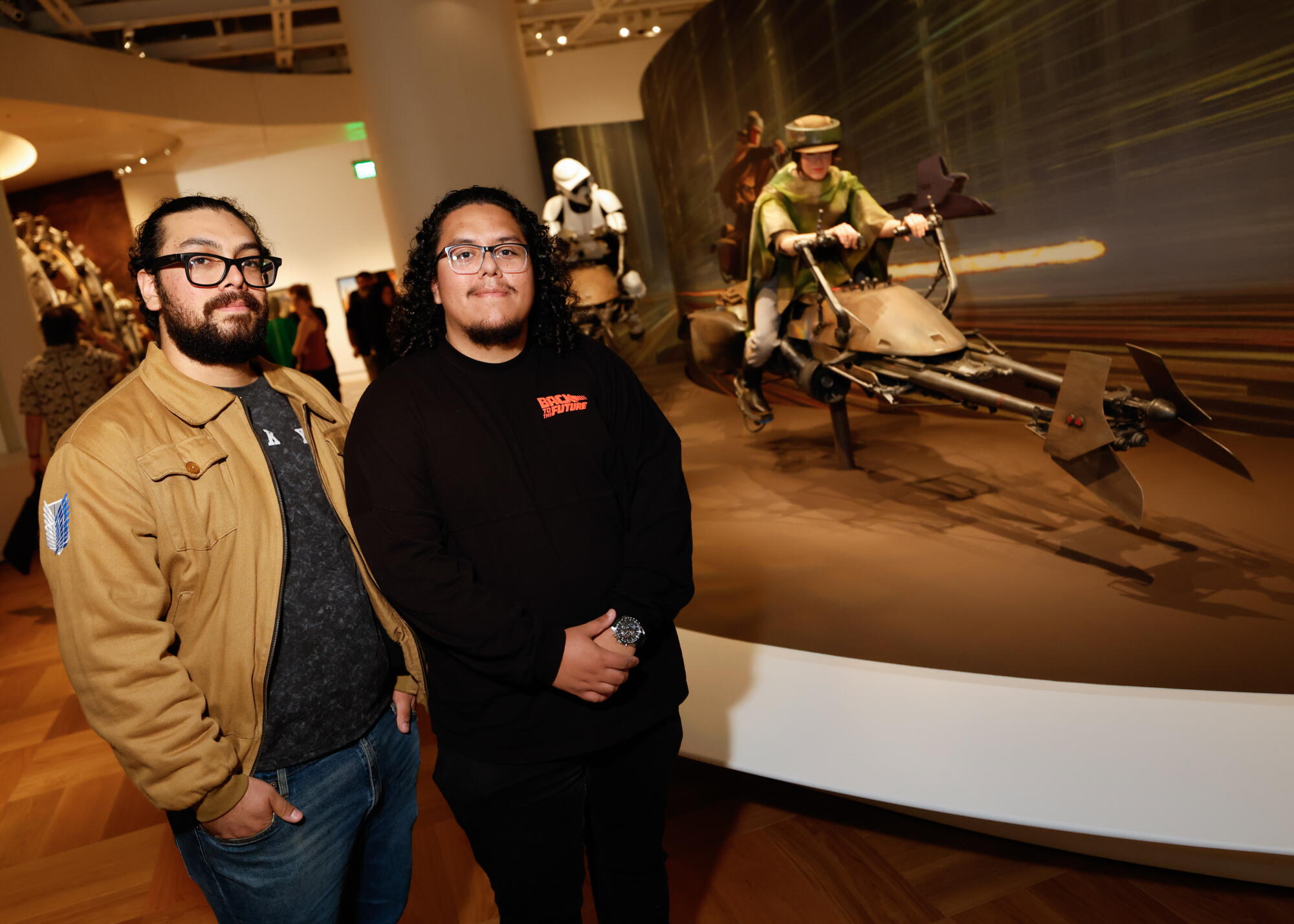
David Perez, 27, (right) donned his “Back to the Future” gear, hoping to see art from the movie. But he and his brother Carlos Perez, 28, (left) were quite pleased with the “Star Wars” artifacts in the Cinema section.
(Carlin Stiehl / For The Times)
Still, the museum, as its famous co-founder George Lucas has repeatedly said, is about more than just one story, however beloved. That sentiment cropped up repeatedly in interviews, too: Early guests seemed to believe the museum’s brochure, which notes that the galleries are about the “narrative art” of illustrating stories.
Co-founders Lucas and businesswoman Mellody Hobson (also Lucas’ wife) gave remarks early Tuesday to the first 100 visitors, consisting of students from USC, Los Angeles Technology Center, Otis College of Art and Design and Los Angeles City College, who were all handed free tickets.
A yellow Naboo N-1 Starfighter hangs above the education lobby, across from the main plaza, guarding the research library.
(Carlin Stiehl / For The Times)
“I’ve spent more than 50 years collecting the work of artists who don’t always get their due — illustrators, cartoonists, muralists, painters — because I believe their images are as vital as any other art form,” Lucas said. “They deserve to be in a museum.”
“This is a museum of the ‘people’s art’ — the images are illustrations of the beliefs we live with every day,” said Hobson, “and for that reason, this art belongs to everyone.”
Later that day, The Times asked visitors to share their impressions of a museum that, until now, has lived largely in the imaginations of fans and in abundant social media posts online. The museum has drawn loads of applause but also plenty of criticism, mostly for its lack of context via wall text, and for displaying art that not everyone agrees should be elevated.
Do the people love the “people’s art”?
Responses have been edited for length and clarity.
Alden Chang and his wife flew 6,800 miles from Taiwan to thank George Lucas for creating the “Star Wars” films and franchise. Chang told The Times that he also wrote an academic paper examining “Star Wars” fan culture in Taiwan.
(Carlin Stiehl / For The Times)
Alden Chang, 32, green product engineer from Taiwan
You flew all the way from Taiwan, just for this?
Chang: Yeah, halfway across the world to meet George Lucas and Miss [Mellody] Hobson.
Did you get to meet them?
Chang: Yeah, I just shook hands with them this morning. It’s like a dream come true.
How long ago did you and your wife get here,and how long are you staying?
Chang: For eight days. We came here on Sept. 18.
Is this the highlight of the trip?
Chang: Sure. [Laughs.] It’s my main mission and my main goal.
(Later, in an email, Chang told The Times that he also wrote an academic paper examining “Star Wars” fan culture in Taiwan.)
Friends Robert Meier, left, and Marc Downing used to work as ushers at the Music Center together. Growing up, Marc rode his bike where the Lucas Museum now stands.
(Carlin Stiehl / For The Times)
Marc Downing, 71, retired, from Exposition Park and Robert Meier, 70, educator, from Highland Park
Downing: I go to all the museums. This was the newest museum, so I had to come and see this.
How does this compare to the other L.A. museums?
Downing: This is ultra modern, ultra space-future. I’m glad the museum is here; highly recommend it. And I’m proud that it’s in my city, and I’m glad that it’s in the neighborhood that I grew up with.
What made you want to be a member of the museum, Robert?
Meier: It’s giving to the neighborhood. I’ve admired George Lucas — I used to have a relative in Marin County, and growing up, we’d go to lunch, and I’d see George Lucas and his family. We’d be at the same restaurant together.
Downing: Well, speaking of this neighborhood: This used to be a parking lot. I remember it very well. And I used to come here and ride my bike in this neighborhood as a kid.
C.S. Lee sits on a bench at the south viewpoint of the museum, gazing out onto the sculpture garden below. “This is why you live in Southern California. This is why you live in L.A.: for days like these.”
(Carlin Stiehl / For The Times)
C.S. Lee, 54, actor, from Koreatown
Lee: “Star Wars” was the very first movie I ever saw in my life as a 4-year-old when I immigrated here from Korea. We landed in Hawaii, in Waikiki Beach. Our family friends took us to a drive-in movie cinema place, and they said, “You want to come see a movie?” And it was “Star Wars” and “King Kong,” double billing. And my mom said when I saw the screen, my eyes popped out of my head because I’d never seen a movie before.
How do you think “Star Wars” impacted how you saw narrative and story?
Lee: I think I carried that all through my life: the story of “Star Wars.” I was like, “Oh, the good guys won!” And it was such an uplifting thing for me to hold on [to] all these years.
What did you think about the rest of the museum?
Lee: It’s so beautifully done: all the curves, all the light. You got the wind coming through the trees that they planted. I mean, honestly, I was just looking out, thinking to myself, “Wow, this is why you live in Southern California. This is why you live in L.A.: for days like these.”
The view of the sculpture garden and grounds beyond that C.S. Lee was contemplating from the south viewpoint.
(Carlin Stiehl / For The Times)
What about the building itself?
Lee: We rarely get to see architecture like this. But I think it’s good for people to see the artistry and the imagination of what people can build.
Janet Jacobs, 62, architect and Hanjin Jacobs, 25, audio equipment manufacturer technician, mother and son on a family trip from Portland (pictured at the top of the story)
I see you’re wearing a “Star Wars” T-shirt.
Janet: Yes, I am — actually from 1977.
Wow, really?
Janet: Yeah, I’ve had it for that long [laughs].
What was your overall takeaway from the museum?
Janet: I know George Lucas wanted to create this museum in a different way, like he didn’t have a sequence of events or a roadmap, he just wanted people to experience it the way they wanted to, so that’s all great. We do wish some of the things were explained a little more. Like, I know who Ralph McQuarrie is; [my kids] do not. So that would’ve been nice. Like in a typical museum, you do have a little blurb.
[My son] brought up a really good point: how ironic it is that it’s about storytelling, but yet there seems to be no storyline.
Andrew Liu, left, and Matthew Haak hang loose in front of a KAWS sculpture. They actually didn’t know it was opening day, but were happy to be there anyway.
(Carlin Stiehl / For The Times)
Matthew Haak, 26, architectural designer, and Andrew Liu, 26, behavioral therapy assistant, both from University Park
Haak: We are not “Star Wars” fans. I haven’t watched a single “Star Wars” movie. I’ve somehow evaded them my entire life.
So, if not for “Star Wars,” why did you come out today?
Haak: I’ve been watching this building being constructed for the past two years. I’m just geeking out over the organic curvilinear forms. Not a single hallway has been straight. And they even have real expensive details, like light coves on the base [of the wall]. All of these things really stand out to me. Also, curved walls like this are so expensive; architects never get a budget to do stuff like that.
I was just surprised: It’s not just “Star Wars” stuff. There’s so much art; it’s so cool.
Nicole Garcia — dressed as Padmé Amidala in her lakeside gown — poses in front of a statue of Princess Leia.
(Carlin Stiehl / For The Times)
Nicole Garcia, 24, cosplayer/costumer from Corona and Veronica Antonucci, 40, administrative assistant from Orange County
So, this might be an obvious question [given their fun outfits], but what brought you guys out today?
Antonucci: This little thing called “Star Wars”!
Garcia: Growing up with “Star Wars,” I always loved all the pieces, knowing that, for example, there’s miniature pieces that look just huge on-screen, and seeing them in-person is just, like, I want to shrink myself down and just be there.
Antonucci: It’s also amazing that it’s not just “Star Wars,” and it’s also so much more that everyone should come out and see.
Is there anything else you were particularly excited to see?
Antonucci: I was really excited to see the Frida [Kahlo]. I didn’t know she was gonna be here, so I think when I saw her, I gasped.
Is there anything else you’d like to add?
Garcia: I just hope the future generations of kids come back to see this, growing up with museums more often, and just learning how to make art — like, physically make art — and be inspired.
Antonucci: Actually, we talked about feeling jealous of all the kids who are going to be here on their school field trips, because we didn’t get to experience this.
Nikki Foster, left, loves a good field trip. She texted her group chat to visit the museum, and her bestie, Shalonda Dean, responded, so they both cleared their calendars for the visit.
(Carlin Stiehl/For The Times)
Shalonda Dean, 47, consulting business founder and president, and Nikki Foster, 45, live event production executive, both from Beverly Hills
Dean: Being a Black woman, I can identify with this little Black girl. Even in 2026, I think this painting depicts a lot of what Black women are going through today, whether it be in the workplace, navigating motherhood, navigating life. And I think this is an example of the barriers that we’re constantly breaking through every day, even today.
Foster: I’ve never seen it in person until now. So when we saw it, we were like, “It’s here, it’s here!” Just to be able to lay our eyes on it, and not have to go to another country, another state — here in Los Angeles. This is divine. It’s a divine day.
“I love meeting people,” Vincent Zabierowski said. “People are my main inspiration. I’m very lucky I get to be in a place where people want to be, and people want to soak up all that creative energy and just experience art.”
(Carlin Stiehl / For The Times)
Vincent Zabierowski, 23, host at the Skywalker Grill and freelance illustrator, lives near Downtown L.A.
As an artist yourself, what are your favorite pieces in the museum?
Zabierowski: I love a lot of the things that are in the graphic novel collection, like the Jack Kirby, the Garfields. My favorite is the Art Nouveau artist Alphonse Mucha. The Diego Rivera mural, that one was really amazing — and just the history here, having it be in L.A.
How does your work as an illustrator inform how you see these pieces?
Zabierowski: When I was going through it with some of my co-workers, I would [ask] “Do you know why they use a blue pencil?” And it’s because, when you take a photograph or a scan, that blue pencil disappears. So it was just really cool to see the behind-the-scenes and understand.
So seeing those blue pencil marks tells you that a piece is real?
Zabierowski: A person made it! I feel like a lot of people see artwork in textbooks, or they see artwork on their phones, or they see artworks on posters, and it takes a lot of skill and intelligence and training to be able to do those pieces of artwork.