Review: Yoko Ono’s ‘Cut Piece’ has lost little of its cutting urgency
The Broad’s “Yoko Ono: Music of the Mind” is more mind than music. She opens your mind; you make the music. Look into an empty “Box of Smile” and maybe you will. “Give Peace a Chance” — of course.
She breaks, and she mends, and not just your mind. Something tells me the Broad won’t go along with Ono’s “Collecting Piece II” from 1963, which has the following instructions: “Break a contemporary museum into pieces with the means you have chosen. Collect the pieces and put it together with glue.”
That’s a smile piece, too, although Ono looks all business holding a crystalline hammer on the catalog cover photo. I still smile when I recall how her piece for an orchestra that asks the players to bang their heads against a stage wall utterly delighted an audience and musicians at a performance in New York. Only Ono remained deadpan.
There were more smiles Saturday evening when The Broad, in collaboration with REDCAT across the street, presented a program of two Ono performance pieces. It began with six members of the Los Angeles Chamber Orchestra playing Boccherini’s First Sextet. This happens to be the first work ever written for pairs of violins, violas and cellos, as an expression of freedom that, in 1776, felt revolutionary.
Perhaps that is why LACO chose the Italian composer to represent a contemporary revolutionary artist in the wake of our 250th July 4. The actual piece being performed was Ono’s “Sky Piece for Jesus Christ,” in which she instructs an orchestra, whatever size (although she tended to like something larger than a sextet), to begin by playing a work, say, by Mozart.
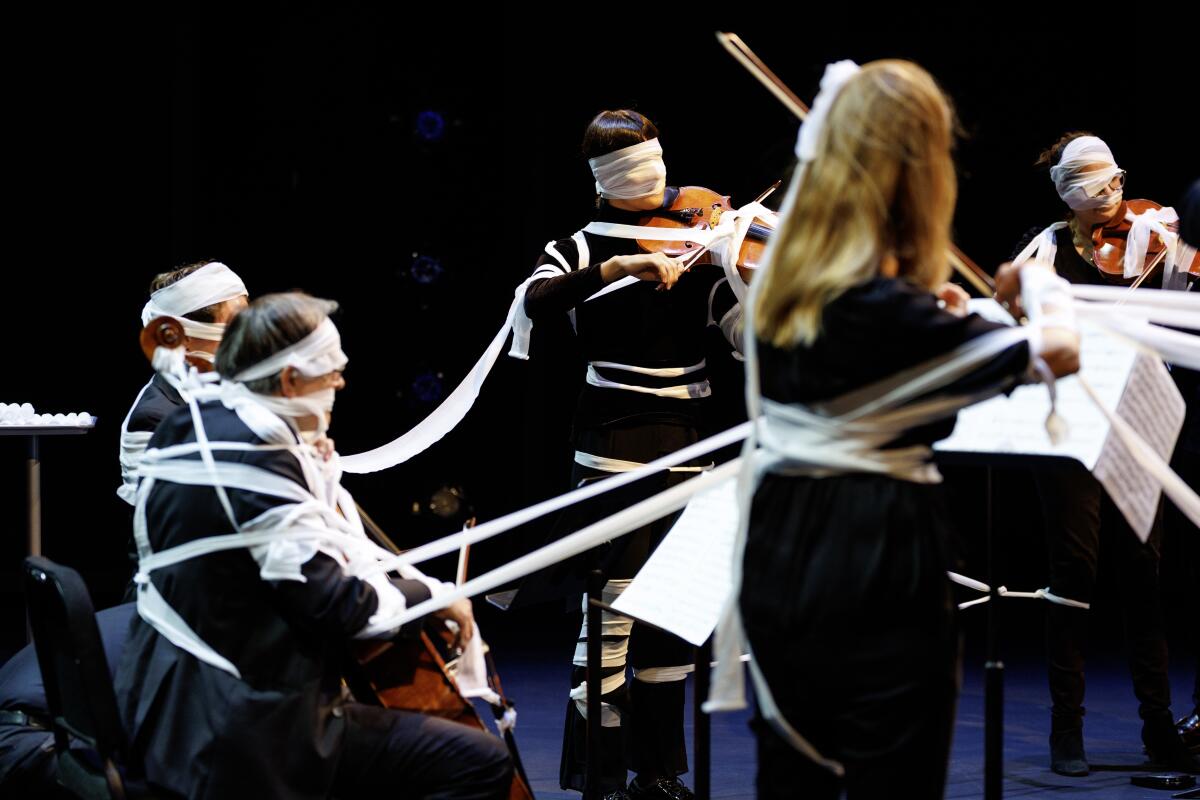
It doesn’t much matter what is chosen, because at the premiere in a 1965 Fluxus concert at Carnegie Recital Hall, Ono and a couple of colleagues crept on stage and began wrapping the musicians in gauze. After a few minutes, they could no longer play.
Amusing, yes, but this is also an act of silencing, maybe even passive-aggressive violence. You smile (and a player or two at REDCAT couldn’t suppress a smile), but you don’t feel so hot doing so.

Members of the L.A. Chamber Orchestra covered in gauze while performing Yoko Ono’s “Sky Piece to Jesus Christ” at REDCAT.
(Gina Ferazzi / Los Angeles Times)
There is, in fact, more to this “Sky Piece” than meets the smile. Ono meant Jesus Christ to stand for John Cage. Cage was a key inspiration for Ono’s art. When the Beatles broke up and Ono and John Lennon moved to New York in the late 1960s, they first wanted to be as far from the limelight as possible, Ono having been demonized in the popular press over supposedly breaking up the Beatles (she didn’t!!!!). Cage found them a small two-bedroom apartment next door to him and his partner, Merce Cunningham, in their modest West Village building (a significant fact curiously ignored in the otherwise illuminating new documentary “One to One: John and Yoko” about the couple’s new New York life there).
Ono and Cage had a long, meaningful but not always easy relationship. Cage, who wrote music to suppress his ego, had a problem with Ono’s exhibitionism. In 1962, he dedicated a piece to Ono titled “0’00” (4’33” No. 2),” an Ono-like composition with a single sentence of instruction: “In a situation provided with maximum amplification (no feedback) perform a disciplined action.”
Cage later added other qualifications. One insistence is that the action should fulfill an obligation to others. However much Ono’s “Sky Piece” comes across as a playful Cage rejoinder, Ono did, the year before in Kyoto, create what could be called a version of “0’00”,” although an actual silent piece.
This is her famous “Cut Piece,” which the performance artist known as MPA performed at REDCAT following “Sky Piece.” It was clearly the draw that caused the program to be sold out months in advance.
There are many meanings that have been inscribed to “Cut Piece,” in which Ono invited the audience to come on stage and, with a pair scissors, cut off a small piece of her dress. Along with questioning social and sexual taboos, feminism and acts of aggression, Ono also confronts her own issues with ego from a Buddhist perspective, just as Cage had.
“Cut Piece” has a central place in Ono’s work as do film clips of her performing it in the Broad exhibition. Ono sits without a trace of emotion as she is stripped bare. Attention is directed away from her to the cutters. But the action is nullified by the fact that Ono assumes the stoic posture of the Buddhist monks seen in the news at the time setting themselves aflame in protest of the Vietnam War.
War had, indeed, inspired Ono in her shocking, exhibitionist (however ego-denying) disciplined action. It’s fulfillment of an obligation to others is, like so much in Ono, a two-edged sword forcing us — be we active cutters or passive observers — into contemplation of violence.
MPA’s performance was extraordinary. She introduced “Cut Piece” by noting that in Ono’s six performances over a half-century, the last in 2003 in response to the Gulf War, anger had turned into something more gracious. It was her way of saying to a new generation, give peace a chance.
To begin her own performance, MPA announced that she has retained Ono’s intent to perform “Cut Piece” in time of war. She said take the square of clothing and honor it, let it mean something to you.
At the few performances I’ve seen of “Cut Piece,” there has typically been audience hesitation at first. Not this time. What looked like almost half the full house immediately walked on stage and lined up. In the age of Instagram, everyone’s 15 minutes of fame has turned into an eternity. The cut piece of fabric — a custom garment designed by Victor Barragá — becomes proof of not missing out.
Most cutters approached MPA self-consciously as if walking to a casket at a funeral, although a few acted more like performers themselves wanting to be seen. Through it all, some 40 minutes, MPA didn’t move a muscle. It was as if she had abstracted herself from scissors and spectators, projecting not so much courage as strength. She inspired silence.
An evening that had begun as silencing a smiling sextet ended in a sublime effort to open the mind beyond body and music to give peace a chance.