‘Direction Potocari’: From Srebrenica genocide to a Belgrade football match | Crimes Against Humanity
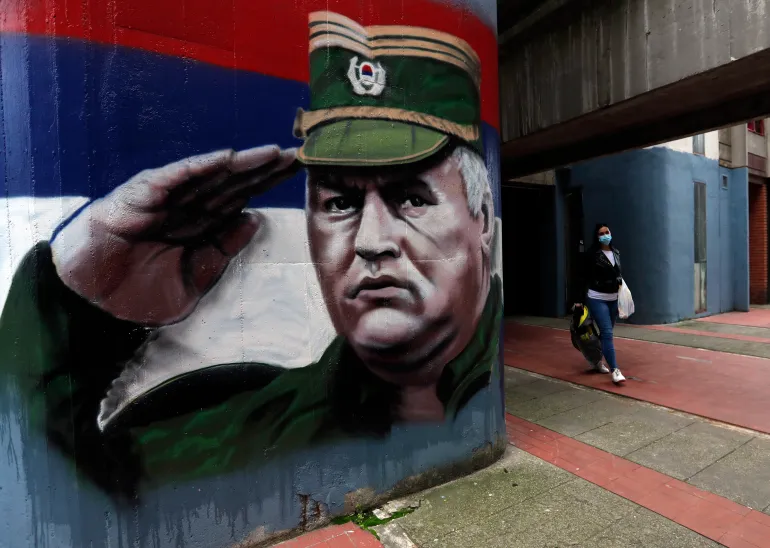
“Pravac Potocari” or “Direction Potocari” were the words used by former Bosnian Serb general Ratko Mladic as he entered Srebrenica on July 11, 1995.
Mladic was referring to the nearby village of Potocari, which hosted a United Nations peacekeeping base and was the initial gathering point for Bosniak refugees during the war in Bosnia. Under Mladic’s command, Bosnian Serb forces committed a genocide against thousands of Bosniak men and boys in the days that followed.
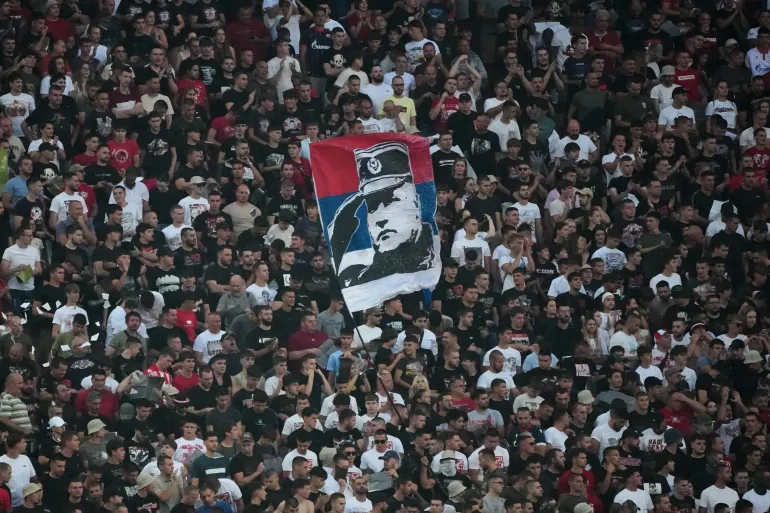
“Pravac Potocari” was also the slogan the fans of the Serbian football team Red Star chose on Sunday to honour the so-called “butcher of Bosnia”, who died in The Hague, the Netherlands, on August 27, while serving a life sentence for genocide, war crimes and crimes against humanity. During a match against city rivals Partizan in the Serbian capital, the supporters also unveiled a giant image of Mladic and observed a minute of silence in his memory.
The tribute came days after European football governing body UEFA fined Red Star a total of 98,250 euros, or $114,100, over a banner -“General, eternal glory and thanks” – dedicated to Mladic that was unveiled by the club’s ultras during a Europa League playoff away leg in Plzen, in the Czech Republic.
The penalty included a ban on Red Star supporters travelling to the club’s next two European away fixtures, in Lugano, Switzerland on October 15 and Ghent, Belgium on November 26.
It was not the first time Red Star supporters had expressed support for Mladic during a European match. Nine years earlier, fans displayed similar messages during a Europa League tie against Belarusian club BATE Borisov.
‘Most shameful event this stadium has seen’
For Slobodan Georgiev, a news director at TV Nova S in Serbia, the minute of silence at Belgrade’s Marakana stadium marked a qualitative shift rather than a repeat performance.
“Glorifying a convicted war criminal is nothing new, but officially paying tribute to him with a minute of silence is new – and it’s the most shameful event this stadium has witnessed,” Georgiev said. “Displaying the shameful slogan ‘Pravac Potocari’ cannot be justified, though in the coming days we’ll surely see attempts to do so.”
He placed the display in a much longer lineage. “Since the breakup of Yugoslavia, the terraces have served as a recruitment centre for paramilitary formations, and in various forms that haven’t changed to this day,” he said. “The worst messages have always travelled through the terraces – everything the authorities didn’t dare say themselves, they most often said through the stands, as they did … at the Red Star–Partizan match.”
But what made Sunday’s so-called “eternal derby” notable was not only the Red Star display.
Partizan’s own hardcore supporters, the Grobari, had raised their own banner in tribute to Mladic – reading “General, thank you” – just a week earlier, on August 31, during a Serbian Super Liga match against OFK Beograd, with Mladic’s flag flying over the north stand for the full 90 minutes.
For Georgiev, the fan groups are not an autonomous phenomenon, but an instrument. “The state, through its secret services and through criminal groups, has always managed these groups and used them for the worst tasks: Mobilisation in war, crime in peacetime, and delivering the ugliest political messages,” he said. “A stand that boasts it was founded by Zeljko Raznatovic Arkan, and that sings in praise of Ratko Mladic without facing any legal consequence for it, speaks for itself.”
Georgiev was referring to Arkan, the Serbian paramilitary leader whose unit committed atrocities during the Yugoslav wars and who, before his assassination in Belgrade in 2000, was closely associated with Red Star’s hardcore fan base, the Delije – a group he is widely reported to have helped organise.
‘Clearest indication issue deeply ingrained’
Sasa Djordevic, a senior analyst at the Global Initiative Against Transnational Organized Crime (GI-TOC), sees the same continuity Georgiev described, tracing it back further still. “The connection between football hooliganism, nationalism and politics in Serbia dates to the late 1980s and became particularly evident during and after the breakup of former Yugoslavia,” he said. “Certain elements of the hooligan scene have since been exploited as a political ‘rent-a-mob,’ and some group leaders have reaped benefits from political protection or business opportunities.”
What worries him most now is not the display itself, but how unremarkable it risks becoming. “Incidents like those that occurred at Marakana last night risk being perceived as routine rather than serious manifestations of hate speech,” he said. “Public debate has nearly vanished, and society seems increasingly desensitised to violence and hate speech in stadiums. When such behaviour starts to feel normal, it may be the clearest indication that the issue has become deeply ingrained.”
Ivana Jeremic, an editor at the Balkan Insight publication, pointed to why sports venues serve that function so well. “Stadiums have long ceased to be merely sporting arenas – they are fertile ground for sending messages that can’t be spoken publicly, or that come wrapped in a softer form,” she said. “Matches involving Partizan, Red Star, and the national team stand out in particular for this.”
The political ties, she argued, are an open secret. “The political connections between the fans leading the stands and those in power are something of a public secret, with a number of documented examples of direct influence. What we hear or see on the terraces could hardly happen without some form of ‘permission’ from the authorities,” Jeremic said. “When it comes to Mladic, we’ve seen a rise in such messages in recent days. Red Star’s fans, as well as the club itself, are currently perceived as a mouthpiece of the government.”
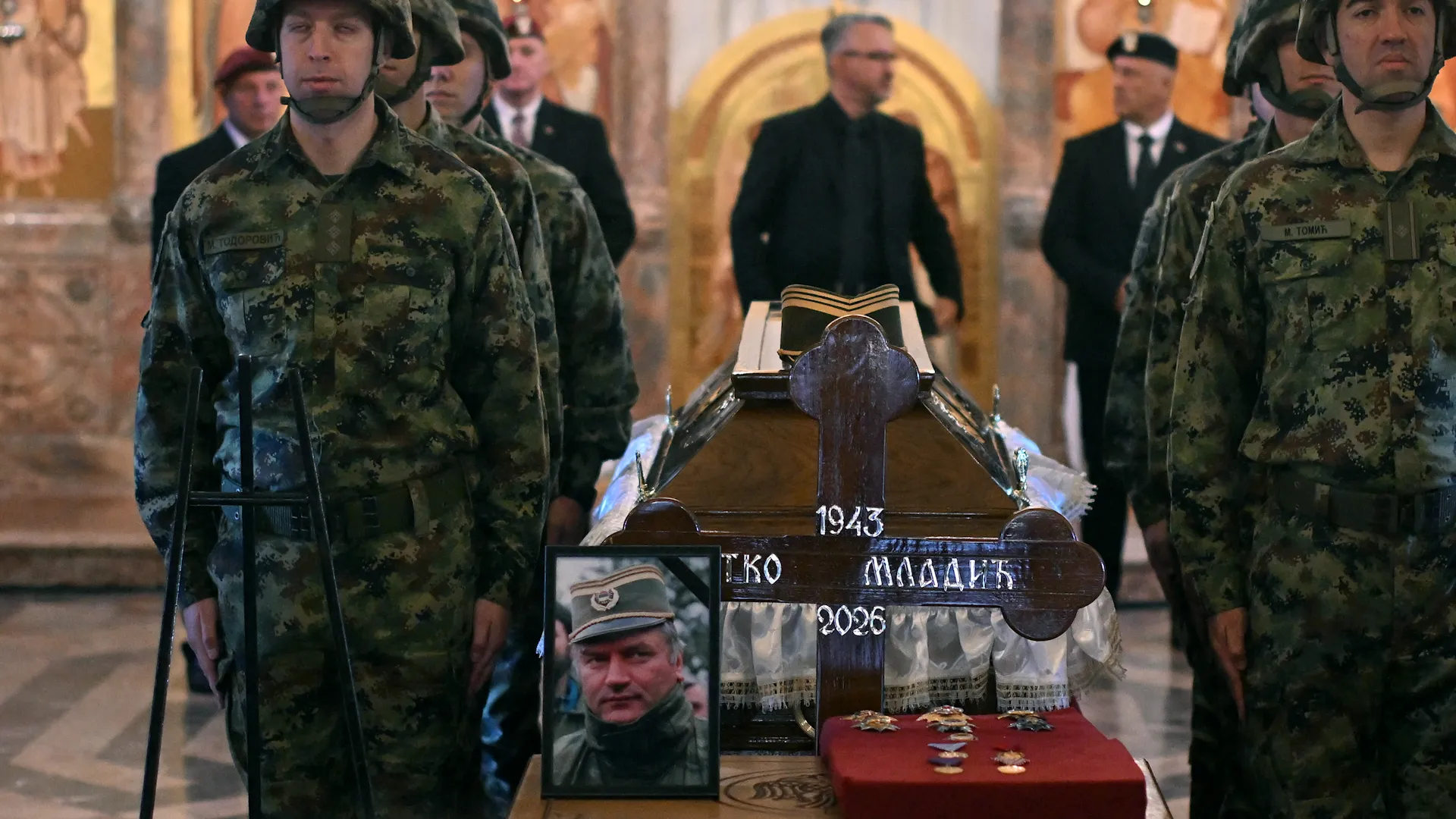
On Thursday, a Serbian government plane carried Mladic’s body from The Hague to Belgrade for burial, where it was received with military honours.

From the terraces to paramilitary structures
Djordevic traced the mechanism behind this convergence to the same period cited by Georgiev. “During the breakup of Yugoslavia, football stadiums became spaces for nationalist mobilisation, and for some young men the step from organised football violence to paramilitary structures was short,” he said. “Hooligan groups since then cultivate loyalty, hierarchy, readiness to use violence and rapid mobilisation to achieve their extremist views that go beyond strictly football supporter beliefs.”
That structure is not unique to Serbia, but it is particularly acute there. GI-TOC’s regional research examined 122 fan groups, identifying 78 as ultras – and found 21 groups combining violent hooliganism with links to extreme politics. “The most problematic situation was in Serbia, followed by Bosnia and Herzegovina,” Djordevic said, while cautioning against overreach. “The term ‘terrorism’ should be used cautiously: The evidence points to particular groups or individuals linked to violent extremism and paramilitary structures, not supporter groups as a whole.”
UEFA’s disciplinary decision detailed the layers of the punishment: A 50,000-euro ($58,000) fine for transmitting a message unfit for a sporting event, an 8,250-euro ($9,580) fine for team misconduct, and the activation of a suspended sanction originally imposed in April 2025 over racist conduct by Red Star fans – a suspended stadium ban now converted into a one-match travelling ban, conditionally extended for a further two years.
But fines on paper, Djordevic said, rarely reach the people who are actually liable. “The problem is that fines imposed on clubs do not necessarily affect those responsible for the incidents,” he said. “If hooligans remain untouched, financial penalties can become simply another cost of doing business rather than a tool for changing behaviour. That does not mean clubs do not care. They respond when sanctions are certain, substantial, and consistently enforced, as seen more clearly in basketball games than in football.”
The gap, he argued, is not a lack of rules. “Serbia already has a solid legal framework,” he said. “The real issue is enforcement. Sanctions need to be applied quickly, consistently and without exceptions, both to clubs and to individuals responsible for violence and hate speech.”