USS Spruance Blasting A Ship With Its Deck Gun Is A First In Nearly Four Decades
A U.S. warship striking another vessel with its deck gun is very rare occurrence in modern times. When the Arleigh Burke class guided missile destroyer USS Spruance opened fire on the Iranian cargo ship Touska on April 19th with its 5-inch MK 45 gun, it marked the first time in almost four decades something like that had happened. In fact, the prior incident took place almost exactly 38 years ago to the day in the same general vicinity against the same enemy.
“From what we are tracking, the last known irrefutable instance of a Navy ship firing its deck gun at another ship was on April 18, 1988 during Operation Praying Mantis,” a U.S. Navy official told us, referring to a duel between the U.S. and Iranian navies in the Persian Gulf.
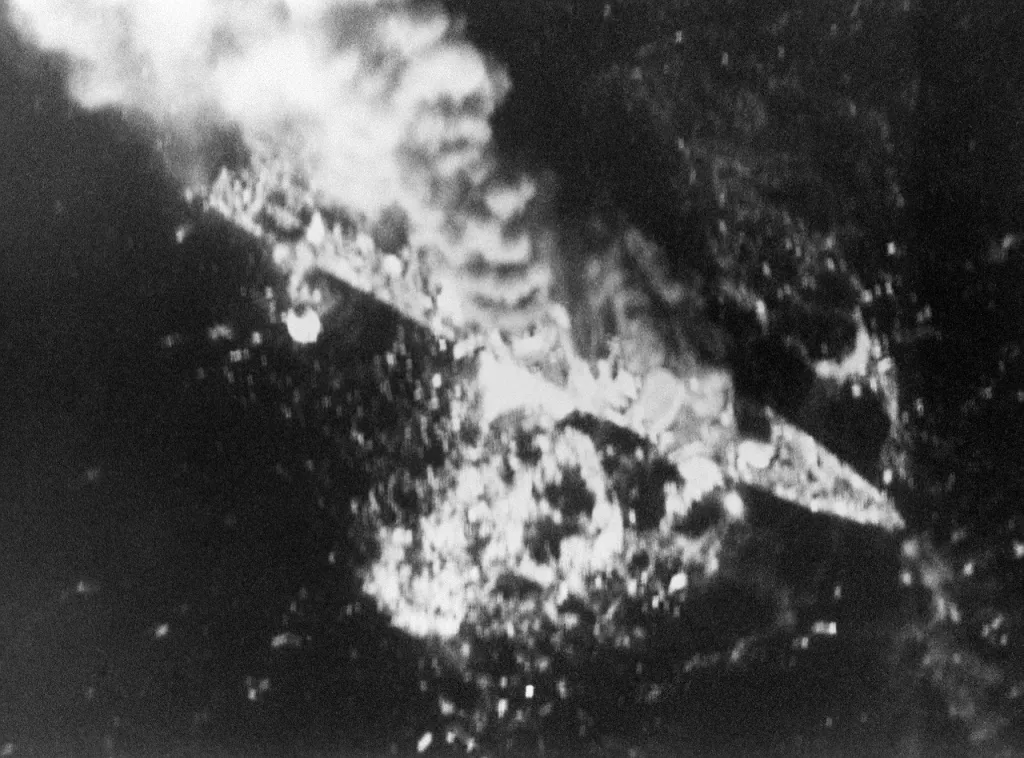
That’s when the Belknap class guided missile cruiser USS Wainwright, Knox class destroyer escort USS Bagley and the Oliver Hazard Perry class guided missile frigate USS Simpson all fired upon the Iranian Karman class fast attack ship IRIS Joshan.

In addition to launching anti-ship missiles at the Iranian ship, the Wainwright and Bagley engaged the Joshan with 5-inch deck guns while the Simpson used its 3-incher, the official noted. The three ships belonged to what was then known as Surface Action Group (SAG) Charlie.
Praying Mantis was part of the much larger Operation Ernest Will, which began in 1987 when Iraqi and Iranian forces increased attacks on merchant ships in the Persian Gulf during latter stages of the Iran-Iraq War.
Ernest Will involved reflagging Kuwaiti oil tankers under the American banner, allowing them to be escorted by U.S. Navy ships. In July, 1987, during the first such escort, one of those ships struck a mine, setting off a chain reaction of events that led to Praying Mantis. That operation was in response to the Oliver Hazard Perry class guided missile frigate USS Samuel B. Roberts striking an Iranian mine.

The mine’s detonation against the Roberts “blew an immense hole in the ship’s hull,” according to a Navy history of the incident. “Ten Sailors from Samuel B. Roberts sustained severe injuries. Four were seriously burned. Commander Paul X. Rinn was hurt as well. The ship should have sunk, but thanks to an extraordinary damage control effort by all hands of an extremely well-trained crew, Samuel B. Roberts was kept afloat.”

“The U.S. response was fierce,” the Navy history continued. “Operation Praying Mantis was the largest of five major U.S. Navy surface actions since World War II. It was the first, and so far only, time the U.S. Navy has exchanged surface-to-surface missile fire with an enemy, and it resulted in the largest warship sunk by the U.S. Navy since WWII.”
At 10:48 a.m. local time, “an approaching Iranian frigate, Joshan, was identified,” according to Defense Media Network. “The Joshan ignored three warnings issued from the Wainwright, and launched a Harpoon missile that narrowly missed the cruiser.”
The vessels in the U.S. Navy’s surface action group returned fire with SM-1 and Harpoon missiles, heavily damaging the Joshan. The burning frigate was then sunk with gunfire.
The Joshan wasn’t the only Iranian asset hit that day.
“In the one-day operation, the U.S. Navy destroyed two Iranian surveillance platforms, sank two of their ships, and severely damaged another,” according to a Navy history of the event.

Praying Mantis helped change the course of events.
“Stung by its defeats, Iran decreased its attacks against merchant vessels after the US responses,” the Modern Warfare Institute at West Point noted.
While the Spruance attack on the Touska is the Navy’s first use of a deck gun on another ship since then, there are more differences than similarities between these engagements.
The Touska is an unarmed civilian cargo vessel that tried to evade the Navy’s blockade on Iranian ports. While the Spruance’s gun blew a hole in Touska’s engine room, the ship didn’t sink, but was instead boarded and seized. The vast majority of Iran’s navy has been destroyed during Epic Fury, leaving an array of small attack craft, but nothing the size of the Joshan still afloat.
You can see video of the Touska being hit with a 5-inch gun below:

US Navy seizes an Iran-flagged ship near the Strait of Hormuz
Here is a file video of a Arleigh Burke class destroyer firing its 5-inch gun:

5-inch 62-caliber Mk 45 Naval Gun Live Fire – Arleigh Burke-class Destroyer
The Touska encounter didn’t seem to have the same effect on Iran as Praying Mantis. If anything, as we previously noted, for at least certain factions within the fragmented Iranian power structure, it hardened the resolve not to enter a second round of negotiations to end the war. Though Trump has extended the deadline for a ceasefire, Iran has yet to indicate it will return to the bargaining table.
Iran, calling the Touska incident an act of piracy, has demanded the return of the ship and its crew and has threatened retaliation. However that has yet to happen.
Regardless, now we know the last time the U.S. Navy has used one of its main deck guns against another ship in anger was 38 years ago.
Contact the author: howard@thewarzone.com