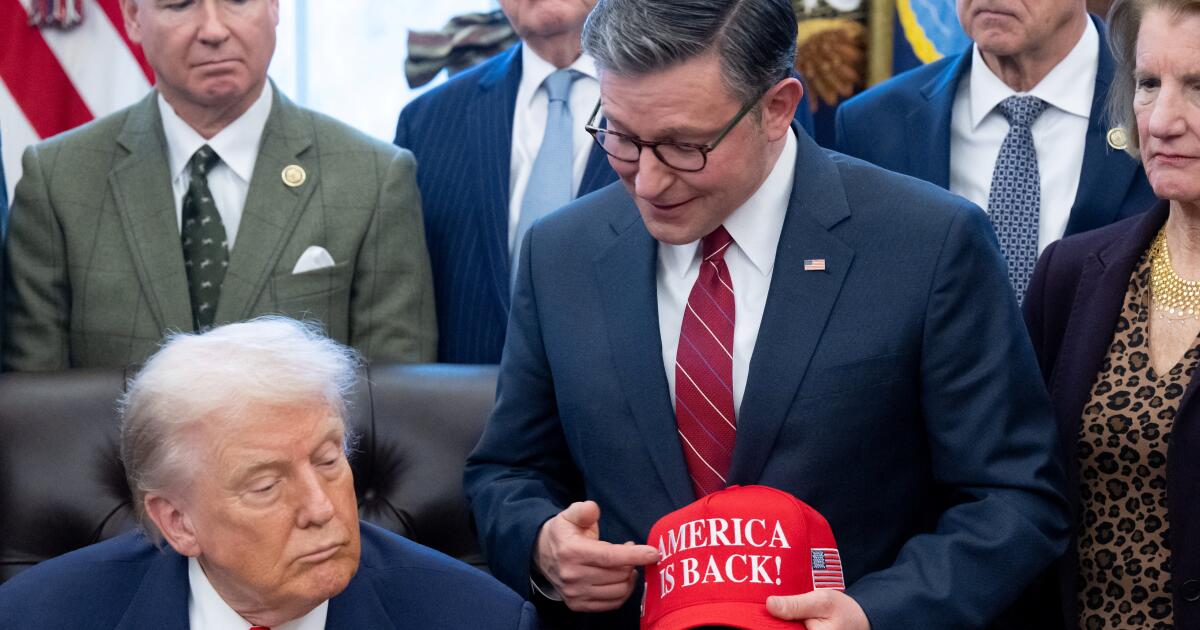
Trump, Mike Johnson spread California election falsehoods
Is Mike Johnson stupid?
The five-term Louisiana congressman earned a law degree and maneuvered his way to become speaker of the House. That requires a certain mental aptitude.
However, wanting that job, which entails bowing and scraping to President Trump while herding an unruly GOP conference with an eyelash-thin majority, does tend to land on the stupid side of the scale.
But maybe Johnson isn’t stupid. Maybe he’s just willfully ignorant, or uninformed. Perhaps he simply doesn’t know any better.
How else to explain his persistent claim there’s something sinister and nefarious about the way California casts and counts its election ballots?
Just last week, Johnson once again repeated one of the sophistries the president uses to dump all over the country’s elections system and explain away his oft-verified loss in the 2020 presidential campaign.
With an apparent eye toward rigging the 2026 midterm election, Trump suggested Republicans should “take over the voting” in at least “15 places,” which, presumably, would all be Democratic strongholds. Johnson — bowing, scraping — echoed Trump’s phony claims of corruption to justify the president’s latest treachery.
“In some of the states, like in California, for example. I mean, they hold the elections open for weeks after election day,” Johnson told reporters. “We had three House Republican candidates who were ahead on election day in the last election cycle, and every time a new tranche of ballots came in, they just magically whittled away until their leads were lost. … It looks on its face to be fraudulent.”
Fact check: There was no hocus-pocus. No “holding open” of elections to allow for manipulation of the result. No voting or any other kind of fraud.
California does take awhile to count its ballots and finalize its elections. If people want a quicker count, then push lawmakers in Sacramento to spend more on the consistently underfunded election offices that tally the results in California’s 58 counties.
That said, there are plenty of reasons — none involving any kind of partisan chicanery — that explain why California elections seems to drag on and vote totals shift as ballots are steadily counted.
For starters, there are a lot of ballots to count. Over the last several decades, California has worked to encourage as many eligible citizens as possible to invest in the state and its future by engaging at election time and voting.
That’s a good thing. Participatory democracy, and all that.
More than 16 million Californians cast ballots in the last presidential election. That number exceeds the population of all but 10 states.
Once votes are cast, California takes great care to make sure they’re legitimate and counted properly. (Which is exactly what Trump and Johnson want, right? Right?)
That diligence takes time. It may require looking up an individual’s address or verifying his or her signature. Or routing a ballot dropped off at the wrong polling location to its appropriate county for processing.
In recent years, California has shifted to conducting its elections predominantly by mail. That’s further extended the counting process. The state allows those ballots to arrive and be counted up to seven days after the election, so long as they are postmarked on or before election day. Once received, each mail ballot has to be verified and processed before it can be counted. That prolongs the process.
County elections officials have 30 days to tally each valid ballot and conduct a required postelection audit. That’s been the time frame under state law for quite some time.
What’s changed in recent years is that California has had several closely fought congressional contests — a result of more competitive districts drawn by an independent redistricting commission — and the nation has had to wait (and sometimes wait and wait and wait) for the results to know the balance of power in a narrowly divided Congress.
“For that reason, we get an outsized amount of criticism for our long vote count, because everyone’s impatient,” said Kim Alexander, president of the nonpartisan California Voter Foundation.
As for why the vote in congressional races has tended to shift in Democrats’ favor, there’s a simple, non-diabolical explanation.
Republican voters have generally preferred to cast their ballots in person, on election day. Democrats are more likely to mail their ballots, meaning they arrive — and get counted — later. As those votes were tallied, several close contests in 2024 moved in Democrats’ direction.
(In 2022, in Riverside County, Democratic challenger Will Rollins led Republican Rep. Ken Calvert for several days after the election before a batch of Republican votes erased Rollins’ lead and secured Calvert’s reelection. You didn’t hear Democrats raise a stink.)
There are plenty of reasons to bash California, if one is so inclined.
The exorbitant cost of housing. Nightmarish traffic. High rates of poverty and homelessness.
But on the plus side, a comprehensive study — the 2024 Cost of Voting Index, published in the Election Law Journal — ranked California seventh in the nation in the ease of casting a ballot. That’s something to be proud of.
As for Johnson, the evidence suggests the speaker is neither dumb nor uninformed when it comes to California and its elections. Rather, he’s scheming and cynical, sowing unwarranted and corrosive doubts about election integrity to mollify Trump and thwart a free and fair election in November.
Which is much worse than plain old stupidity.