F-22 Raptor “2.0” Spotted Undergoing Flight Testing
We are getting ever-better views of new stealthy external fuel tanks and underwing infrared sensor pods for the F-22 Raptor. We also now have our best look to date at the U.S. Air Force’s new AGM-181A Long-Range Standoff (LRSO) nuclear-armed cruise missile, spotted under the wing of a B-52H bomber. Both of these developments reflect a larger surge in Air Force flight testing activities as of late, including the sighting of a B-21 doing air-to-air related flight testing for the first time earlier this month. All of this comes as the service pushes ahead with plans to field a host of next-generation capabilities in the coming years.
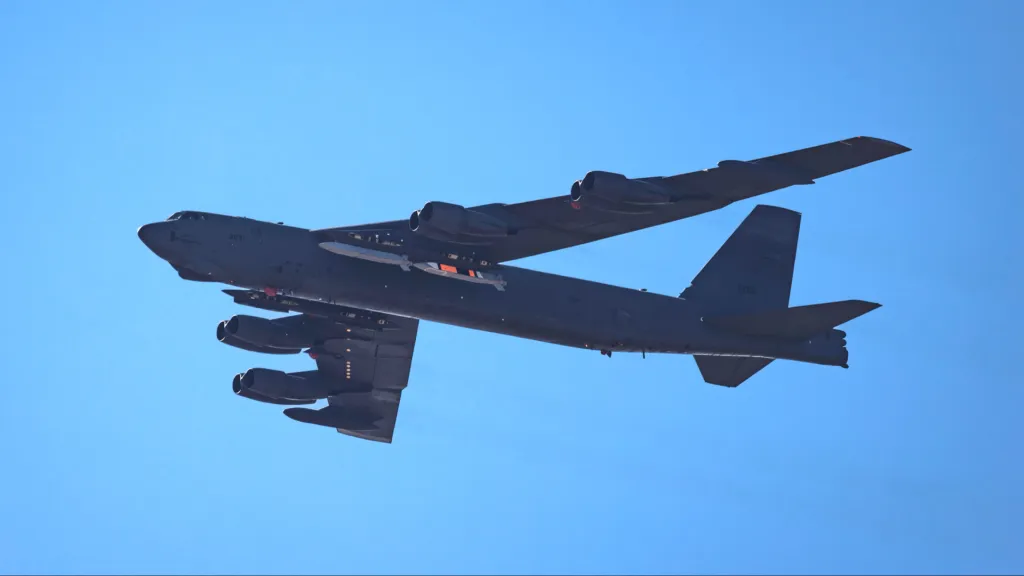
This past weekend, aviation photographer Jarod Hamilton shared new pictures of the F-22 with the stealthy underwing fuel tanks and sensor pods, as well as the B-52 carrying the LRSOs, taken as they flew over the Mojave Desert. This is an area where flight testing out of Edwards Air Force Base in California commonly occurs.

The aircraft were seen at separate times linking up with a KC-135 aerial refueling tanker. Hamilton even managed to grab a picture of all three aircraft flying together.
Critical F-22 upgrades
When it comes to the new underwing stores for the F-22, these are capabilities that have been in development for years now. However, the Air Force and prime contractor Lockheed Martin have only recently begun to talk about them openly. The tanks and pods are part of a larger upgrade plan for the Air Force’s F-22 fleet, which Lockheed is also now referring to as “Raptor 2.0.” The complete package also includes a new Infrared Defensive System (IRDS) integrated into the aircraft itself, as well as enhanced radar, electronic warfare, and other capabilities that you can read more about here.

The new external fuel tanks and infrared sensor pods are particularly important. As TWZ previously wrote, after a scale model of an F-22 in the Raptor 2.0 configuration was shown at the Air & Space Forces Association’s annual Warfare Symposium earlier this year:
Most obvious on the model are the new stealthy fuel tanks, a critical addition to ensure that the F-22 is able to better cover the vast distances that would be involved in a potential future conflict in the Indo-Pacific. In the past, the Raptor’s notoriously short range has been mitigated by using non-stealthy 600-gallon tanks, but these are not a realistic option when faced by more capable hostile air defenses. They are, however, a regular fit for the Raptors that sit alert in Alaska, which need the wing tanks for their intercept missions that can cover vast distances over long periods.
“So the way that I would describe it is, they are low-drag tanks. So the way you could interpret that is, they wouldn’t necessarily be required to punch [be jettisoned] to be in a combat scenario,” Katie Ciccarino, Vice President of the F-22 Program at Lockheed Martin, also told TWZ directly when asked about this specific detail in an interview on the sidelines of the 2026 Warfare Symposium. “They are [jettisonable] if you needed to be in a scenario where you had to, but the idea would be that you don’t have to, and you can perform any of the same maneuvers that you would on a clean wing with these tanks.”
Furthermore, as we also wrote previously:
While they are also stealthy, adding the IRST pods will nevertheless also have radar signature implications for the F-22. However, the tradeoff is considered acceptable, further evidence of just how critical this feature has become in air combat. In particular, an IRST sensor is useful for detecting stealthy targets, something that is also becoming increasingly relevant in the Pacific region. There is also the option of IRST-equipped Raptors sharing their sensor data with ‘clean’ F-22s, enhancing their situational awareness. You can read more about what the IRST brings to the F-22’s overall capabilities here. At this stage, we don’t know what specific sensor is used in the pods; Lockheed Martin refers to this store as the Advanced Sensor Pod.

As of 2024, the Air Force hoped to begin deliveries of the stealthy external fuel tanks to F-22 squadrons this month. However, in its annual budget request last year, the service said it was “closing out technical discrepancies under EMD [engineering and manufacturing development phase] contract to integrate [a] fix prior to RAA [required asset available] delivery,” but did not elaborate. At that time, the Air Force said it expected to begin operational testing of the tanks in the fourth quarter of Fiscal Year 2025, which ended on September 30 of last year.
The most recent Air Force budget documents also said that “qualification testing” of the infrared sensor pods was set to run through the third quarter of Fiscal Year 2026, which ends on June 30 of this year.
When either the external fuel tanks or the infrared sensor pods are currently set to enter operational service is unclear.
A new stand-off addition to America’s nuclear arsenal
Flight testing of the AGM-181A Long-Range Standoff (LRSO) cruise missile has also been going on for years, but only limited details about the design have emerged so far. The Air Force only released the first official rendering of the weapon, which is set to replace the existing AGM-86B Air Launched Cruise Missile (ALCM), last June. Four months later, a B-52 was spotted carrying two prototypes or test articles under its wing for the first time. One of them was painted a solid dark gray, while the other also had light gray, black, and orange markings painted on the side. The new pictures from Jarod Hamilton show the same mix of prototypes/test articles, but it is unclear if they are the exact same ones seen during the flight test last year.

As TWZ previously wrote after the rendering was released last year:
Most notably from this first unclassified render, the LRSO features an inverted tail very similar to the conventionally-armed AGM-158 JASSM stealthy air-launched cruise missile. The AGM-129 featured a similar arrangement, although with a differently shaped vertical tail. The missile looks like it has a trapezoidal fuselage cross-section design with a wedge-like nose. The wing design is also similar to JASSM. We see no air inlet in the concept rendering, which could be for security reasons, considering the inlet design is often a closely guarded feature on stealthy flying machines, or it could be located on the top of the missile. We also can’t say with any certainty how accurate this official rendering is of the actual design, but it is a given that some features will be omitted or even misleading for an initial public release.
The pictures we now have show that the rendering was relatively faithful to the real-world design. We also have a good look now at how the missile’s pop-out main wings look in their stowed configuration before release, as can be seen in the close-up below.

It is also known that the AGM-181 will carry a W80-4 thermonuclear warhead. These warheads are being created through what is described as a Life Extension Program (LEP) that involves the refurbishment and modernization of older W80-1s. Existing AGM-86Bs are armed with W80-1s, which are so-called dial-a-yield types that reportedly have two settings, either five kilotons or 150 kilotons.
Otherwise, “the W80-4 LEP will… enhance safety, security, and reliability,” the Department of Energy’s National Nuclear Security Administration (NNSA) said in a press release back in 2023. “Key design requirements of the W80-4 include use of the existing insensitive high explosive design, incorporation of modern components and safety features, extensive use of non-nuclear component technology developed for other LEPs, and parallel engineering with the USAF on the warhead-missile interface.”

The Air Force said previously that it hoped that the AGM-181 would reach initial operational capability in 2030. However, since 2024, the projected timeline for the missile entering service has been categorized as “controlled unclassified information” and withheld from public release. The service has also said that it is looking to start low-rate production of the missiles in Fiscal Year 2027, ahead of a full-rate production decision in Fiscal Year 2029. Currently, the planned launch platforms for the AGM-181 are the B-52H and B-21 Raider bombers.
As noted, the new F-22 and B-52 test flight pictures underscore a larger uptick in such activities as the Air Force moves ahead with several advanced aircraft and other capability development efforts. The service, as a whole, is expecting to receive a host of next-generation platforms and munitions, as well as other systems, in the next 15 to 20 years. This notably includes the B-21, the F-47 sixth-generation fighter, and multiple types of Collaborative Combat Aircraft (CCA) drones. The developments are also being accompanied by new tactics, techniques, and procedures.
We can expect to see more of the F-22 in its “Raptor 2.0” configuration and of the AGM-181, among other things, as flight testing of various new capabilities expands.
Special thanks to Jarod Hamilton for sharing these pictures with us.
Contact the author: joe@twz.com