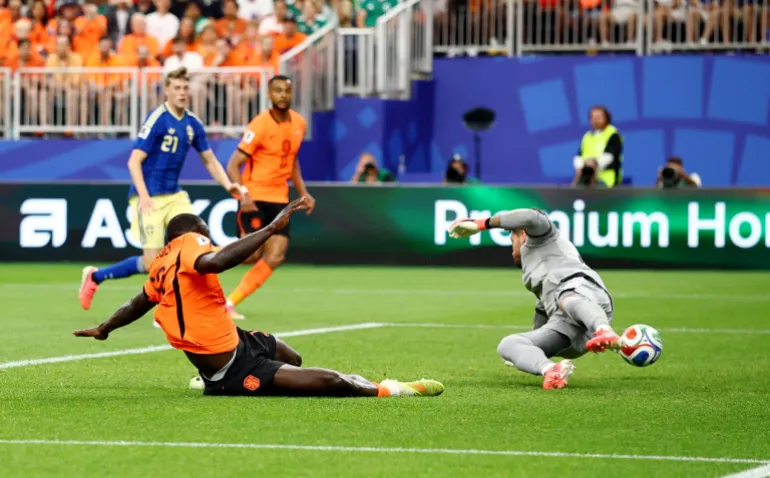
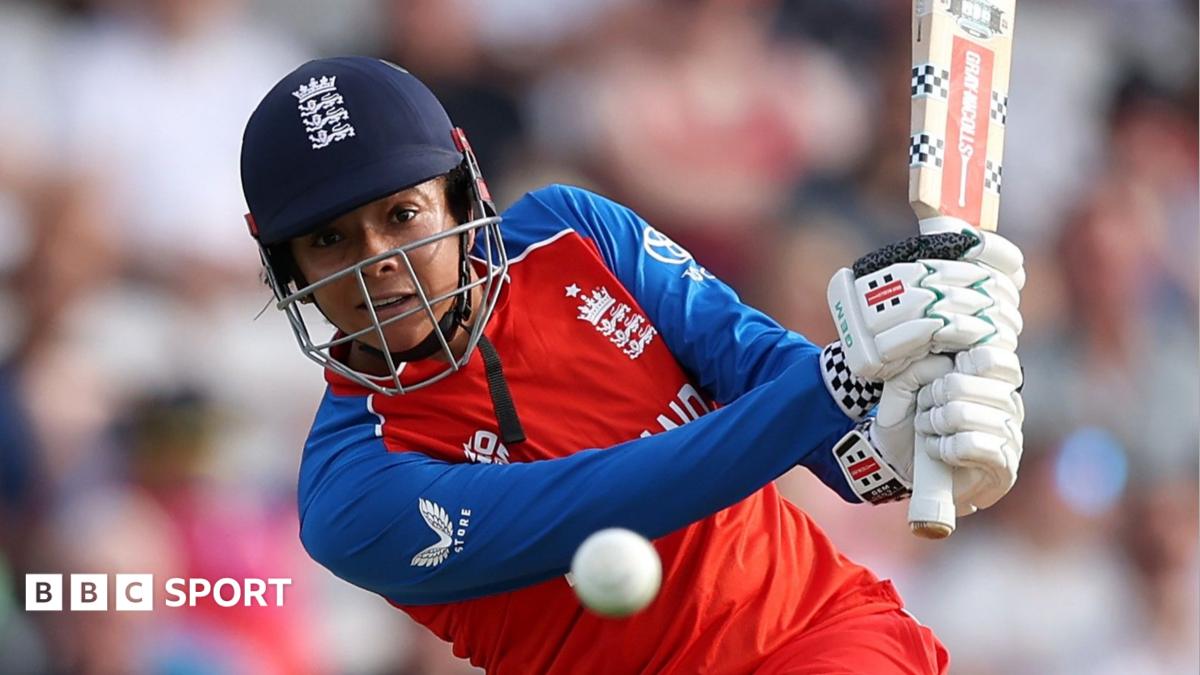
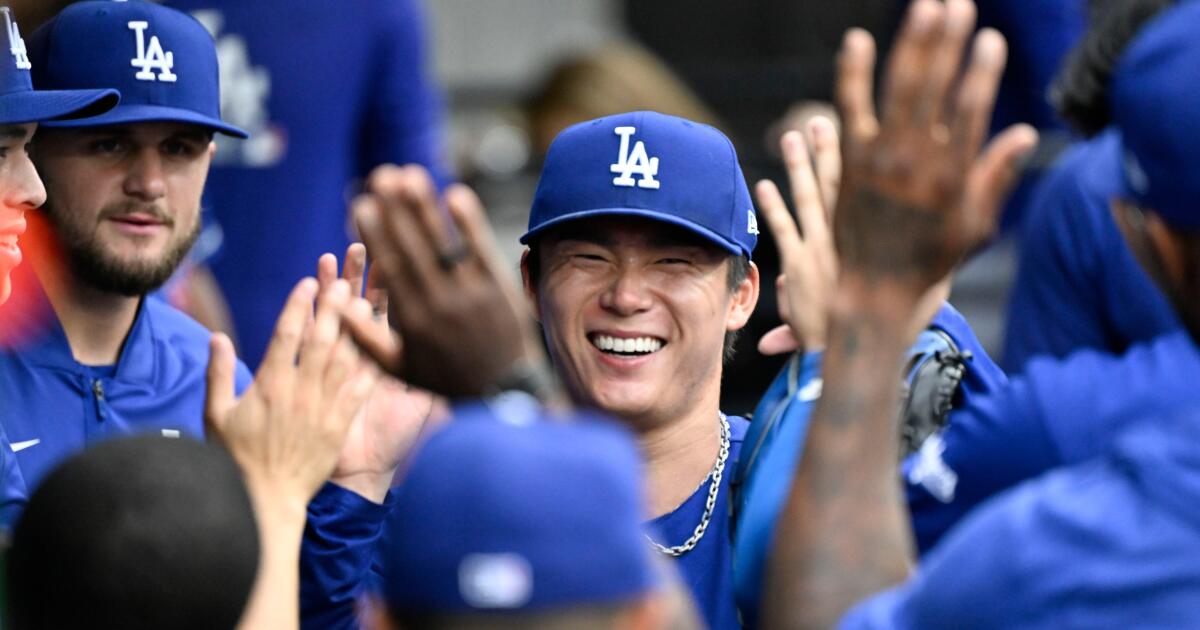
Napoli will turn Manchester United striker Rasmus Hojlund’s loan into a permanent move, West Ham winger Crysencio Summerville is being monitored by a number of clubs and Chelsea consider appointing Xavi Hernandez as their next manager.
Napoli say they will sign on-loan Manchester United striker Rasmus Hojlund, 23, on a permanent deal. The Serie A side are close to securing a Champions League spot which would trigger a £38m fee for the Denmark forward. (Mirror), external
West Ham attacker Crysencio Summerville, 24, is being monitored by a number of clubs across Europe, with the Dutch winger’s asking price set to drop if the Hammers are relegated. (Telegraph – subscription required), external
Former Barcelona boss Xavi Hernandez is under consideration by Chelsea to be their next manager. (Independent), external
Liverpoolboss Arne Slot is set to stay at the club, despite Ajax being interested in the Dutchman. (Mirror), external
Liverpool are weighing up a move for 28-year-old Bournemouth and Argentina defender Marco Senesi, who has verbally agreed to join Tottenham if they avoid relegation from the Premier League. (Talksport), external
Barcelona are interested inBournemouth‘s 19-year-old forward Junior Kroupi but will face competition from Manchester City and several other Premier League clubs for the France Under-21 international. (Sky Sports), external
Newcastle United boss Eddie Howe will get the chance to lead the club’s biggest rebuild since the 2021 takeover, with significant change expected at St James’ Park this summer. (i sport), external
Major League Soccer sides LA Galaxy and Inter Miami lead the race to sign Manchester United‘s Brazil midfielder Casemiro, 34, when his Old Trafford contract expires, despite interest from clubs in Saudi Arabia and Turkey. (Talksport), external
Casemiro’s desire to play with Lionel Messi means the 34-year-old is willing to reduce his salary demands to join the 38-year-old Argentina forward at Inter Miami. (Sky Sports), external
Real Madrid and Brazil forward Vinicius Jr, 25, wants some things to change at the Bernabeu – not just his salary – before he signs a new contract with the club. (Radio Marca – in Spanish), external
Bayern Munich’s honorary president Uli Hoeness says Austria midfielder Konrad Laimer, 28, is “not Maradona” as the two parties struggle to agree a contract extension. (Sky Sport Germany – in German), external
Raducanu last played a match in Indian Wells on 8 March, and has since missed the Miami Open and clay-court events in Linz and Madrid because of her post-viral symptoms.
However, the 23-year-old has been practising in recent weeks at the National Tennis Centre in London and at the Ferrer Academy near Benidorm.
She had been accompanied in Rome by Jane O’Donoghue, a friend and former LTA national coach, and physio Emma Stewart, who perhaps tellingly was with Raducanu during her interviews.
“Coming on to the clay courts is much more physically demanding than potentially other surfaces but I want to come back 100% ready,” Raducanu said.
“I have been building my way up slowly and looking forward to when I get out there.”
We now know she will not be getting out there in Rome this week.
Raducanu has one last chance to play a WTA event before the French Open in either Strasbourg or Rabat in two weeks’ time.
But if she misses the entire clay swing, then Raducanu will have been absent for three months by the time the grass-court season begins.
Even if Raducanu is fit to compete at Roland Garros, which begins on 24 May, she will do so as an unseeded player.
The 2021 US Open champion is currently 30 in the world rankings but only 32 players are seeded – and she will drop several places now she is no longer able to defend the points she earned from a fourth-round run in Rome last year.
Halfpenny was originally a member of the Ospreys academy who let him go because of concerns about his size.
He signed for Cardiff Blues ahead of the 2007-08 season and played for Cardiff RFC and the then Cardiff Blues between 2007 and 2014.
“I’ll be forever grateful to Cardiff for giving me the opportunity to join the academy and start my professional career,” said Halfpenny.
“I instantly felt at home and will always look back at my time at Cardiff as some of the most memorable years of my life.”
During that seven-year stint, Halfpenny made 87 appearances and scored 568 points, winning the Amlin [now European] Challenge Cup and [now defunct] Anglo-Welsh Cup.
He signed for Toulon in 2014, winning the 2015 European Champions Cup with the French side before returning to Wales with Scarlets in 2017, spending six seasons in Llanelli.
Halfpenny travelled to New Zealand to join Crusaders in 2024 before linking up with Harlequins the following year.
After being involved as a kicking coach for Wales’ summer tour of Japan in 2025, Halfpenny returned to Cardiff with a short-term contract in September 2025 as a kicking coach and player and that deal was extended until the end of the season.
He played his first game for the Blue and Blacks in 4,347 days when he faced Ulster in the win in December 2025 and also featured against the same opposition the following month.
That appearance off the bench in Belfast during the 21-14 defeat could be his final professional match, if Halfpenny is not involved in Cardiff’s two remaining United Rugby Championship (URC) matches against Glasgow and Stormers or any further play-off games.
“It’s a special club and to be able to finish my playing career where I started means so much,” said Halfpenny.
“I have given everything to rugby, and in return, it’s given me more than I could ever have dreamed of.
“It’s never going to be easy to say goodbye but I’m finishing with an immense sense of pride and gratitude.”
Poland’s Swiatek said she would prefer continued discussions and negotiations with the majors instead of a boycott.
“I think the most important thing is to have proper communication and discussions with the governing bodies so we have some space to talk and maybe negotiate,” the Wimbledon champion said.
“Hopefully before Roland Garros there’s going to be opportunity to have these type of meetings and we’ll see how they go.
“But boycotting the tournament, it’s a bit extreme kind of situation.
“I guess we as players are here to play as individuals, and we’re competing against each other.
“So it’s really hard for me to say how it would work, if it’s even there on the picture. For now, I haven’t heard anything.”
But French Open champion Gauff thinks strike action would be a genuine possibility if the players come together as one.
“If we all collectively agree, then yes,” the American said.
“I wouldn’t want to be the only one, but we definitely can move more as a collective.
“From the things I’ve seen with other sports, usually to make massive progress and things like this, it takes a union. We have to become unionised in some way.”
World number two Elena Rybakina says she has not been involved in the campaign, but would go with the majority.
“If the majority say we are boycotting, then of course I’m up for it. It’s not an issue,” the Australian Open champion said.
World number five Jessica Pegula has been an articulate advocate of the players’ campaign, but virtually ruled out strike action during a BBC Sport interview in Indian Wells in March.
“We love playing the Slams – I don’t think anyone’s going to strike against the Slams,” the American said.
“I just think it’s us asking for what we think we deserve, but I do think that if the men and the women can come together – which we have on that front – and keep pushing, there’s nothing wrong with us just asking for what we think is right.”
Videos from a tournament kit reveal photo shoot and images from training sessions highlighting Team Melli’s preparations.
Published On 5 May 20265 May 2026
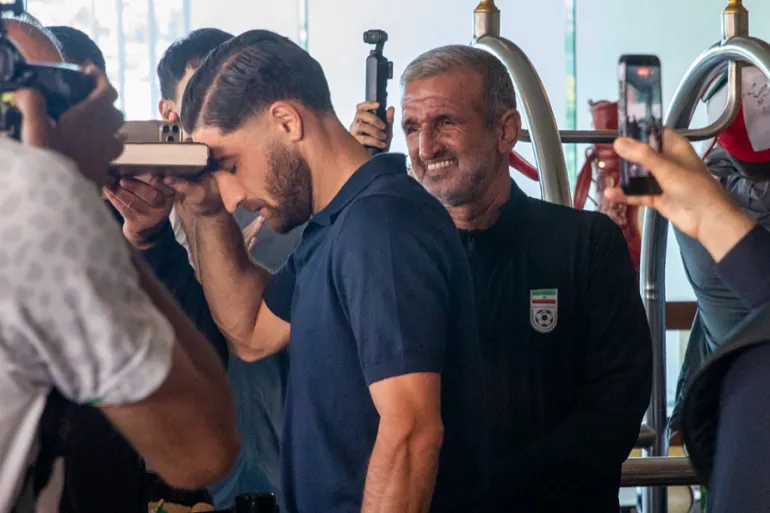
Iran’s preparations for the FIFA World Cup appear to be on track, as social media posts from the team’s official account hint at an upcoming tournament kit reveal and show the squad training at an undisclosed location.
Videos posted by Team Melli’s Instagram account on Monday showed players taking part in a photo shoot for what appears to be Iran’s home kit for the World Cup.
Iran are in Group G of the World Cup and will play all their games in the United States, which is cohosting the tournament with Canada and Mexico.
Several members of Iran’s squad, including first-choice goalkeeper Alireza Safar Beiranvand and winger Milad Mohammadi, were shown wearing a new kit in a series of social media posts.
The Team Melli account also posted photos from training sessions, which have been held in Iran before the squad travels to Turkiye for three friendly matches before the World Cup.
The Asian giants’ participation in the tournament became uncertain after the US and Israel launched a war on Iran on February 28, with Iranian officials questioning the US’s role as host and President Donald Trump suggesting Team Melli’s players may not be safe if they travel to his country for the championship.
However, recent statements by FIFA president Gianni Infantino and Iranian football officials have reaffirmed the country’s participation in the World Cup.
Infantino confirmed that Iran will play its games in the US in his opening remarks at the FIFA Congress in Canada on Thursday.
“Let me start at the outset. Of course, Iran will be participating at the FIFA World Cup 2026. And of course Iran will play in the United States of America,” Infantino said.
“If Gianni said it, I’m OK,” Trump told reporters at the White House. “You know what? Let them play.”
Football officials in Iran have outlined the team’s training and preparations for the tournament, which include camps at home and in neighbouring Turkiye before travelling to the US.
“The first phase of the preparation period will end with an intra-team game on Wednesday,” assistant coach Saeed Alhoei told Iranian sport news outlet Varzesh3.
The game will be held at a stadium, and the players will wear official match kits, with an international referee and video assistant referee technology (VAR) to simulate tournament-like conditions.
Alhoei said the squad will depart for Turkiye on Monday for their final leg of preparations before travelling to the US in June.
Team Melli will kick off their campaign against New Zealand in Los Angeles on June 15 before taking on Belgium at the same stadium on June 21.
“We will have three friendly matches, two of which will probably be against [local] club teams and behind closed doors, and the third against an African team,” Alhoei said. “It is a quality team that can be a good simulation for playing against African teams.”
Iran will face Egypt in their final group match in Seattle on June 26.
On Monday, Iran suffered a significant blow after it was confirmed that winger Ali Gholizadeh had suffered a season-ending knee injury while playing for his club Lech Poznan in Poland.
Gholizadeh, who would have started on the right wing at the World Cup, was stretchered off the pitch against Motor Lublin last Saturday, and tests later confirmed he had torn the anterior cruciate ligament in his left knee.
“Gholizadeh will face surgery in the coming days, followed by several months of rehabilitation,” the club said in a statement.
Manchester City will host their FA Youth Cup final against Manchester United at their smaller Joie Stadium after turning down an offer to switch it to Old Trafford.
City were drawn at home for the game but are unable to use the main pitch, with Pep Guardiola’s first team still having three home Premier League games to play.
While there is an 11-day gap between their match against Crystal Palace and the last game of the campaign against Aston Villa, club officials argue playing the final in that space will rob them of essential time to complete construction work on the North Stand, which is planned to open for Villa’s visit.
The club also have a test event booked for Sunday, 10 May. They feel they are entitled not to agree to a switch as they are the confirmed home team.
United, who last won the trophy in 2022 – when more than 60,000 were at Old Trafford to watch a team including Kobbie Mainoo and Alejandro Garnacho beat Nottingham Forest – told City they were prepared to host the game.
City said no, so the game will be played at the 7,000-capacity ground, which is used by the club’s Premier League 2 and women’s teams.
The club have used the stadium to host Youth Cup finals previously but since 2000, every other host club has played the game at their main stadium.
Two years ago a crowd of 20,000 watched City beat Leeds United in the final at Etihad Stadium.
It is a repeat of the 1986 final, hosted over two legs at Old Trafford and Maine Road and won by City.
United sources feel it is a mistake and will cost the majority of the players involved an experience in what could turn out to be the biggest game of their lives.
City are yet to confirm a date for the game but it is likely to take place on Thursday, 14 May.
From Broderick Turner: Lakers center Deandre Ayton bounced across the court after practice Monday wearing all black, his chains swaying, his mood jovial as he approached the media to talk about his role in the Western Conference semifinals.
Simply put, Ayton’s high-level of play will be paramount for the Lakers when they begin the best-of-seven series Tuesday night in Oklahoma City.
“Everything has been pretty solid, just staying in my role and just doing more in my role,” Ayton said. “This is the playoffs, so everybody can do more, everybody has another level. And this is the second round coming in, so I think we all deserve that little bit of increase of confidence from what we’ve done so far and the outcome from the adversity we’ve faced.
“I feel like that’s where we are right now and I think that’s what’s motivating me, as well, coming into these games. Just seeing, listening and being dialed in and seeing the results of it.”
Get the latest on L.A.’s teams in the daily Sports Report newsletter.
By continuing, you agree to our Terms of Service, which include arbitration and a class action waiver. You agree that we and our third-party vendors may collect and use your information, including through cookies, pixels and similar technologies, for the purposes set forth in our Privacy Policy such as personalizing your experience and ads.
Lakers playoff schedule
Second round All times Pacific
Tuesday at Oklahoma City, 5:30 p.m., NBC/Peacock Thursday at Oklahoma City, 6:30 p.m., Prime Video Saturday at Lakers, 5:30 p.m., ABC Monday at Lakers, 7:30 p.m., Prime Video *Wed., May 13 at Oklahoma City, TBD *Saturday, May 16 at Lakers, TBD *Monday, May 18 at Oklahoma City, TBD
*-if necessary
Dodgers win, but Ohtani is slumping
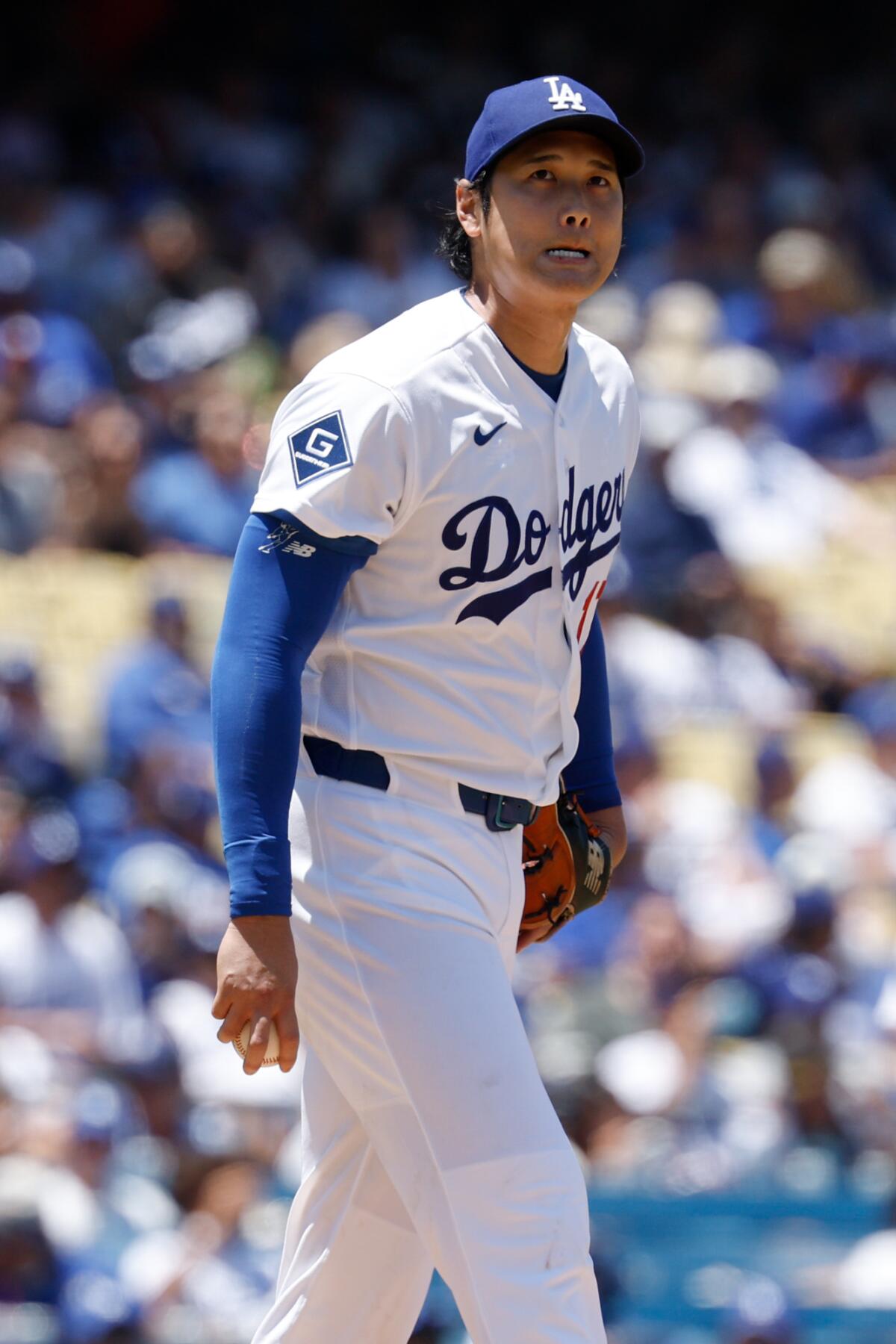
From Maddie Lee: It was the perfect time for Shohei Ohtani to step up to the plate. The Dodgers’ offense was rolling again, ready to make a statement with a third-inning rally against the Astros. They loaded the bases and turned over the batting order.
Then Ohtani chased a sinker off the plate and chopped a slow bouncer to Astros third baseman Isaac Paredes, giving Paredes an easy play at second. A far departure from the eye-popping exit velocities that Ohtani’s swing usually produces, the run-scoring grounder was soft enough to avoid a double play.
In the Dodgers’ 8-3 win Monday against the Astros, Ohtani’s hitless streak stretched to five games, his longest such skid since 2022, when he also went five games without a hit (May 24-28).
Manager Dave Roberts had planned to have Ohtani pitch and hit Tuesday. But during Monday’s game, he decided to change course. Ohtani will just pitch Tuesday.
Murakami’s two-run blast in the fourth inning kept the Japanese rookie tied with New York Yankees slugger Aaron Judge for the major league lead in home runs. Murakami also hit his first double of the season in the sixth, singled and scored in the eighth, finishing three for four with two RBIs and three runs scored.
Davis Martin gave up five hits in seven shutout innings, with 10 strikeouts and no walks. He improved to 5-1 and lowered his ERA to 1.64. The right-hander escaped his only jam in the seventh, getting Josh Lowe to fly to deep center with runners on first and third.
From Kevin Baxter: T-Mobile Arena sits just off the Las Vegas Strip, not far from a faux Manhattan skyline, a pyramid and a casino made to look like a castle.
The line separating illusion from reality can be a thin one in Sin City, where the Ducks opened the second round of the playoffs Monday intent on proving their first-round victory over the Edmonton Oilers was more than a facade. It didn’t go well, with Brett Howden’s goal early in the second period and Ivan Barbashev’s tiebreaking tally late in the third period giving the Vegas Golden Knights a 3-1 victory in the best-of-seven series.
Mitch Marner added an empty-net goal with six seconds to play to end any hope of a Ducks comeback. Mikael Granlund scored for the Ducks with six minutes left in the game.
But the game turned on what the Ducks thought was a missed icing call just ahead of Barbashev’s goal, which came 65 seconds after Granlund tied the score.
“Clearly I disagreed with the call. Clearly it was icing,” Ducks coach Joel Quenneville said. “That was the play for me. We had just scored. It was a huge call. And an easy call.”
Monday at Vegas, 6:30 p.m, ESPN Wednesday at Vegas, 6:30 p.m., TNT, truTV, HBO MAX Friday at Ducks, 6:30 p.m., TNT, truTV, HBO MAX Sunday at Ducks, 6:30 p.m., ESPN *Tuesday, May 12 at Vegas, TBD, ESPN *Thursday, May 14 at Ducks, TBD, TNT, truTV, HBO MAX *Saturday, May 16 at Vegas, TBA, ABC or ESPN
*-if necessary
This day in sports history
1908 — 34th Kentucky Derby: Arthur Pickens aboard 66-1 chance Stone Street wins in muddy track conditions; 2:15.20 slowest Derby in history.
1934 — Cavalcade wins the Kentucky Derby by more than three lengths over Discovery. It’s his third victory in less than two weeks.
1966 — The Montreal Canadiens beat the Detroit Red Wings 3-2 to win the Stanley Cup in six games.
1969 — The Boston Celtics beat the Lakers 107-102 in the seventh game to win the NBA championship for the 10th time in 11 years. Player-coach Bill Russell and Sam Jones retire as players.
1969 — Milwaukee Bucks sign #1 NBA Draft pick, star UCLA center Lew Alcindor.
1973 — Secretariat, ridden by Ron Turcotte, wins the Kentucky Derby with a record time of 1:59.2. Secretariat beats Sham by 2½ lengths and goes on to win the Triple Crown.
1993 — Canisius beats Niagara 11-1 in softball to set an NCAA Division I record with 34 straight wins.
2001 — Monarchos wins the Kentucky Derby carrying Jorge Chavez across the finish line in 1:59 4-5, only two-fifths of a second off the track record set by Secretariat en route to the Triple Crown in 1973. Monarchos finishes a dominating 4¾ lengths over Invisible Ink.
2007 — Street Sense, ridden by Calvin Borel, roars from next-to-last in a 20-horse field to win the Kentucky Derby by 2 1-2 lengths over Hard Spun.
2007 — Floyd Mayweather Jr. beats Oscar De La Hoya in one of the richest fights. Mayweather, with superb defensive skills and superior speed, wins a 12-round split decision and the WBC 154-pound title in his first fight at that weight. The sellout crowd of 16,200 at the MGM Grand Garden in Las Vegas sets a record $19 million gate.
2012 — I’ll Have Another catches Bodemeister down the stretch and pulls away in the final furlong to win the Kentucky Derby. Jockey Mario Gutierrez, riding in his first Derby, guides the 3-year-old colt to a 1½-length victory in front of a Derby-record crowd of 165,307.
2012 — English FA Cup Final, Wembley Stadium, London (89,102): Chelsea beats Liverpool, 2–1; Didier Drogba scores winner for Blues’ 7th title.
2013 — LeBron James is the overwhelming choice as the NBA’s Most Valuable Player. The Miami star gets 120 of 121 first-place votes, giving him the award for the fourth time.
2017 — Corey Perry scores 6:57 into the second overtime after the Ducks rally from a three-goal deficit in the final minutes of regulation, completing a spectacular 4-3 comeback win over the Edmonton Oilers. Rickard Rakell scores the tying goal with 15 seconds left in regulation to cap a stunning sequence of three goals in just over three minutes, all with goalie John Gibson pulled for an extra attacker.
2018 — Justify splashes through the slop to win the Kentucky Derby by 2½ lengths, becoming the first colt in 136 years to wear the roses after not racing as a 2-year-old. The colt that began his racing career in February improves to 4-0 and gives trainer Bob Baffert his fifth Derby victory. Jockey Mike Smith earns his second Derby victory as the 5-2 favorite in the field of 20.
Compiled by the Associated Press
This day in baseball history
1904 — Cy Young of the Red Sox pitched a perfect game against the Philadelphia Athletics, beating Rube Waddell 3-0. Having pitched nine hitless innings in two previous efforts, he ran his string of hitless innings to 18.
1917 — Ernie Koob of the St. Louis Browns pitched a no-hitter against the Chicago White Sox for a 1-0 win in St. Louis.
1925 — Manager Ty Cobb of the Detroit Tigers hit three homers, a double and two singles against the St. Louis Browns.
1925 — Shortstop Everett Scott of the New York Yankees was benched, ending his streak of 1,307 consecutive games played that started while playing for the Boston Red Sox. Scott, who gave way to Pee Wee Wanninger, had the longest playing streak before Lou Gehrig.
1933 — Pepper Martin of the St. Louis Cardinals hit for the cycle and scored four runs in a 5-3 win over the Philadelphia Phillies.
1939 — Sam Chapman of the Philadelphia Athletics hit for the cycle in a 10-5 win over the St. Louis Browns. Chapman completed the cycle with a single in the ninth.
1955 — Brooklyn Dodgers rookie Tom Lasorda makes his first major league start as he he throws three wild pitches in one inning, tying a major league record. After his pitching career, Lasorda will enjoy far more success as a Hall of Fame manager.
1962 — Bo Belinsky of the Los Angeles Angels beat the Baltimore Orioles 2-0 with a no-hitter at Dodger Stadium. Belinsky struck out nine and walked four.
1975 — The Oakland Athletics release pinch-runner Herb Washington, ending his unusual major league career. Curiously, Washington played in 105 major league games without batting, pitching, or fielding. He collected 31 stolen bases and scored 33 runs.
1978 — Pete Rose became the youngest and 14th player with 3,000 hits when he singled against Montreal’s Steve Rogers at Cincinnati’s Riverfront Stadium.
1980 — National League president Chub Feeney suspended Pittsburgh’s Bill Madlock for 15 days and fined him $5,000 for shoving his glove in the face of home plate umpire Gerry Crawford.
1999 — Colorado became the first team in 35 years and the third this century to score in every inning in a 13-6 win over the Chicago Cubs. The last time a team scored in all nine innings was also at Wrigley Field, when St. Louis beat the Cubs on Sept. 13, 1964.
2000 — St. Louis Cardinals first baseman Mark McGwire hits the longest home run in the 30-year history of Cinergy Field, but the 473-foot shot is not enough as Ken Griffey, Jr.’s home run leads the Cincinnati Reds past St. Louis, 3-2.
2003 — Matt Stairs of the Pittsburgh Pirates hits a home run off Houston Astros pitcher Wade Miller which is estimated at 461 feet, making it the longest in the history of Minute Maid Park.
2004 — Mike Piazza set a major league mark for homers as a catcher, hitting No. 352 in the New York Mets’ 8-2 victory over the San Francisco Giants.
2004 — Roger Clemens of the Houston Astros moves past Steve Carlton for second place on the strikeouts list with his 4,137th in Houston’s 6-2 win over the Pittsburgh Pirates.
2006 — At Citizens Bank Park, Omar Vizquel of the San Francisco Giants plays his 2,302nd game at shortstop, catching Cal Ripken, Jr. for third-most all time. Vizquel is now behind Hall of Famers Luis Aparicio (2,581) and Ozzie Smith (2,511). He will eventually pass both.
2015 — Bartolo Colon became the first pitcher in at least 100 years to beat the same opponent with seven different teams, stopping Baltimore once again and leading the New York Mets to a 3-2 win over the Orioles.
2018 — In pitching a perfect 9th inning in a 6-5 win against the Rangers, Craig Kimbrel of the Red Sox becomes the 29th man to record 300 saves. He is the youngest to reach the mark at 29 (Francisco Rodriguez was 31) and has needed the fewest games, 494 (Mariano Rivera had done so in 537 games) and save opportunities (330, compared to 335 for Joe Nathan) to do so.
Compiled by the Associated Press
Until next time…
That concludes today’s newsletter. If you have any feedback, ideas for improvement or things you’d like to see, email me at houston.mitchell@latimes.com. To get this newsletter in your inbox, click here.

Athletic Club have appointed German boss Edin Terzic as their new head coach.
The former Borussia Dortmund coach has agreed a two-year contract and is scheduled to be presented by the Bilbao-based club at the start of next season.
The 43-year-old will replace Ernesto Valverde, who said in March that he would leave Athletic Club this summer after four years in charge.
Terzic has had two spells in charge of Dortmund, winning the German Cup in 2021, narrowly missing out on the Bundesliga title in 2023 and reaching the Champions League final in 2024.
He asked to leave Dortmund shortly after losing 2-0 to Real Madrid at Wembley and was yet to resume his managerial career.
Terzic had previously been Slaven Bilic’s assistant at Turkish club Besiktas and Premier League side West Ham.
Athletic Club are currently eighth in Spain’s La Liga table with four games of the season left.
The ninth in an occasional seriesof profiles on Southern California athletes who have flourished in their post-playing careers.
When the Dodgers drafted David Lesch in January 1980, they had visions of his fastball lighting up radar guns at Dodger Stadium.
He never made it that far.
Lesch never climbed above the lowest rung on the minor league ladder, where he pitched just 10 innings and gave up more runs, hits and walks than he got outs. Less than 18 months after he was drafted, Lesch, wracked by a rotator cuff injury, was released, his major league dream over before he was old enough to legally buy a beer.
“I went to Disney World after that,” he said.
But that wasn’t the only decision the Dodgers made that changed Lesch’s life. When he was drafted, the team gave him just a small bonus, but sweetened the deal by offering to pay for college if he ever went back to school. For the team, it seemed a safe bet.
“They probably have this algorithm saying ‘this is the No. 1 draft pick. If he doesn’t make it, he’s not going back to college. He’ll be assistant baseball coach of his high school or something,’” Lesch said.
Oops.
Lesch not only went back to college, but he also wound up getting three degrees, including a master’s and a PhD from Harvard. It was arguably the most important investment in humanity the Dodgers made since signing Jackie Robinson, because Lesch went on to become one of the world’s top experts on the Middle East, writing 18 books and more than 140 other publications while advising four presidents and a cadre of United Nations diplomats.
David Lesch interacts with students in his history class at Trinity University in San Antonio.
(Lucero Salinas / Trinity University)
“That was the best deal,” Lesch, 65, said by phone from San Antonio, where he is the Ewing Halsell Distinguished Professor of History at Trinity University.
“Without that I probably could not have said yes to Harvard because of the price. The Dodgers committed to paying.”
And by doing so, the Dodgers may have altered history just a bit.
Lesch’s regular meetings with Syrian president Bashar al-Assad, which ended with Lesch facilitating an important if temporary breakthrough in U.S.-Syrian relations? The diplomatic and conflict-resolution work in Syria and the wider U.N. initiatives on regional issues throughout the Middle East? The thousands of students Lesch inspired to go on to perform important diplomatic and public-service roles of their own?
None of that happens if Lesch’s shoulder had held on or if the Dodgers had reneged on their deal.
“It was very fortunate that he hurt his rotator cuff. Baseball’s loss is academia’s gain,” said Robert Freedman, a scholar and expert on Russian and Middle Eastern politics who taught Lesch at the University of Maryland Baltimore County.
“I’ve been teaching for, I guess, 60 years now and I can tell when a student can see a complex problem and can penetrate right to the heart of the problem very quickly. He was one of those students.”
Still, it took a slightly offhand comment from Freedman, who now teaches at Johns Hopkins, to launch Lesch on his post-baseball career.
“We were having lunch and he was looking for a project and I mentioned to him ‘you know, there hasn’t been a good American scholar doing work on Syria for many, many years,’” he said.
“That struck his interest.”
Playing a child’s game and managing life-and-death Middle East politics share very little in common. But Lesch made the transition seamlessly.
“It is like he’s several different people, or has been,” said journalist and author Catherine Nixon Cooke, whose book “Dodgers to Damascus: David Lesch’s Journey from Baseball to the Middle East” traces those parallel lives.
“I’m wondering if, in a sense, it all worked out the way it was supposed to,” Cooke continued. “Even though his dream was to be a major leaguer, David certainly has reinvented himself to this really remarkable man following a completely different path.
“It was the Dodgers who paid for him to go to Harvard and so it’s kind of a weird thing. Baseball took away his dream because he got hurt, but baseball also gave him his backup plan.”
Lesch was still a teenager when, 20 minutes into his first spring training camp in Vero Beach, Fla., Dodgers manager Tommy Lasorda plucked him off a minor league practice field to pitch batting practice in the main stadium.
It was the first time — and nearly the last — that Lesch faced big-league hitters. And it didn’t start well.
Batting practice pitchers throw from behind an L-shaped screen that protects them from comebackers and Lesch had never used one. That, combined with his understandable nervousness, caused him to short-arm his first fastball, which sailed at Cey’s head, sending him sprawling into the dirt.
“He got up and gave me this mean look,” Lesch said. “I remember it so vividly right now. I really thought I was going to be released that day.”
Instead, he gathered himself and finished the session, earning pats on the back from both Garvey and Lasorda. The incident, he said, has colored the rest of his life.
“I’ve met with presidents, prime ministers, been in war zones, all sorts of things,” Lesch said. “Anytime I say ‘well, you know, this should make me nervous,’ I think about that episode and the fact that I made it through and did OK.”
In high school, Lesch had focused on basketball and baseball. Academics? Not so much. So after spending his freshman year of college at Western Maryland College, he transferred to Central Arizona, a junior college, so he would be eligible for the January 1980 draft, allowing him to trade his books in for a baseball.
The so-called secondary draft, which was discontinued six years later, was specifically targeted toward winter high school graduates, junior college players, college dropouts and amateurs who had been previously drafted but did not sign. As a result, the bonuses teams offered winter draft picks were just a fraction of what players taken in the June draft received.
Lesch’s was so low, he can’t even remember what it was.
“I want to say $10,000 to $15,000,” he said. “No more than $20,000.”
When it became clear the Dodgers weren’t going to budge on the money, Lesch’s father, Warren, a family physician in suburban Baltimore, pulled out the Harford County phone book and looked up the number for Baltimore Orioles coach Cal Ripken Sr. Lesch played high school ball against Ripken’s son Cal Jr., who had been a second-round draft pick of the Orioles two years earlier. So his father thought the Ripkens might have some advice on what to ask of the Dodgers.
David Lesch, a former Dodgers draft pick, stands on the baseball diamond at Trinity University in San Antonio.
(Lucero Salinas / Trinity University)
“Ripken goes ‘does your son like school and is he smart?’” Lesch’s older brother Bob remembers. “So Ripken suggested if they offer you XYZ bonus money, take less and say ‘I’ll take this amount, but you have to cover education if he doesn’t make it.’”
Neither side thought that clause would ever be triggered; Lesch, a big, intimidating right-hander who threw bullets from behind Coke-bottle eyeglasses, wasn’t headed to a classroom, he was going to Dodger Stadium.
Until he wasn’t.
Lesch missed a couple of weeks with a back injury. By overcompensating for the sore back, he developed paralysis in the ulnar nerve in his right arm, limiting him to five appearances in his first minor league season.
He arrived healthy for his second spring in Vero Beach and threw three no-hit innings in his first outing against double-A and triple-A players, creating such a buzz that Ron Perranoski, the Dodgers’ major league pitching coach, showed up to watch his second game. By then the shoulder and back stiffness that shortened his first season had returned, and Lesch was rocked. Perranoski left early and unimpressed.
Lesch’s delivery had one major flaw: He threw directly overhand, as opposed to three-quarters or even sidearm, which can increase velocity but also places additional strain on the shoulder and elbow. As a result, his fastball could top out in the mid-90s one day, but when the stiffness and pain returned, it left him throwing in the low 80s.
The inconsistency continued to plague Lesch, and eventually the Dodgers decided they’d seen enough and released him. When he got back to Maryland, Lesch’s father sent him to see an orthopedic surgeon, who found the problem wasn’t in his back or elbow but rather the rotator cuff.
“We didn’t live in the era of pitch counts. So he just pitched,” said David Souter, a high school and college teammate who went on to develop big-league pitchers.
“He had the ability if he was developed and stayed healthy. I think he probably overthrew and tore his rotator cuff and nobody knew it.”
If Lesch had come along 10 years later, when rotator cuff surgeries were common, he might have returned to the mound. But in 1981, a rotator cuff injury was a death sentence for a pitcher.
“It’s just a crapshoot based on physiology,” Lesch said. “I probably was destined. Something would have happened.”
If he could do it over again, Lesch said he would change one thing.
“I’d throw sidearm,” he said. “It’s much less stress.”
He threw to big league hitters just one more time. Following the strike that interrupted the 1981 season, Ripken Sr. phoned Lesch back and asked him to throw batting practice at Memorial Stadium to help the Orioles prepare for the resumption of play. As a reward, the Orioles let Lesch hit — he never had batted in the minors — and he drove a pitch over the left-field wall, then dropped the bat and walked away.
He never stepped on a major league field again.
The Dodgers’ investment in Lesch’s education appeared manageable when he enrolled at a satellite campus of the University of Maryland, in part because his brother Bob was the school’s sports information director.
But it was 1981 and the Middle East was at the forefront of geopolitics. Lesch became convinced the Middle East would be central to world affairs for decades to come. Inspired and encouraged by Freedman and another professor, Lou Cantori, he applied to graduate school at Harvard, Georgetown, Johns Hopkins and the University of Chicago, knowing he couldn’t afford any of those schools on his own.
“I probably could not have said yes to Harvard when they accepted me because of the price,” Lesch said. “The Dodgers had committed to paying and whatever it was, it was a lot more collectively — my undergraduate MA and PhD — than I had gotten in the bonus.”
That wasn’t the only time his baseball background worked in his favor. Years after starting at Harvard, Lesch stumbled upon written evaluations of his application and learned that his grade-point average and other factors were similar to those of other applicants, but it was his athletic career that had swung enough votes in his favor to get him accepted.
“Failure is at the core of sports. And so you have to have this resiliency,” Lesch said. “What a lot of the top colleges have found is that these young kids out of high school who somehow get a 4.6 GPA, they come in — and I’ve seen this as a professor — they get their first C and they’re distraught.
“Athletes stick with it. They say ‘how can I turn this around? How can I get better?’ Admissions departments across the board have looked at athletes much differently.”
The struggles Lesch experienced on the diamond did not follow him into academia. Yet becoming an expert on the Middle East definitely was a backup plan.
“His first passion was clearly baseball and basketball,” said Souter, the former teammate. “Every kid dreamed … that.”
If the shoulder injury wasn’t a strong enough sign that that dream was over, the fire that destroyed Lesch’s childhood home a few years later was. The flames, which severely burned both his parents, also erased his baseball career, consuming all the photos and memorabilia he had collected, save for the championship ring from his one minor league season, which he found buried in the embers. It was the only thing to survive the blaze intact.
David Lesch’s championship ring from his one minor league season, the only surviving keepsake of his professional career after a his family’s home was destroyed in a fire.
(Courtesy of David Lesch)
A post-graduate trip to Syria, the first of more than 30 visits he has made to the country, sealed the deal a few years later. The love he once had for baseball he now felt for a strange and mysterious place that was as old as history itself yet as secretive as the classical ciphers.
Soon Lesch was helping arrange high-level meetings between Syrian president Hafez al-Assad and President George H.W. Bush, a baseball fan who seemed as interested in Lesch’s Dodgers days as his Middle Eastern expertise. But his big break came during the first presidential term of Bush’s son George W. Bush, when Bashar al-Assad, who succeeded his father as Syria’s president, welcomed Lesch for the first of many interviews that informed his book, “The New Lion of Damascus: Bashar al-Assad and Modern Syria.”
“His forte is listening,” Cooke, the biographer, said of Lesch, whose polite, unassuming manner reflects an adult life spent mostly in San Antonio. “When he goes in to try to mediate something, he is a big listener. There is a side of David that doesn’t talk much. But he’s listening.”
The book humanized al-Assad and opened, for a time, the possibility of normalized relations between Syria and the West, with Lesch serving as an unofficial liaison between Damascus and Washington, as well as other Western capitals.
“He’s absolutely a critical player in what we would call two-track diplomacy,” Freedman said. “If the government wants to reach out but doesn’t want to take the political consequences, they send somebody to sound out the situation.
“It’s absolutely critical that we have people like that who can speak the language and understand the overall context, which sadly is lacking in the current administration.”
David Lesch teaches students in his history class at Trinity University in San Antonio.
(Lucero Salinas / Trinity University)
But that opening closed as quickly as it opened. Lesch’s close contacts with al-Assad raised suspicions among some in Syria, and Lesch was poisoned twice. His relationship with al-Assad was severed completely shortly afterward when he criticized al-Assad for failing to implement promised reforms and becoming a “bloodthirsty tyrant.” The Syrian civil war took nearly 700,000 lives and displace another 6.7 million people before al-Assad and his family fled into exile in Russia in 2024.
“Many governments think that they can reduce war to a calculation,” Lesch said. “What we cannot measure accurately or fully appreciate is the human element. We cannot assess a people’s sense of grievance, passion, revenge, ideological commitment and historical circumstances that shaped the nature of their response and staying power.
“This is where academics can make a contribution to policy, giving it the depth and insight gleaned from years of study and learning the culture and the people.”
Baseball’s loss wasn’t just academia’s gain. It may prove to be humanity’s as well.
“I don’t really have any regrets,” Lesch said. “My career turned out great. I could not think of doing anything else at this point and, in fact, in a way I’m glad [baseball] didn’t work out.”
Murakami’s two-run blast in the fourth inning kept the Japanese rookie tied with New York Yankees slugger Aaron Judge for the major league lead in home runs. Murakami also hit his first double of the season in the sixth, singled and scored in the eighth, finishing three for four with two RBIs and three runs scored.
Davis Martin gave up five hits in seven shutout innings, with 10 strikeouts and no walks. He improved to 5-1 and lowered his ERA to 1.64. The right-hander escaped his only jam in the seventh, getting Josh Lowe to fly to deep center with runners on first and third.
Andrew Benintendi added four hits — all singles — and an RBI for the White Sox, who have won six of their last seven games.
Nolan Schanuel and Travis d’Arnaud had two hits apiece for the Angels, who have lost 13 of 15 and have the worst record in the majors at 13-23.
Angels starter José Soriano looked nothing like the ace who went 5-1 with an 0.84 ERA in his first seven starts and became the first Angel to win AL pitcher-of-the-month honors since Matt Shoemaker in August 2014.
Soriano, slowed by neck stiffness in his previous start, gave up a season-high five runs and eight hits in four innings, striking out five, walking three and needing 88 pitches to record 12 outs. The right-hander looked out of whack mechanically in the first, throwing nine of his first 11 pitches for balls and walking two. Run-scoring singles by Chase Meidroth and Benintendi gave Chicago a 2-0 lead.
Soriano escaped two-on, two-out jams in the second and third innings before being tagged for three runs in the fourth. Murakami followed Sam Antonacci’s single by clubbing an up-and-away 98-mph fastball an estimated 429 feet to center for a two-run homer. Vargas followed with a solo shot to right-center to make it 5-0.
Up next: RHP Erick Fedde (0-3, 3.24 ERA) will start for the White Sox on Tuesday night. LHP Sam Aldegheri (1-0, 5.40 ERA) is expected to start for the Angels.
“We went to a small village in Malaysia,” Tonton Zola Moukoko told me. “I gave my passport to the officer. He was shocked. ‘Are you really Tonton Zola Moukoko?’ he asked. ‘You can’t be the one that was playing at Derby!'”
Moukoko’s legend travelled far and wide, carried on fans’ forums and whispered between Championship Manager anoraks. And there was truth in its roots.
Derby beat AC Milan and Bologna to sign the 15-year-old from Djurgardens in Sweden, where he moved from Democratic Republic of Congo to live with his brother after losing both parents.
He was a fledgling star in County’s academy, whose attributes on the game would see him grow into a skilful number 10 in the mould of Lionel Messi, often ending up at Europe’s biggest clubs.
At real-life youth or reserve games, fans would ask for his signature. But Moukoko never made a senior appearance at Derby. The death of his older brother saw him return to Sweden, and he spent his career in the lower Scandinavian leagues.
“Things happened around me which changed me a lot, changed my football career,” he said. “I didn’t really enjoy football any more.
“I found it very difficult to sleep for a long time after my brother died. Football was not the right thing for me after that.”
Moukoko is happy, though, that his legend endures among those who signed him on the game: “Still now, I have people calling from Australia, France, all over the place.”
LAS VEGAS — T-Mobile Arena sits just off the Las Vegas Strip, not far from a faux Manhattan skyline, a pyramid and a casino made to look like a castle.
The line separating illusion from reality can be a thin one in Sin City, where the Ducks opened the second round of the Stanley Cup playoffs Monday intent on proving their first-round victory over the Edmonton Oilers was more than a facade. It didn’t go well, with Brett Howden’s goal early in the second period and Ivan Barbashev’s tie-breaking tally late in the third period giving the Vegas Golden Knights a 3-1 victory in the best-of-seven series.
Mitch Marner added an empty-net goal with six seconds to play to end any hope of a Ducks comeback. Mikael Granlund scored for the Ducks with six minutes left in the game. Game 2 is in Las Vegas on Wednesday.
The Ducks were a shadow of the team that eliminated Edmonton. After averaging a playoff-high 4.33 goals a game, the Ducks were stymied by Vegas goalie Carter Hart, who turned away 33 shots. And after converting eight of 16 power-play opportunities against the Oilers, the Ducks were shut out in four chances against the Golden Knights.
Although the Ducks played their best defensive game of the postseason, giving up just 21 shots, the balanced Knights gave them few good scoring opportunities, especially on the power play.
The Ducks, who needed to use their superior speed to counter the Knights’ edge in experience, pushed the pace in the opening period but got nothing to show for it. The Knights took the lead less than four minutes into the second period when Howden made a dash to the edge of the crease to deflect in a pass from Marner for his fifth goal of the playoffs.
Vegas defenseman Rasmus Andersson celebrates after Mitch Marner’s empty-net goal in the final seconds of a 3-1 win over the Ducks on Monday.
(Ethan Miller / Getty Images)
Howden had a chance to double the lead less than six minutes before the second intermission, but he whiffed trying to bat a loose puck in an open net from the right side.
Mark Stone had an opportunity to score on the power play with less than nine minutes left, but Ducks’ goalie Lukas Dostal made a spectacular save to keep it a one-goal game. And that paid off when Granlund put the puck through Brayden McNabb’s legs 2½ minutes later.
The tie was short-lived, however, with Barbashev redirecting in a pass from Pavel Dorofeyev for the go-ahead goal. Ducks players and coaches vehemently protested, believing officials missed an icing call before the goal.
The Ducks mounted a furious rally after pulling Dostal with about two minutes to play, but that ended with Marner clearing the puck the length of the ice into the empty net.
HOUSTON — It was the perfect time for Shohei Ohtani to step up to the plate. The Dodgers’ offense was rolling again, ready to make a statement with a third-inning rally against the Astros. They loaded the bases and turned over the batting order.
Then Ohtani chased a sinker off the plate and chopped a slow bouncer to Astros third baseman Isaac Paredes, giving him an easy play at second. A far departure from the eye-popping exit velocities that Ohtani’s swing usually produces, the run-scoring grounder was soft enough to avoid a double play.
In the Dodgers’ 8-3 win Monday against the Astros, Ohtani’s hitless streak stretched to five games, his longest such skid since 2022, when he also went five games without a hit (May 24-28).
“I do feel like over the course of my career it’s just a reality that I’m not exactly hitting at the best of my ability at this time of year,” Ohtani said last week through interpreter Will Ireton. “At the same time, as a player, I do want to be better and get to that position where I’m feeling really good. It’s a balancing act of the two.”
The rest of the Dodgers’ offense finally broke out on Monday, against a snakebitten Astros pitching staff.
Alex Freeland ended the Dodgers’ homerless streak at six games with an opposite-field shot into the Crawford boxes in the second inning. Leading off the third, Kyle Tucker hit a solo home run of his own, giving the Dodgers their first multi-homer game in two weeks.
Seven Dodgers combined for 13 hits, with Freeland and Will Smith leading the pack with three apiece. Tucker and Freddie Freeman each contributed a pair of RBIs.
The offensive surge just didn’t extend to Ohtani.
Kyle Tucker hits a solo home run for the Dodgers in the third inning against the Astros on Monday.
(Tim Warner / Getty Images)
In contrast to his offensive struggles, Ohtani has been dominant on the mound. He earned a pitcher of the month award for the first time in his career Monday after recording a 0.60 ERA in five starts in March and April.
Unhappy with just one-sided success, however, Ohtani shook up his routine with early on-field batting practice Monday.
“Most of the times when he does this, it works,” manager Dave Roberts said.
Ohtani took on-field batting practice before Game 3 of the 2025 NL Championship Series and then hit three home runs in Game 4. He usually prefers the batting cages for his pregame BP. But Monday marked the second time this season that he moved his session to the field.
“If you hit a ball down the line the other way in the cage, it kind of looks like it’s a foul ball,” hitting coach Aaron Bates said. “Whereas on the field you can see it’s fair, you can kind of see the spin of the ball a little better. It just kind of changes up the environment a little bit. The depth perception, too, helps a lot.”
Hitting the ball the other way was one of Ohtani’s goals.
Dodgers starting pitcher Yoshinobu Yamamoto delivers during the first inning Monday against the Astros.
(Ashley Landis / Associated Press)
Amid his slow offensive start, Ohtani’s swing has become pull-happy. He’s been hitting the ball to the right side at 53.4% entering Monday, compared to 43.2% last season, according to Statcast.
“It’s more about timing and feel for him, backing up the baseball,” Bates said. “When he gathers correctly and hits through the baseball, obviously we’ve seen what he’s capable of doing. But just kind of managing his at-bats right now, trying to get to the big part of the park.”
For the first time since 2023, Ohtani is also balancing a full starting pitcher’s workload with his offensive responsibilities.
“It is easier to maintain something good when things are going well,” Ohtani said. “But when things are not going well, it’s not easy, in the sense that I have to make sure that I’m healthy and not overdoing it in terms of repetition. So while I’m working on certain things, it’s also a balancing act of making sure I’m not overdoing it physically and making sure that I’m healthy.”
No matter what, it’s going to take a greater physical toll. Case in point: after hitting on the field Monday, Ohtani also threw a bullpen session.
The Dodgers have tried to help him manage his workload by giving him days off from hitting on some of his pitching days. Those pitching-only days weren’t a regular occurrence when Ohtani was with the Angels, but now Ohtani is also preparing for what’s expected to be a deep postseason run.
The Dodgers have given Ohtani two pitching-only days already this season, but Roberts said he plans to have Ohtani hit when he pitches against the Astros on Tuesday.
“It’s doable,” Roberts said when asked about Ohtani trying to fix his swing while pitching. “The bottom line is, there’s no other alternative. He’s going to DH a lot. He’s going to pitch a lot. Now, how best we preserve him and keep him strong and healthy is the question.”
Ohtani’s search for his usual offensive production will continue at least another day. He drew two walks Monday. And the best contact he made was on a fly out to center field (91.2 mph exit velocity) in the seventh inning.
The 2025-26 season has been a breakthrough campaign for Wu.
He claimed his first ranking title at the International Championship in Nanjing last November, then reached the semi-finals of the Masters on his debut.
That form enabled him to rise up to 10th in the world rankings and he will now climb to fourth after picking up snooker’s most famous silverware on Monday.
However, things have not always come easy for Wu, who told the media earlier in the tournament that he would purchase his ideal home if he collected the winner’s prize of £500,000.
His mother, who has been in Sheffield for the tournament, still lives in China and is only an occasional visitor to the UK.
“In the beginning there was not a lot of prize money, so there was definitely a lot of pressure and also there was a lot for myself to improve in terms of my game, so I was definitely feeling the pressure at the time,” said Wu.
“I wasn’t mentally in a good place, but I’m really happy I overcame many difficulties to come to here to where I am today.”
Aside from his swashbuckling and fearless attacking play, there is one other notable thing that stands out where Wu is concerned – his mullet hairstyle.
While that has been dispensed with recently, it highlights that he is not afraid to display his individuality in a sport known for its formal attire and disciplined appearance and that attitude has carried him to glory.
City have three home games remaining – against Brentford, Palace and Aston Villa, on the final day of the season (24 May).
Their remaining away match is at in-form Bournemouth, who City play just three days after their FA Cup final.
While City are aiming for a domestic treble, Arsenal now have a realistic chance of claiming both the Premier League and Champions League trophies.
Their European semi-final against Atletico Madrid is finely poised before Tuesday’s second leg after a 1-1 draw in the Spanish capital last week.
Arsenal‘s three remaining league games are at relegation-threatened West Ham, then home to already-relegated Burnley before a final-day trip to Palace.
“I am worried for the West Ham game,” added Henry. “Like I was worried for Manchester City‘s match today.”
BBC Sport pundit and former England captain Wayne Rooney, meanwhile, has predicted on his BBC podcast Arsenal will win all of their remaining league games and lift the title.
He said: “We’ve heard a lot about Arsenal cracking under pressure, but Guehi has never been in a position where he’s challenged for the Premier League, [Antoine] Semenyo hasn’t. And I think you’ve seen tonight might be the first sign of that.
“I think it’s Arsenal‘s year. And I hope it is for Arteta’s sake. The work he’s put in over the last five years, and then against his former boss, Guardiola – if he goes and wins that title, that is huge for him.
“Arsenal are very consistent while City can be a little bit up and down. City at their best, you’re the best team in Europe.”
City, though, will be left extremely concerned by their capitulation against Everton, having gone ahead but been unable to see out the game.
January signing Guehi was culpable for the opening goal and City’s defence were sliced open time and time again – Everton should have been out of sight by the time they conceded a 97th-minute equaliser.
City fans who had left the stadium had to scramble back when Haaland scored to give their side hope, before Doku earned a point.
Guardiola looked to the positives by saying: “A really good performance. We played outstanding in the first half. Really, really good.
“In the second half, they made a step up and we maybe weren’t as aggressive and after [that] we gave away the goal.
“They came back and made it a proper English game – so, so aggressive in the duels.
“But in general, we made a really good performance.”
Lakers center Deandre Ayton bounced across the court after practice Monday wearing all black, his chains swaying, his mood jovial as he approached the media to talk about his role in the Western Conference semifinals.
Simply put, Ayton’s high-level of play will be paramount for the Lakers when they begin the best-of-seven series Tuesday night in Oklahoma City.
“Everything has been pretty solid, just staying in my role and just doing more in my role,” Ayton said. “This is the playoffs, so everybody can do more, everybody has another level. And this is the second round coming in, so I think we all deserve that little bit of increase of confidence from what we’ve done so far and the outcome from the adversity we’ve faced.
“I feel like that’s where we are right now and I think that’s what’s motivating me, as well, coming into these games. Just seeing, listening and being dialed in and seeing the results of it.”
There were times Ayton was a force against the Houston Rockets in the first round. He had double figures in rebounds in four of the six games and had three double-doubles in the series. He averaged 11.8 points and his 10.8 rebounds are third-best in the postseason.
“DA’s had a great season,” Redick said. “He was instrumental in us getting past Houston. I think his baseline of who he is every day for the last two, two-and-a-half months has been awesome. And I know his teammates, certainly the staff, we’ve all embraced him all season long. Again, he’s the person that changes our ceiling the most.”
Both Ayton and Marcus Smart came to the Lakers last summer, giving them a much-needed center and a defensive-minded guard. Smart said he didn’t know Ayton before they became teammates, but the two of them have bonded.
Lakers teammates Marcus Smart, left, and Deandre Ayton celebrate during Game 6 against the Houston Rockets on May 1.
(Kenneth Richmond / Getty Images)
They sit next to each other in the locker room and Smart is the first to always encourage Ayton, to push him, to expect more out of him.
“Not his big brother, but I’m just somebody who he respects,” Smart said. “He sees [me] go out there and not only preaching, I’m actually doing what I’m preaching. I’m not just preaching, I’m out there with him, in the midst of it, battling with him, going through adversity with him, right? I think that drives a lot of respect for one another in that aspect, when you’re going to battle with somebody. You’re struggling while they’re struggling right there with you, trying to help you get through yours.”
The 7-foot Ayton will be going up against 7-1 Chet Holmgren and 7-foot Isaiah Hartenstein. Holmgren averaged 17.3 points, 8.5 rebounds and 2.0 blocks in the first round and Hartenstein averaged 11.0 points, 8.3 rebounds and 1.0 blocks.
Ayton will have to hold his own against them and still be the force the Lakers have leaned on in the postseason.
“Playing bigger. … Just being relentless on the glass, you know, protecting the rim as much as possible and not letting them in my paint,” Ayton said. “It’s gonna be big with me protecting that paint in this series. They really generate and touch the paint. … Them having 50-plus points in the paint, you know they’re a really unstoppable team. So, I’m really just looking forward to protecting the paint as best as I can and staying on the floor as long as possible. That’s about it.”
Being on the road and in a hostile environment is something that Ayton also is looking forward to. He knows the crowd in Oklahoma City is like a college atmosphere and that he and the Lakers can’t get rattled.
“Yeah, you can’t hear yourself,” Ayton said. “It’s definitely the ‘Thunder’ for a reason, you know? Their fans are thunderous. You know, you can hear the floor shaking, the bleachers, you can’t even hear a play call. And you gotta be super dialed in.
“They’re the defending champs and you know their fans have been in atmospheres and hype games and you know they’re ready for their team to do their thing. So, we just gotta come in super prepared and just dial out all the noise and just come in and play together.”
Kobbie Mainoo (Manchester United): When you look at the back end of the season compared to the start of the season it has been night and day. It just shows what a bit of love and care can do to somebody. I’m not willing to say Mainoo is the man yet – I think we have to see more of a body of work – but I would say the win against Liverpool was the best performance I’ve seen him have in a United shirt. Dominated the game, made some big tackles, passing forward, breaking up the play but also coming with the goal. The most complete performance from him, I thought he was excellent.
Dominik Szoboszlai (Liverpool): Goal and assist for him at Old Trafford. Liverpool have been terrible all season but he comes out with his head high as one of the best around. His stock has grown in a poor season for them. He keeps coming up with big performances.
Conor Gallagher (Tottenham): I was going to put James Garner in there, but Gallagher gets it for me because the game was even more important for Spurs. Big goal. He has had a tough time there but with Roberto de Zerbi and the philosophy of pressing and running hard, I think that makes Gallagher an unbelievable buy for Spurs. He will not only be good this year but for the coming years.
Mathys Tel (Tottenham): I thought Tel was arguably the most overrated player that Spurs bought, but since the turn of the year he has had a light switch in head that says ‘hold on, I was at Bayern Munich and now I could be playing in the Championship’. He stepped up. He has played big minutes in terms of carrying the ball forward, being an outlet and now is adding assists to it. That cross for Richarlison was a striker’s dream.
Jeremy Doku (Manchester City): He wasn’t going to be in it until the last kick of the game. Two unbelievable strikes in the same match and one with either foot. He’s the most frustrating player to watch because you think ‘you are faster than everyone else – kick and run’, but he likes his tricks. When he puts his two goals in the corner, he has kept Manchester City’s season alive because it was dead. I still think Arsenal will win it, but he has made it interesting.