
U.S. crude oil posts largest one-day dollar gain in six years after Trump's hawkish Iran speech
U.S. crude oil posts largest one-day dollar gain in six years after Trump's hawkish Iran speech
Source link
U.S. crude oil posts largest one-day dollar gain in six years after Trump's hawkish Iran speech
Source link
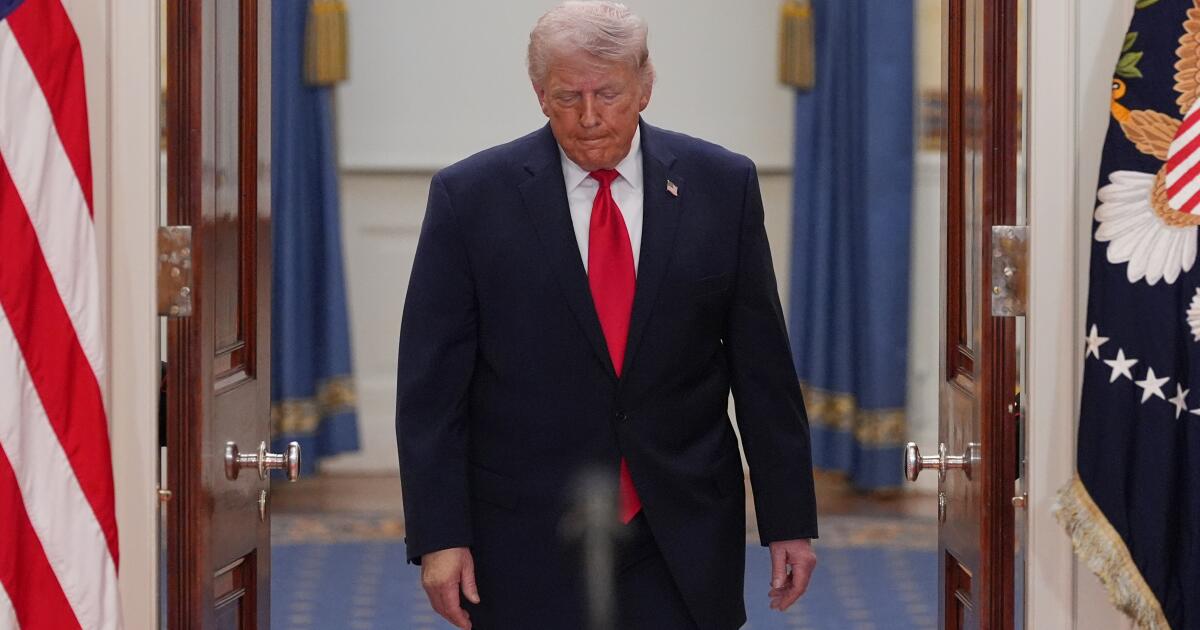
President Trump’s meandering speech on the Iran war late Wednesday — in which he paired promises of a swift exit with new threats of escalated bombing and denied responsibility for the Strait of Hormuz — did little to assuage U.S. allies and world markets concerned about the conflict’s ongoing disruptions to the global oil supply.
Stocks dropped after markets opened Thursday and oil prices soared, with the price of U.S. crude oil jumping more than 10%, to above $110.
In the wake of the speech, diplomats from more than 40 nations — not including the U.S. — met to strategize on how to lift Iran’s continued stranglehold on the strait, the vital oil corridor that the U.S.-Israeli war drove Iran to restrict but which Trump on Wednesday said wasn’t his problem.
Iranian officials remained unbowed, asserting the U.S. and Israel “know nothing” of its remaining capabilities, that “not a single life will be spared” if either attempts a ground incursion into its territory, and that “every last” Iranian would become a soldier if necessary.
“Iranians don’t just talk about defending their country. They bleed for it,” Iranian parliament Speaker Mohammad Qalibaf, a pugilistic figure and one of Iran’s most prominent wartime voices, wrote on X. “You come for our home… you’re gonna meet the whole family. Locked, loaded, and standing tall. Bring it on.”
Meanwhile, remarks Trump made earlier Wednesday about leaving NATO elicited subtle rebukes from both international and domestic allies, including French President Emmanuel Macron and Senate Majority Leader John Thune (R-S.D.), while the president’s comments about the U.S. not being able to focus on social services like Medicare or other domestic needs such as child care as it wages its foreign war sparked outrage at home.
Far from a call for a unified push to end the war alongside allies, Trump’s speech — his first formal address to the nation since the war began a month ago — further isolated the U.S. and the Trump administration on the global stage.
Trump firmly asserted in his speech that reopening the Strait of Hormuz to oil tanker traffic was not the responsibility of the U.S., despite it causing the war, because it receives less oil from the corridor than other nations.
“The countries of the world that do receive oil through the Hormuz Strait must take care of that passage. They must cherish it. They must grab it and cherish it. They could do it easily. We will be helpful, but they should take the lead in protecting the oil that they so desperately depend on,” Trump said.
“To those countries that can’t get fuel, many of which refuse to get involved in the decapitation of Iran — we had to do it ourselves — I have a suggestion: No. 1, buy oil from the United States of America. We have plenty. We have so much,” Trump continued. “And No. 2, build up some delayed courage.”
He said those nations should have been better assisting the U.S. in its war effort already, but should now “go to the strait and just take it, protect it, use it for yourselves.”
“Iran has been essentially decimated,” he said. “The hard part is done, so it should be easy.”
Trump has consistently downplayed the threat Iran continues to pose in the region. And securing the strait — which runs along Iran’s mountainous coast, full of strategic locations from which Iranian forces can threaten ship traffic — is not an easy task, as was acknowledged by the foreign diplomats meeting to solve the issue without the U.S. on Thursday.
“We have seen Iran hijack an international shipping route to hold the global economy hostage,” said U.K. Foreign Secretary Yvette Cooper.
Meanwhile, Macron, speaking in South Korea, said the U.S. “can hardly complain afterward that they are not being supported in an operation they chose to undertake alone.”
Macron also slammed Trump’s criticism of NATO, which Trump called a “paper tiger” in remarks prior to his speech Wednesday.
“If you cast doubt on your commitment every day, you erode its very substance,” Macron said.
Trump for weeks has suggested that NATO allies who declined to join the U.S. war had failed to live up to their treaty obligations, and that remaining in the alliance may not be worth it for the U.S., though he made no mention of NATO in his Wednesday evening speech.
Trump has no power to unilaterally withdraw the U.S. from NATO. That power sits with Congress — where Trump’s own allies downplayed the idea.
“We got an awful lot of people who think that NATO is a very critical, incredibly successful post-World War II alliance,” Thune said. “I think in the world today, you need allies.”
Trump’s formal speech appeared to be geared in part toward his allies at home, including his MAGA base, where frustrations with the war have mounted among the cohort of Trump supporters who’d championed his “America First” message and campaign promises to extricate the U.S. from foreign entanglements, not start new ones.
Trump said he has promised since his first foray into politics in 2015 that he would never let Iran develop a nuclear weapon. He told Americans listening that the war “is a true investment in your children, and your grandchildren’s future,” because it was making the world safer.
However, Trump exacerbated frustrations over the war’s distraction from domestic priorities with separate comments he made earlier on Wednesday at a private Easter luncheon, video of which the White House posted online and then deleted.
In those remarks, Trump said U.S. military needs had to take priority over social services and other major costs for Americans, such as child care, which maybe states could pay for by increasing taxes.
“It’s not possible for us to take care of daycare, Medicaid, Medicare, all these individual things,” Trump said. “They can do it on a state basis. You can’t do it on a federal. We have to take care of one thing: military protection. We have to guard the country.”
The president’s political opponents leaped on the remarks as out of touch.
“Trump says we can pay for war in Iran but can’t afford childcare,” Rep. Ro Khanna (D-Fremont) wrote on X, before asserting that the billions of dollars the U.S. has spent in Iran could have been used to offset Americans’ daycare costs.
White House Press Secretary Karoline Leavitt, in response, accused Democrats and the media of taking Trump’s remarks “out of context,” and claiming he was only talking about “stopping the scams” and rooting out fraud in such programs.
Democrats also took broader swipes at Trump’s framing of the war.
“Donald Trump’s month-long war with Iran has come at a big cost to taxpayers and has tragically taken the lives of 13 American service members. He dragged our country into a conflict that rattled markets, drove up gas prices, squeezed working families, and further destabilized the Middle East,” Sen. Alex Padilla (D-Calif.) wrote on X. “With his poll numbers falling to record lows, Trump is now trying to cut and run with little to show for it. He started this unauthorized war with no clear or consistent justification and the consequences of his choices won’t disappear when he walks away.”
United Nations Secretary-General António Guterres on Thursday said the war was “inflicting immense human suffering and already triggering devastating economic consequences,” and called directly on the U.S. and Israel to end it. He also called on Iran to “stop attacking their neighbors” and “respect navigational rights and freedoms along critical maritime routes, including the Strait of Hormuz.”
“Conflicts do not end on their own,” Guterres said. “They end when leaders choose dialogue over destruction.”
In addition to defending NATO, Macron and other French politicians on Thursday were also reacting to Trump mocking Macron in his remarks Wednesday. He mimicked a French accent while accusing Macron of only wanting to aid the U.S. war effort once the battle had been “won” and referenced a moment last year when Brigitte Macron was caught on video pushing her husband’s face, which he said was them joking with each other.
“There is too much talk, and it’s all over the place,” Macron said, according to French newspaper Le Monde. “We all need stability, calm, a return to peace — this isn’t a show!”
Yaël Braun-Pivet, president of France’s lower house of parliament, told the French broadcaster franceinfo that the Iran war is “having consequences for the lives of millions of people, people are dying on the battlefield, and we have a president who is laughing, who is mocking others.”
Times staff writer Nabih Bulos in Beirut contributed to this report.
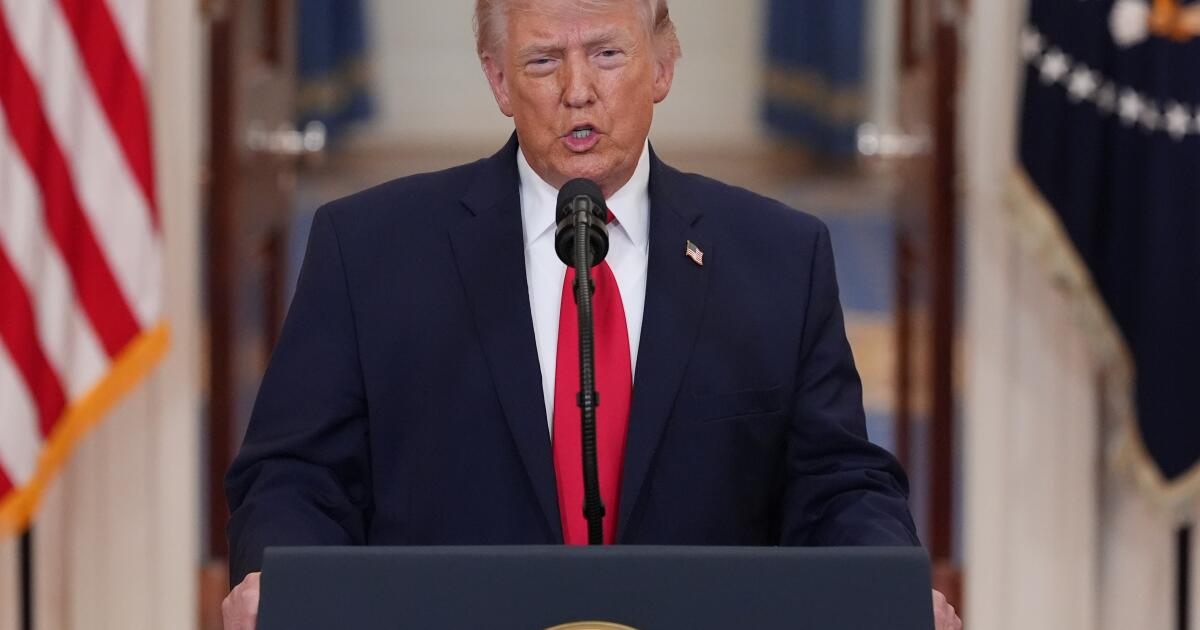
WASHINGTON — In his first formal address to the nation since launching a war on Iran more than a month ago, President Trump on Wednesday night repeated a familiar list of claimed successes — and brushed aside setbacks — while providing little clarity on a clear path to ending the conflict.
“We are going to finish the job, and we’re going to finish it very fast. We are getting very close,” the president said from the White House.
Trump said Iran is “no longer a threat,” yet spoke of potentially needing to escalate the conflict and increase bombings on Iran’s energy and oil infrastructure if it continues to fight back.
“If there is no deal, we are going to hit each and every one of their electric generating plants, very hard and probably simultaneously,” he said. “We have not hit their oil, even though that’s the easiest target of all, because it would not give them even a small chance of survival or rebuilding. But we could hit it, and it would be gone, and there’s not a thing they could do about it.”
Trump earlier this week said he expects to pull American forces from Iran within three weeks, and emphasized that the United States does not have to be in the Middle East but that it is only there to “help our allies.”
In his speech, Trump did not lay out a specific timeline for an exit strategy, but said the the U.S. is “on track to complete all of America’s military objectives shortly, very shortly.”
“We are going to hit them extremely hard over the next two to three weeks. We are going to bring them back to the Stone Ages, where they belong,” he said. “In the meantime, discussions are ongoing.”
He also repeated his assertions, made for weeks, that the U.S. has basically already defeated Iran and won the war, which he characterized as a “decisive, overwhelming victory.”
He also stressed that it is “very important that we keep this conflict in perspective,” before listing out — by month and day — the length of World War I, World War II, the Korean War, the Vietnam War and the Iraq War.
Prior to Wednesday night’s formal address, Trump had only spoken of the war — which U.S. and Israel launched against Iran on Feb. 28 — in less formal settings, during media gatherings and other public events.
The speech was a key messaging moment for the president, who, 33 days into the war, has struggled to clearly explain the scope and objectives of a conflict that has killed thousands of people in Iran and neighboring countries and disrupted global markets.
Trump repeatedly insisted that the U.S. is doing great, is “in great shape for the future,” and doesn’t need the oil that Iran has put a stranglehold on in the Strait of Hormuz, ignoring the clear effects of the war and those disruptions on the U.S., including on gas prices.
Those effects are already contributing to fractures within Trump’s base. Some have expressed frustration with the administration’s decision to enter a new conflict in the Middle East, concerns that could become a political liability for Republicans ahead of the high-stakes midterm elections in November.
In his remarks, Trump appeared to be speaking to those who have criticized him for deviating from his campaign promises by entering the war, saying he had promised to never allow Iran to have a nuclear weapon “from the very first day” he announced his first presidential campaign in 2015.
Trump has repeatedly downplayed the economic pressure the war has placed on Americans, including rising gas prices, arguing that the short-term financial strain is necessary for national security. He has also promised that gas prices will “come tumbling down” when the conflict ends.
“Gas prices will rapidly come back down,” Trump repeated on Wednesday. “Stock prices will rapidly go back up. They haven’t come down very much. Frankly, they came down a little bit, but they’ve had some very good days.”
Trump appeared less energetic during his evening speech than during some of his previous daytime events, where he has consistently maintained an upbeat tone about the war, while offering inconsistent accounts of what his administration aimed to achieve, or how long and what it would take to meet those objectives.
Those inconsistencies were evident even hours ahead of the address. In an interview with Reuters, he said he was not concerned about the enriched uranium held by Tehran — a statement that appeared to undercut a central justification for the war.
“That’s so far underground, I don’t care about that,” Trump said, adding that the U.S. military will be “watching it by satellite.”
In public remarks ahead of the address, Trump said the war was launched to prevent Iran from developing a nuclear weapon, but also that the U.S. had completely obliterated Iran’s nuclear capabilities months prior, in separate attacks over the summer. He also said he was worried about Iran’s enriched uranium, wanted the U.S. to take it, and would even consider sending U.S. forces inside Iran to collect it.
There have also been mixed messages about the U.S.’s intentions for Iran’s leadership since Iran’s Supreme Leader Ayatollah Ali Khamenei was killed at the start of the conflict, leaving a leadership vacuum that was filled by his son, Mojtaba Khamenei, a 56-year-old hard-line cleric who Trump initially called an “unacceptable choice.”
As Iran’s clerical rulers maintained a firm grip on the country, Trump administration officials, such as Secretary of State Marco Rubio, argued that U.S. war objectives had “nothing to do” with Iran’s leadership. But Trump in recent days has repeatedly talked about how “regime change” was achieved.
On Wednesday, Trump said a deal remained within reach with Iran’s new leaders, who he called “less radical and much more reasonable.”
Hours before Trump was to deliver his speech, Rubio posted a video which he began by saying, “Many Americans are asking, ‘Why did the United States have to attack Iran now?’” — an apparent acknowledgment that Trump’s own answers to that question in recent days may have failed to resonate.
Rubio also pushed another rationale for the war that the administration has floated on and off for the past month — saying Iran was building up an arsenal of missiles and drones to shield its nuclear ambitions, and that the war was the “last best chance” for the U.S. to eliminate those weapons capabilities before it was too late.
“We were on the verge of an Iran that had so many missiles and so many drones that nobody could do anything about their nuclear weapons program in the future,” Rubio said. “That was an intolerable risk.”
Others also tried to frame the war narrative Wednesday.
Prior to Trump’s speech, Iran President Masoud Pezeshkian issued a public letter denouncing what he described as “a flood of distortions and manufactured narratives” from the U.S., and arguing Iran is not a threat and has only ever defended itself against U.S. aggression.
He called on the American people to “look beyond the machinery of misinformation” from the Trump administration and reach their own conclusions about the war and its purpose, at one point echoing a question also being asked by some in Trump’s base: “Is ‘America First’ truly among the priorities of the U.S. government today?”
He noted Iran was in the midst of nuclear negotiations with the U.S. when the U.S. attacked it “as a proxy for Israel,” and accused U.S. leaders of committing a “war crime” by targeting Iran’s energy and industrial facilities.
“Exactly which of the American people’s interests are truly being served by this war?” he asked.
WASHINGTON — President Trump is not immune from civil claims that he incited a mob of his supporters to attack the Capitol on Jan. 6, 2021, a federal judge has ruled in one of the last unresolved legal cases stemming from the riot.
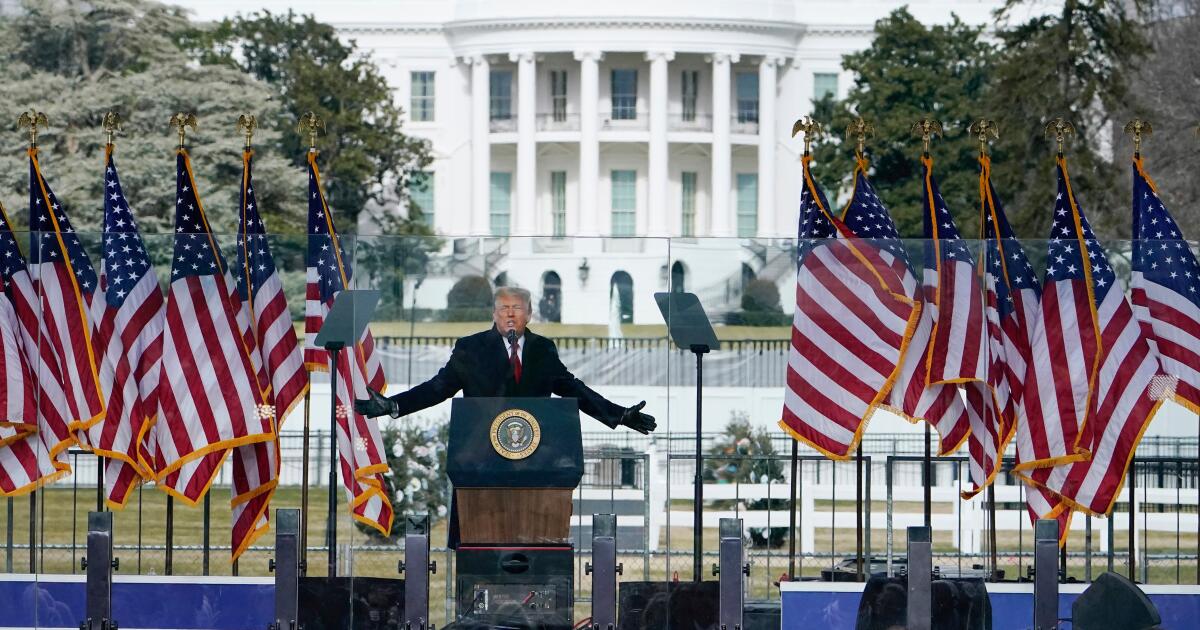
U.S. District Judge Amit Mehta ruled Tuesday that Trump’s remarks at his “Stop the Steal” rally, held on the Ellipse near the White House shortly before the siege began, “plausibly” were inciting words that are not protected by the 1st Amendment right to free speech.
The Republican president is not shielded from liability for much of his Jan. 6 conduct, including that speech and many of his social media posts that day, according to the judge. But Mehta said Trump cannot be held liable for his official acts that day, including his Rose Garden remarks during the riot and his interactions with Justice Department officials.
“President Trump has not shown that the Speech reasonably can be understood as falling within the outer perimeter of his Presidential duties,” Mehta wrote. “The content of the Ellipse Speech confirms that it is not covered by official-acts immunity.”
The decision is not the court’s first ruling that Trump can be held liable for the violence at the Capitol and it is unlikely to be the last given the near-certainty of an appeal. But the 79-page ruling sets the stage for a possible civil trial in the same courthouse where Trump was charged with crimes for his Jan. 6 conduct, before his 2024 election ended the prosecution.
Mehta previously refused to dismiss the claims against Trump in a February 2022 ruling that Trump was not entitled to presidential immunity from the claims brought by Democratic members of Congress and law enforcement officers who guarded the Capitol on Jan. 6. In that decision, Mehta also concluded that Trump’s words during his rally speech plausibly amounted to incitement and were not protected by the 1st Amendment.
The case returned to Mehta after an appeals court ruling upheld his 2022 decision. He said Tuesday’s ruling on immunity falls under a more “rigorous” legal standard at this later stage in the litigation.
Mehta, who was nominated by Democratic President Obama, said his latest decision is not a “final pronouncement on immunity for any particular act.”
“President Trump remains free to reassert official-acts immunity as a defense at trial. But the burden will remain his and will be subject to a higher standard of proof,” the judge wrote.
Trump spoke to a crowd of his supporters at the rally before the mob’s attack disrupted the joint session of Congress for certifying Democrat Joe Biden’s 2020 electoral victory over Trump. Trump closed out his speech by saying, “We fight. We fight like hell and if you don’t fight like hell, you’re not going to have a country anymore.”
Trump’s lawyers argued that Trump’s conduct on Jan. 6 meets the threshold for presidential immunity.
The plaintiffs contended that Trump cannot prove he was acting entirely in his official capacity rather than as an office-seeking private individual. They also said the Supreme Court has held that office-seeking conduct falls outside the scope of presidential immunity.
Rep. Bennie Thompson, D-Miss., who at that time led the House Homeland Security Committee, sued Trump, Trump’s personal attorney Rudolph Giuliani and members of the Proud Boys and Oath Keepers extremist groups over the Jan. 6 riot. Other Democratic members of Congress later joined the litigation, which was consolidated with the officers’ claims.
The civil claims survived Trump’s sweeping act of clemency on the first day of his second term, when he pardoned, commuted prison sentences and ordered the dismissal of all 1,500-plus criminal cases stemming from the Capitol siege. More than 100 police officers were injured while defending the Capitol from rioters.
The plaintiffs’ legal team includes attorneys from the Lawyers’ Committee for Civil Rights Under Law. Damon Hewitt, the group’s president and executive director, praised the ruling as a “monumental victory for the rule of law, affirming that no one, including the president of the United States, is above it.”
“The court rightly recognizes that President Trump’s actions leading to the January 6 insurrection fell outside the scope of presidential duties,” Hewitt said in a statement. “This ruling is an important step toward accountability for the violent attack on the Capitol and our democracy.”
Kunzelman writes for the Associated Press.
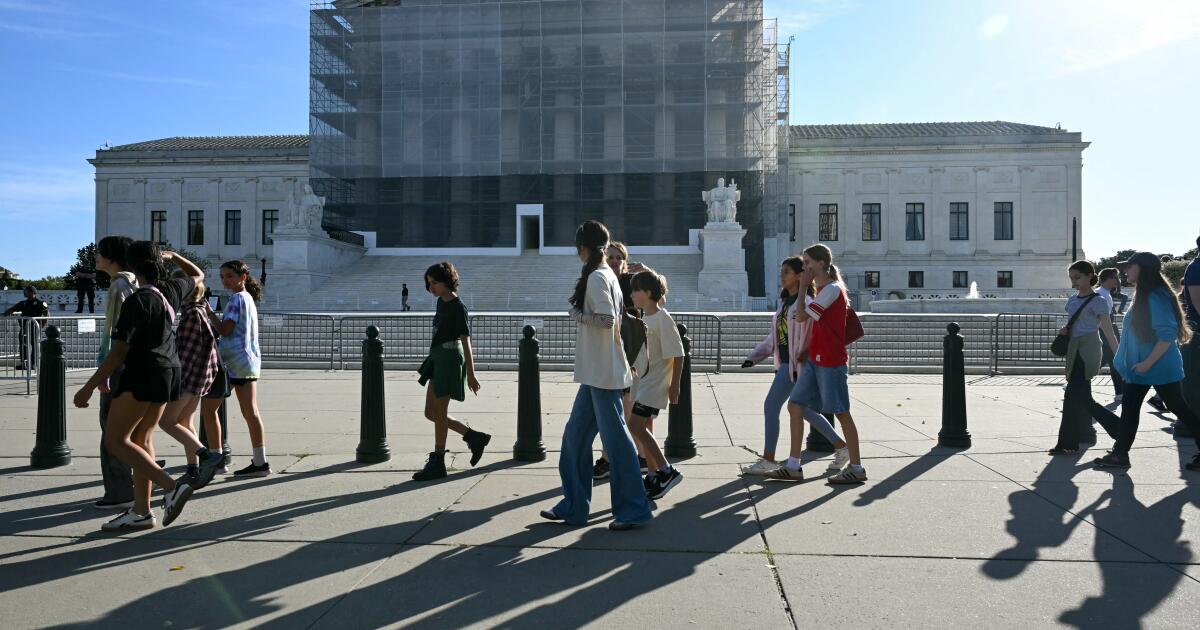
WASHINGTON — The Supreme Court ruled Tuesday that state laws forbidding “conversion therapy” for minors may violate the free speech rights of licensed counselors.
The 1st Amendment ruling is likely to undercut similar laws in California and 23 other states.
In an 8-1 decision, the justices said Colorado’s ban on “talk therapy” may prevent Christian counselors from helping teens work through their feelings about sexual attractions or their gender identity.
State lawmakers passed the new measures in response to healthcare professionals who said that efforts to change a teenager’s sexual orientation were both ineffective and harmful.
Kaley Chiles, a licensed counselor in Colorado Springs, sued and argued the state’s law violated her rights to free speech and the free exercise of religion.
She said she does not seek to “cure” young clients of same-sex attractions or to “change” their sexual orientation. Instead, she said she is guided by their goals.
“As a talk therapist, all Ms. Chiles does is speak with clients; she does not prescribe medication, use medical devices or employ any physical methods,” Justice Neil M. Gorsuch said for the court.
But she could run afoul of the state’s law because she said she may help some of her clients “reduce or eliminate unwanted sexual attractions or change sexual behaviors.”
If so, the law “censors speech based on viewpoint” and is therefore unconstitutional, he said.
“Colorado may regard its policy as essential to public health and safety. But the 1st Amendment stands as a shield against any effort to enforce orthodoxy in thought or speech in this country,” Gorsuch wrote.
Justice Ketanji Brown Jackson dissented alone in a 35-page opinion. She said the issue was one of regulating medical practice.
“The 1st Amendment cares about government efforts to suppress ‘speech as speech’ (based on its expressive content), not laws, like [Colorado’s] that restrict speech incidentally, due to the government’s traditional, garden-variety regulation of such speakers’ professional conduct,” Jackson wrote. “States have traditionally regulated the provision of medical care through licensing schemes and malpractice regimes without constitutional incident.” she continued.
The Trevor Project, a crisis intervention organization for LGBTQ+ young people, condemned the ruling.
“The Supreme Court’s decision to treat the dangerous practice of conversion therapy as constitutionally protected speech is a tragic step backward for our country that will put young lives at risk. These efforts, no matter what proponents call them, no matter what any court says, are still proven to cause lasting psychological harm,” Chief Executive Jaymes Black said in a statement.
The conservative First Liberty Institute called the ruling a “great victory for religious liberty.”
“Americans should never have their professional speech censored simply because the government disfavors that speech,” said Kelly Shackelford, the group’s president.
The ruling is the third significant defeat for LGBTQ+ rights advocates in the last year.
The conservative majority upheld state laws that prohibit puberty blockers and other “gender affirming” care for minors. And last month, the justices said parents in California have a right to know about their child’s gender identity at school.
They said California’s student privacy policy violated parents’ rights, including the free exercise of religion.
The Alliance Defending Freedom appealed her case to the Supreme Court and described her as “a practicing Christian [who] believes that people flourish when they live consistently with God’s design.”
Her clients “seek her counsel precisely because they believe that their faith and their relationship with God establishes the foundation upon which to understand their identity and desires,” they said. “But Colorado bans these consensual conversations based on the viewpoints they express.”
The state law defines “conversion therapy” as “any practice or treatment by a licensee that attempts or purports to change an individual’s sexual orientation or gender identity, including efforts to … eliminate or reduce sexual or romantic attraction or feelings toward individuals of the same sex.”
Violators may be fined up to $5,000, but no one had been fined, the state says.
The challengers had lost in the lower courts.
A federal judge and the 10th Circuit Court of Appeals in Denver rejected the free speech claim. By a 2-1 vote, the appeals court said the state law was not a ban on free expression. Rather, it regulated the conduct of licensed medical professionals. States have the authority to regulate the practice of medicine.
In their appeal to the high court, lawyers for Chiles said the state was “censoring” voluntary conversations and forbidding speech on only one side of a controversy.
The Trump administration supported the 1st Amendment challenge because the state seeks “to suppress a disfavored viewpoint.”
In response, the state said its law “safeguards public health” by prohibiting “a discredited practice” that was shown to be harmful. It stressed the law regulates licensed professionals only and does not extend to religious ministers or others who provide private counseling to young people.
In 2012, California was the first state to ban licensed counselors from using conversion therapy for minors.
Then-Gov. Jerry Brown said these “change” therapies “have no basis in science or medicine and they will now be relegated to the dustbin of quackery.”
Equality California condemned the court’s ruling and said it “has weakened the ability of state licensing boards to intervene if clinicians use unproven, misleading, or coercive techniques.”
The group urged support for a pending bill in Sacramento that would “extend the statute of limitations for survivors to pursue civil claims against licensed mental health providers who subjected them to these harmful practices.”
Tuesday’s ruling was also criticized for undercutting state regulations of medical practice a year after taking the opposite view in a Tennessee case.
In June 2025, the court in a 6-3 decision upheld laws in Tennessee and 24 other red states that prohibit “gender affirming” puberty blockers and hormone treatments for minors.
The majority said then it was deferring to the state and their lawmakers who decided to prohibit such medical treatments for minors.
But in the Colorado case, the court majority did not defer to the state’s judgment that conversion therapy was harmful and potentially dangerous.
The decision is also the third victory for the Arizona-based Alliance Defending Freedom in its free speech challenges to Colorado laws. A maker of custom wedding cakes and the designer of websites won suits seeking an exemption from the state law that required them to provide equal service for same-sex weddings.
RABAT, Morocco — A Moroccan court sentenced a rapper known for his criticism of the country’s ties with Israel and accusations of government corruption to eight months in prison, the latest in a string of penalties against young musical artists.
Souhaib Qabli’s songs sharply criticize Morocco’s 2020 decision to normalize ties with Israel in an accord brokered by the first Trump administration. His lyrics also call out problems with public services and restrictions on freedom of speech, grievances also voiced by Morocco’s Gen Z protesters last year.
The judge ruled Thursday that Souhaib Qabli, a 23-year-old rapper, was guilty of insulting a constitutional body, his attorney Mohamed Taifi told the Associated Press. Qabli, who is a member of Al Adl Wal Ihsane, a banned but tolerated Islamist association, was also fined $106.
“The court did not clarify what it meant by a constitutional body. No specific party was identified in the case file, and there are many constitutional institutions,” Taifi said.
The attorney said that his client is appealing the verdict. He also said Qabli was cleared of other charges, including insulting public officials and disseminating false allegations.
Before the public hearing, dozens of supporters gathered outside the court in Taza, a city in north-central Morocco about 160 miles from the capital, Rabat, holding banners calling for Qabli’s release. Rights groups in the North African kingdom have described the case as a political measure aimed at curbing freedoms.
Qabli, known by the stage name L7assal, was arrested earlier this month and remained in custody until the court delivered its verdict. He was studying refrigeration and air conditioning at a vocational training institute in addition to his music career.
His attorney said that Qabli was questioned in court about his songs and social media posts. Qabli said he had no intent to insult any constitutional body and was expressing his views through his music.
His songs include “No to the Normalization,” referring to Morocco’s decision to normalize ties with Israel in the U.S.-brokered Abraham Accords in 2020, in exchange for Washington’s recognition of Morocco’s claim to the disputed Western Sahara territory.
The move was criticized by Morocco’s pro-Palestinian supporters and sparked large protests in several cities. While authorities allowed the rallies, they have arrested activists who criticized the decision.
Morocco’s constitution generally guarantees freedom of expression, and the country is seen as relatively moderate compared with others in the Middle East. Yet certain types of speech can trigger criminal charges, and Morocco has seen tightening restrictions on dissent, including against journalists and activists.
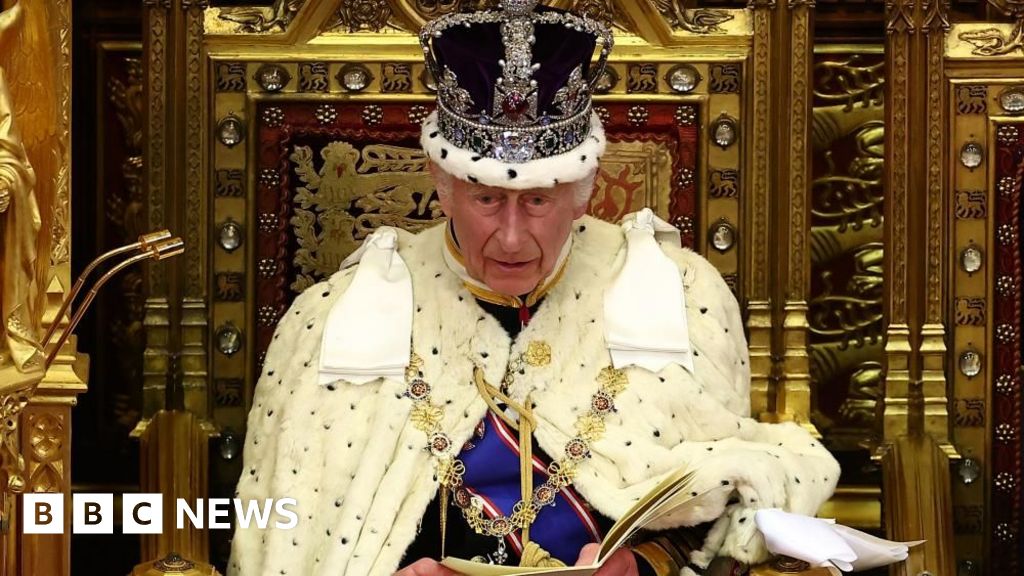
King Charles III will attend Parliament to read out the government’s legislative agenda for the coming months.
Source link
March 20 (UPI) — The U.S. Supreme Court on Friday ruled in favor of allowing a so-called street preacher in Mississippi to challenge a law prohibiting where he can protest.
The high court said Gabriel Olivier can file a civil suit in response to a law in Brandon, Miss., that prevents public protests outside of designated areas. He said the law violates the 1st Amendment’s free speech protection.
Police in Brandon, Miss., arrested Olivier in 2021 as he and a group of protesters shouted slurs and insults at concertgoers as they entered an amphitheater. Some members of the group also held up graphic signs showing aborted fetuses.
He was convicted of violating the city’s laws banning protesters from coming within about 265 feet away of the amphitheater and from using loudspeakers that can be heard from more than 100 feet away, CNN reported.
Olivier pleaded no contest to the charges and was ordered to pay a fine and serve a year of unsupervised probation. Following his sentence, he sued the city, saying its law violated his free speech rights.
A 1994 Supreme Court ruling — Heck v. Humphrey — though says that a defendant convicted of a crime can’t then sue over the legality of their conviction. Otherwise, he and other defendants could be cleared of their convictions outside of the normal criminal appeals process, The Washington Post reported.
Olivier’s lawyers said his case should be allowed to proceed because success wouldn’t affect the result of his conviction, for which he wasn’t imprisoned. The Supreme Court agreed with a unanimous vote.
The ruling did not pass judgment on the constitutionality of the city of Brandon’s laws, only that Olivier is allowed to challenge them.

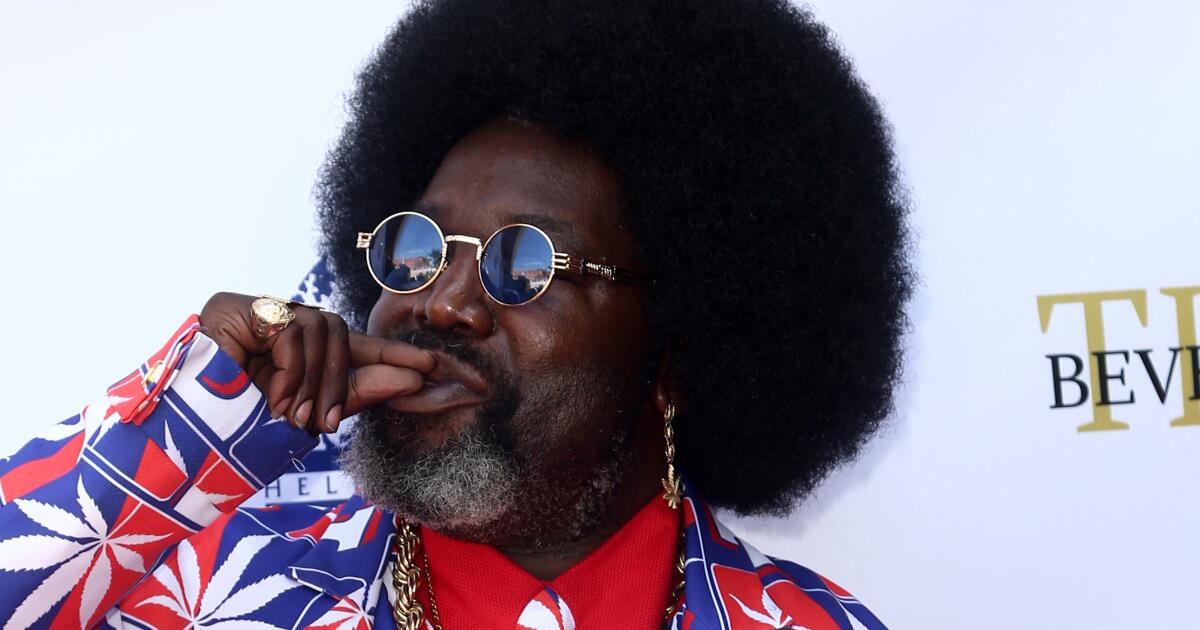
Afroman testified Tuesday in a civil lawsuit brought by seven members of an Ohio sheriff’s office who allege he used their likenesses without permission in music videos and on merchandise and spread lies about them after they raided his home in August 2022.
The fault, the “Because I Got High” rapper maintained, was not his. On Wednesday, the jury was deliberating the case.
The 51-year-old, whose real name is Joseph Edgar Foreman, said on the stand Tuesday that he was in the right, according to local station WCPO Channel 9 in Cincinnati.
“The whole raid was a mistake. All of this is their fault,” Foreman testified, taking the stand wearing sunglasses with American flag lenses and a red, white and blue suit and matching tie made of fabric recalling the American flag. “If they hadn’t wrongly raided my house, there would be no lawsuit, I would not know their names, they wouldn’t be on my home surveillance system, and there would be no songs, nothing.”
Officers were acting in 2022 on a warrant showing probable cause that drugs and drug paraphernalia would be found on the property. The warrant also alleged that trafficking and kidnapping had happened there. No evidence of a crime was found, and no charges were filed. Foreman wasn’t home during the raid but was able to see at least part of it via a video recorded by his ex-wife and footage captured on his home security system before law enforcement turned off those cameras.
It was that footage that was used in the various videos the rapper subsequently posted, including a music video for the song “Lemon Pound Cake,” which he wrote about the raid.
Officers tore down his door, he said, and damaged his house, taking money, vape pens and a small amount of marijuana. There was a discrepancy about the amount of money taken and returned to the rapper, which seemed to be a point of contention linked to whether he was misrepresenting what the deputies did during the raid.
“After they left, I had the right to kick the can and to do what I had to do to repair the damage they brought to my house. Yes, I did,” Foreman said. “I have freedom of speech. I’m a rapper. I entertain.”
His testimony came on the second day of the trial, after the deputies took the stand the first day and testified that though the raid wasn’t perfect, Foreman had been spreading lies about them for years since it occurred. Deputy Lisa Phillips, whose gender identity had been called into question in Foreman’s videos and social media posts, cried on the stand as some of those videos were played for the court.
Footage with a song called “Licc’em Low Lisa” showed Foreman saying he thought he would “crack some musical jokes” in the wake of the raid, then going to comfort a crying actor who resembled Phillips. “I didn’t know they hurt you that bad. … I was just having fun with a bad situation.” The same video showed the actor engaging in sexual activity with another woman.
In their lawsuit, WCPO said, the deputies said the posts and videos caused them “humiliation, ridicule, mental distress, embarrassment and loss of reputation” and made it difficult to do their law enforcement work.
In an amicus brief, however, the ACLU argued that the deputies’ lawsuit was a “classic entry into the SLAPP suit genre,” referring to a type of lawsuit that seeks to discourage criticism of public officials.

LONDON — The BBC filed a motion Monday asking a U.S. court to dismiss President Trump’s $10 billion lawsuit against it.
The British national broadcaster said that the Florida court where the case is expected to be heard does not have jurisdiction over it. It also argued that Trump could not show that it intended to misrepresent him.
Trump filed a lawsuit in December over the way a BBC documentary edited a speech he gave on Jan. 6, 2021. The claim seeks $5 billion in damages for defamation and a further $5 billion for unfair trade practices.
Last month a judge at the federal court for the Southern District of Florida provisionally set a trial date for February 2027.
The BBC argued that the case should be thrown out because the documentary was never aired in Florida or the U.S.
“We have therefore challenged jurisdiction of the Florida court and filed a motion to dismiss the president’s claim,” the corporation said in a statement.
In a 34-page document, the BBC also argued that Trump failed to “plausibly allege facts showing that defendants knowingly intended to create a false impression.”
Trump’s case “falls well short of the high bar of actual malice,” it added.
The documentary — titled “Trump: A Second Chance?” — was aired days before the 2024 U.S. presidential election.
The program spliced together three quotes from two sections of a speech Trump made on Jan. 6, 2021, into what appeared to be one quote, in which Trump appeared to explicitly encourage his supporters to storm the Capitol building.
Among the parts cut out was a section where Trump said he wanted supporters to demonstrate peacefully.
The broadcaster’s chairman has apologized to Trump over the edit of the speech, admitting that it gave “the impression of a direct call for violent action.” But the BBC rejects claims it defamed him. The furor triggered the resignations of the BBC’s top executive and its head of news last year.
Twenty-three years ago, the Oscars were in turmoil. President George W. Bush had just begun an invasion of Iraq after the Sept. 11 attacks, and as the nation’s TV screens filled with the “shock and awe” campaign, many did not know quite how to proceed with Hollywood’s biggest night.
ABC wanted to postpone, presenters begged off, Jack Nicholson urged his fellow actor nominees to boycott (animated feature winner Hayao Miyazaki did), documentary winner Michael Moore attempted to directly shame Bush from the stage (to loud boos) and many of the acceptance speeches acknowledged the war and included pleas for peace.
President Trump’s recent decision to attack Iran is not precisely the same — American troops have thus far not invaded and the Bush administration’s media blitz of rockets lighting up the sky is absent. No one expected the Oscars to be canceled or delayed and there has been no talk of boycotts; whether the war and (if polls are to be believed) its general unpopularity are noted, either by host Conan O’Brien (who has already said he will not be mentioning Trump) or the winners, remains to be seen.
But if recent history is any indication, it could go unmentioned. Which would be something of a political statement in itself: It would be terrible if the false notion that awards shows have become too political had a chilling effect on anyone who wanted to use their platform to speak about something important they care about.
Thus far, film and television awards winners have stayed away from the issues that have prompted widespread public outrage and protests this year — including the often brutal methods of Immigration and Customs Enforcement, the ongoing concern over the war in Gaza and the endless revelations of the Epstein files.
Despite complaints from certain quarters, awards shows, particularly the Oscars, rarely have more than one or two truly political moments. But this year, the absence has been notable.
Compared with the Grammy Awards, where Trevor Noah, in his final stint as host, roasted Trump and anti-ICE sentiment reigned in speeches and on pins, this year’s Golden Globes (which aired three weeks before the Grammys) appeared to exist in another world. A few stars wore similar pins and spoke on the red carpet, but aside from a few digs about Epstein and CBS News from host Nikki Glaser, there was no mention of the many issues roiling the nation. (As he was beginning to make late-in-speech remarks about this being an important time to make films, Kleber Mendonça Filho, Brazilian director of the non-English language film winner “The Secret Agent,” ran over time and was played off.)
Has Hollywood lost its spine? Or, having been beset for years by grievances that the Oscars have become “too political” and “too woke,” are filmmakers and actors saving their outrage and passion for social media and bowing to pressure to keep their acceptance speeches grateful and celebratory?
“I know that there are people who find it annoying when actors take opportunities like this to talk about social and political things,” said Jean Smart on the Golden Globes red carpet, adding, when she won for actress in a TV comedy: “There’s just a lot that could be said tonight. I said my rant on the red carpet, so I won’t do it here.”
It was an echo of Jane Fonda’s famous 1972 Oscar speech: “There’s a great deal to say, and I’m not going to say it tonight.” And, perhaps, a response to more recent “shut up and dribble” criticism, as distilled by 2020 Golden Globes host Ricky Gervais, who cautioned the audience: “If you do win an award tonight, don’t use it as a platform to make a political speech. You’re in no position to lecture the public about anything. You know nothing about the real world.”
Indeed, as Oscars ratings have plummeted over the last 20 years, some have suggested that political speechifying is to blame. This is patently absurd. Viewership for just about everything except the Super Bowl has dropped dramatically, and the Oscars ratings do not take into account the millions who watch portions of the show on social media. (We’ll see what happens when the Oscars move to YouTube in 2029.)
And the Oscars have never been particularly political.
Speeches that deviate from the ubiquitous laundry list of thank yous always get more attention, whether they’re political or not, for the simple reason that they’re so dang unusual. But taken as a whole, either by decade or particular telecast, the Oscars is mostly, and consistently, apolitical. As in, almost every minute of a three-hour-plus show, year after year after year.
Unless, of course, you consider thanking God to be political. Which I do not. Nor do I categorize as such any speech that underlines the fact of a historic win (as Halle Berry did in 2002), encourages Hollywood to tell more diverse stories (as Cate Blanchett did in 2014) or reminds audiences in a general way that systemic oppression and war are bad (as Adrian Brody did amid his ramblings in 2025).
Many of the speeches that have been branded as “political” are simply underscoring the themes of the films being honored — in 2009, both Dustin Lance Black and Sean Penn advocated for gay rights when accepting Oscars for “Milk,” which chronicled the life of assassinated gay rights activist Harvey Milk. Likewise, John Irving supporting abortion rights and Planned Parenthood after winning for “The Cider House Rules” in 2000 and John Legend and Common speaking passionately about civil rights, past and present, after winning for “Glory,” a song from the civil rights drama “Selma,” in 2015 was only natural.

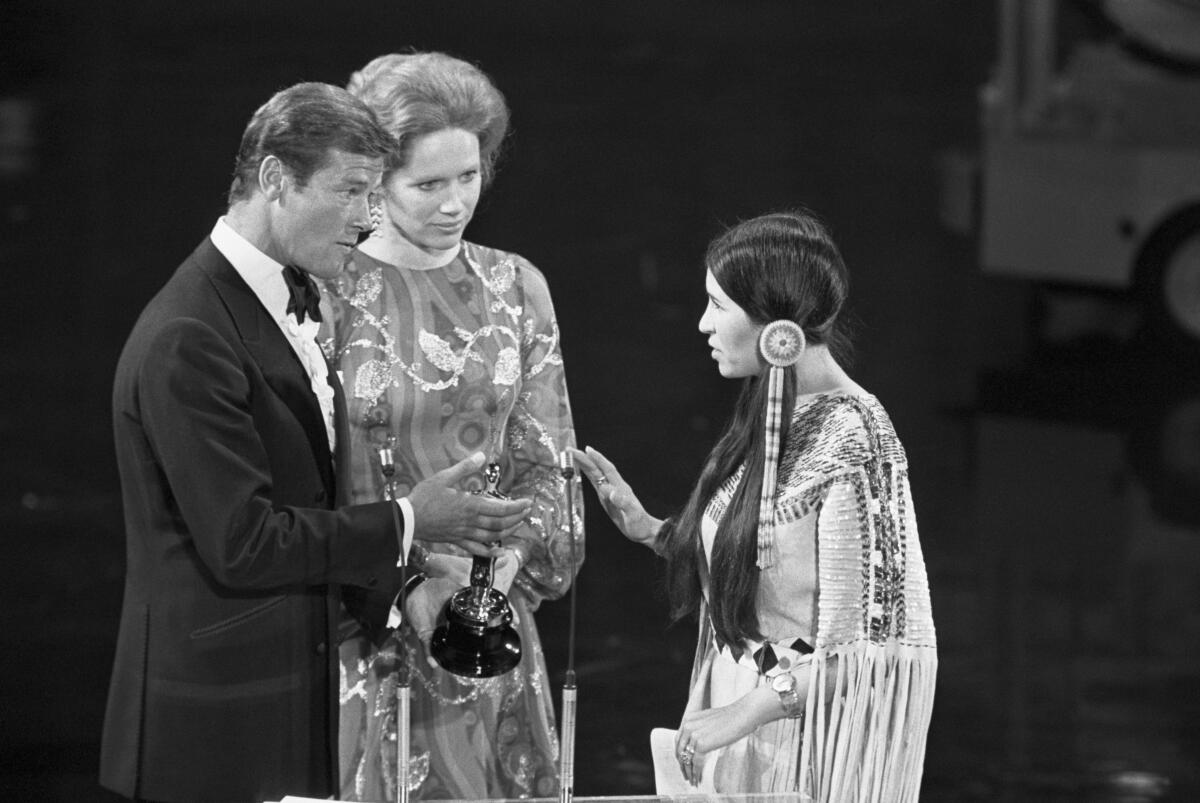
Sacheen Littlefeather refuses the lead actor Academy Award on behalf of Marlon Brando in 1973.
(Bettmann Archive)
A purely political speech, to my mind, directly calls out specific leaders, policies or crises, which may or may not have anything to do with the film being awarded. The most famous are, of course, Marlon Brando’s decision to send Sacheen Littlefeather to accept his Oscar for “The Godfather” and protest the treatment of Native Americans, and Vanessa Redgrave’s 1978 denunciation of “Zionist hoodlums” who were demonstrating against her involvement in a pro-Palestinian documentary even as she accepted for supporting actress in “Julia.”
In 1993, while many Oscars attendees wore red ribbons to honor those living with HIV/AIDS and call for government assistance, then-couple Susan Sarandon and Tim Robbins took it further, using their time as presenters to ask the U.S. government to allow HIV-positive Haitians being held at Guantanamo Bay to be let into the country. That same year, presenter Richard Gere used the fact that “1 billion people” were watching to send “sanity” to Chinese leader Deng Xiaoping in the hopes that he would allow the people of Tibet to “live free.” (Then-Oscars producer Gil Cates quickly denounced the three presenters; Gere did not return to the Oscars until 2013.)
A year after Moore blasted Bush over Iraq, Errol Morris, winning for “The Fog of War,” briefly compared the war in Iraq to the “rabbit hole” of Vietnam (which was the subject of his film). In 2015, “Boyhood” star Patricia Arquette used most of her supporting actress speech to demand equal wages for women. That same year, “Birdman” director Alejandro G. Iñárritu dedicated his award to his fellow Mexicans, with the hope that they would be treated by Americans “with dignity and respect” so that together, they could build a “great immigrant nation.” (Which frankly plays more purely political now than it did at the time.) A year later, Leonardo DiCaprio spoke about climate change after winning for “The Revenant.”
In 2019, Spike Lee, accepting for adapted screenplay (“BlacKkKlansman”), called on voters in the upcoming election to mobilize and “be on the right side of history” and in 2024, “Zone of Interest” director Jonathan Glazer, accepting for international film, riled many by comparing the dehumanization required for the Holocaust to occur with events in Gaza.
Even now, the most notable examples of political speeches, the ones that are always mentioned, are from the freaking ‘70s. Which certainly obliterates the idea that the Oscars have grown more political and undermines the argument that it is a Big Problem.
Put these relatively few moments next to the endless hours of acceptance speeches that, with varying degrees of emotion, honor the art of movie-making and the legions that support those who are doing it (including God, parents, spouses, children, some random but heaven-sent teacher) and it’s difficult to see much “wokeness.”
The people who gather at the Oscars are storytellers, and many of the stories they tell deal with uncomfortable truths about our collective past, present and future (including best picture front-runners “One Battle After Another” and “Sinners”). Of course nominees and winners have opinions about politics, science, social issues, international conflict and those suffering without recourse or voice — that’s why they make movies. So if a few of them decide to skip thanking their manager or the studio head and say a few words about climate change or whatever current law/policy/presidential action they believe is making lives worse for a lot of people, that’s their choice. They just won an Oscar!
For those uncomfortable watching it, just use the 45 seconds to grab a snack and by the time you’re back, the host will be moaning about how long the show is and the next five winners will inevitably cry and smile; praise their fellow nominees; thank the producers; say something sweet about their cast, crew and mamas; before telling their kids they love them and it’s time to go to bed.
And that’s OK too.