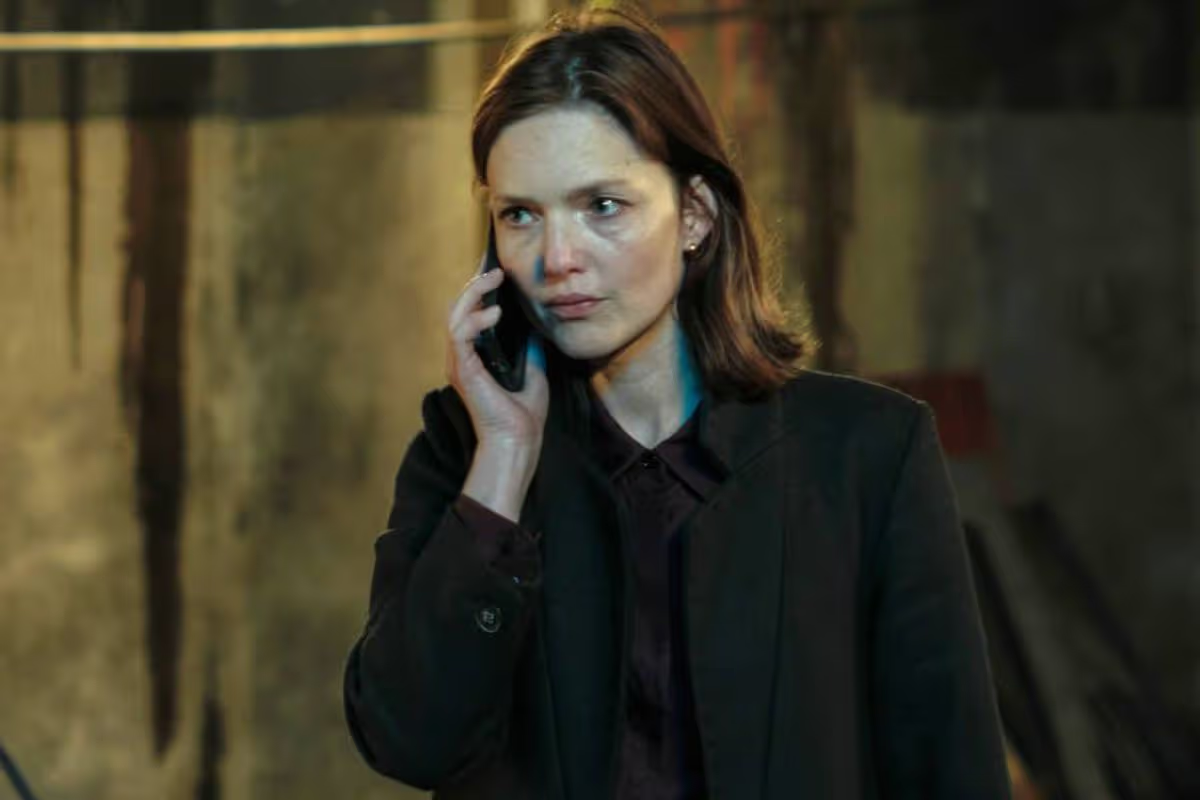
BBC The Capture’s long-awaited season three finale has almost arrived with fans already on tender hooks.
The Capture is available to watch on BBC One and BBC iPlayer. (Image: BBC)
The Capture season three is nearly over and the BBC has now confirmed what’s going to take its place next week.
BBC fans were shocked when the revelation around Simon’s true identity was discovered in last week’s episode of The Capture season three and are desperate to find out how it ends.
But with the grand finale airing tonight, Sunday, April 12, at 9pm, many have already turned their attention to what they will watch next week when it’s all over.
The BBC has since announced that The Capture season three’s time slot on Sunday, April 19, is going to be taken over by a “powerful” royal special.
To mark what would have been Queen Elizabeth II’s 100th birthday, BBC One will be airing a one-off film that explores the life and legacy of the country’s longest-reigning monarch.
Queen Elizabeth II: Her Story, Our Country won’t be one to miss as it is going to feature “powerful” old and new interviews with global icons including Dame Helen Mirren, Barack Obama, Sir David Attenborough and her daughter-in-law, HM Queen Camilla.
Describing what else to expect, its official synopsis reads: “Spanning an era that saw the nation move from the age of Empire to the rise of celebrity culture — from the Blitz to the 2012 London Olympics — Queen Elizabeth II lived through extraordinary change.
“More than a witness to history, she became an enduring symbol of continuity in a rapidly evolving world.
“Through the prism of her life, the documentary tells the story of modern Britain in a richly historical and emotionally resonant exploration of both The Queen and the people she served.”
Queen Elizabeth II: Her Story, Our Country won’t be the only way the BBC will be marking what would have been the late Queen’s centenary year either.
Ahead of the one-off special airing, BBC One will be showing Antiques Roadshow : Royal Special at 8pm with Fiona Bruce visiting Windsor Castle for the episode.
She will be taking a closer look at some of the late Queen’s more cherished items, childhood clothes and her coronation gown.
Bruce is also going to be given access to a selection of Queen Elizabeth II’s clothes which are set to go on display in a special exhibition at the King’s Gallery at Buckingham Palace.
Queen Elizabeth II: Her Story, Our Country airs on Sunday, April 19, at 9pm on BBC One.
Wrexham came agonisingly close to earning a shock win over the Saints on the opening day of the campaign.
Josh Windass opened the scoring from the penalty spot for the visitors at St Mary’s Stadium but last-gasp goals from Ryan Manning and Jack Stephens earned the hosts victory.
Despite that triumph, the Saints struggled under Will Still and parted company with the head coach in early November.
They have drastically improved under German boss Eckert, winning nine of their past 12 league fixtures.
But Lewis O’Brien, who netted his side’s second goal at West Brom last time out, feels Wrexham’s improvement since the first fixture between the sides is evident.
“We were a pretty new team. There were a lot of signings and we were trying to understand how everyone played,” the midfielder said of the August contest.
“We’ve now got three games at home and three away and hopefully we can pick up as many points as we can.”
Weekly insights and analysis on the latest developments in military technology, strategy, and foreign policy.
The rescue of the F-15E weapon systems officer (WSO) missing in Iran after his fighter was shot down was one of the most complex and dangerous missions the U.S. military can undertake. These kinds of operations can come in many forms. In this case, before the WSO was finally recovered from the mountain crevice where he was hiding, a forward arming and refueling point (FARP) deep inside enemy territory had to be rapidly set up and secured so that it could act as a staging area for the aircraft, equipment and troops taking part in the mission. This is an exact mission set U.S. special operations forces train for extensively.
To get more insights about how such a FARP would be set up and operated, we reached out to Kyle Rempfer, a former Special Tactics Squadron (STS) airman who served in Afghanistan and Iraq. STS units are an elite cadre of operators who work to control aircraft in the air, including from airfields they establish deep inside contested territory, and direct airpower onto the enemy, among other duties, including rescuing personnel trapped behind enemy lines. They are often paired with special operations units, such as SEALs, Delta Force and Rangers, to bring their unique skills to their missions.
Air Force Special Tactics – the Air Force’s ONLY Special Operations Ground Force
Rempfer, a journalist and former colleague of the author at Military Times, offered unique insights into the process as someone who trained for these missions.
Some of the questions and answers have been lightly edited for clarity.
Q: What happens in the Special Tactics Squadron level when the word comes out that there’s an aircraft down deep into enemy territory?
A: By this point in the campaign, Air Force Special Tactics teams – which are made up of combat controllers (CCTs) and pararescue jumpers (PJs) – would have surveyed or identified scores of Iranian runways and austere airfields that can be used for landing zones or drop zones down the line. Even if CCTs hadn’t set foot on these sites, they’d have pulled imagery of the locations and started using tools like AutoCAD, a surveying and mapping software, to sketch out the dimensions of an airfield and identify what type of aircraft could land there. Is this a site that could only work for a light short take off and landing (STOL) aircraft, or could we land something bigger like a C-17? Those types of questions are on their minds. And since this event appears to have happened near the Isfahan nuclear facility, it can be assumed that Special Tactics has been scoping out landing zones in that area since at least this war started, maybe far earlier.
Kyle Rempfer in Paktika Province, Afghanistan. (Courtesy photo)
For this mission, the Special Tactics team just needed someplace to land a couple of MC-130J Commando IIs. Those are designed to infiltrate and exfiltrate special operations troops into and out of the hinterlands, so an agricultural runway intended for crop-spraying planes would fit the bill in terms of dimensions. But on the ground, the soil strength might not hold up for repeat landings, or perhaps the recent weather has eroded the area or left it muddy. That can have an impact, and there are tools like dynamic cone penetrometers that Special Tactics teams use to assess soil strength. They’ve used those and a host of other tools to scout airfields all around potential conflict zones in Africa, northern Iraq, Syria, etc., but given the tight security in Iran, that probably was not feasible to do in advance here. So the soil strength might have been a known-unknown going in.
Q: What would happen once the FARP is set up?
A: They can do these fast. Everything is prestaged, even inside the MC-130. AH-6 Little Bird helicopters were probably offloaded and taking off within minutes, not hours, and beaming toward the WSO’s beacon. At that point, the team at the FARP site is pulling security and talking to all the aircraft overhead. Those pilots and aircrews are using sensors to monitor all the roadways that plausibly lead to the site, and potentially even putting warheads on those roadways to make them unusable. We know there were some diversionary bomb drops as part of the rescue, so they could also take that time to put big potholes in the roads.
Airbus satellite images show major road damage in Iran’s Isfahan near where U.S. forces conducted a rescue mission Sunday to recover a crew member from a downed F-15E.
Q: Can you talk about what systems, personnel and equipment would have secured the site?
A: The people who are surveying and setting up the landing zone and FARP are probably CCTs [Combat Control Teams] from the 24th Special Tactics Squadron. They would have had imagery to look at ahead of the mission, but you might not know what level of stress the ground can take until you physically get there. CCTs are trained to inspect that, blow up obstacles on the runway if needed, scan enemy activity around the landing site, etc., and then set up the austere airfield to start accepting planes and helos. They might not have had time to do a full-on reconnaissance mission, of course.
CCTs have dirt bikes, something like a Kawasaki KLR 250, that they can drive up and down the airstrip for quickly setting up lights and visually inspecting the terrain. The lights they’d use to create the airstrip would be set up to infrared mode so only people with night vision devices can see them. This isn’t the early days of Afghanistan, though, and night vision devices have proliferated to such a degree that infrared lights are no longer the game changer they once were. However, it still prevents civilians from seeing the operation at night, and that is important given reports that Iranian state media was mobilizing the population to look for the downed airman.
A 320 STS combat controller waits for the location point of a role player in Exercise Teak Knife on Camp Humphreys, South Korea, Sept. 13, 2021. Utilizing various equipment and resources helped these special operators to hone a range of unique skills during the exercise to maximize unit readiness. (U.S. Air Force Photo by Capt. Kim Chatto) Capt. Kimberly Chatto
Q: Who would be brought in for force protection?
A: The CCTs of course are not alone at the landing zone. They had DEVGRU (SEAL Team 6) for security and dozens of aircraft backing them up with an absolutely jarring amount of aerial firepower. CCTs are usually also certified JTACs so they can manage the aircraft stacks not just for landing the MC-130s and AH-6s returning from the WSO rescue, but also the dozens of aircraft overhead that can fire at targets as necessary.
Q: Reports indicate that the WSO climbed up a 7,000 foot crevice and hid out there with intermittent communications while the Iranians were looking for him. How does that complicate things? And what would the team on the ground be doing?
A: I imagine that all the communications would have been encrypted – not anything that the Iranians could listen in on. For the guys on the ground, the biggest situation is monitoring to make sure that other forces aren’t approaching the area and protecting that forward arming and refueling site, because while it’s not a base, for all intensive purposes it is the center of mass of the most U.S. forces, the safest zone you have. So basically probably just protected that site.
A Latvian Special Operations Unit Joint Terminal Attack Controller (JTAC) and U.S. Air Force Special Forces Combat Controller guide an incoming MC-130J Commando II assigned with the 352nd Special Operations Wing as part of a bilateral exercise in Riga, Latvia October, 25 2021. The aircraft was transporting a platoon in charge of the Wisconsin Army National Guard’s High Mobility Artillery Rocket System (HIMARS) demonstrating the rapid, ready response capabilities that special operations enable for conventional forces in austere environments. (U.S. Army Photo by Sgt. Patrik Orcutt) Warrant Officer Patrik Orcutt
Q: What would be happening in the air?
A: You would have ISR assets that would be scanning the area, and not just the immediate area, but probably any roads and highways leading up to where that FARP site was set up. They would be watching anyone who could possibly be approaching.
That whole area would just be soaked with ISR assets, and I know the Iranians knocked out two Reaper drones during the operation. So presumably, there was plenty of ISR.
There would be a mix of attack and surveillance aircraft. There would be dozens of aircraft available for this mission. That is great for the team on the ground, but just like an air traffic control tower at Ronald Reagan Airport in DC can be overburdened, so will the JTAC who’s on the ground controlling all these different pilots and aircrews calling in to report threats they’ve spotted, relay their fuel or munitions status, report radio chatter they’re picking up from the ground, etc. This could require multiple JTACs on the ground, and probably also pilots in A-10s or F-35s who can act as an extra layer of forward air control in the sky, handling aircraft check-ins and keeping track of specific assets so the JTACs on the ground aren’t losing their minds mind handling a massive air stack behind enemy lines.
Most CCTs also have a JTAC certification, so they can help call in airstrikes as needed to protect the FARP site. And attack aircraft, like A-10s, or multi-role fighters, like F-35s, also have pilots who are certified as Forward Air Controller (Airborne) — or FAC(A). The E-3 can also provide a command and control function to help manage this complex battlespace.
A U.S. Air Force F-35A Lightning II in support of Operation Epic Fury, March 2, 2026. (U.S. Air Force Photo) U.S. Central Command Public Affa
Q: How difficult is a mission like this? What are the dangers?
A: This would have been a hot refueling site, with engines running refueling, and you’re doing all that blacked out, and you have to probably keep the amount of radio chatter on the ground to a minimum because you don’t know if maybe Iran does have something where they can break through the encryption.
So I would imagine that the danger is even more than just the IRGC coming in and shooting at you. The danger is the technicalities that you’re dealing with, with the forward arming and refueling sites and all these aircraft moving around under night vision in blacked out conditions in a tight area. It’s a small airfield, you have to keep your signature low.
A U.S. Airman assigned to 21st Special Tactics Squadron, 24th Special Operations Wing, Air Force Special Operations Command, guides a UH-1Y Venom during an assault basics exercise during Weapons and Tactics Instructor course 1-26 at K-9 Village, Yuma Proving Grounds, Arizona, Oct. 4, 2025. (U.S. Marine Corps photo by Lance Cpl. Christopher J. Castro) Lance Cpl. Christopher Castro
Thankfully, they were able to get more aircraft in to usher everyone out. But that just shows how even what they were dealing with, the runway probably wasn’t built to handle these kinds of aircraft, or not maintained.
Clearly this kind of operation – where you’re coming in, setting up an airfield, whether it’s for a follow-on parachute jump or even just air landing more troops and supplies – would be repeated in most of the other scenarios people are talking about. For instance, going in and digging out Iran’s enriched uranium. I think it would have to be pretty similar. You would send in a special tactics team with some Ranger recce guys, and the Ranger reconnaissance company would maybe parachute in, and check out the airfield, and they would start bringing in the MC-130s. It’s going to be a remote, austere airfield. It’s not going to be easy to land aircraft there, it’s not going to be well maintained, and you’re going to run into a lot of problems on the ground with aircraft.
In addition to the fixed-wing planes, the U.S. also destroyed a reported four Little Birds on the way out. Imagine if you’re trying to do sustained operations bringing aircraft in, that all those aircraft are wearing down that obscure runway as you’re coming in, and you’re having more and more troops flow in. Your signature is going to be bigger and it’s going to be there for a longer time.
So this is how you create a window into a country to conduct follow-on operations. In this case, it was just to look for one guy and pick him up. But, they’re obviously looking at runways and airfields all across the country, whether they’re actual runways that are in use by the Iranian government or municipal governments, or if they’re just like roads that they can use or dirt fields that they think they can land on. So this rescue mission was probably a snapshot into larger operational planning.
Here we see a destroyed Little Bird on the right, with the hulk of a C-130 to the left. (Via X)
Q: After the rescue of the pilot, the search for the WSO seemed to turn fairly quickly from a traditional PJ mission to a Tier One rescue operation. Can you talk about that transition and how those two fit together?
A: That’s right. From my understanding, there were two missions. The first was a traditional CSAR mission that was launched in daylight immediately after the F-15E went down. This likely involved the PJs from a rescue squadron that was on standby. They were aboard HH-60W Jolly Greens and had refueling support from an HC-130J. That mission is obviously very risky and time sensitive. They’re flying low and slow, in daylight, and vulnerable to ground fire. We saw people shooting at them with small arms, which probably won’t do much barring really lucky shots, but the crews are still exposed to man portable air defense systems (MANPADS).
You can see Iranians firing small arms at the CSAR aircraft in the following video.
This initial CSAR package successfully recovered the F-15E pilot, who would have had a beacon and survival radio. But obviously the WSO was still at large. Perhaps they knew his location but couldn’t get to him before the region came alive like a bees’ nest – with everyone from locals to actual security forces scouring the scene. At that point, it appears the mission shifted from a more traditional CSAR operation conducted by a rescue squadron to something we’re actually more familiar with from Afghanistan and Iraq – Tier One raids into denied territory. This makes sense to me because this was the single most important mission going on, and it makes sense to flood this with assets to successfully pull off a second pick up. In a bigger war, I doubt downed aircrew can expect JSOC rescue parties every time one of them goes down.
A lot of people were surprised that MC-130s and AH-6s were used for this, but it actually reminds me a lot of the early Afghanistan missions Joint Special Operations Command (JSOC) conducted in fall 2001, before the Taliban fell. At least one of these involved Air Force Special Tactics CCTs parachuting into a remote part of Afghanistan, setting up a dirt airstrip, landing two MC-130s, off-loading a couple of Little Birds and then flying those around all night striking Taliban targets.
An AH-6 Little Bird is rolled off an MC-130. (DoW) Airman 1st Class Joseph Pick
This rescue raid isn’t too different. It sounds like Air Force Special Tactics CCTs surveyed the airfield in advance – maybe in person, maybe just using satellite imagery – and then brought in the MC-130s that held the AH-6s to actually conduct the rescue that grabbed the WSO. This sort of scheme makes sense given the distance inside Iran. The MC-130s can bring extra fuel and ammunition to set up a mini-special ops refueling and re-arming site.
One thing to note here is why the commandos reportedly blew up the MC-130s on the way out. If the government’s version of events is accurate, this might have been because the runway was not suitable for the MC-130s and those planes got stuck or damaged landing there. The CCTs may have known this was a possibility but determined it was the least bad option. There’s also the possibility the aircraft were more damaged by enemy fire than we’ve been told. We may never know.
An image taken at the airstrip showing burned-out wrecks of an MC-130 and Little Birds.
Q: What would be the biggest danger from the Iranians? Indirect fire like artillery? Drones?
A: Hard for me to say. If the team had the element of surprise, which it seemed to, then the Iranians would have been caught off guard enough that they didn’t have time to stage artillery or have drones already scanning the area. In that case, I could see the biggest threat being local police or civilians stumbling upon the site early in the mission. As the operation gets underway, the noise signature would probably attract more and more attention. And then you have IRGC teams speeding to the scene. If they’re moving fast, they might only have small arms, maybe some belt-fed machine guns, small caliber mortars, and potentially MANPADs. The longer the U.S. team was on the ground, the more time Iran had to rush forces to the scene and that’s when things appeared to get dicey, the Army’s Delta Force reportedly had to blow in place the MC-130s and call in a quick reaction force (QRF) for pickup.
Because people keep asking, the WSO was extracted on little birds flying STS and DEVGRU. Smoke checked 9 EKIA on tgt. The QRF that got called in for the FARP was from Delta. https://t.co/mmCbzrRjys
This is also why having so many aircraft overhead would be useful. Not only are those planes there to strike targets, they can listen to enemy communications and local civilian radio chatter, they can use their sensors to scan all the routes leading up to the airfield, and they can use jamming and spoofing to befuddle the Iranian response. All that helps buy time.
Q: What kinds of geospatial tools would have been used to find and prep the site and carry out the mission?
A: I imagine in advance of this mission the airfields and runways in this area were pre-scouted using satellite imagery. I’m probably too out of date to go into specifics even if I wanted to, but we have very high resolution satellite imagery that’s available in the commercial space and is very impressive. Additionally, aircraft can fly over sites and scan the terrain using LIDAR to build 3D maps of the environment. Suffice to say, the CCTs would have a great picture of the environment before going in, but being physically on the ground shows new problems — can the soil hold up to landing an MC-130? How fine is the sand? When the AH-6s take off, are they creating a brown-out environment?
U.S. Air Force Tech. Sgt. Jacob Logsdon, 66th Weapons Squadron (WPS) combat controller, communicates with pilots of a C-130J Super Hercules prior to takeoff from a dirt runway during a U.S. Air Force Weapons School mission at Red Devil Landing Zone, Colorado, Oct. 3, 2025. The 29th and 66th WPS conducted an airdrop and evacuation in high-altitude mountain conditions, challenging students to coordinate across air and ground elements and plan complex objective areas that support joint mission success. (U.S. Air Force photo by Airman 1st Class Jennifer Nesbitt) Airman 1st Class Jennifer Nesbitt
In an ideal scenario, the CCTs could parachute in before the main mission, conducting a high-altitude, high-opening (HAHO) jump and then confirming on the ground that the site will work to land an MC-130. We don’t know if that’s what happened, but if the reporting is accurate that an MC-130 got stuck and had to be blown up in place, then perhaps they made a mistake or – my bet – they knew the runway was rough and accepted the risk.
Bayern Munich are waiting on the fitness of “very special” Harry Kane to see if he can lead their challenge to overcome Real Madrid in the Champions League quarter-final.
The 32-year-old England captain took part in training in Munich on Monday morning, before travelling to Madrid with the rest of Bayern’s squad after the “minor issue” – believed to be an ankle knock – that kept him out of England’s friendly defeat against Japan at Wembley.
Kane was also missing for Bayern’s 3-2 victory against Freiburg, and coach Vincent Kompany was playing his cards close to his chest about his involvement at The Bernabeu.
Kompany said a final decision on whether Kane starts will be made on Tuesday, but speaking on Monday evening, he said: “Harry’s part of the team so that’s positive for us. We have to wait until tomorrow (Tuesday) to get the final information, then we will make our decision.
“It was important that he did a lot of training today (Monday). I don’t think he’s lost his rhythm.”
Kane is a key part of Bayern’s plans for the quarter-final first leg, having scored 10 goals in the Champions League this season. He is also the Bundesliga’s leading scorer with 31 this season.
Bayern team-mate Joshua Kimmich underlined Kane’s importance, as he said: “How many goals has he scored? How many assists does he have? Forty or 50 this season?
“This shows how important he is – apart from all the goals – extremely vital for our game.
“We are glad he is here with us. He is not only a poacher or a selfish goalscorer just trying to score as many goals as he can for us.
“He is an absolute leader who is always trying to have the maximum success for the team. This is a very special mindset for an attacking player. He’s a role model.”
Kimmich added: “It is important to have Harry on the pitch with us with all his qualities of leadership.”
Kompany fielded several questions on Kane’s fitness, saying: “Harry Kane knows how important this game is, but it is important to take a decision with each player.
“You keep asking about Harry Kane and to be honest I like it. I don’t mind but I don’t give you an answer.”
Slegers described an “unbelievable performance” in the second leg because of the fightback Arsenal knew Chelsea would give.
Goalkeeper Daphne van Domselaar returned to the starting XI and put in a stunning performance, denying Sam Kerr on several occasions in the second half.
England defender Lotte Wubben-Moy was a rock at the back in the absence of Leah Williamson and Arsenal were not shaken when fellow centre-half Steph Catley went off with a calf injury at the end of the first half.
In-form striker Alessia Russo was full of tricks and flicks. The England international usually keeps touches on the ball to a minimum but she did what it took to escape tricky situations when pressure was building.
Slegers said her team were prepared to “suffer” in order to get what they wanted and it paid off in the end.
“It’s suffering for something you love. I think that’s what the team did really well. They were prepared for a difficult scenario and for momentum shifts,” she added.
“In the first 15 minutes, potentially at the end of the game when things changed again, they just stayed in the ‘controlled middle’, as we call it.
“They stayed in the game and were constantly in control of whatever scenario or momentum swing. They did their job. Mentally we were in control.
“Of course, we wanted to stop them getting chances and in an ideal world there are no shots but it was two really good teams going against each other.”
Former England captain Steph Houghton said Arsenal were “better in big moments” and deserved to progress on the balance of the tie.
Brighton forward Fran Kirby added: “Arsenal allowed Chelsea to have the ball, they were comfortable in their block and defensively worked really hard.
“With the opportunities that they had, they could even have gone on and won the game, so they will be really proud of the performance.
“It showed a different side to Arsenal. It showed what they can do when they have to defend.”
Arsenal will hope to book their place in the final when they take on the winner between Lyon and Wolfsburg – who play each other on Thursday night.
Call The Midwife bosses will replace the much loved festive episode with a prequel show of the historical BBC drama series as it attempts a ‘temporary pause’
Call The Midwife bosses remove the BBC show from the Christmas TV schedule(Image: BBC)
Call The Midwife bosses have decided to shake up the Christmas schedule by removing the much loved historical drama from the winter TV schedule. Now, viewers will be treated to a prequel episode titled Sisters In Arms which is said to be replacing the coveted prime time slot.
The prequel is set in the period of World War II and it seems it will feature the younger versions of the older characters, who have become fan favourites. The characters may include Fred Buckle, Dr Turner, Sister Julienne, Sister Evangelina and Sister Monica Joan.
It has been speculated that the prequel could also focus on Nurse Trixie Franklin’s story, who is played by the highly acclaimed actress Helen George. In the upcoming show, Helen George’s character will be played another actress reportedly in her teens or early twenties.
**Ensure our latest headlines always appear at the top of your Google Search by making us a Preferred Source. **Click here to activate** or add us as your Preferred Source in your Google search settings.**
The show creator and writer Heidi Thomas confirmed plans of the shake-up, according to The Sun. She previously said: “No, there won’t be a Christmas special this Christmas, not in the traditional mould.” She added: “This is really just a very temporary pause in the usual pattern.”
Showrunner Heidi previously explained: “The opening of new doors at Nonnatus House feels profoundly emotional, and yet just right. I have never run out of stories for our midwives, and I never will.”
She added: “But having wept, laughed, and raged my way from 1957 to 1971, I found myself yearning to delve into the deeper past. The Blitz years in the East End were extraordinary – filled with loss, togetherness, courage and joy.”
Heidi continued: “The bombs fell, the babies kept on coming, and the Sisters kept on going. There will be so much in the prequel for our wonderful, loyal fans, including the appearance of some familiar (if much younger!) faces.
Series 15 of the show took viewers on an emotional journey as Sister Monica Joan died. The character was played by Judy Parfitt since the show first aired in 2012. The plot follows the lives of a group of nurses and midwives in East London, who made it their mission to care for the people of the East End.
Not only is there a prequel to be aired later this year but the hit show will also become a film, set overseas in 1972. However, a release date for the movie has not yet been confirmed.
Speaking to the Radio Times, Heidi said the film is about “strong women above all else.” She then admitted: “Everything changes and nothing changes,” she observed, recognising its connections to the most recent series.”
Ranting about the decline of comedy specials while releasing a new one at the same time feels a bit like an oxymoron. But somehow it still makes sense coming from alt-comedy pioneer David Cross, who isn’t just complaining; he’s finding his own route to making specials feel special again. The only way to do that is by putting one out in the manner he’d like to see more often — starting by making the whole crowd stand up too.
Capturing the energy of a concert at the famous 40 Watt Club in Athens, Ga., was the first step in differentiating “The End of the Beginning of the End” from the typical hour you watch on a big streamer. And, with this new special, Cross is able to get back to his own beginnings of touring across the country with love bands as his openers, performing for crowds for as long as he could until he had to run offstage to pee.
Premiering the special earlier this month on his website (and on April 7, it will be available on YouTube via production company 800 Pound Gorilla), Cross is hoping the special connects with comedy fans in a way that we’ve forgotten specials could.
This interview has been edited for length and clarity
Your new special is called “The End of the Beginning of the End.” What does that title mean to you as it relates to the impending doom of what we’re all living right now.
David Cross: Well, you can look at it in a couple different ways. To me, it signifies that the beginning of the end has occurred. And we are now at the end of the beginning of the end. And from where you go with that, that’s for you to decide.
One of the things I love about the special is the fact that you shoot it at a club in the style of a live–music concert.
I’ve shot specials in theaters and it’s just different, not that one is better than the other, but they’re just different. You have a different relationship with the audience. When I first started touring, I would go to music venues and I’d have a band open for me and then I would just go up and pretty much [perform] as long as I could until I had to pee. Sometimes I’d have a band playing, sometimes two bands, then I’d go out. And I did that a couple of times, and then stopped doing that and did theaters, and I decided for the last two specials I’m going to go to, when I shoot it, I’ll go to a music venue, and I was at the 40 Watt Club in Athens this last time, I was at the Metro in Chicago before that, both places I played on earlier tours, and, you know, it’s not seated. People are standing there at the stage, and I prefer it. It’s more fun. It’s not as lucrative but, to me, a more fun show to do.
Comedian David Cross
(Jason Armond / Los Angeles Times)
The ambience of it was great.You can hear people shouting and drinking and having a good time, and the crowd work is also a little more spontaneous and fun than it would be in a regular venue.
Yeah, well, there’s more opportunity for that. But my thing has never been about crowd work. I like engaging with it, it’s kind of a nice distraction from the set that you’ve been doing 100 times, 150 times at that point. So it’s always fun to have that thing happen and that feeling of spontaneity. And like the guy [who I talk to in the crowd during the special], I could not have asked for [someone better]. I mean, even if it was scripted, it wouldn’t have been as good. The guy who [I talk to] during the stuff about hiking Machu Picchu [with Bob Odenkirk], that’s just… [chef’s kiss].
Speaking of Bob Odenkirk, you guys have this long relationship. How would you describe the dynamic of working with Bob and just how you guys bounce ideas off each other?
I mean, it’s great. We have an inordinate amount of respect for each other, both as people and as creative partners. And so there’s never any real issues. There’s things we will definitely disagree with, but we’re both decent people. So you know somebody backs off and says, “OK, let’s do it that way.” But even then, there aren’t that many of those [issues]. We just have really worked well at building something or molding it, creating it and shaping it. And our aforementioned hike to Machu Picchu, we have a documentary about that, that will be premiering at a fancy festival at some point in the near-future. And so we got that doc and we’ve been working on that. And for the way we work now, because he lives in L.A. and I live in New York, and it’s been like that for a while, he’ll write a bunch of stuff, I’ll make notes, I’ll write my things, send it back. And so we’re able to do that and not necessarily have to be in the same room because we’ve had 30-plus years of working with each other.
It’s a kind of like an unspoken language you guys probably have in terms of comedy, which is super important, I imagine, just for collaborating.
Yeah, and it’s something we discovered very early on … before there was even “Mr. Show,” what would ultimately become “Mr. Show,” when we got together to write sketches for this bigger kind of comedy collective thing, and these shows that we would all do with each other, for each other, and the stuff that we would write together was just, like, really good, easy writing — again, one person adding this thing and one person saying here’s a switch yeah and another person adding this thing in. It was fun, it’s cool, still is. One thing he doesn’t get credit for is he’s a really decent human being. And with all the awfulness in the world that’s magnified, every sense is bombarded with it — it’s just good to be hanging with somebody whose energy is a good person, a decent person and an equitable, nice guy, so that’s good as well.
Comedian David Cross poses for a portrait ahead of his comedy special “The End of the Beginning of the End.”
(Jason Armond / Los Angeles Times)
One thing you guys also have in common is you both have kids, and he has a comedy show for kids called “The Appropriate Show.” Have you taken your daughter to see it?
It’s a sketch show [in which] all the sketches are appropriate for kids to watch. And the sketches have been done in other sketch shows onstage, live. And he puts together this thing once, twice a year here in L.A. And I took my daughter to it last year. It’s just sketches that kids can [understand]. At least if they don’t understand the actual references they get the archetype. “Oh, that’s the boss, that’s that uh… And it’s great, it’s a really cool idea uh… “ And would an ass— think of [a show like] that? No, one good decent person; a good man. But listen, this interview isn’t about me, it’s about Bob Odenkirk, so let’s get back to that.
Well, speaking of having comedy geared toward kids, your daughter’s at an age where she’s probably consumed or seen some of your comedy at this point.
Not, not really. No, no.
Do you shield her from your stuff, or are you not so concerned about it?
I don’t actively shield her, but I don’t introduce her to anything. So I was a little bummed out, and I got over it pretty quickly, but when I found out that she had seen a little bit of “Alvin and the Chipmunks,” and only because I don’t want to spoil the enjoyment of what movies are and what kids’ movies are and how things work. And I feel like that would introduce an element of reality that I want her to be able to just enjoy these things without — she’s seen “Kung Fu Panda”when she was younger, like, I don’t know, three, four, five times, has no idea that I’m in that, that my voice is in there. She knows I do stand-up, she gets that now. And when she was younger, she’d say, “Daddy’s silly for a living.” … I’m just trying to ride the balance of letting her have those childhood joys and experiences.
Comedian David Cross.
(Jason Armond / Los Angeles Times)
Does having a kid make you think about what’s coming up in the future of comedy, or what kids are gonna maybe find funny, or what they find funny now? Do you have any thoughts on kid comedy in general?
Not really. I mean, I can see that she and her friends, who are kind of like-minded, are naturally funny, and then that’s kind of encouraging and heartwarming and they’re silly, but I’ll be long gone when that generation is is providing comedy. And I’m still, although I’ve kind of given up, I’m still trying to grasp what works now. I mean, it’s short-term TikTok, Instagram stuff. There are some amazing, like really, really great things being done as far as film sketches for YouTube channels. “Almost Friday,” they’ve got genius-level stuff. I mean, really good. And where the sketch goes in a place, you’re never ahead of it, goes in a place where you’re not expecting. It’s really well written and well performed.
What are your thoughts on what a comedy special is nowadays or what it should be?
I mean, that’s a great question. I think anybody who plays with the form, whether I think it’s that funny or not, is different. But I’m happy when anybody kind of tries at least to play with a form. I just went to Rory Scovel‘s taping last week of his latest special. I don’t know when that’ll air, but if you’ve seen the beginning to his first special, stuff like that where you’re like, “Wait, what’s happening? What’s going on?” I love stuff like that.
I still get excited to watch specials by some of my favorite comics, but there’s a quality that’s missing. And these are stand-ups I love, and they’re not that great. They’re not bad but they’re not special, you know? And all those guys I mentioned, and more, have great specials. Like, you can go back and they’re great. And I don’t know why that is. I mean, there’s still funny stuff, but I don’t ever want to get to that place where its just feels a little phoned-in a little bit… that is, in part, why the last two specials were shot in this more intimate setting that feels special. And … as I said, the energy’s different, it’s a little bit different, and it’s less slick. It feels like you’re in the moment. You don’t need a million dollars to shoot a special. You don’t 28 camera angles, it‘s just bull—. And it takes something away.
Comedian David Cross
(Jason Armond / Los Angeles Times)
It all should feel the right amount of unsafe as well, I think.
That’s never gonna happen at a theater show. You’re never gonna feel that. And I don’t know, it really does feel almost like maybe we peaked in a sense, like there’s too much, and because of that, these things aren’t special. They’re not revelatory, they’re not unique. I dunno, can 18,000 people in an arena really relate to a … billionaire talking about how they’re gonna get canceled. I mean, is that a thing I guess? Those other big, slick specials that are shot in, like, a 3,200-seat, 3,500-seat theater, it just feels like, “Oh this person is up there and I’m listening to their jokes.” There’s nothing wrong with that. They’re often very funny jokes, but it doesn’t go beyond that. It’s just like, “All right, tell me your joke.” It might as well be an audio thing, you know?
Well, hopefully the robots aren’t coming for your job anytime soon.
Absolutely not. I mean, this could be naive, but I feel 100% safe that you are never going to replicate an evening of stand-up at a nigtclub like that. And not sitting down at tables while you’re having drinks and waitresses are coming by. I’m talking about everybody’s up on the stage, sold-out, maximum capacity; everybody’s there, focused, we’re all sharing that thing. You can’t. AI’s not going to be able to do that.
Yeah, the robots can’t do that, Terminator can’t do that..
Oh, I forgot about Terminator. He could do that. G— it.
March 23 (UPI) — A sheriff in Riverside, Calif., has seized more than 650,000 ballots from a 2025 state election that allowed the state to redistrict to gain five congressional seats.
Sheriff Chad Bianco, who is running for California governor, said Friday that he is investigating allegations by an activist group that alleged the reported tallies don’t match the ballots.
“This investigation is simple,” he said at a press conference. “Physically count the ballots and compare that result with the total votes reported.”
The election Bianco is investigating is the special election for Proposition 50, asking voters for endorsement to redraw the congressional districts in response to other Republican-led states, like Texas, redrawing their districts to pick up seats.
Californians voted to redistrict, and it was not a close election: 7.4 million in favor to 4.1 million.
A group called Riverside Election Integrity Team called for the investigation saying its examination of records shows about 45,000 more ballots were counted than received, Bianco said.
Local election officials said those allegations were based on a misunderstanding of how ballots are officially counted, the Palm Springs Desert Sun reported.
“County election staff follow detailed procedures established by state and federal law to protect the integrity of the vote and to ensure that every eligible ballot is processed and counted in accordance with those legal requirements,” Riverside County Executive Officer Jeff Van Wagenen said in a statement.
Bianco seized the ballots with two warrants signed by a judge. California Attorney General Rob Bonta sent Bianco a letter March 6 alleging, “my office has serious concerns as to whether probable cause existed to support the issuance of the warrants and whether your office presented the magistrate with all material evidence as required by law.”
Bonta also alleged that Bianco’s office is not qualified to count ballots and the investigation “sets a dangerous precedent and will only sow distrust in our elections.”
Bianco replied: “A judge approved the warrant, so Bonta’s opinion means absolutely nothing.”
Bianco also said Friday that he would give the investigation to a judge-appointed special master.
Democrats and Republicans in the state have said the investigation is baseless.
“It looks to me like it’s a politically motivated effort,” Jon Fleischman, former executive director of the California Republican Party, told The New York Times. “It’s awfully coincidental that he would be taking this high-profile and extreme of an action literally two months before he’s facing a statewide election.”
California Secretary of State Shirley Weber, a Democrat, said Bianco’s claims are not supported by the evidence.
“The Riverside County Sheriff’s Office has taken actions based on allegations that lack credible evidence and risk undermining public confidence in our elections,” Weber said in a statement on Friday.
“Investigations into election processes must be conducted by those with the appropriate legal authority and subject matter expertise. Similar claims raised in other states by individuals without election administration experience have been thoroughly reviewed and debunked.”
Antonio Villaraigosa, a Democrat running for governor, said Bianco is trying to gain national exposure.
“What we’re seeing from Chad Bianco is a dangerous abuse of power and no different from what we’re seeing from Donald Trump and the extreme Republican efforts to disenfranchise voters nationally,” Villaraigosa said in a statement.
“Seizing hundreds of thousands of ballots without credible evidence is an attack on the very foundation of our democracy. If you’re willing to undermine free and fair elections for MAGA stardom, you have no business holding public office.”