Sixty-nine years ago this day, the Soviet Union launched Sputnik 1, the first satellite to orbit Earth, opening the Space Age and setting off a race with the United States.
Ten years later, on October 10, 1967, the Outer Space Treaty came into force.
Recommended Stories
list of 3 itemsend of list
In 1999, the United Nations started observing World Space Week – from October 4 to 10 – to celebrate the contribution of space technology for the benefit of humanity. Schools, space agencies, museums and astronomy clubs around the world hold stargazing nights, science classes, exhibitions and talks by astronauts and scientists.
Today, more than 80 countries have put satellites into orbit, and people from over 50 of those have travelled to space.
In this visual explainer, Al Jazeera looks at which countries have done so, how many space travellers have been women, and what comes next for human spaceflight.
The first man in space – Yuri Gagarin
On April 12, 1961, Soviet astronaut Yuri Gagarin became the first human in space.
On board the Vostok 1 spacecraft, he completed one orbit of Earth at about 27,400km/h (17,025mph) during a 108-minute flight. He later ejected from the spacecraft and landed by parachute.
The mission demonstrated that humans could survive launch, weightlessness and re-entry, giving the Soviet Union a major early victory in the Cold War Space Race.
Yuri Gagarin, the world’s first spaceman [File: Getty Images]
Six years later, on October 10, 1967, the Outer Space Treaty entered into force. Signed by the US, the United Kingdom and the Soviet Union, it established that space should be explored and used peacefully and that no country could claim it as territory.
Less than two years later, NASA’s Apollo 11 mission landed the first humans on the moon. On July 20, 1969, Neil Armstrong became the first person to walk on its surface.
Astronaut Neil Armstrong, in training for the projected Apollo 11 lunar landing mission, is being suited up for the first full dress rehearsal of activities he is to perform during the projected moon landing [File: Getty Images]
Where does space begin?
There is no single agreed boundary for where space begins: most international bodies use the Karman line, 100km (62 miles) above Earth, while the US military, NASA and the Federal Aviation Administration count anyone who flies above 80km (50 miles).
Either way, it is closer than it sounds: if Earth were the size of an apple, space would begin about as far from the surface as the thickness of its skin.
Which countries have sent people to space?
By the Karman line measure, at least 746 people from 52 countries have travelled to space, including professional astronauts and paying tourists.
Some hold dual nationality, and some flew for countries that no longer exist, such as the Soviet Union.
The graphic below breaks down space travellers by country.
Two countries still dominate the list. The US has sent 369 people to space, and the Soviet Union and Russia have sent 138 combined. China, the third country to launch people on its own rockets, has sent 29.
American astronaut Alan Bartlett Shepard Jr, commander of NASA’s Apollo 14 lunar landing mission at the Kennedy Space Center in Florida, on November 14, 1970 [Space Frontiers/Getty Images]
One in seven space travellers is a woman
Space remains a male-dominated frontier. Science fiction may be full of women commanding starships, but of the 746 people who have travelled to space, only 112, or 15 percent, have been women, about one in seven.
Soviet astronaut Valentina Tereshkova became the first woman to travel to space in June 1963. The US did not follow for another 20 years, until Sally Ride flew in June 1983.
The share of women is rising, though, largely because of commercial flights. More than half of the women who have flown since 2020 went up as paying passengers or guests on Blue Origin’s suborbital rocket.
Valentina Tereshkova, who became the first woman in space in 1963, at the Science Museum in London, March 15, 2017 [Leon Neal/Getty Images]
The typical space traveller is 40
Most people who have flown to space were in their 30s or 40s on their first flight, which together account for 85 percent. The median age is 40. Commercial flights have widened that range.
The youngest traveller, Oliver Daemen, was 18 when he flew in 2021. The oldest, Ed Dwight, was 90 years and eight months old when he flew in 2024, about two months older than William Shatner had been on his flight three years earlier.
What comes next for human spaceflight?
In April 2026, the Artemis II crew flew around the moon and reached about 406,771km (252,756 miles) from Earth, breaking the distance record set by Apollo 13 in 1970.
Next is Artemis III in 2027, a rehearsal in Earth orbit to test docking with lunar landers built by SpaceX and Blue Origin. NASA is targeting 2028 for Artemis IV, which aims to land astronauts near the moon’s south pole, the first crewed landing since 1972.
India plans its first crewed Gaganyaan flight in 2027, making it the fourth country to launch people on its own rocket. China aims to land astronauts on the moon around 2030.
Elon Musk’s SpaceX’s next-generation Starship rocket reached orbit for the first time despite an unexpected engine shutdown mid-flight on Monday. But it exploded in a ball of flames when it touched down in a controlled landing over the Pacific Ocean.
Accra, Ghana – The Africa Space Expo (ASPEX), which closed in Abidjan, Ivory Coast, last week, was not designed as a showcase for rockets and astronauts. Organisers presented it instead as a marketplace for space applications in food security, climate resilience, territorial monitoring, connectivity and maritime security, bringing start-ups, project labs and investors together to move ideas from demonstration to deployment.
The event also produced several concrete agreements. The Ivory Coast signed the Artemis Accords, becoming the 75th signatory of the agreement on space exploration and development, while Angola signed a letter of intent on space cooperation with the United Arab Emirates.
But beyond the agreements, the expo highlighted a question that is becoming harder to avoid: Can Africa move from using space technology to building more of it itself?
Ghana offers a clear illustration of both the progress and the gap.
Ghana’s ambitions in space and nuclear science date back to its early years of independence. In 1961, President Kwame Nkrumah’s government initiated a nuclear reactor project in Accra. Two years later, the government established the Ghana Atomic Energy Commission through an act of Parliament with a mandate covering the peaceful applications of nuclear energy.
The reactor project was shelved after Nkrumah was overthrown in 1966, but the institution he helped establish remains the parent body of the Ghana Space Science and Technology Institute (GSSTI).
Joseph Tandoh, director of the GSSTI, traces Ghana’s more recent space programme to a partnership with South Africa.
“Ghana became a partner through South Africa,” he told Al Jazeera. “Through that project, we were able to reconstruct the old satellite antenna at Kuntunse into a radio telescope.”
Through its partnership with South Africa on radio astronomy, Ghana converted a redundant 32-metre (105ft) antenna at Kuntunse into a functioning radio telescope. Ghana became the first of South Africa’s eight African Square Kilometre Array partner countries to complete the conversion, and the telescope was launched in August 2017.
Ghana’s National Space Policy was approved by the cabinet in 2022 and launched in 2024. The government approved the establishment of a Ghana Space Agency in 2025, beginning the process of creating a dedicated national institution for the sector.
The institutional framework is taking shape. The harder question is how Ghana moves from using space technology to developing and building more of it itself.
What Ghana is already doing
At the GSSTI, that transition is already under way.
Tandoh told Al Jazeera GEOMAIZE, a partnership between the GSSTI and VITO, the Flemish Institute for Technological Research in Belgium, has demonstrated how satellite data can be applied to Ghanaian agriculture.
The project monitored crop health and developed algorithms to classify crops. Ghana is also expanding its use of Earth observation data and artificial intelligence for crop monitoring and yield prediction.
A crop health monitoring app developed by Galaxy Aerospace Ghana to support food security [Handout/GSSTI/Galaxy Aerospace Ghana]
But predicting yields has proved more difficult. Tandoh said the model’s accuracy fell short of expectations, largely because many Ghanaian farmers practise smallholder mixed cropping and satellite soil-moisture data are too coarse to capture differences between small farms.
A follow-up project supported by the French embassy and international research partners, is now working to improve the estimates.
The GSSTI has also used satellite data to track forest loss linked to mining and is working with partners in Nigeria on a digital twin to simulate coastal erosion at Keta and Agavedzi. Japanese cooperation has provided technical training while the French government supported work on space legislation that produced a draft now being reviewed by the attorney general.
“We always say that Ghana Space Science and Technology Institute becoming an agency is to position Ghana in a way that we will not only be users of the technology but we will also contribute to designing, developing and building our own tools,” Tandoh said.
The funding wall
Victor Tagborloh founded Galaxy Aerospace Ghana in 2020. Two years later, his team launched a high-altitude balloon into near space, capturing images of Ghana’s geography with clearance from national security and airport authorities.
The company has since designed mini-rockets for the GSSTI, trained young people in space robotics and artificial intelligence and pushed for the introduction of Starlink in Ghana in 2024.
But Tagborloh said the company has yet to secure an investor, six years after it was founded.
Galaxy’s longer-term plans include a space university on 33,000 hectares (82,000 acres) that it has secured at Apam in Ghana’s Central Region as well as a ground station that would give the country greater capacity to monitor floods, mining activity and coastal erosion.
The company is seeking investors for the ground station and a geospatial intelligence platform. Tagborloh said the curriculum is ready and the land is available. What is missing is the capital to turn those plans into infrastructure.
He also argued that Ghana’s position near the equator could provide an advantage for launching spacecraft, potentially reducing the fuel required to reach orbit. Several other African countries share similar geography.
But Tagborloh’s ambition goes beyond launching rockets. He wants Ghana to develop more of the infrastructure and expertise needed to build its own space capabilities.
Who is building the industry?
Bright Atsu Sogbey, president of the Africa Development Council and a senior research engineer at the Ghana Atomic Energy Commission, argued that the private sector cannot build the industry alone.
“Borrowed technology cannot be sustainable,” Sogbey told Al Jazeera. “The state must be in the driver’s seat, using the natural resources we have to ensure that, in partnership with the private sector, we can have laboratories and manufacturing hubs for the space industry.”
He pointed to South Africa, Egypt and Nigeria, which have established space laboratories and manufactured test satellites. Ghana, he said, still lacks the state-backed laboratories and manufacturing hubs needed to produce more of its own components rather than importing them.
Ghana’s radio telescope is used for research and training [Handout/GSSTI]
“Enough of the talk shop,” Sogbey said. “The next expo should see African satellites assembled on this continent and launching capability for African satellites.”
Engineer Daniel Aboagye, CEO of African Progressive Research and Innovations, said the change must also begin in education.
“With how technology is advancing, Africa must introduce space science into its education systems,” Aboagye told Al Jazeera. “We cannot continue to be consumers of technology we do not understand.”
Kwadwo Dwomo II, CEO of COMCENT Ghana, works on agritech systems that depend on satellite data. He also called for greater government investment in the sector.
Ghana is home to a small cluster of companies, including Galaxy Aerospace, Xavier Space Solutions and Ayeji Aerospace, working in areas such as satellite technology, Earth observation and geospatial services.
Galaxy Aerospace confirmed to Al Jazeera that it was unable to participate in this year’s expo. The company said it hopes to participate in the next expo.
A continental project
The challenge facing Ghana is shared across much of Africa: moving from using space technology to developing and building more of it locally while overcoming limited investment, infrastructure and manufacturing capacity.
ASPEX was designed in part to address that gap.
The African Space Agency, headquartered in Egypt, is intended to provide a continental framework for cooperation while the expo aims to connect investors with African start-ups, researchers and space projects.
But the distance between the ambitions presented at the expo and the resources available to engineers trying to turn them into businesses remains substantial.
For Tandoh, Ghana’s immediate priority is to build the application layer: a satellite-data processing hub capable of serving ministries across government before the country moves further into designing and launching its own satellites.
“Space cuts across all the ministries,” he told Al Jazeera. “We should be able to build and validate our own tools first.”
For Tagborloh, the timeline is more urgent.
“We shouldn’t wait for tomorrow,” he told Al Jazeera. “Whatever decision we have to take, especially for human resource capital in the space industry, it has to be now.”
Ghana has the policy. It has engineers, research institutions and companies trying to build a space industry. What it does not yet have is the capital and manufacturing capacity to turn those capabilities into a domestic industry.
“We have the team, the knowledge, the research and the technical know-how,” Tagborloh told Al Jazeera. “We just need funds.”
Cape Canaveral Space Force Station is getting lasers that can zap drones intruding into its airspace. When installed, the new directed energy defense system will be part of a much larger effort to protect the spaceport against drone incursions, a spokesperson for Space Launch Delta 45 (SLD 45) told us.
The idea is to ensure the safety of launches and to keep prying eyes away from an installation full of secrets about America’s military and commercial space efforts. Companies like SpaceX, United Launch Alliance, Blue Origin and Relativity Space use the installation for space launches. The base defense modernization effort comes as the Cape Canaveral region is inundated with drone incursions. There were hundreds last year.
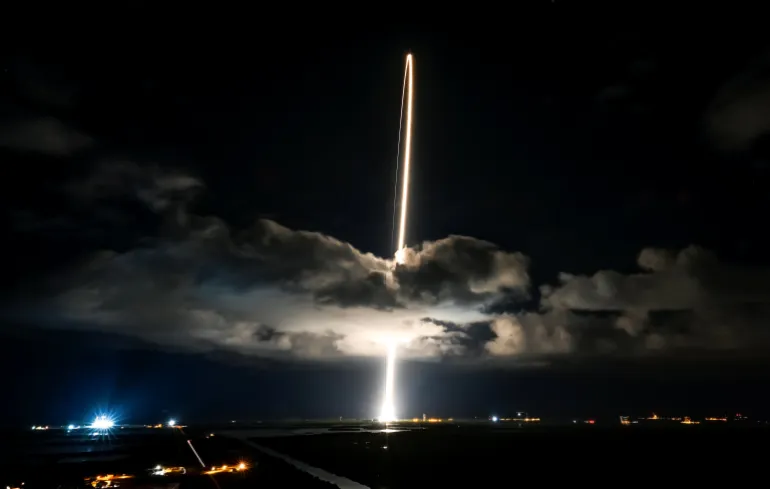
A SpaceX Falcon 9 rocket launches from Space Launch Complex 40 at Cape Canaveral Space Force Station, Florida, on May 29, 2026. (U.S. Space Force photo by Gwen Kurzen) Gwendolyn Kurzen
“As the world’s premier spaceport continues to support an unprecedented launch tempo for national security and commercial missions, securing critical launch infrastructure from low-altitude aerial threats remains a top operational priority,” the spokesperson explained. “The ongoing security modernization integrates detection, tracking, and defensive capabilities to include directed energy systems. These will provide security forces with real-time situational awareness and the necessary tools to safeguard personnel, launch complexes, and national security payloads.”
The spokesperson did not have a timeline for when the directed energy system will be operational. Florida Today was the first to report that lasers will make up this defensive system.
Col. Brian Chatman, who commands Space Launch Delta 45, told the publication that the facility is “bringing on a directed-energy system that can do a kinetic kill against UASs (Unmanned Aircraft Systems) that are coming into the area that are having nefarious intent.”
“The Air Force Research Laboratory [AFRL]-tested system has been proven to be able to safely bring down a drone,” Florida Today noted. “This directed-energy system uses lasers to shoot down any drone that flies into restricted areas.”
Chatman didn’t name the specific system to Florida Today and the SLD 45 spokesperson declined to say.
The following video shows one such AFRL-tested system that has been used in combat before.
Raytheon laser weapon demo: Drones don’t stand a chance
For the spaceport, being able to use lasers is even more important than it is for other locations needing protection from drones. That’s because the traditional method of jamming radio frequencies to interfere with drone connections to controllers could damage spacecraft.
“If you start blasting a bunch of RF energy you run into potential challenges,” Chatman explained. “You don’t want that.”
There is good reason for Chatman to be concerned about drones. The spaceport has been subjected to many unauthorized incursions, the spokesperson told us. However, there were no statistics immediately available on how many or whether they occurred during launches. There were 500 unauthorized drone flights over the adjacent Port Canaveral in 2025, Port Canaveral CEO Capt. John Murray said.
In addition, on Sept. 18, a Chinese tourist pleaded guilty to a federal misdemeanor charge after flying a drone in restricted airspace above NASA’s Kennedy Space Center (KSC) in late July. KSC is located across the Banana River from the space station.
It is unclear if the new laser system will also protect the skies over KSC. The spokesperson did not immediately know and is checking into it.
Cape Canaveral. (Google Earth)
That tourist, Xiaodong He, flew a drone that videotaped the installation, according to federal documents. The drone got within 1.56 miles of pad 39B, from where the next crewed lunar flight is expected to launch in 2028.
NASA’s Kennedy Space Center pad 39B. (NASA)
Encompassing about 25 square miles, Cape Canaveral Space Force Station is a large, unpopulated, open area with a long Atlantic Ocean shoreline. The station’s physical layout allows many vectors for drone incursions, and what’s housed there makes it a logical target for a nefarious actor.
The systems being prepared for launch and launched at the sprawling facility are extremely valuable and can take many years to build, costing billions. When they are out on the pad or being transported around, the rockets are massive tubes packed with high explosives that would cause a devastating secondary explosion if struck.
Even disrupting launches there due to a successful or even attempted attack could have major national security impacts.
The move to bring directed energy systems to protect the spaceport comes as the military is investing heavily in these systems to counter drones. Late last month, for instance, troops from the Joint Task Force-Southern Border (JTF-SB) employed an Army Multipurpose High Energy Laser (AMP-HEL) system during an operation dubbed Ardent Vanguard. The AMP-HEL was used “to engage and defeat three hostile UAS, determined to be such based on their use in direct support of activities posing a physical threat to U.S. military personnel and CBP [Customs and Border Protection] partners,” according to a media release at the time.
The shootdown was part of the U.S. government’s ongoing effort to counter drones being flown by Mexican drug cartels.
Joint Task Force – Southern Border personnel used the Army Multipurpose High Energy Laser system to engage and defeat a hostile drone. (U.S. Army Photo by Sgt. Daniel Huerta) Operation Ardent Vanguard
The military is seeking to expand its ability to counter drones with directed-energy weapons. In May, the Defense Department and Joint Interagency Task Force 401 selected five installations to participate in a directed-energy counter-unmanned aircraft systems pilot program required by the Fiscal Year 2026 National Defense Authorization Act.
“This initiative will accelerate the fielding and evaluation of advanced directed energy capabilities to protect critical infrastructure, military installations and homeland missions,” the Pentagon explained. “The locations were deliberately selected to support rigorous testing and operational assessments across diverse environments and mission sets.”
The Pentagon selected two “key southern border installations” for this program: Fort Huachuca, Arizona; and Fort Bliss, Texas. It also tabbed Naval Base Kitsap, Washington; Grand Forks Air Force Base, North Dakota; and Whiteman Air Force Base, Missouri.
Though the Pentagon is pressing forward with making directed energy a key part of counter-drone efforts, laser weapons have limitations. These include their short-term magazine depth being limited to how many successive shots they can fire before thermal loads require the system to cool down. Energy supply can also be a limiting factor. Additionally, laser systems don’t function as well in heavy cloud cover and other inclement weather.
You can see the Iron Beam’s first claimed kills in the following video.
A World First — Combat-Proven Laser Defense, Powered by Rafael
For the first time in history, high-power laser systems have been used to intercept aerial threats in combat. This unprecedented breakthrough took place during the Swords of Iron War — with Rafael’s advanced… pic.twitter.com/B3D6UdCJvE
— Rafael Advanced Defense Systems (@RAFAELdefense) May 28, 2025
At the same time, a laser weapon of this kind is very much a point-defense weapon, with its short range meaning that multiple systems will be needed to provide coverage of a significant area. In some situations, even a single, large military base like Cape Canaveral Space Force Station might require more than one to provide full defensive coverage.
In addition, there have been concerns about the safety of the systems and the authorities required to use them in the homeland.
Safety concerns about using directed energy weapons, and especially kinetic ones, to take down drones in the U.S. have been a major factor in why they haven’t been previously used in this role. Almost two years ago, officials at U.S. Northern Command (NORTHCOM), which has coordinating authority for counter-drone efforts in the U.S., said the use of such weapons was not yet on the table. The reason is that they can create dangerous or otherwise serious collateral effects that are less of a concern in a war zone.
That the U.S. Space Force is bringing in a laser system to protect some of the nation’s most important and secret military assets is a strong indication that these concerns are being overcome.
U.S. Space Force’s top officer has shared new details about his service’s use of electronic warfare capabilities during Operation Epic Fury against Iran earlier this year. This underscores how space is steadily becoming an arena where conflict actually occurs, and the implications this has for forces operating inside and outside of the Earth’s atmosphere.
Chief of Space Operations Gen. Douglas Schiess highlighted the actions of a member of the 42nd Electromagnetic Warfare Combat Detachment (EWCD) in support of Epic Fury during a keynote speech earlier this morning. Schiess’ remarks came at the Air & Space Forces Association’s (AFA) 2026 Air, Space & Cyber Conference, at which TWZ is in attendance. This is his first major engagement since taking over as head of Space Force less than two weeks ago.
A previously released picture showing a member of the 42nd Electromagnetic Warfare Combat Detachment forward-deployed somewhere in the Middle East in 2024. USAF/Senior Airman Zeeshan Naeem
“During Operation Epic Fury, our components, notably at U.S. Central Command and Space Command, with support from our components at European Command and Pacific Command, demonstrated that Guardians [the official term for uniformed Space Force personnel] are not supporting from the sidelines as a nice-to-have [sic], but we are delivering space power directly into the fight as a need-to-have,” Schiess said. “One of those impressive Guardians is Specialist Gray, who hails from Tampa, Florida. She joined the Space Force just two years ago, but listen to the impact she [has] made in her short term already.”
“She deployed to the CENTCOM AOR [Central Command area of responsibility] as a part of the 42nd Electronic Warfare Detachment [sic], and within hours of OEF kicking off, she received a top priority target package with one critical objective: reconfigure her weapon system and execute critical non-kinetic fires,” he continued. “She locked onto the target, optimized her weapon system, and waged electromagnetic warfare against a determined adversary. Even as ‘Alarm Red’ sirens were blaring, and incoming missiles targeted her site, she courageously held the line, protecting forces, denying adversary capability, and delivering space effects, until her commander had to literally pull her from the console to safety.”
“Specialist Gray is just one of the outstanding members of the entire enterprise of dedicated guardians, including the acquisition professionals that developed and fielded the weapon system that she operated, the intel Guardians that developed the targeting package that she used, and the cyber guardians who ensured communication, connectivity, and network defense for the command and control, the guardian instructors who trained her for combat, and the list goes on and on,” the Chief of Space Operations added.
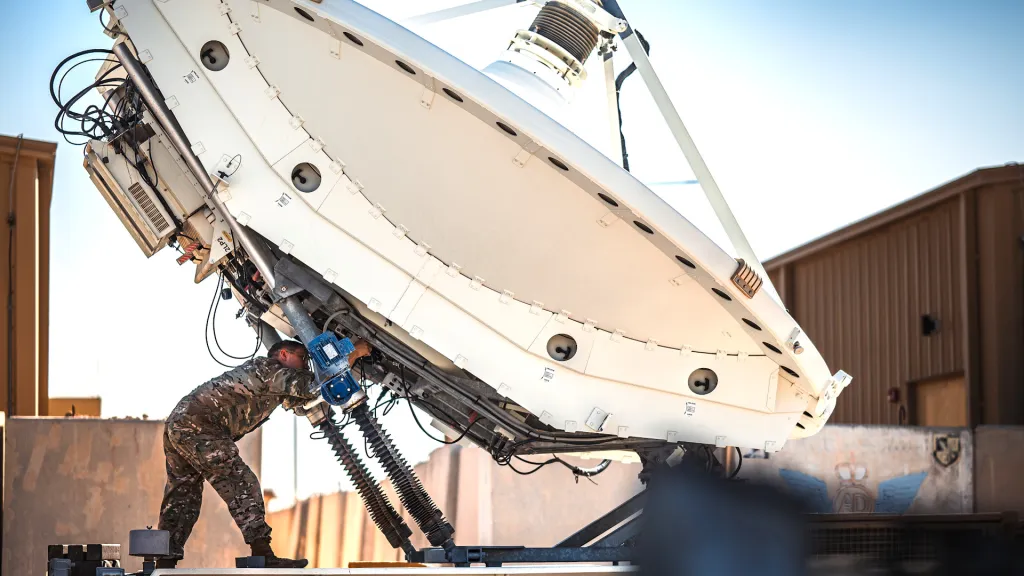
Schiess did not name the system in question or elaborate further on how it was employed. However, previously released pictures of elements of the 42nd EWCD in the Middle East have shown personnel working with trailer-mounted multi-band antennas that have been associated in the past with variants of the Counter Communications System (CCS). CCS is a family of ground-based electronic warfare jammers primarily designed to disrupt enemy space-based communications capabilities. Prior to yesterday, CCS was the U.S. military’s only publicly acknowledged anti-satellite weapon. Space Force has now confirmed it also has weapons in orbit, which we will come back to later on.
Members of the 42nd EWCD pose in front of a trailer-mounted antenna at an undisclosed location in the Middle East in 2024. USAF/Senior Airman Zeeshan NaeemA picture released in 2020 showing members of the 4th Space Control Squadron standing in front of what is explicitly said to be an element of the Block 10.2 version of the Counter Communications System. USAF
The 42nd Electromagnetic Warfare Combat Detachment has been operating in the Middle East since at least 2024 under the umbrella of Space Force’s main headquarters in the region, U.S. Space Forces – Central (SPACECENT). President Donald Trump briefly called attention to the detachment’s “cutting-edge defense activities” during a Christmas Eve conference call with deployed service members last year.
“Sometimes we have to be within the footprint of the satellite, and so that’s why Guardians go into harm’s way,” Gen. Schiess did tell TWZ and other outlets at a roundtable after his speech this morning when asked for more details about the 42nd EWCD’s role in Operation Epic Fury, and what lessons Space Force has been learning from the conflict more broadly.
“Electromagnetic warfare was a big part of that, but also satellite communications,” he added. “The ability to keep communications, obviously GPS and PNT [positioning, navigation, and timing], were important there.”
“And then, really, missile warning and missile tracking was [sic] incredibly important. Both [Air Force Chief of Staff] Gen. Wilsbach and I talked about ‘Red Alarm’ situations,” the Chief of Space Operations continued. “Being able to tell our forces to be able to take cover was extremely important. And as we’ve seen from Ukraine to Iran, the amount of missiles and the amount of things, the folks that are doing that each and every day are incredible, and they are saving lives.”
Chief of Space Operations Gen. Douglas Schiess. USAF
Gen. Schiess’ anecdote about Specialist Gray and the 42nd EWCD did highlight how Iran, especially in the opening phases of the conflict earlier this year, was able to deal real blows to U.S. and allied facilities and forces across the Middle East. Iranian missiles, drones, and other capabilities were able to damage and/or destroy a variety of high-value assets, including aircraft and radars, and cause hundreds of casualties, as TWZ has drawn attention to on several occasions in the past. This has already been a sobering wake-up call with serious implications for potential future conflicts against larger and even more capability opponents, especially China.
“I think the whole joint force is learning a lot from Operation Epic Fury, the previous operation there, on exactly what needs to be in underground facilities, [and] what maybe can we do from remote locations,” the head of Space Force said at the roundtable today. “You could also look at what can we do from space to do some of those things? And so we’re looking at all those [lessons learned].”
Gen. Schiess mentioning subterranean facilities and remote operations is particularly notable. Even before Operation Epic Fury began, the U.S. Air Force had been working to expand options for directing operations in the Middle East from a command center in the United States. The service had also been looking to push certain command and control functions at Al Udeid Air Base in Qatar underground. Al Udeid was among the many bases Iran subsequently targeted.
For Space Force, operations against Iran have provided a broader opportunity for the service to demonstrate its active role in forward-deployed operations. That, in turn, has generated its own lessons learned beyond just steps needed to help better protect units in the field.
Then-Lt. Gen. Douglas Schiess meets with forward-deployed members of the 42nd Electromagnetic Warfare Combat Detachment in 2025. Schiess was head of US Space Forces – Space (S4S) and the Combined Joint Force Space Component Commander at SPACECOM at the time. Space Force
This extends to “reconstitution [of forces] in a combat environment, the logistics and the importance of that relationship with TRANSCOM [U.S. Transportation Command] and to be able to get supplies and replenishment into the theater,” Chief Master Sergeant of the Space Force John Bentivegna also said today, speaking alongside Gen. Schiess at the roundtable. That is “something we haven’t really worked on before. So definitely, it was a great lesson learned.”
Space-based capabilities including early warning, general intelligence gathering, weapons guidance, near-real-time communications, and more, are already absolutely central to U.S. military operations. America’s long-standing dominance in space is also steadily being eroded, with China, in particular, surging ahead in the deployment of new satellites to support a host of mission requirements, including intelligence-gathering and long-range targeting. The ability to leverage space is also proliferating to smaller adversaries, including Iran.
In addition, as mentioned, the space domain is no longer limited to just supporting operations within the atmosphere, but is a place where real engagements happen. The U.S. military is now capable of generating so-called counter-space effects using forces and assets within the atmosphere as well as in orbit, as was just disclosed yesterday.
Overall, Gen. Douglas Schiess’ comments today about the role played by Specialist Gray and the 42nd EWCD during Operation Epic Fury are indicative of not just what is to come in future operations, but how the Space Force is already engaged in combat missions now.
Canada and France plan to cooperate on space-launch systems and ground-based infrastructure as Ottawa seeks closer economic and security ties with Europe.
Prime Minister Mark Carney announced the initiative Sunday with French President Emmanuel Macron in Saint-Pierre and Miquelon, the French
“The Pineapple” promised to be intense, but even hours before the show had begun, it had me startled.
I was warned, via a waiver attendees must sign to experience the production, to expect “intimate, and/or aggressive physical contact,” “confined spaces and passageways,” and that I may be asked to crawl, kneel or lie down. All of it would happen in a show that I was cautioned would present simulated violence or “disturbing imagery.”
As much as I love participatory, immersive theater — productions that often rely on some form of audience participation — “The Pineapple” was providing me with a checklist of things I generally avoid. It was a feeling that only grew when I reached the waiver’s end, and signed off that I was OK with claustrophobia (I am not).
What had I done?
None of it, though, had fully prepared me for what Candle House’s “The Pineapple” actually was. By the time the hourlong experience in North Hollywood had reached its conclusion, I had been straddled by a woman who forced a gloved finger down my throat, outfitted with hooded, vision-impairing face masks, grabbed by the wrists as they were taped together, ordered to crawl toward a blood-stained room, and spooned or kissed by multiple male performers.
“The Pineapple” is a secretive hourlong show that seeks to disorient attendees.
(Sona Earnest)
“The Pineapple” is a buzzed-about show among the tight-knit immersive community, one that fits into the medium’s long tradition of productions designed for a sole audience member. A short run last year in New Jersey sold out. Candle House has such a devoted following that its L.A. shows have been selling out almost as instantly as they are announced. While it’s thus far been shrouded in secrecy — “The Pineapple” will not even release a program or cast list until its run has concluded — it comes highly recommended from acquaintances who saw it on the East Coast. I was alternately excited and apprehensive to take part, and my editor would like me to note that I pitched this story on my own accord.
“The Pineapple” in its limited online description promises an alien encounter. Sign up, and an email will tell you that it will “change your life.”
For the passionate crowd of immersive enthusiasts who may want to experience “The Pineapple” and are worried I just spoiled the show, I call nonsense. For one, I believe audiences should know exactly what they are paying for, and two, I do not think “The Pineapple” can be properly spoiled. It was at times otherworldly, in moments psychedelic, and while there were scenes in which I felt fear, there were also others in which I laughed. While “The Pineapple” flirts with horror, torture and conspiracy nuts, it also provides space for Jimmy Buffett’s “Margaritaville.”
And in “The Pineapple’s” best instances, it created a sense of personal intimacy with its performers. These were actors who may have earlier been needling at or attempting to push my boundaries. “The Pineapple” wants to toy with our trust, to create a safe space where it can intermix themes of abuse and empathy until their lines are blurred. Consider its waiver, then, not just a warning but an attempt to weed out those who may be offended or triggered.
“The Pineapple” tries to break us. And it charges nearly $250 for the privilege.
“How do I put this,” says the show’s core creator/director Evan Neiden when asked his intentions behind “The Pineapple.” “I think the show is designed to boil you. Like the lobster in the pot. It gets warmer and warmer and warmer and it’s slowly acclimating you to this new set of rules that keep changing to this new environment of degeneracy and conspiracy.”
“The Pineapple” teases an alien encounter. It is theatrical production designed for one guest.
(Sona Earnest)
Neiden, the 27 year-old founder of Candle House, has long specialized in one-on-one phone productions designed to be done from the caller’s home. While drastically different in narrative content, his horror show “Claws,” in which its solo guest acts as an emergency line operator, is good prep for “The Pineapple” as it also seeks to push people to the brink of comfort.
If there is an artistic thesis behind the work of the New York-based Candle House, it is to cast its audience as performers, but then poke, prod and disorient until they stop performing and start reacting on instinct — or, in theory, become unguarded. It’s an idea that simply to get through the day we are playing a role of sorts, tuning our conversations to please others, or presenting exaggerated, false or tidied-up versions of ourselves on social media.
“In an experience like this, you’re alone with the inhabitants of the world, and they’re all there as part of your hallucination, your dream and your journey,” Neiden says. “You don’t need to worry about presenting a certain way or being perceived in a certain way. All the characters in ‘The Pineapple’ are degenerates, and this show invites you to become one as well. That’s very hard to do if someone from the respectable, outside world is watching.”
The setup for “The Pineapple” is simple. I was playing a respondent to an ad for a meeting with an alien. But things quickly spiral beyond clear narrative recognition, as piecing together the story becomes a puzzle unto itself. And it will shift depending on how one reacts, as there are multiple endings. But know only that in its opening minutes we learn that we have been swindled and are now part of a ritual of sorts to summon said alien.
“The Pineapple” offers intimate actor interactions designed to push boundaries.
(Sona Earnest)
You may find yourself, as I did, raising your voice, as “The Pineapple” did light research on me. My career was insulted, and I was mocked for fumbling around while attempting to juice a pineapple with a woefully inadequate kitchen utensil. Neiden says many attendees try to break the show itself, to push back and see how far its narrative can bend. This is typically not how I play, wanting to experience a production as its designers have intended and thus I let “The Pineapple” take the lead rather than trying to force my will upon it.
I am not easily offended and never used the safe word provided, although there were instances where I came close, namely when my feet were being aggressively, unwelcomely massaged. And yet there were scenes in which I thought about deeply personal relationships I have had, specifically when a character asked me to think of a time when forgiveness or an apology was craved from someone I am no longer closely connected with.
“The Pineapple” then began to feel like a metaphor. As I moved from darkened room to darkened room, ridiculed in one, flirted with in another, a thread of finding one’s own personal paradise in a hellscape began to emerge. Is it aliens we are seeking, “The Pineapple” begins to ask, or simply perhaps purpose? The act of forgiveness, Neiden tells me, was on his mind when crafting the show.
“I never really felt like I fully understand it,” Neiden says. “What is forgiveness? Some people say it’s letting someone off the hook. Others say it’s releasing yourself of the burden of a grudge. And it’s a word wrapped in religion and politics. There are so many definitions of it, and we hear it everywhere — forgiveness and its counterparts of guilt, shame and accountability. What does it mean? The show doesn’t answer that.”
Maybe. That’s up to the audience, not its creator.
Days after I’ve seen “The Pineapple,” friends and peers keep asking if I enjoyed it, and I don’t think it’s a simple answer. It’s not for everyone. I’m not sure it’s even for me. Simulated torture is not my idea of a good time. But “The Pineapple” did wear me down, and it’s beautiful in the way it highlights the lonely anguish at the heart of Buffett’s “Margaritaville.”
As its small cast obsesses over a fabled alien encounter and seems willing to stop at nothing to find release in a divine being, be careful, “The Pineapple” argues, of the personal Eden you seek.
At least that was my takeaway. You might walk away with an entirely different message.
“Maybe you just fell in with the wrong crowd and got abducted by aliens,” Neiden says.
WASHINGTON — The United States has confirmed for the first time that it has deployed weapons in space.
Air Force Secretary Troy Meink told the Air and Space Cyber Conference in Maryland on Monday that the U.S. has fielded “on-orbit space control weapons capable of defending the Joint Force against hostile adversary action.”
Meink did not detail what the weapons were or how they work. In 2024 the U.S. said Russia was developing a new anti-satellite weapon that could be launched from space. At the time the White House said the danger wasn’t imminent.
But reports of the anti-satellite weapon reflected longstanding worries about space threats from Russia and China, given that much U.S. infrastructure is dependent on satellite communications.
In his remarks, Meink also said the Air Force was adding more autonomous systems to its capabilities and predicted the service would look “radically different” by 2032. For example, he foresaw one-way attack drones replacing artillery as the “primary killer.”
“We are increasing readiness against existing threats,” he said.
In an abandoned warehouse in Barcelona, the diva concealed her face beneath a helmet. Her hair moved like a black waterfall as she strutted, bare feet arched, as if in heels. The heels do appear later, click-clacking as the camera reveals a screen on her pelvic region, and as she reveals her face, growling a provocative verse from “Taconeando” — “Yo sé que tu quieres que me venga.”
Throughout the course of her July 27 “XXXXX” livestream, which beamed her first album in five years to the world, the artist-producer Alejandra Ghersi Rodríguez, best known as Arca, bathed in the warm hue of red light and strobes — and later, what seemed to be blood.
She blew kisses to the camera and toward the sky. She let out vocoded screams as she writhed on an industrial floor and lay resplendently upon a mountain of sand. She covered her bikini-clad body in peonies, visually echoing anAna Mendieta “Silhueta.”
It would be too simplistic to label “XXXXX” as a return to form for the expansive Venezuelan artist; this record is more than a pop-timized syncretization of her previous electronic experimentations, such as her 2013 debut EP “&&&&&,” or the hourlong single “@@@@@.”
Lest we forget her celebrated self-titled album in 2017, which was the first time we heardArca’s voice untreated to the doleful melody of a tonada, the Venezuelan folk genre popularized by llanero troubadourSimón Díaz; or the wildly ambitiousfive-album “Kick” cycle, in which she indulged in the Caribbean sounds of dembow and reggaeton, then melded them together into one ambient stream, with her signature glitchy flair.
The album cover of “XXXXX,” which calls to mind one of Swiss artist’s H.R. Giger’sbiomechanoid machine-human chimeras, nods to the much-ness inherent here: specifically the post-humanist conceit of “diva as technology” that lies at the bloody, beating heart of this record.
What best captures her ambitions on “XXXXX” is the aptly named song “Everything,” which centers a soft-hard sequence of percussion that threatens to consume you — and if it does, you let it.
When every color of paint is mixed together, a dark color emerges. When every sound is blended together, what does it become? An orchestral flourish slowed to a whisper as in “Finisher?” An explosion, like in the fast-rattling crackle of “Syncope?” Or a hand on your hookup’s throat, telling them they know exactly what you want from the interaction as in “Fxck?”
The alchemy on “XXXXX” doesn’t always go down smoothly. Arca’s never been an artist to be easily swallowed and thrown back into the ouroboros of the pop machine; if she’s always been the sand in the cog, what happens when the underground diva herself surfaces to mainstream superstardom? These are problems to ponder in the shadows of a club.
The diva as a concept is already rooted in transformation. A beautiful, powerful woman flaunts her voice dramatically onstage, reaching new heights and incarnating — to paraphrase Wayne Koestenbaum’s observations on operatic divas, like Maria Callas in his seminal text “The Queen’s Throat” — an airy sense of freedom.
Arca — a nonbinary trans woman who makes uncategorizable music and embodies unquestionable glamour — anchors her divahood in a mutation of body, soul and sound. It’s a concept she has been playing with since hersecond album, “Mutant,” which alsogave her fanbase a name.
Still, attempting to situate her in any tradition is moot.
Her divahood exists in the context of Venezuelan underground electronic music, where Arca was the youngest of a generation of DJs and producers. This includes theraptor house don DJ Babatr; hard fusion father DJ Yirvin; Luis Garban (who plays as Cardopusher andSafety Trance); MPeach; and Phran.
Arca is now the kind of artist who could be seen walking runways in Berlin, or seated front row at the Saint Laurent show at Paris Fashion Week. Last month in Iceland, Arca served as the high priestess of Echolalia: an eclipse rave helmed by longtime collaborator Björk and a coterie of local acts.
Arriving in a summer defined by pop divas switching gears —Charli XCX turning to rock music (in a sense),Madonna leaning hard into nostalgia after a career of refusing to repeat herself, and the ever-smileyKarol G surrendering to her saudade — Arca’s “XXXXX” is similarly an invitation to transmute.
But if we can locate Arca’s divahood in a lineage, it might be in the modern tradition of the anonymous and enigmatic doll at the rave: ready to let her ego dissolve into the bass.
You listen to the quiet internal world Arca conjures on “Raver,” with its jangling and haunted electronic keys. You can see her clearly there: lost under the strobes, eyes turned up toward heaven, letting herself sway, sweaty, between moments of euphoria, completely in her body. Has anyone ever been more enraptured and glorious? Every raver has, in a sense, wandered gladly to oblivion with “eyes closed and heart open,” as Arca says on “Cinch.”
We may get drugged up to forget it all; or we go sober with earplugs and water and good sneakers and coffee, or cold yerba mate toward the music. Yet all of us seek to get lost in the sound, to cinch our waists and let the bass move through us — to have the transcendental experience of “[letting] the beat f— you,” as Australian scholarMcKenzie Wark describes halfway through her essential book, “Raving.”
The aesthetics of ravers reaching the mainstream — and into the hands of normies through the rise of so-called “corporate raves” — has allowed for the creation of depictions that exist outside of the real, silent moments of transcendence. It’s the communion, after so much ceremonial dance, with the divine.
For all the modernity of its rave philosophy and sci-fi metallic soul, “XXXXX” has a connection to an ancient divinity — to older technologies, from ritual to radio.
Near the beginning of “XXXXX,” the song “Willow” ushers us into this new world, with a clanging that evokes the sound of church bells in space. After a minute of this, the crash of hi-hat punctures the silence. Arca’s pitched-up vocals seep through, matching the beat in a disjointed chant: “Willow tree blowing in the wind, let it fall.” The song continues flourishing with the deconstructed trap beat and dark synthesizers that call to mind the classic sounds ofwitch house. It’s the opening of the ceremony, the energetic cleansing of the space.
The album’s loose framework as a transmission from an intergalactic underground radio station, “Diva Experimental FM,” is a structure she’s been playing withfor years in the form of a show streamed on NTS. She launched this new era with another mix for the show called “Airdoll,” a storm of baile funk with currents of ambient music, R&B and Gregorian chants. These various sonic streams fuel the mechanical but witchy futurist soul of “XXXXX.”
In their multi-genre 2025 book “Dysphoria Mundi,” Spanish trans philosopher and activistPaul B. Preciado points to gender dysphoria as a symptom of the world’s broken state and the utopia that could well rise from the ashes.The constant procession ofnatural disasters — and the indifferent leaders and the violent bloodthirsty systems they work under — push society to mutate into something better. As with Arca the artist, “XXXXX” is a curse-breaker, a cultural palate cleanser and a call to evolve.
The United States has acknowledged deploying space weapons in orbit of the Earth.
US Air Force Secretary Troy Meink confirmed on Monday that the so-called “space control weapons” would be used to defend US forces on the planet, marking a significant new chapter in the militarisation of space – or at least the transparency of it.
The announcement, which Meink framed as a message to US rivals China and Russia, could turn Earth’s orbit into an increasingly contested military domain, experts warn. Warfare could include countries targeting each other’s satellites, which provide critical services such as GPS, communications and intelligence to military forces on the ground, as well as civilian infrastructure.
“Space Force doctrine describes ‘space control’ as having the outcome of space superiority, which they define as the ability to operate at the time and place of their choosing, while denying the same to an adversary,” Victoria Samson, chief director of Space Security and Stability for Secure World Foundation, a private non-profit focused on military space and security issues, told Al Jazeera.
So, what do we know about the US-deployed weapons in space? And do some countries already have them?
NASA’s Lucy spacecraft, atop a United Launch Alliance Atlas V rocket for a mission to study the Trojan asteroids in the outer solar system, launches from Pad-41 at Cape Canaveral Space Force Station in Cape Canaveral, Florida, the US, October 16, 2021 [Steve Nesius/Reuters]
What do we know about these space weapons?
Not a lot. Air Force Secretary Meink said the US has stationed “weapons” in Earth’s orbit, but did not specify when they were placed there, how many there are, or what they are designed to do.
“Today, we continue to ensure we remain ready to meet the challenges of evolving threats wherever they exist,” Meink said at the Air, Space and Cyber Conference. “This is why the United States now has on-orbit space control weapons capable of defending the Joint Force against hostile adversary action.”
However, he did not give any details about what sort of weapons these may be, where they are positioned or what they are designed to do.
Samson said the keyword from Meink’s announcement is “weapons” in the context of “space control”. “Space control encapsulates the mission areas required to contest and control the space domain – employing kinetic and non-kinetic means to affect adversary capabilities,” Meink said, adding that “these capabilities can be employed for offensive and defensive purposes”.
“That’s the first time any official has acknowledged an actually designed weapon has been placed in space,” Samson told Al Jazeera. “It’s always been ‘systems with capabilities’ prior.”
Experts say these weapons are likely to be space-based communications jammers rather than kinetic ones that launch strikes. Kinetic weapons – for instance, a suicide satellite designed to ram into an adversary’s satellite – would likely cause fast-moving debris to be launched dangerously into space.
Bleddyn Bowen, an associate professor in astropolitics at Durham University in the United Kingdom, told the BBC’s Radio 4 Today programme: “We don’t know exactly what the mechanism of the weapon is. I would expect there to be some kind of electronic warfare or radio-jamming platform. This would be a non-destructive kind of anti-satellite weapon, and these variants already exist on Earth.
“Less likely would be a kinetic kill vehicle of some sort, so a vehicle that would release a projectile of some sort that would ram into a satellite and destroy it.”
US President Donald Trump gestures towards the US Space Force flag during a presentation of the flag in the Oval Office of the White House in Washington, DC, the US, May 15, 2020 [Kevin Lamarque/Reuters]
What is the US Space Force?
The US Space Force is the newest branch of the US military, created in December 2019 under President Donald Trump’s first term, responsible for organising and conducting US military operations in and through space.
Unlike NASA, which focuses on civilian space exploration, Space Force is part of the US Air Force and comes under US Space Command, which is headquartered at the Pentagon in Arlington, Virginia.
Its responsibilities include operating and protecting military satellites, providing satellite communications and positioning services, monitoring objects and potential threats in space, and supporting US forces on Earth.
“China and Russia are developing new space systems to enhance military effectiveness and end any reliance on US space services,” the Space Force’s website says. “China and Russia are also testing and fielding sophisticated counterspace capabilities with the intent to disrupt and degrade US space-enabled capabilities.”
US Secretary of the Air Force Troy Meink speaks during the 2026 graduation ceremony at the US Air Force Academy, in Colorado Springs, Colorado, the US, on May 28, 2026 [Matt Rourke/AFP]
Aren’t there treaties limiting weapons deployments in space?
Yes, but they do not amount to a blanket ban on weapons in space.
The key agreement is the 1967 Outer Space Treaty, which prohibits countries from placing nuclear weapons or other weapons of mass destruction in orbit or stationing them in outer space. It also bans military bases and weapons testing on the moon and other celestial bodies.
However, the treaty does not expressly prohibit conventional weapons from being placed in Earth’s orbit. That means systems such as conventional anti-satellite weapons, electronic-warfare systems, or other counterspace capabilities are not automatically prohibited.
Such gaps leave room for interpretation and are at the heart of current international efforts to enhance military activities in space.
How have Russia and China reacted to the US announcement?
China’s Foreign Ministry opposed the move, warning against the “weaponisation of outer space, turning it into a battlefield, as well as an arms race there”.
“We urge the US side to stop expanding its military capabilities and preparing for war in outer space,” ministry spokesman Guo Jiakun told a news briefing.
Russia called for space to be kept “free of any weapons”.
“We are counting on broad international consolidation to continue working towards the complete demilitarisation of space,” said Kremlin spokesman Dmitry Peskov.
Are Russia and China developing space weapons too?
Independent reports from research groups and think tanks note that both China and Russia are developing a broad range of counterspace capabilities designed to interfere with, disable, or potentially destroy satellites and other space systems.
The Center for Strategic and International Studies (CSIS), a foreign policy think tank based in Washington, DC, identified both countries as possessing or developing kinetic and non-kinetic counterspace weapons.
A 2025 CSIS report notes that both Moscow and Beijing have direct-ascent anti-satellite (ASAT) weapons, as well as capabilities involving jamming, spoofing, and cyber operations.
Samson of the Secure World Foundation (SWF) told Al Jazeera that her team has highlighted in their reports that “China and Russia have space-based jammers”. Therefore, she told Al Jazeera, “I always thought it would be strange that the US didn’t have them too.”
Bowen told the BBC: “In the last 10 years, Russia and China have been doing a lot more manoeuvres in space – rendezvous and proximity operations, as we call them – so, flying up really close to Western satellites, inspecting them, taking pictures. And on another occasion, the Chinese have demonstrated a ‘space tug’ capability. So, a vehicle that goes up to a satellite can grapple it and then move it into a different orbit.”
China has executed such a manoeuvre only with one of its own old satellites, which needed to be moved away from its location, he added.
What about other countries?
The emerging space-weapons race is not limited to the US, Russia and China: India has also demonstrated an ASAT capability and is developing technologies that could allow spacecraft to operate alongside other satellites.
France is also reported to be developing co-orbital capabilities, while the UK has conducted on-orbit cooperative operations with the US.
A 2026 report by SWF also notes how Iran, for instance, illustrates the less visible side of space warfare, relying increasingly on jamming and spoofing satellite-based services. Israel, meanwhile, has developed significant military space and electronic-warfare capabilities, although there is no public record of it conducting a debris-generating ASAT test.
Countries like North Korea and South Korea are also racing to develop more sophisticated space-based tech.
A view of NASA’s Orion spacecraft in the foreground, lit up by the sun as the moon and Earth are visible behind it as photographed by one of the cameras on the Orion spacecraft’s solar arrays during the Artemis II crew’s flyby of the moon on April 6, 2026 [NASA/Handout via Reuters]
Is space the next frontier of war?
Samson told Al Jazeera that the US announcement of deploying weapons in Earth’s orbit is not essentially disruptive in the context of space technology. “What this does is normalise weaponising space,” she said.
“Space has always been a domain with the potential of being a flashpoint for conflict; this just turns up the heat there,” Samson added.
A US Space Force spokesperson told ABC News that the US “capabilities can be employed for offensive and defensive purposes at the direction of combatant commands”. The spokesperson noted that Washington “has warned about Russian and Chinese weapons testing and operationalisation since 2007”.
“Due to their actions, it is no longer a question that space is a warfighting domain,” the spokesperson said. “Open communication strengthens deterrence, prevents adversary miscalculation, and normalises space operations alongside the other services.”
Samson further noted that Meink’s statement “crosses a line”, and would “either encourage China and Russia to also declare weapons in space, or will make US allies and partners want to also place weapons in space”.
“Counterspace capabilities have been proliferating already – this speeds up that trend,” she said, adding that this “is incredibly destabilising and will work against US national security goals”.
“By opening the door to weaponising space, the US loses the most,” Samson noted. “Every person on this planet uses space-based data and services in some way. Any interference with access to or use of space will affect everyone, not just space powers.”
At age 14, Glen Walsh started surfing because of a crush. He was a boogie boarder until the object of his adoration told him, “What are you riding that for? You should be surfing. Get a surfboard.” So, he did. “I was terrible at it, but I kept going. I was super persistent.”
That resilience proved useful. As a gay teenager in Santa Monica, Walsh was often called slurs on the Venice Pier. “You think you’re like a unicorn — a weirdo,” he says. He felt at odds with the local surf community. To Walsh, surfing was “super straight, very hypermasculine, very intimidating.” Yet his love of the ocean — and sure, crush-worthy surfers — kept him returning to the water. “I wanted to be around them, and surf with them,” he says.
When Instagram launched in 2010, Walsh began posting one of his early loves — only this time, it was morning surf conditions. Every morning, before surfers paddled out, the longtime Venice resident described swells, winds and surf conditions to his followers, becoming for some the town’s trusted surf chronicler.
A “Surf Swim” sign greets beachgoers at Venice Beach — a stretch of coast where daily surf reports and grassroots organizing have helped break down traditional surf stereotypes.
(Christina House / Los Angeles Times)
His videos combined informative dispatches with the laid-back vibe of surfer ASMR. “Light offshore wind. Clean, glassy barrels,” he declares softly to the camera as gray waves break behind him. “Lumpy close-out with hollow barrels with low tide, fam.”
At first, the account functioned like a group chat for local surfers. “Friends were asking me how the waves were, and I was texting them. I figured I’d jump on Instagram and start doing it for them,” says Walsh, who has been a Venice resident for 15 years.
What began as a practical update for a handful of friends eventually attracted followers in London, Berlin and Tokyo — people who checked in daily to see whether the surf was firing in Venice Beach. The account has amassed over 10,000 followers, inspiring imitator accounts. “Now it’s just for everybody,” says Walsh. “I built a community around the surf reports. It really blew me away. I didn’t realize that people were so interested.”
His surf reports have made him an unofficial mayor of Venice surf culture, getting recognized at the beach town’s local hangouts like Hinano Cafe and the Cow’s End. “People stop me and tell me they love my surf reports. They don’t even surf, but they see it every day,” says Walsh. “I always tell people I’m very popular between Washington Boulevard, Lincoln Boulevard and Rose Avenue.” His nickname around town is Glenice Venice.
However, the real triumph wasn’t becoming recognizable around Venice — it was finding other queer surfers, something that felt elusive in Walsh’s youth in Southern California. “I had met a lot of other surfers from all over the world and built a queer community of surfers here in L.A.,” says Walsh. “It was pretty awesome.”
Walsh saw an opportunity to use his surf report to not only report on the condition of the ocean — which is especially unpredictable during our current El Niño cycles — but to also create a burgeoning queer space in the Venice surf scene. “I could set up a community-based surf report for everybody, and the fact that I happen to be queer made it a little more unique,” he says. He began to connect with gay surfers, organizing trips with them and building lasting friendships. “It was just a lot of fun, building a little team.”
Later, Walsh became a co-producer and music supervisor of a movie about homophobia in surfing titled “Out in the Line-Up” that premiered at film festivals across the world in cities such as New York, San Francisco and Sydney, Australia. “The movie kind of spoke for itself. It was a worldwide issue — homophobia in surfing.” Since then, Walsh has served on panels about queer people in the surf world. Last June, the film had a 10th anniversary screening in Venice, hosted by the Venice Surfing Assn. “At some point, I brought some diversity to this culture. I put my name on it,” he says.
In recent years, others have joined Walsh’s efforts to create a burgeoning queer surf scene at Venice Beach. In 2020, Shelly Guidera relocated to Venice and noticed that there wasn’t a strong queer presence in surfing. “My friend and I were maybe the only queer people some of these surfers had ever seen,” she says. Shortly after, Guidera started Dream Team Surf, a collective for queer surfers to meet up and build camaraderie.
Its mission is simple. “It’s all of us looking out for each other,” Guidera says. “ Having a team of people makes the experience that much more enriching and safe.”
Surfers ride the waves near the Venice Pier, where Glen Walsh does his daily surf reports.
(Eric Thayer / Los Angeles Times)
Early on, Guidera was inspired by Walsh’s uplifting presence in the Venice surf scene. “This person is respected in the community for what he brings, which is knowledge and insight and fun and flair,” says Guidera. In turn, Walsh has championed Dream Team Surf.
In January 2025, Dream Team Surf hosted a Pride beach party with a banner that read: “Trans bodies belong on the beach.” In some San Diego area beaches, Guidera says, queer representation can still feel like an anomaly. “It’s so funny because it’s like these people have maybe never seen a woman in a bathing suit with hairy legs,” she says. “I’m like, ‘Oh my God, it’s not that deep.’”
Guidera is certified in surf therapy, taking courses through Groundswell Community Project, a surf therapy program that uses surf to promote holistic healing. The mental health benefits of surfing are lifelong, Guidera explains. “Growing up as a swimmer, surfing was a form of play and wellness,” she says. “It eased the brakes on competition and the structure within competitive swimming.”
Group photo of Dream Team Surf, which hosted a Pride beach party.
(Sara Werner)
Even if you don’t shred waves, being in the ocean can promote healing. “To give people access to the ocean that is in and of itself a form of wellness,” she says. “There’s a level of surrender and humility that comes with surfing and that comes with being in nature. … You have to be so present in such a way that makes you a stronger person.”
Like Guidera, Walsh also works as a surf instructor with a similar goal to instill confidence in his students. “I was teaching a lot of people to surf, mostly women who didn’t want a straight man to teach them how to surf because it feels vulnerable enough,” says Walsh. “I try to break down the stereotypes and have a little fun with them and let them become a kid again.”
When done correctly, he argues, surfing can invite expansiveness. “I love seeing people out there. Feel the fear and do it anyway,” says Walsh. “And creating a lifestyle around it — going to different beaches — and meeting friends.”
There’s a cross on the roof, stained glass in the windows and a choir loft upstairs, but this whitewashed three-level building near Sunset Boulevard in Silver Lake is no longer a house of worship.
It’s the Hotel Lucile, a 25-room boutique lodging that opens Sept. 14 with a restaurant and bar in the high-ceilinged sanctuary where churchgoers once gathered. This opening follows more than a decade of controversy and transformation, including a community debate, bankruptcy and the arrival of a new hotelier in 2020.
The new hotelier is Los Angeles-based Casetta Group, which specializes in adapting older structures and has six properties in California and New Mexico, including the Surfrider Hotel in Malibu and Casa Cody in Palm Springs.
When guests arrive at Hotel Lucile, they will find many reminders that the building was constructed as Bethany Presbyterian Church in 1931. But those guests will also see plenty of updates, including 25 guest rooms in the space that once held a church school; a small pool (about 15 feet square); and a rotating display of more than 100 contemporary artworks (many for sale). The organ loft is now a meeting space. The choir loft is retooled as a zone for coffee and drinks. The rooftop is a lounge with downtown views.
1.Bathroom inside a suite.2.Desk inside a premium king room.3.Sitting area inside a suite.(Myung J. Chun / Los Angeles Times)
“The building has lived several lives,” Hotel Lucile general manager Anthony Gutierrez said in an email. “It has always been a place for people to gather.”
The establishment fell idle as developer Dana Hollister took over the lease and sought city permits to convert it into a hotel with alcohol and dancing. Despite opposition from many neighboring homeowners and businesses alarmed by possible traffic impacts, those permits were approved in 2014.
But Hollister declared bankruptcy in 2018 and sold her interest in the property in 2020. That’s when the Casetta Group took over Hollister’s long-term lease from the Presbytery of the Pacific, which owns the property.
This church-to-commerce transition isn’t entirely unique. Across the city and the country, declining attendance has idled many religious buildings, often leading to conversions. In DTLA, the restaurant and event space known as Redbird + Vibiana was previously St. Vibiana’s Cathedral, deconsecrated by the Catholic Church after suffering damages in the 1994 Northridge earthquake. In Beachwood Canyon, the Monastery of the Angels was built as a private mansion and rebuilt by the Catholic Church in 1948 as a monastery. In early 2026, Homeboy Industries bought it from the church and began remaking it into Home of the Angels, a “recovery campus” for people impacted by trauma, substance use disorders and involvement in the justice system.
More church conversions may follow, thanks to California law SB4, passed in 2023 to allow faith-based groups and nonprofit colleges to avoid some local restrictions when converting buildings into affordable housing.
Meanwhile, the Hotel Lucile begins a new chapter, retaining interior arches, masonry, woodwork details and a rooftop cross that the hotel will keep alight at night. (The old church bell, however, will remain silent.)
Because the hotel has no on-site parking, it will rely upon valets and street parking (already tight in the neighborhood) to accommodate the cars of overnight guests and restaurant diners.
The rates begin at $441 nightly, plus a $50 amenity fee. To start, management is offering a “locals rate” of 15% off for guests who can show a California state ID.
“We did preserve as much as we could of the original beams and stained glass,” said Laney Langenstein, who oversees strategy and marketing for Casetta. Though guest rooms have minibars (curated by Erewhon and other partners), Langenstein noted that hotel staffers will also push a martini cart that will “go through the hallways and see if anybody thinks it’s cocktail hour.”
The dinner-only restaurant, Sous Sous, will draw upon cooking traditions of southern France and the American South, seating up to about 120, with occasional live music on the room’s stage. A hotel cafe will be open to guests for breakfast and lunch.
The new look of the hotel was produced by Casetta Hotels and design firm Electric Bowery. Children are permitted at the hotel, but not encouraged by the layout. (Of 25 rooms, 24 have a single king bed and one has two queens. Most rooms have showers, not tubs. There is one suite, which has its own courtyard patio and fountain.)
With an eye to potential expansion later, hotel management has also bought up one of the three immediately neighboring properties.
Meanwhile, now that the hotel is about to open, feelings among neighbors are mixed.
A booth at Sous Sous restaurant.
“When they tried to get a permit for the hotel, we all went to speak against it. But they got the permit,” said Jin Chang, longtime owner of nearby Big Mac’s Liquor on Sunset. Now, Chang said, he’s neutral about the hotel opening and relieved that his mini-mall has its own parking lot.
“What’s the definition of progress?” asked VJ Kesh, a longtime neighborhood resident. “Is this hotel a reflection of Silver Lake? Hell, yes. So I’m in favor.”

![Yuri Gagarin, the world's first spaceman. [Getty Images]](https://i0.wp.com/occasionaldigest.com/wp-content/uploads/2026/10/GettyImages-514885012-1791125806.jpg?w=640&ssl=1)
![Astronaut Neil A. Armstrong, in training for the projected Apollo 11 lunar landing mission, is being suited up for the first full dress rehearsal of activities he is to perform during the projected moon landing. [Getty Images]](https://i0.wp.com/occasionaldigest.com/wp-content/uploads/2026/10/GettyImages-515287304-1791126174.jpg?w=640&ssl=1)

![American astronaut Alan Bartlett Shepard Jr (1923 - 1998), Commander of NASA's Apollo 14 lunar landing mission at the Kennedy Space Center in Florida, 14th November 1970. [Space Frontiers/Getty Images]](https://i0.wp.com/occasionaldigest.com/wp-content/uploads/2026/10/GettyImages-1141685928-1791125972.jpg?w=640&ssl=1)