Wildfires are rampaging through vast areas of land in southwestern Europe, forcing France and Spain to evacuate more than 325,000 people from their homes.
Some of the worst fires in France since World War II come just weeks after record-breaking heatwaves scorched Europe. Authorities have deployed thousands of firefighters to battle the blazes.
Recommended Stories
list of 3 itemsend of list
On Sunday, France’s Interior Minister, Laurent Nunez, said about “115,000 hectares (284,171 acres) have burned in wildfires in France since the start of the year”. In Spain, 119,458 hectares (295,187 acres) of land have been burnt as of July 22 , according to data from the Copernicus European Forest Fire Information System (EFFIS).
More than 150,000 hectares have burned across Spain since January, said Prime Minister Pedro Sanchez – that’s six times the area destroyed during the same period last year.
Wildfires destroyed 2.2 million hectares (5.4 million acres) of land in Europe in 2025 – up from 1.4 million hectares (3.5 million acres) in 2022, according to the United Nations.
What is the main cause of the wildfires and why are authorities struggling to contain them?
What has happened?
Since early July, wildfires have been burning across southern and western Europe, with France and Spain being the worst hit.
About 220,000 people have been evacuated from their homes in France, about 75,000 people in Spain, and around 30,000 others there ordered to shelter in place, according to authorities.
In Spain, a fast-moving wildfire in the Andalusia region killed at least 12 people on July 10 . By July 20 , the fires had spread hundreds of kilometres to the capital, Madrid. At least 10,000 people have been evacuated following wildfires in the central region of Madrid. On July 24 , Spanish authorities declared a national emergency, saying two major blazes were “out of control”.
Over the weekend, a separate blaze in Spain’s eastern Castellon province ravaged more than 4,300 hectares (10,625 acres), regional authorities said.
“The fire is out of control, it’s very difficult to extinguish from a technical standpoint, especially because of the adverse weather conditions that will continue throughout the day,” the regional leader of Valencia, Juanfran Perez, told reporters near the site.
The wildfire in Spain has now entered the Sierra de Espadan natural park, containing large forests of pine trees and cork oaks.
In France, the wildfires are among the country’s worst since World War II and have particularly ravaged the Cap Ferret peninsula, an exclusive holiday destination on France’s southern Atlantic coast about 70km (43 miles) from Bordeaux.
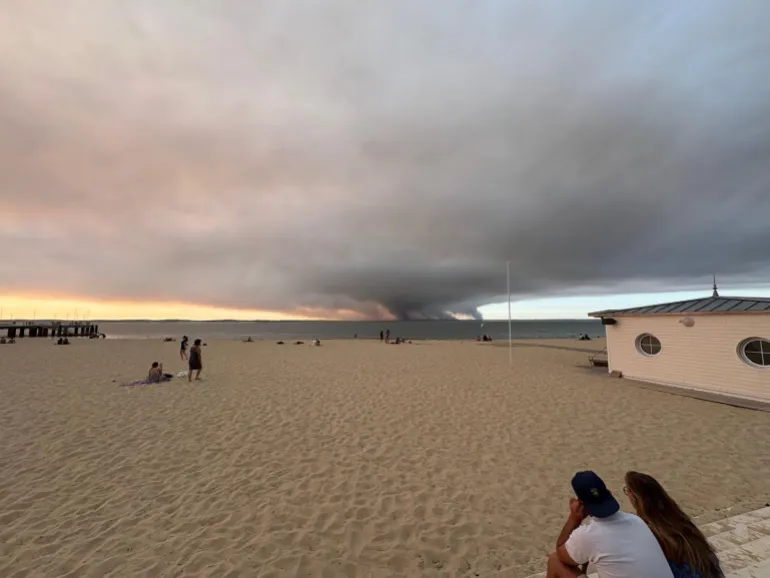
Reporting from Maubec, near Toulouse, Al Jazeera’s Nina Montagu-Smith said: “When I visited Arcachon, a seaside town just across the bay from Cap Ferret on Thursday last week, we could see the fires on the peninsula. Within hours, the sky had blackened and the smoke was thick over Arcachon town.”
“All trains from Arcachon were cancelled, apparently due to an ‘electrical fault’,” she added. “Fire engines were lining the A63 from Bordeaux towards Arcachon on Thursday evening as I drove eastwards to Libourne, which is 100km from the fires in the Gironde region,” she said.
Our correspondent noted that after the wind picked up on Thursday evening, smoke from the blaze reached Libourne, where ash was falling from the sky.
“We have since relocated further east in France towards Toulouse, where the sky is very grey and we could still smell the smoke on Sunday night,” she added.
Fires on the Cap Ferret peninsula in southwest France, as seen from across the bay in Arcachon, a town on the French Atlantic coast [File: Courtesy of Nina Montagu-Smith]
The wildfires have now spread through areas surrounding Bordeaux, where firefighters were trying to prevent the flames from reaching the regional capital.
Bordeaux Mayor Thomas Cazenave said the fire was just 15km (nine miles) from entrances to the main city.
“We have a fire that is not under control and which is moving in the direction of the city area,” Interior Minister Laurent Nunez told France 2 TV on Sunday evening. “The overall situation is very unfavourable, we are in a situation that is unprecedented.”
So far, authorities have moved 197,000 people from areas around Bordeaux – including popular holiday spots which are generally crowded at this time of the year.
The Bordeaux region is famed for its vineyards and the city is one of the main transport hubs for tourists visiting nearby holiday resorts on the Atlantic coast.
Cazenave said earlier on Sunday that there were no plans yet to evacuate Bordeaux, whose wider metropolitan area has a population of about 850,000. Nunez said authorities would continue to assess the situation calmly and realistically, and the government has warned against road or rail travel to the area.
The wildfires disrupted Sunday’s Tour de France finale in Paris, which organisers shortened from 133 to 89 kilometres (83 to 55 miles) after security forces originally assigned to the race were redeployed to fight the fires instead.
Why are these fires so bad?
Scientists are warning that pyrocumulonimbus clouds – unprecedented in southwest Europe – are forming.
According to the British Royal Meteorological Society, these are thunder clouds “created by intense heat from the Earth’s surface”. They can make conditions almost impossible for firefighters.
They are formed similarly to normal clouds, but “the intense heat that results in the vigorous updraft comes from fire, either large wildfires or volcanic eruptions”, the society said. It explained that there may be a burst of rain because of them but warned that this rain “can then carry embers from the fire, igniting spot fires away from the source. In some cases, dry lightning from these storms can strike without rain, further spreading the wildfire”.
A spokesman for France’s National Firefighters Federation of France (FNSPF) told the AFP news agency: “Lightning forms within the cloud, striking the embers on the ground and further fuelling the fire … It produces a low, rumbling sound. While this type of fire occurs regularly in Canada and Australia, it is unprecedented in France,” he said on Sunday.
“We have reached a point of ‘operational impossibility’ that requires us to accept the need for strategic retreat – to understand and acknowledge a natural force beyond our control,” he said.
“It calls for … knowing what can be done and, above all, what cannot. The situation on the ground is defensive rather than offensive; it is a war-like scenario where we are under constant bombardment and must get everyone to safety,” he added.
What are authorities doing now?
Spanish and French authorities say firefighters alone cannot fight the blaze and have appealed for international help.
On Sunday, Spanish PM Pedro Sanchez visited fire-hit areas in Avila, one of three central provinces affected by major blazes alongside Madrid and Toledo, where more than 45,000 hectares (111,000 acres) have burned.
“We have a window of opportunity this weekend to fight the wildfire and, therefore, to protect lives, protect population centres and, ultimately, to bring this very serious wildfire under control as far as possible,” he said.
Sanchez said his government will declare a civil protection emergency for the central provinces plagued by the wildfires on Tuesday, unlocking additional recovery funding.
French Prime Minister Sebastien Lecornu wrote on X on Saturday: “The fires which are hitting our country have reached a level that has never been seen before”.
Lecornu called another government crisis meeting on Saturday for ministers to discuss the response to the emergency, the second such meeting in as many days.
The European Union’s civil protection mechanism is monitoring the situation and has been assisting. Under the mechanism so far, Greece and Italy have sent firefighting aircraft to Spain, while Portugal has deployed more than 100 military personnel, along with equipment.
Two more aircraft will arrive “as soon as possible” from Turkey, the Spanish interior ministry added on X.
Why are these fires becoming so much harder to contain?
Wildfires have been a common occurrence in Europe in recent years, but authorities have increasingly been struggling to contain them.
Sanchez said the growing scale of the fires and their intensity, fuelled by increasingly extreme weather such as the heatwaves this summer, require policies grounded in climate science.
Eduardo Rojas, chairman of the Board at the Programme for the Endorsement of Forest Certification told Al Jazeera’s Inside Story programme on Sunday that there are multiple factors causing the wildfires which also need attention.
He said the fires in the wild lands of the country have occurred where the “urban interface is extraordinarily complex”. He noted that some areas were “built up in the 60s, 70s and 80s without a proper city plan and with lack of infrastructure, lack of water availability…and with a lack of knowledge of the neighbourhoods.” When a fire occurs, therefore, there is a “lack of knowledge” about how to deal with them.
“The fire in west Madrid is a kind of fire that doesn’t burn a huge area but creates a lot of hesitation,” he said.
“We also have farms where cereals are harvested and even [with] a small lightning [strike], the cereal can start to burn and at the end a big agricultural area ends up burning which is a big damage for farmers,” he noted.
“These kinds of fires need to be tackled in a totally different way because their cause and their environment and conditions are incomparable with one another,” he added.
Laurie Laybourn, executive director of Strategic Climate Risks Initiative, a non-partisan thinktank told Al Jazeera that governments across the continent are unable to cope with the pace at which climate change is occurring.
“All governments develop what are called reasonable worst-case scenarios to inform their planning and in many instances the events that we’re seeing are going beyond even those. So what that tells us is that the tools that we’ve got, the analysis that is informing government planning is a step behind how fast climate change and its supercharging of disasters is,” he said.
So is this all mainly because of climate change?
According to the European Forest Institute, a wildfire “is a chemical reaction of combustion, which requires a source of heat (lightning, an agricultural “burn” which escapes, or a spark originating in an electric line), oxygen and fuel (forests, shrubs or pastures) to get started.”
“Wildfire risks are increasing worldwide because of climate change and land use change,” the institute added in a July 9 report.
In a recent report, the World Health Organization’s regional director for Europe issued a warning about climate change, saying it is directly responsible for intensifying wildfires and their increasing frequency.
There are clear indications that climate change is “supercharging” incidents such as wildfires, Laybourn told Al Jazeera.
“Any disaster is very complex. The causes are multilayered, including how we build and how we use land…But climate change is supercharging the conditions that make us vulnerable to things like wildfires and that has been something that’s been predicted now for many decades and tragically becoming true in front of our eyes,” he said.
According to Copernicus, the European Union’s climate change service, Europe is now the fastest warming continent on Earth, with temperatures increasing twice as fast as the global average since 1980.
Laybourn explained that this summer’s heatwaves were also caused by climate change.
He warned and stressed that governments need to prioritise tackling the issue.
“This should be a moment of profound alarm and reflection, particularly for governments.”
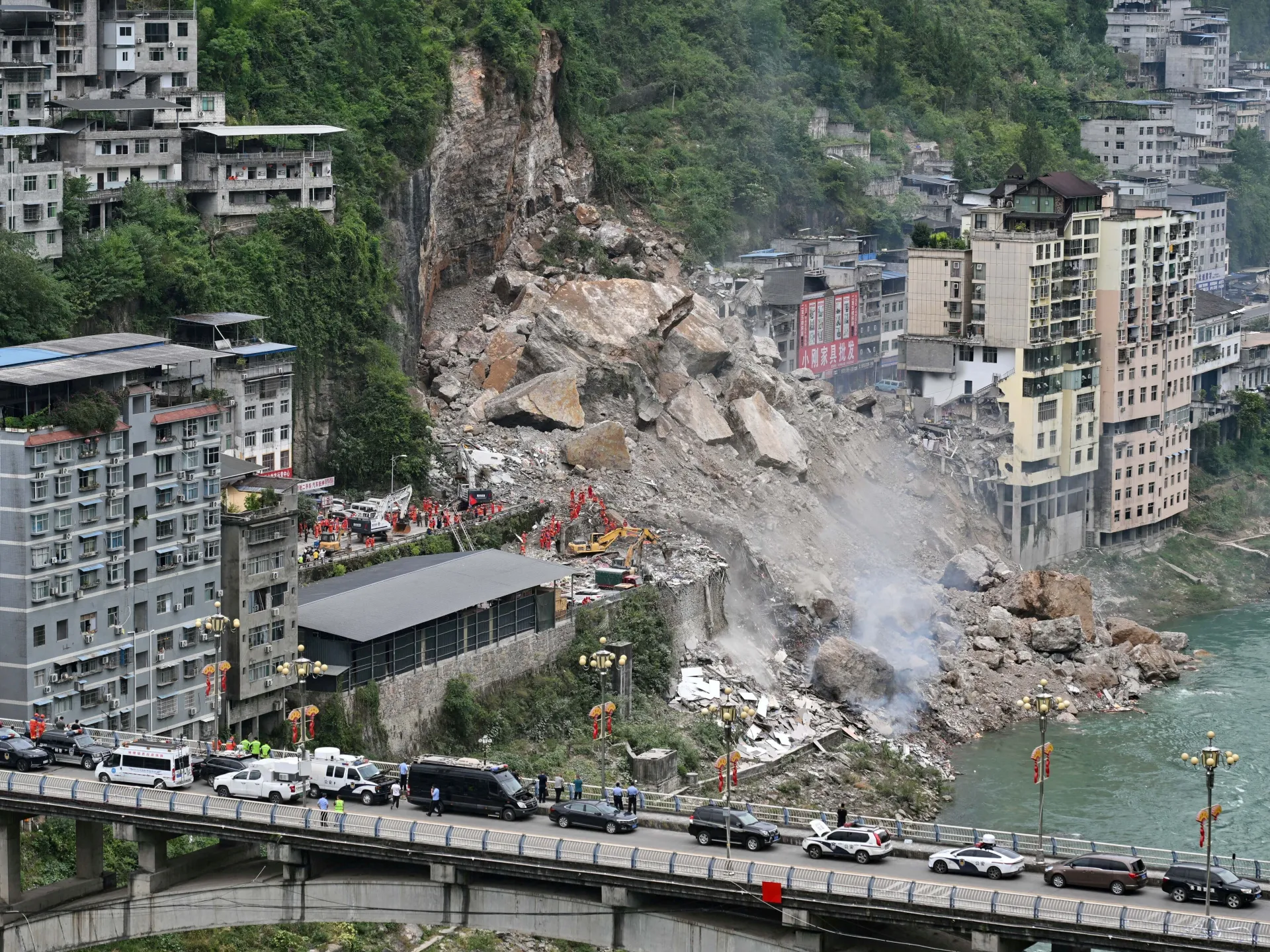
A landslide on the outskirts of the southwestern Chinese city of Chongqing has killed at least eight people and left 34 missing. 10 residential buildings have been buried, forcing more than a thousand residents to evacuate.
Industry Minister Kim Jung-kwan announces semiconductor investment projects during an investment briefing meeting chaired by President Lee Jae Myung at Cheong Wa Dae in Seoul on Monday. Pool photo by Yonhap
South Korea plans to develop a new semiconductor production base in the country’s southwestern region through 800 trillion won (US$517.9 billion) in corporate investments that will create four memory chip fabrication plants, Industry Minister Kim Jung-kwan said Monday.
Kim unveiled the investment plan to transform the Gwangju and Jeolla regions into the nation’s second major semiconductor cluster, alongside the existing hub in the Seoul metropolitan area, during a national investment briefing chaired by President Lee Jae Myung at Cheong Wa Dae.
“Relying on a single production base in the Seoul metropolitan area is no longer sufficient to meet surging semiconductor demand,” Kim said, noting that constraints on power and water resources limit further expansion under existing plans.
The semiconductor investment is part of the government’s “three mega projects” initiative, which calls for large-scale investments by chip giants Samsung Electronics Co. and SK hynix Inc., as well as other companies, in semiconductors, physical artificial intelligence (AI) and AI data centers.
Kim said the Chungcheong region will be developed into an advanced semiconductor packaging hub through 81 trillion won in investment to meet growing packaging demand as chip production expands, while the Daegu and North Gyeongsang regions will be fostered as innovation hubs for semiconductor materials, components and equipment.
He added that the government will help companies accelerate semiconductor investment by bringing forward the construction schedule for new fabrication plants by as much as 12 years, from the mid-to-late 2040s to the mid-2030s.
To support the expansion, the government vowed to streamline permits and construction procedures while investing in critical infrastructure, including electricity and industrial water supplies.
At the meeting, attended by Samsung Electronics Chairman Lee Jae-yong and SK Group Chairman Chey Tae-won, Kim outlined a government-industry plan to invest 30 trillion won over the next 15 years to support the entire semiconductor value chain, from research and development and chip design to testing and manufacturing.
The ambitious industrial blueprint is aimed at transforming the country from a global manufacturing powerhouse into a leader in the artificial intelligence era, anchoring its strategy on semiconductors, AI infrastructure and physical AI.
For the robotics sector, Kim said the government will foster an AI-powered robotics industry to strengthen South Korea’s manufacturing competitiveness in the intensifying global competition.
Kim warned that China has already begun mass-producing humanoid robots through regional manufacturing hubs, underscoring the need for South Korea to accelerate the commercialization and mass production of its own humanoid robots.
“We must accelerate the foundation for mass production,” Kim said, adding that the government plans to create early domestic demand by procuring humanoid robots for education, defense and disaster response.
The initiative aims to raise South Korea’s share of the global humanoid robot market from just 1 percent last year to 20 percent over the long term.
As the third pillar of the strategy, Minister of Science and ICT Bae Kyung-hoon outlined a plan to expand the nation’s AI data center infrastructure, emphasizing that ample data is important for South Korea to secure a leading position in the global physical AI race.
“The next three years will be the golden time to become No. 1 in the area of physical AI,” Bae said. “The government will lead the physical AI sector, by designating it as a national strategic industry.”
Under the plan, an initial investment of 550 trillion won will be spent to build 8.4 gigawatts (GW) of AI data centers by 2029. The ministry will gradually expand the infrastructure by 10 GW until 2035, Bae said.
To support the initiative, the government pledged to ensure adequate supplies of electricity and industrial water, and strengthen power infrastructure around existing semiconductor clusters.
Once the data infrastructure is in place, the science ministry plans to develop a general-purpose foundation model for physical AI in the next three years, based on a world model, or AI tools that understand the dynamics of the real world.
Copyright (c) Yonhap News Agency prohibits its content from being redistributed or reprinted without consent, and forbids the content from being learned and used by artificial intelligence systems.
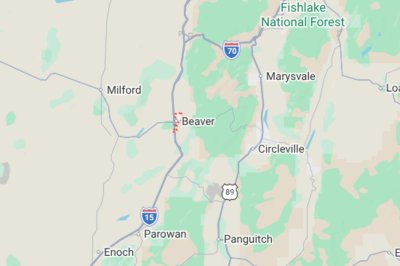
A wildfire that started in Beaver, Utah, has prompted the National Weather Service to issue warnings about its potential spread. Photo by Google Maps
June 26 (UPI) — The National Weather Service on Friday evening issued its first Dangerous Situation Red Flag Warning in the history of Salt Lake City, Utah, based on concerns about rapid growth of wildfires in the state.
NWS issued warnings for an area in southwest Utah that it considers to be in significant danger based on ongoing wildfires and weather conditions, the agency said in a series of posts on X.
NWS has predicted low humidity levels — less than 10% — and wind gusts of at least 50 miles per hour, which could help to grow the Cottonwood Fire, which has already burned nearly 72,000 acres, KSL-TV reported.
The fire started Monday near Beaver, Utah, before spreading to cover more than 70,000 acres as gusty winds and dry conditions helped the flames to spread, NBC News reported.
“This is the first formal PDS Red Flag Warning we’ve issued since it was formalized by NWS,” the agency said in a post on X.
“This is the first time we’ve reached the Weather Risk Outlook level of ‘Extreme,'” NWS said of the language it has not used in a notification since 2021. “In short, this combinaton of high winds, low humidity, very dry fuels and a large fire is a rare and dangerous situation!”
Utah this year experienced its lowest-ever snowpack and a heatwave that started in March prompted Utah Gov. Spencer Cox to sign an executive order limiting fireworks celebrations throughout the state through July 5.
Utah meteorologist Jason Stroud told The Washington Post that the warning, which has been in place for the last few days, that the danger from fires in the area could be devastating and potentially life-threatening.
“This shows that the combination of weather effects that are coming in the next 48 hours are extremely concerning,” Stroud said, reiterating that the fact that Salt Lake City’s NWS office has never issued the type of warning that is currently in effect.
The airline may now have to walk back its recently revised policy after significant backlash from some customers – it has been a point of contention for passengers online
Rachel Vickers-Price UK and World News Reporter
07:49, 29 May 2026Updated 07:50, 29 May 2026
(Image: Getty Images)
An airline that faced significant backlash for its controversial “customers of size” policy may now be forced to walk back on recent changes regarding plus-sized passengers.American commercial carrier Southwest Airlines changed its Customer of Size policy in January, when the airline moved to assigned seating. The updated guidelines require travellers who were unable to fit between lowered armrests to buy a second seat ahead of their journey. Passengers arriving without a prior reservation for an extra seat faced being rebooked if the flight reached capacity, or they were compelled to pay high same-day prices for the additional space.
But on Tuesday (May 26), one TikTok user reported to have been told “the best news ever” by a Southwest gate agent.
Content cannot be displayed without consent
In the short social media clip, the traveller claimed Southwest is “rescinding at least part of their new customer of size policy” that went into effect at the start of year. January. “They will be changing back to the original policy, at least in some form, where you can come into the airport and get an additional seat booked for you at no cost,” the woman in the video claimed. “You will no longer have to pre-purchase the seat.”But, as per a statement shared with Newsweek, the airline recently said: “On flights where seats are available, our agents at the airport are empowered to provide an additional seat at no extra cost to customers who require one.”
The statement added: “If another seat is not available., we will work to accommodate the customer on a later flight. We continue to encourage customers who need an additional seat to book it in advance to help alleviate any last-minute inconvenience at the airport.” The statement to Newsweek left several questions unanswered, specifically regarding the timeline for these implementations and whether passengers who choose to pre-purchase an additional seat would remain eligible for refunds.