southern california

LAX’s long-delayed people mover: The little engine that can’t

In the summer of 1957, Walt Disney spotted a monorail in Europe and decided he’d like to have one of his own. Design and construction began in 1958, and the following year, Disneyland had a monorail.

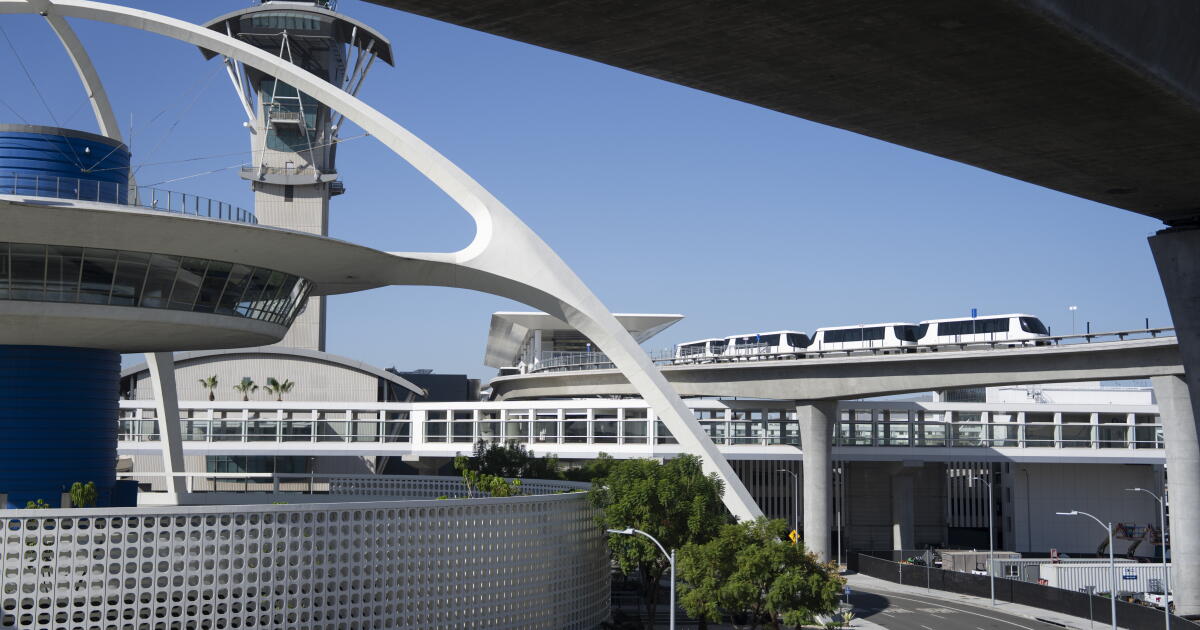
The LAX SkyLink people mover was approved by the L.A. City Council in 2018 and construction began in 2019, with a targeted completion date of 2023. In the latest news of yet another delay, the hoped-for startup has been pushed into next year.

Almost eight years, and the train has not left the station.

It’s the little engine that can’t.

The people mover that doesn’t.

There’s been finger-pointing, litigation and a grand jury probe into how a $1.9-billion choo-choo has become a $3.3-billion boondoggle.

Maybe they should have hired Disney.

“Tell me about it,” said Los Angeles City Councilmember Monica Rodriguez, who noted that Disney imagineer Bob Gurr, who helped design the monorail and other iconic Disneyland attractions, lives in her district.

I’m waiting to hear back from Gurr, who’s in his mid-90s, to see if he’s available to work a little magic and help get the people mover moving.

“I’m down with that,” Rodriguez said. “And we get an E Ticket ride.”

To fully appreciate the madness, a bit of historical context is helpful.

Given the region’s legendary traffic, a well-designed transit system has always made sense in Southern California, and billions of dollars have been invested, with quite a bit to show for voter-approved sales tax increases with Measures R and M and boatloads of federal dollars.

But the ride has been bumpy.

In the 1990s, the Green Line, as it was then known, was supposed to go to the airport.

It stopped two miles short.

The rail line known as the purple, or the D, was sometimes referred to as the Subway to the Sea.

But even if its next phase is ever completed, it would stop about 3.5 miles short of the beach. (You can, however, take the E Line to downtown Santa Monica.)

Meanwhile, as The Times’ Colleen Shalby just reported, construction is beginning this week on the Van Nuys-Pacoima light rail line.

Only five years behind schedule.

And the cost has gone from $1.3 billion originally to almost $4 billion.

Are you catching on to a pattern here?

And these are not rocket launches we’re talking about. A light rail line. A people mover.

We’re in California, which has a Silicon Valley and Silicon Beach and a few remnants of the aerospace industry, but we can’t get Joe Blow from the Hertz rental lot to an airport terminal in less than eight years?

Meanwhile, the Vision Zero plan introduced 11 years ago by then-Mayor Eric Garcetti, with a goal of eliminating traffic deaths with roadway design and safety improvements, has fallen far short. As Damian Kevitt of Streets Are for Everyone told Shalby, for three years running, L.A. has had more traffic fatalities than homicides.

“The rest of the world has seen a decrease in traffic deaths,” Kevitt told me. “There are ways to do this, and we run into roadblocks. … It’s lack of leadership … at every level. … To me, the people mover is almost an indicator of systemic issues across the city.”

L.A. Mayor Karen Bass is the chair of Metro and appoints airport commissioners. So unsurprisingly, Councilmember Nithya Raman, her challenger in the mayoral campaign, is going after her on the people mover debacle and other transportation shortcomings.

Bass says the LAX project began before she took office, and regarding disputes that led to delays, “we pushed for a settlement so there would be a firm finish line.”

That’s weak.

There’s never been a firm finish line.

It’s like every other major public project in L.A. and beyond. They come with no firm starting time and no firm completion date, and the only two guarantees are that the tab will keep growing, and when the job finally is complete, public officials will take bows at the ribbon cutting.

So what happened in the case of the people mover?

The grand jury report goes into great detail about an arrangement in which L.A. World Airports awarded designing, building and operating authority to a private contracting consortium called LINXS, for LAX Integrated Express Solution.

Are you comfortable with that? Can you understand why anyone would be, other than the contractors?

The grand jury found no criminal activity on anyone’s part, but you’ll be shocked to know there was a considerable amount of eyebrow-raising behavior. The contractor has sued the city, blaming it for delays, but the grand jury suggested it was the contractor who caused the delays, essentially holding out for payment of $550 million in settlement claims.

It’s as if city officials, who missed out on having the project done in time for the World Cup matches, were easy marks, desperate to make sure the trains are running at least by the 2028 Olympics.

We could have flying taxis by then, but no airport locomotive. This would not be a good look.

Rodriguez, who initially voted no on the upcoming convention center expansion project, said she was explicit about one concern she had regarding that public-private partnership.

“Whatever contract language was in the people mover contract, make sure it’s not in the convention center project,” she said.

“This is an embarrassment, by all means,” said James Moore, emeritus engineering professor at USC.

Although the people mover — which would finally make it possible for rail passengers to connect to LAX — is only 2.25 miles long, it’s a sophisticated feat of engineering. But, as Moore noted, countless airports around the world have figured out how to get the job done.

“Should it have taken this long? No,” Moore said. But “when anything goes right in Los Angeles, that’s when I’m surprised.”

Paging Bob Gurr, Disney designer extraordinaire.

We need your help, Bob, and you can name your price.

Money appears to be no object.

steve.lopez@latimes.com

Source link

L.A. Chargers vs. Kansas City Chiefs: How to watch, start time, odds

p]:text-cms-story-body-color-text”>

Six weeks into the NFL season and Chargers versus the Kansas City Chiefs pits a winless team against an unbeaten one. Last season, when the Chargers swept the Chiefs, feels like a lifetime ago.

This game might not be as lopsided as it appears, considering these teams know each other so well. But these are rough times for the Chargers, who are still missing their two starting tackles and All-Pro safety Derwin James Jr. What’s more, it has been a terrible start for Justin Herbert, who has five touchdowns, seven interceptions, an anemic passer rating of 70.2 and has been sacked 17 times.

Conversely, Chiefs quarterback Patrick Mahomes is on a roll despite returning from last season’s devastating knee injury. He has nine touchdowns, two interceptions, a 106.2 rating and six sacks — almost two-thirds fewer than Herbert.

A big battle for Los Angeles will be on defense, as the Chargers have done a good job against the run and are facing Kansas City’s Kenneth Walker III, who has rushed for 537 yards at an average of 6.2 yards per carry.

Source link

Prep talk: Southern California has long history of sending officials to NFL, college

Jimmy Crowley, the son of former Southern Section commissioner Dean Crowley, had a Friday night off from officiating Big Sky Conference football games, so he went to St. John Bosco last week to evaluate the high school officials for a game against Orange Lutheran.

Southern California high school football games have been used as a proving ground for years and a first stop for officials wanting to move to college and the NFL.

It used to be that the commissioners in the City Section and Southern Section were high school or college officials. Jim Cheffers, a former City Section commissioner, used to officiate in the Pac-8. Now his son, Carl, is one of the top NFL referees and has worked three Super Bowls.

Tony Corrente, a former baseball coach at La Mirada who won a CIF title in 1988, made it to the NFL for 26 years as an official and was referee for Super Bowl XI. Former Hollywood High principal Jim Tunney was a long-time NFL referee.

While fans sometimes don’t appreciate officials, in Southern California high school football, you might be watching a future college or NFL referee.

This is a daily look at the positive happenings in high school sports. To submit any news, please email eric.sondheimer@latimes.com.

Source link

Chargers vs. Seahawks: How to watch, prediction, betting odds

p]:text-cms-story-body-color-text”>

His right arm is unquestionably superb, but does Justin Herbert have two left feet?

NFL linebacker-turned-anayst Tedy Bruschi pondered as much this week in breaking down why the relationship between the Chargers’ quarterback and offensive coordinator Mike McDaniel has yet to click.

“I want to know if Justin Herbert can dance,” the impassioned Bruschi said on ESPN. “Really, like dance on a dance floor. Does he have rhythm?”

Because, Bruschi said, quarterback Tua Tagovailoa seemed much more attuned to McDaniel’s offense when the two teamed up for the Miami Dolphins.

“When Tua ran this offense, he was dancing,” Bruschi continued. “All the fakes, all the rhythmic, on time, left-handed. I mean, you would watch Tua and it was like boom, boom, boom, boom, gone [throwing an imaginary football]. He was dancing back there in the pocket. It was smoke and mirrors. That, at its best, is what this system is.

“And you’ve got a cyborg back there [in Herbert], a quarterback who can do everything under the sun, and now he has to learn to dance? ‘No, man, I don’t dance. I play football.’ So there’s just a little bit of conflict going on.”

The Chargers are 0-3 and Herbert has yet to hit his stride heading into Sunday’s game at Seattle. He has three touchdowns, four interceptions and a ho-hum passer rating of 73.4 after never finishing a season with a rating lower than 93.2. Granted, it’s early and there’s plenty of time for him to course correct, and his receivers have had several key bobbles and drops. But the schedule doesn’t get any easier soon for the Chargers, whose next games are against Denver, Kansas City, the Rams, Houston and Baltimore.

In short, the Chargers had better learn to navigate that dance floor. The night is not so young anymore.

Source link

Iconic SoCal bookstores Vroman’s and Book Soup have a new owner

Stalwart bookstores Vroman’s in Pasadena and Book Soup in West Hollywood announced new ownership on Thursday, after a two-year search for a buyer.

Longtime owner Joel Sheldon, whose family has helmed Vroman’s for more than a century, announced his retirement in 2024. At the time, Sheldon said he was looking for “someone who shares our core values and who is committed to preserving Vroman’s as a community treasure.”

Sheldon said he found that in the new owner, Robert Hoffman, who has worked on tech regulation and other public policy in Washington, D.C., for several decades, but who grew up in Southern California with his family living in the area for generations.

“After talking with Robert and his family, I knew we had found the right stewards. They understand what makes this store special, and they’re committed to preserving that legacy while moving Vroman’s forward for our customers and the Pasadena community,” Sheldon said in a statement posted Thursday to the bookstore’s website.

Hoffman was born in Pasadena and has been visiting Vroman’s since his mother brought him in when he was 5 years old, according to the Thursday announcement.

His mother, in turn, had been introduced to the store by her grandmother, Georgia Bullock, a decades-long Pasadena resident and the first woman to serve as a municipal and superior court judge in California.

Hoffman was born in Pasadena and attended UCLA. He currently heads government relations and regulatory affairs at semiconductor company Advanced Micro Devices, according to his LinkedIn page.

Book Soup, a Sunset Boulevard landmark, was founded in 1975 by Glenn Goldman, a UCLA graduate student who raised investments with his friends to establish the store. Goldman died in 2009 at age 58, and Sheldon acquired the store from Goldman’s estate that year.

A post to Book Soup’s Instagram page said Hoffman and his family are “genuinely invested in this community.”

“Same shelves, same staff, same WeHo icon. Same gratitude for you,” the bookstore said in the social media post.

Vroman’s was founded in 1894 by Adam Clark Vroman, an ex-railroad worker from Illinois who moved to California hoping the sunny weather would improve his wife’s health. His wife eventually died of tuberculosis, and a brokenhearted Vroman, a bibliophile, sold off a chunk of his vast book collection to collect capital to open the store. The Sheldon family stewarded the store after Vroman’s death in 1916.

Vroman’s catered to various clientele and communities, from traveling dignitaries to academics and leisure readers on vacation. When the federal government incarcerated Japanese Americans from the San Gabriel Valley and elsewhere in the 1940s, an activist lugged books from Vroman’s to the Manzanar camp in the Owens Valley. Science fiction author Octavia Butler, who grew up in the area, frequented the bookstore.

Vroman’s second location in Hastings Ranch was forced to close in 2024 after the company was unable to reach a new lease agreement with the property owner. The store was otherwise sustainable, but was forced to close “due to increasing occupancy expenses,” the company wrote in a social media post at the time.

Vroman’s flagship location on Colorado Boulevard remains open. However, the property itself changed hands, with Sheldon selling it to GD Realty Group for $15.5 million amid uncertainty about its future.

The bookstore has a long-term lease with the real estate group, whose chief executive, Arash Danialifar, said in a statement last year to news outlet Pasadena Now that the bookstore was a “staple of the community” and that he hoped it would remain there “for the foreseeable future.”


Source link