Russia’s policy towards Southeast Asia is undergoing a remarkable adjustment period. From focusing on defense cooperation, which has been its traditional strength, Russia is gradually shifting its focus to more sustainable areas. This shift reflects Russia’s flexible efforts to maintain its presence in a region strongly affected by great power competition, while demonstrating its ambition to position itself as a reliable and independent partner, contributing to the balance of influence against the expanding US involvement in the Indo-Pacific.
From diplomatic presence to substantive cooperation
For many years, Russia’s Southeast Asia policy has been largely confined to diplomatic presence and participation in ASEAN-led multilateral forums. However, in the wake of Trump 2.0’s tariff adjustments, Moscow has increasingly recognized Southeast Asia as a potential market to fill the economic void left by sanctions. This realization has led to more proactive and substantive shifts in Russia’s regional policy.
Since the beginning of 2025, Russia has stepped up bilateral cooperation with key ASEAN economies such as Indonesia, Vietnam, and Thailand, focusing on areas that the US and China have not yet focused on competing in, such as oil and gas exploitation, agriculture, and civil nuclear power. At the same time, Russia has also expanded its network of embassies, cultural centers, and trade promotion agencies in most ASEAN countries, thereby creating a multi-layered approach from politics to economics.
One of the most notable changes is the shift of Russia’s traditional trade to non-dollar payment mechanisms to minimize the risk of sanctions. According to statistics from the Russian Ministry of Economic Development, in 2024, trade turnover between Russia and ASEAN reached a record for the second consecutive year, increasing by 5.8%. Over the past decade, trade turnover has increased by 70%, with most transactions being settled in local currencies or currency swaps. At the same time, Southeast Asia is also a potential area to promote exports of liquefied natural gas (LNG), fertilizers, and military materials, helping to reposition Russia as a stable energy supplier.
Diversifying partners outside of China
The trend of diversifying partners beyond China has emerged as a new driving force in Russia’s Southeast Asia policy. After years of relying on the Chinese market as a “lifeline” for its wartime economy, Russia has increasingly recognized the asymmetry in its trade relations as China has gradually gained an overwhelming position. This has forced Russia to rebalance its dependence and expand its influence by seeking alternative partners.
The “multi-directional” policy that Russia is implementing is clearly demonstrated through the strengthening of bilateral economic relations with a number of countries in the region. According to Russian Deputy Foreign Minister Andrey Rudenko, the international situation is opening up many new opportunities for Russia to strengthen relations with the region of more than 650 million people. On the contrary, from the perspective of ASEAN, cooperation with Russia has its own appeal, because investment capital from Russia is considered less politically binding than the “debt trap” risks often associated with projects within the framework of China’s Belt and Road Initiative (BRI). However, limited financial resources have caused this direction of Russia to largely stop at the level of framework agreements or projects waiting to be launched.
In addition, Russia has also proposed establishing cooperation mechanisms focusing on less sensitive areas such as maritime security, counter-terrorism, and disaster relief. Although these initiatives have not yet reached the institutional level, they reflect Russia’s efforts in the regional innovation race with the US and China.
Connecting Southeast Asia to the Eurasian Axis and the Global South
Since launching the “Pivot to the East” policy in 2014, Russia’s strategic interests have gradually shifted from the European region to a vision of Eurasian integration. While in the early stages, this policy was mainly aimed at demonstrating efforts to “pivot” according to the trend of global power shifts; entering the 2020s, Russia has concretized its orientation with in-depth initiatives.
Following the Free Trade Agreement between the Eurasian Economic Union (EAEU) and Vietnam in 2015, Russia continued negotiations with Indonesia and Thailand, aiming to form an economic network that is less dependent on the dollar system. Russia is also promoting initiatives for the construction of a connecting corridor between the Russian Far East and Central Asia with maritime routes in the Indian Ocean and the Pacific Ocean. Speaking at the International Conference on Eurasian Security in Minsk, Belarus, on October 28, 2025, Russian Foreign Minister Sergey Lavrov emphasized that Russia wants to build a common development structure for the entire region and does not exclude any country on this continent. Transcontinental connectivity projects such as the Vladivostok-Chennai transport corridor or the Asia-Europe maritime and air route are integrated by Russia into its vision of an expanded Asia-Europe economic space, reflecting its efforts to bring Southeast Asia into the Russia-led “Greater Eurasia” strategy.
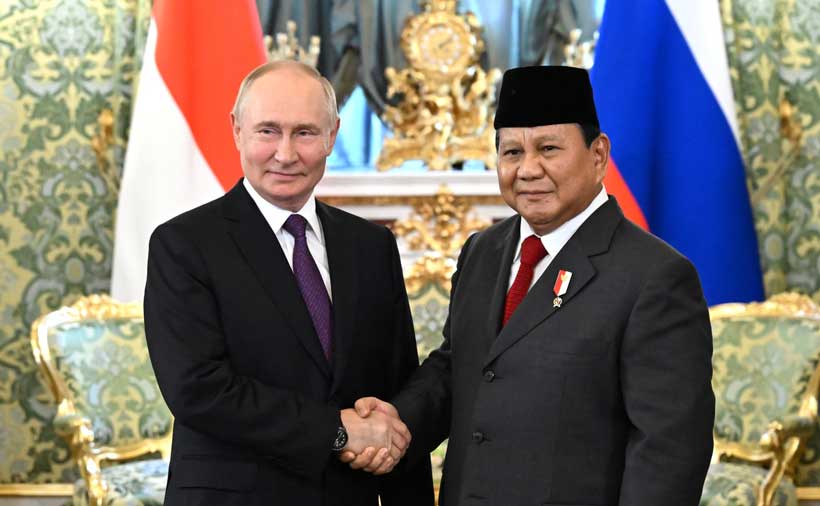
At the same time, Russia has been actively promoting the “multipolarization” discourse through mechanisms such as BRICS and the Shanghai Cooperation Organization (SCO), in collaboration with China and India, to strengthen the image of a post-Western order. Russia’s support for Indonesia’s entry into BRICS not only reflects the group’s efforts to expand its sphere of influence but also demonstrates Russia’s strategy of integrating Southeast Asia into the emerging South-South partnership network. Through this, Russia wants to demonstrate its flexible integration into the Asia-Pacific region while also being a voice to show that Russia is not isolated in the process of restructuring the global order.
Taking advantage of ASEAN principles
One of the factors that helps Russia maintain a stable position in Southeast Asia is its ability to effectively exploit ASEAN’s neutral space. Unlike the US or China, which often pursue a strategy of competing for influence by “choosing sides” under pressure, Moscow chooses a flexible approach based on the principle of non-interference in ASEAN’s internal affairs and consensus.
Thanks to these principles, Russia’s participation in ASEAN-led multilateral mechanisms is not interpreted as an attempt to form political alliances or challenge the existing order, but on the contrary, is seen as consistent with the spirit of openness and inclusiveness. It is ASEAN’s neutral space that provides Russia with access in a variety of roles, from observer to dialogue partner to direct participant, thereby legitimizing Russia’s presence in Southeast Asia.
In fact, Russia actively participates in ASEAN-led mechanisms such as the ASEAN Regional Forum (ARF), the ASEAN Defense Ministers Meeting Plus (ADMM+), and the East Asia Summit (EAS) to promote cooperation in less sensitive areas, helping Russia both strengthen its image as a constructive contributor and avoid creating suspicion from the West.
Rebooting defense and energy diplomacy
Through the two pillars of defense and energy, Russia has put into its foreign policy to reaffirm its position. These are considered the spearheads by which Russia still maintains its most substantial competitive capacity compared to the US.
In the defense sector, Russia is restoring bilateral cooperation with traditional partners such as Vietnam, Laos, Myanmar, and Indonesia. Previously, Russia accounted for about 25% of the arms market share in Southeast Asia, maintaining its position as the largest supplier in the region. However, instead of continuing to rely on sales contracts, Russia is now focusing on expanding the “after-sales” sector, such as training, maintenance, technology transfer, and joint research in the defense industry. At the multilateral level, Russia actively participates in high-level defense dialogue mechanisms such as ADMM+ and ARF to demonstrate the voice of a responsible partner, promoting peace and stability in the region.
Along with defense, Russia considers energy a common concern to expand its influence in Southeast Asia. Russia takes advantage of its deep-sea oil and gas exploitation techniques and develops nuclear power technology to strengthen cooperation with developing economies with large energy consumption needs. Leading energy corporations such as Zarubezhneft and Rosatom have been cooperating with Vietnam in gas exploitation projects on the continental shelf of the East Sea. Russia also boosts LNG exports to Thailand and the Philippines to expand its market share in the region while cooperating with Indonesia’s Pertamina Group in developing petrochemical refining and building civil nuclear energy infrastructure. These steps reflect Moscow’s efforts to establish an Asian energy supply chain to replace the disrupted European market.
Position on the East Sea dispute
Russia’s stance on the East Sea dispute is clearly cautious. Basically, Russia supports the settlement of disputes by peaceful means based on international law and the 1982 United Nations Convention on the Law of the Sea (UNCLOS), while emphasizing the central role of ASEAN in conflict management. Unlike the US, which always emphasizes the issue of freedom of navigation, Russia chooses the role of a “balancing third party,” maintaining cooperative relations with all parties. However, Russia also avoids making specific statements regarding China’s sovereignty claims in order not to harm the Russia-China relationship, which is currently the leading pillar of its foreign policy.
In addition, Russia also supports the early completion of the Code of Conduct in the East Sea (COC), considering it an important tool to maintain stability and calling on all parties to exercise restraint. Instead of directly engaging in disputes, Russia maintains its presence through limited oil and gas cooperation within the exclusive economic zone (EEZ), demonstrating Russia’s commitment to the legitimate sovereignty of its partner countries. At the same time, participating in joint exercises with ASEAN countries also helps Russia affirm its image as a responsible power, promoting trust and the ability to coordinate security at sea.
However, Russia’s influence in the South China Sea is still limited. The war in Ukraine has significantly reduced the frequency of Russian military patrols in the region. In addition, the increasingly close relationship between Moscow and Beijing has also made some ASEAN countries cautious, worried that Russia’s “neutrality” could be broken.
The adjustments in Russia’s Southeast Asia policy clearly reflect Russia’s efforts to adapt to a situation where it has to allocate resources to multiple goals. It is easy to see that Russia has chosen to shift from an ideological orientation to a pragmatic strategy, focusing on areas that can generate specific benefits. Instead of directly confronting the US or competing for influence with China, Moscow seeks to exploit gaps to position itself as a balancing factor.
Russia’s current Southeast Asia policy is a survival adaptation, reflecting a strategic effort to maintain influence in a regional structure that is reshaping under the pressure of US-China competition. Under increasing pressure from the US, Russia is forced to pursue a more autonomous path in Southeast Asia to maintain its strategic space. However, Russia’s influence is still limited by its internal capacity and competition from other powers. Russia may not be able to shape the rules of the game or lead the order, but it is certainly a factor that cannot be left out of the Southeast Asian strategic chessboard.