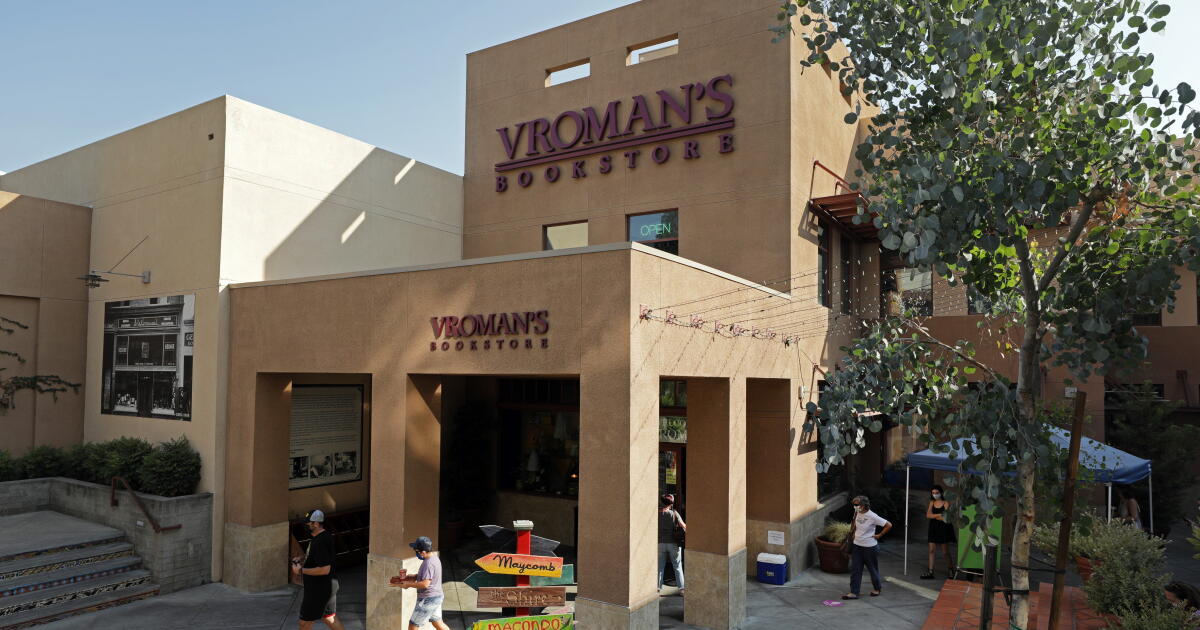
Iconic SoCal bookstores Vroman’s and Book Soup have a new owner
Stalwart bookstores Vroman’s in Pasadena and Book Soup in West Hollywood announced new ownership on Thursday, after a two-year search for a buyer.
Longtime owner Joel Sheldon, whose family has helmed Vroman’s for more than a century, announced his retirement in 2024. At the time, Sheldon said he was looking for “someone who shares our core values and who is committed to preserving Vroman’s as a community treasure.”
Sheldon said he found that in the new owner, Robert Hoffman, who has worked on tech regulation and other public policy in Washington, D.C., for several decades, but who grew up in Southern California with his family living in the area for generations.
“After talking with Robert and his family, I knew we had found the right stewards. They understand what makes this store special, and they’re committed to preserving that legacy while moving Vroman’s forward for our customers and the Pasadena community,” Sheldon said in a statement posted Thursday to the bookstore’s website.
Hoffman was born in Pasadena and has been visiting Vroman’s since his mother brought him in when he was 5 years old, according to the Thursday announcement.
His mother, in turn, had been introduced to the store by her grandmother, Georgia Bullock, a decades-long Pasadena resident and the first woman to serve as a municipal and superior court judge in California.
Hoffman was born in Pasadena and attended UCLA. He currently heads government relations and regulatory affairs at semiconductor company Advanced Micro Devices, according to his LinkedIn page.
Book Soup, a Sunset Boulevard landmark, was founded in 1975 by Glenn Goldman, a UCLA graduate student who raised investments with his friends to establish the store. Goldman died in 2009 at age 58, and Sheldon acquired the store from Goldman’s estate that year.
A post to Book Soup’s Instagram page said Hoffman and his family are “genuinely invested in this community.”
“Same shelves, same staff, same WeHo icon. Same gratitude for you,” the bookstore said in the social media post.
Vroman’s was founded in 1894 by Adam Clark Vroman, an ex-railroad worker from Illinois who moved to California hoping the sunny weather would improve his wife’s health. His wife eventually died of tuberculosis, and a brokenhearted Vroman, a bibliophile, sold off a chunk of his vast book collection to collect capital to open the store. The Sheldon family stewarded the store after Vroman’s death in 1916.
Vroman’s catered to various clientele and communities, from traveling dignitaries to academics and leisure readers on vacation. When the federal government incarcerated Japanese Americans from the San Gabriel Valley and elsewhere in the 1940s, an activist lugged books from Vroman’s to the Manzanar camp in the Owens Valley. Science fiction author Octavia Butler, who grew up in the area, frequented the bookstore.
Vroman’s second location in Hastings Ranch was forced to close in 2024 after the company was unable to reach a new lease agreement with the property owner. The store was otherwise sustainable, but was forced to close “due to increasing occupancy expenses,” the company wrote in a social media post at the time.
Vroman’s flagship location on Colorado Boulevard remains open. However, the property itself changed hands, with Sheldon selling it to GD Realty Group for $15.5 million amid uncertainty about its future.
The bookstore has a long-term lease with the real estate group, whose chief executive, Arash Danialifar, said in a statement last year to news outlet Pasadena Now that the bookstore was a “staple of the community” and that he hoped it would remain there “for the foreseeable future.”