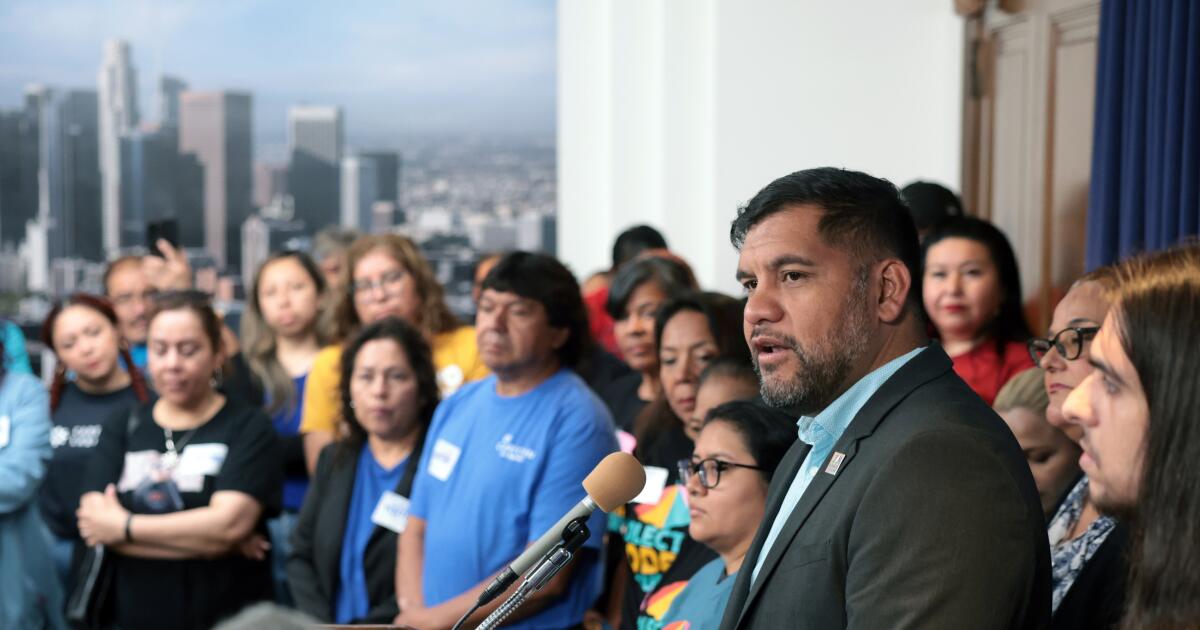
Noncitizen voting was gaining steam in L.A. Then fears of Trump backlash scuttled the plan
It was a traumatic moment for much of Southern California, as federal immigration agents snatched undocumented workers from car washes, garment factories and Home Depot parking lots.
Angelica Salas, who heads one of Los Angeles’ most influential immigrant rights groups, met regularly last summer with City Councilmember Hugo Soto-Martínez — himself the son of Mexican immigrants — as they formulated a response. The two kept circling back to a singular issue: the lack of political power wielded by noncitizens.
“A lot of this is happening because immigrants don’t have the right to vote,” said Salas, executive director of the Coalition for Humane Immigrant Rights.
Those conversations helped fuel Soto-Martínez’s decision in late April to push for a ballot proposal aimed at giving noncitizens the right to vote in city and school district elections. The proposal quickly gained momentum, with two-thirds of the council voting in mid-June to draft a measure for the Nov. 3 ballot.

Los Angeles City Council member Hugo Soto-Martínez attends a City Council meeting following elections at City Hall June 3.
(Etienne Laurent / For the Times)
But the effort collapsed on Tuesday, with the council reversing course and sending the proposal to a committee for more study. Before the vote, Soto-Martínez acknowledged that he had not performed sufficient outreach, particularly to the city’s Black community leaders.
By then, critics were accusing the council of failing to do its homework, leaving voters to fill in the blanks on such questions as whether undocumented immigrants would be covered by the expanded franchise. Some worried the proposal would endanger the very people it was designed to help, making them a fresh target for the Trump administration.
Even community leaders who have worked on civil rights issues were urging the council to slow down.
Mobilizing Preachers and Communities, a national nonprofit that represents clergy and civil rights advocates, asked for a delay, citing concerns about President Trump. Rev. K.W. Tulloss, the group’s western regional director, said he was also hearing concerns from Black residents and their religious leaders about the potential for weakening Black voting representation.
That, in turn, could reduce the overall number of Black elected officials in Los Angeles, he said.
“That’s a major concern among our community,” Tulloss said. “And we can’t be afraid to have that dialogue.”
In L.A., Black residents make up about 8% of registered voters, according to the Sacramento-based firm Political Data, Inc. That figure has been gradually declining over the past few decades. An influx of noncitizen voters — Latinos, Asians and others — could cause it to shrink even more.
At the end of the year, L.A.’s 15-member City Council will have two Black representatives, down from three, all in South L.A.-based districts. Two Latinos are running in this year’s election to replace Councilmember Curren Price, who is Black and retiring after serving the maximum three terms.
The county’s five-member Board of Supervisors has one Black member. Voters have given the go-ahead to add four more members, which some fear could leave the board with one Black member out of nine.
Tulloss said his organization supports creating a pathway to citizenship for the city’s undocumented immigrants. At the same time, he worried that Soto-Martínez’s proposal could in the short term divide Black and brown residents, who share a common struggle on a wide range of issues.
“At the end of the day, we don’t want any type of deal that will be divisive in the community,” he said.
Soto-Martínez, who represents an Echo Park-to-Hollywood district, said in an interview Wednesday that noncitizen voting was part of his platform when he first ran for City Council in 2022. He said he first thought about the issue seriously a decade ago, when San Francisco voters passed a measure allowing noncitizen parents to cast ballots in school board elections.
Since its formation, the United States has repeatedly redefined the right to vote, broadening it to include women, Black people and other groups, he said.
“To me, it just seemed very natural to expand it,” he said. “It’s part of our history.”
The idea of noncitizen voting has been circulating in L.A. for years. School board member Kelly Gonez persuaded her colleagues to begin exploring it in 2019. But the effort was set aside after the onset of COVID-19, which caused massive disruptions across the Los Angeles Unified School District, said Michael Trujillo, a political strategist for Gonez.
Last summer, as the Trump administration was launching immigration raids across Southern California, the city was convening a 13-member citizens commission to come up with proposals for rewriting the City Charter, L.A.’s governing document.
The commission took up noncitizen voting in March, narrowly rejecting it. Several commissioners said they were worried about unintended consequences, like the Trump administration taking aim at newly registered voters, said Raymond Meza, who served as the commission’s chair.
“I thought those concerns were not fully addressed,” Meza said, “so I actually switched my vote” and opposed the proposal.
A month later, with the deadline for placing items on the Nov. 3 ballot fast approaching, Soto-Martínez introduced a motion calling for a two-step process for expanding voting rights. First, voters would be asked to give the City Council the authority to grant noncitizens the right to vote.
The council would then examine the details surrounding the change before passing an ordinance expanding those voting rights.
Soto-Martínez said his motion was based on a simple idea: Those who live in the city, raise their families there and pay taxes “deserve to have a voice” in local decision-making. He did not offer many specifics, saying those would be worked out at a later date.
Critics, and even some supporters, said Soto-Martínez was making his move at the wrong time. Councilmember Monica Rodriguez, who voted against the proposal in mid-June, voiced fears that the list of noncitizen voters would immediately be seized by federal immigration authorities.
Former Los Angeles Mayor Antonio Villaraigosa said he opposes noncitizen voting in city elections. He does favor it for L.A. Unified — but only for parents of children attending those schools.
Villaraigosa, who led the city from 2005-13 and recently ran for governor, argued that this is not the right time to make even that change.
“With Trump ferreting through every record he can find looking for undocumented people, I just think it’s the wrong time,” he said. “I think these people would be exposing themselves to deportation, and the well-intentioned would be exposing them as well.”
Soto-Martínez portrayed such arguments as “fear mongering,” saying undocumented immigrants take risks every day in their quest to create a better future for their families.
Salas, the head of CHIRLA, echoed that idea.
“At end of day, we are already targets,” she said. “This is not going to make it worse. Don’t tell me voting against this was for the protection of immigrants.”
The Trump threat was not the only reason council members hesitated.
Rodriguez, who has expressed some interest in the proposal, said city leaders had not determined how county election officials would issue separate ballots for voters who would be barred from state and national contests. They also had not determined the cost of such a service, she said.
Twenty-two local jurisdictions across the country have approved and implemented noncitizen voting, according to Megan Dias, who is co-author of “Immigrant Voting and the Movement for Inclusion in San Francisco,” a report examining that city’s push to allow immigrants to vote in school board elections.
Dias said that backers of noncitizen voting need to build a broad coalition — grassroots organizations, election officials, lawyers for the city — before taking the proposal to voters.
Council President Marqueece Harris-Dawson said he is confident that noncitizen voting will get a much more extensive review in the coming months, and make the ballot in 2028. First, he said, the council will need to provide voters with specifics on how the changes would work.
Harris-Dawson said he heard from people who wanted more time to understand the proposal, to “make sure that it was done in a way that protected Black voting districts in particular.”
During the deliberations on the proposal, it also was not clear whether the change would apply to green card holders, recipients of Deferred Action on Childhood Arrivals or other categories of noncitizens.
“When something goes to the ballot, we need the details to be figured out — like how much something is going to cost, exactly how it’s going to work, and what the parameters are,” Harris-Dawson said. “All of that needs to be defined.”