I visited a unique British city which has plenty of character, a liberal vibe and a thriving art scene, but it’s often overshadowed by its posher neighbour

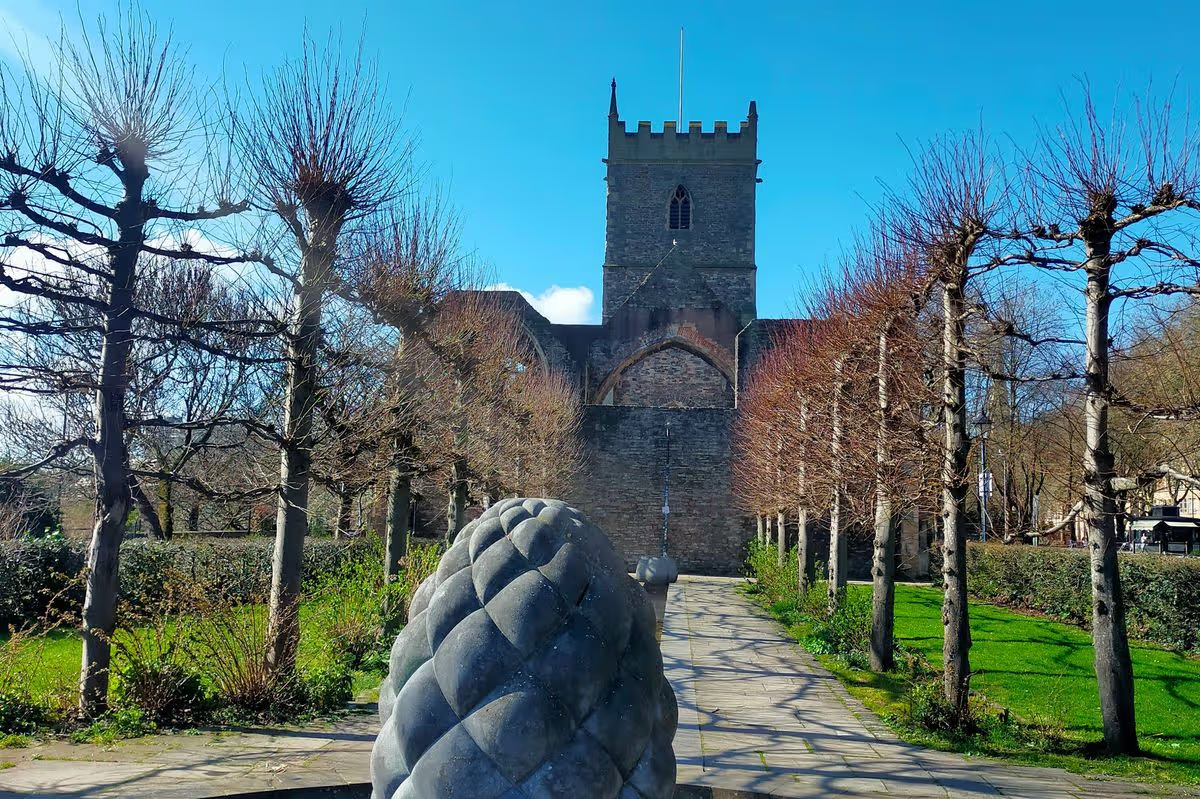
The city’s Castle Park is a relaxing place to spend time in(Image: Katie Oborn)
Britain boasts numerous cities waiting to be explored, and it’s remarkable how distinctive each one is, moulded by its heritage, residents, and surrounding terrain. I recently returned to a British city I’ve visited before, and whilst much has evolved in this vibrant metropolis over the years, it frequently gets overlooked because of its more celebrated neighbour.
I’ve been travelling to Bristol for several decades now, and the city conjures up warm memories of the Lakota nightclub from the late 1990s – the night spot is still open.
This urban centre has always possessed a rebellious “soul” with an independent spirit – and in recent years, the Green Party have effectively assumed complete control of Bristol City Council. During my visit to the city, I was struck by how spotless it was in the shopping area – and also how welcoming locals were.
As with everywhere else I’ve travelled to recently, there appears to be substantial construction underway in Bristol as the need for new housing continues to surge, but the city also boasts some striking, well-maintained period buildings.
I observed that many of the historic structures in Bristol were constructed from the same stone as those in the neighbouring city of Bath – and Bristol is frequently overshadowed when compared to the more conventionally picturesque city of Bath.
Nevertheless, Bristol possesses its own distinctive appeal and a progressive atmosphere, the city has a multicultural population alongside a flourishing arts culture, as well as some excellent retail and culinary destinations.
Bristol’s historic structures, constructed from a honey-hued limestone (referred to as Bath stone), contrast strikingly with the contemporary cityscape, whilst numerous modern buildings in Bristol have been decorated in vibrant colours, enhancing its distinctive charm.
A trip to Bristol can often prove more budget-friendly than Bath, and the city boasts excellent transport connections including a train service to London taking merely one hour and 30 minutes.
During my visit to Bristol I was accommodated at the Clayton Hotel on Broad Street, this four-star establishment occupies what was formerly a historic printworks location – with the structure dating back to approximately 1900.
The hotel’s striking Art Nouveau facade was created by William James Neatby, who served as the principal designer at Royal Doulton throughout the late 1800s to the early 1900s.
Broad Street itself proved fascinating, as upon exiting the hotel and glancing right, positioned just at the street’s end stood an ancient church, St Johns, which I’ve since learnt originates from medieval times and sits within the original city walls.
Visitors can pass through an archway of St Johns church (Nelson Street) to reach a main thoroughfare and considerably newer section of the city, creating the genuine sensation of travelling back in time; this district comprises Bristol’s old town.
Stumbling upon remnants of Bristol’s historic quarters is captivating, and nestled within the charming Castle Park in the city stands another church (St Peter’s) which traces its origins to the 11th century, encircled by a Physic Garden – and spending time here allows you to envision the lives that once unfolded in centuries past.
Today, Bristol city centre sits just 30 minutes from Bristol Airport with regular buses and coaches ferrying passengers back and forth – and there are rail connections or coaches to South West locations including Cornwall or Devon.
Many people mistakenly believe that Bristol sits within Somerset, but the city and its surrounding areas are actually an independent county corporate, established as far back as 1373, with a present-day unitary authority council.
The About Bristol website put it clearly: “Bristol is the largest city in the south west of England, with a population of approximately half a million.
“The city lies between Somerset and Gloucestershire and has been politically administered by both counties in part at various times. However, Bristol is historically a county in its own right and is properly entitled the City and County of Bristol.”
So what makes Bristol “better” than Bath, well there’s the Banksy claim to fame and the Banksy trail – and I’ve encountered a couple of these iconic works on previous trips.
Then there’s the nightlife. During this visit I attended an experimental gig at Strange Brew and the vibe was edgy yet inviting (that encapsulates Bristol perfectly I’d say).
Bath is undeniably a beautiful city to explore, but it exudes an air of affluence, whereas Bristol, rich in its own history, has a more down-to-earth vibe – and there are far fewer tourists to navigate around.
Indeed, Bristol made headlines in 2020 when a historical contentious bronze statue of Bristol-born slave trader Edward Colston was defaced and toppled during an anti-racism protest nearly six years ago – and this certainly raised some eyebrows at the time.
Those involved were making a stand and delivering a significant message, despite many labelling the statue’s toppling as vandalism at the time.
This act by protesters will also be etched in history as those responsible spotlighted Colston’s involvement in the Atlantic slave trade, in a manner that brought it to the attention of a wider audience – and I believe Bristol will always possess a rebellious spirit, it’s simply the nature of the city.