Clash between Inglewood and SoFi Stadium operators hits ballot
SoFi Stadium is going strong. The deal that built it is in a smoldering heap.
A decade ago, Rams owner Stan Kroenke and Inglewood Mayor James T. Butts Jr. happily dug ceremonial shovels into the dirt at Hollywood Park, celebrating the impending construction of the world’s most expensive stadium.

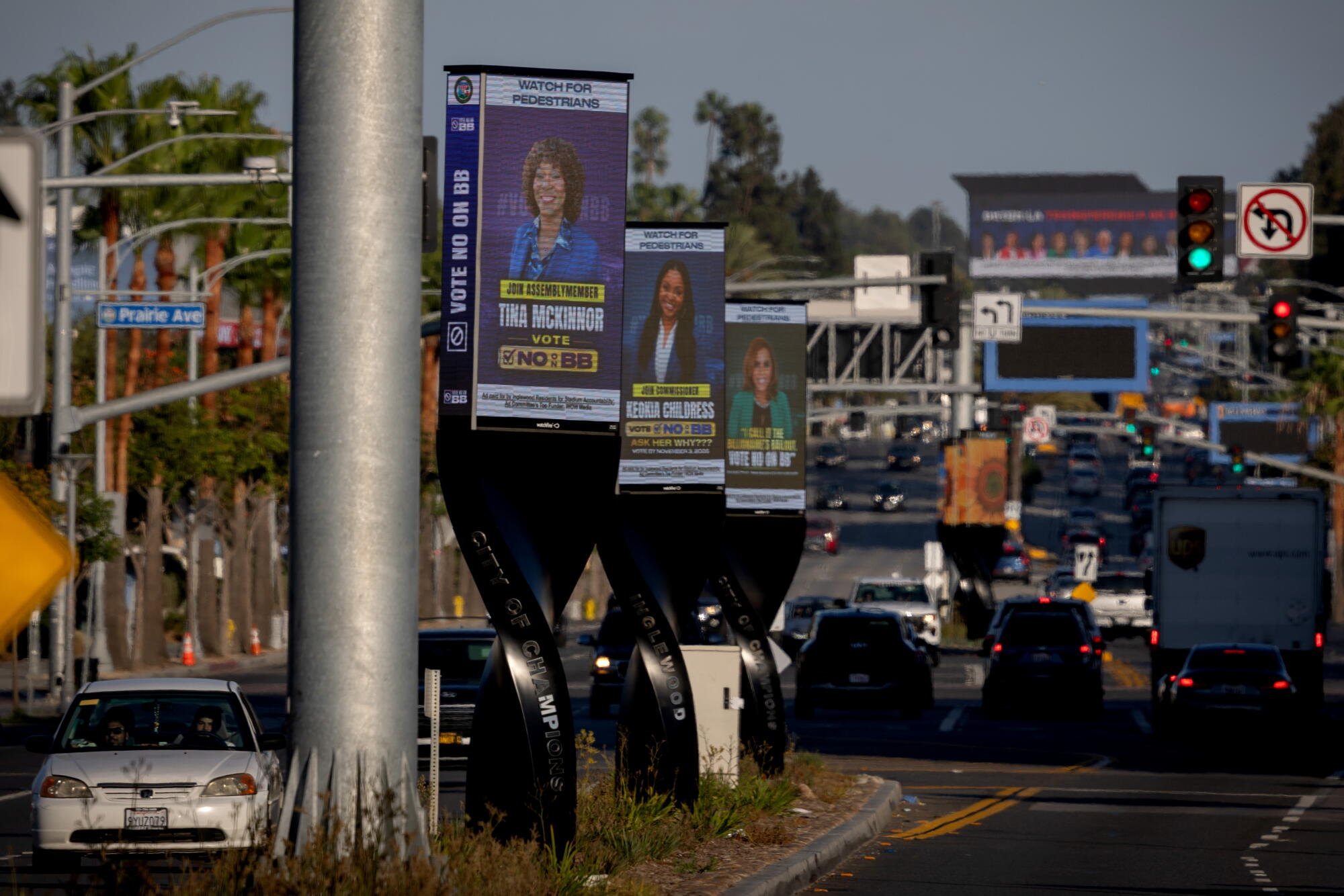
Electronic billboards are seen along Century Boulevard in Inglewood on Tuesday, Oct. 20.
(Eric Thayer / Los Angeles Times)
Now they’re on opposite sides of a court fight that has spilled onto the Nov. 3 ballot and threatens further development on the nearly 300-acre site.
The feud started over billboards. Last year, Inglewood signed a deal with WOW Media to put electronic advertising all around the city — 60 digital signs carrying 108 screens. Some are bus-shelter-sized kiosks, while others are street displays up to 22 feet tall and positioned on sidewalks and medians.
Those present problems for SoFi Stadium, Intuit Dome and the Forum because they have their own advertising deals and sponsors who paid for exclusivity. Those venues collectively sued Inglewood and WOW Media to block the deal, raising this scenario in a court filing: “Will Pepsi want to sponsor the Super Bowl, knowing Coca-Cola could pay WOW to put up full-motion billboards next to the stadium?”
Skip Miller, lead attorney for the city, said the kiosks are “quite nice and blend in with the surrounding areas,” and that they are connected to a network that provides critical traffic and safety information to thousands of drivers and pedestrians.
Electronic billboards are seen on along Century Boulevard on Tuesday, Oct. 20, 2026 in Inglewood, CA.
(Eric Thayer / Los Angeles Times)
A judge sided with Inglewood, and an appeal is under way.
In the meantime, those opposed to the billboards are taking it to the voters. On the ballot is Measure BB — as in “Billboard Blight” — which would restrict billboard advertising on public property. Miller said the city will challenge it in court if it passes, calling it free-speech discrimination.
The signs generate as much as $7.4 million a year, according to Inglewood budget records.
A consultant hired by the Yes on BB campaign estimated the city’s digital kiosk deal with WOW Media would generate $280,000 to $1.1 million a year, roughly 0.1% to 0.5% of Inglewood’s $238-million general fund.
John Shallman, a Los Angeles-based political strategist managing the “Yes on BB” campaign, also pointed to the unusual length of the billboard deal, which is 20 years plus two 10-year options.

Rams owner Stan Kroenke, right, talks to team president Kevin Demoff before a game against the New York Giant at SoFi Stadium on Sept. 21.
(Allen J. Schaben / Los Angeles Times)
“It’s biblical in length,” Shallman said. “You go back 40 years. We didn’t even have the Internet. We didn’t have cellphones.”
The billboards are part of the fight, but there’s a lot more. Back when the development agreement was signed in 2015, the deal was that Hollywood Park — interchangeable here with Kroenke’s companies — would pay up front for all the improvements around SoFi Stadium and eventually be reimbursed by the city. That means all the road upgrades, water lines, streetlights and the like. Same for event-day police and emergency services.
Over the years, that ran up a significant bill. Kroenke’s companies now want $448 million from the city. Inglewood, which last year wired Kroenke $20 million, is demanding that money back.
So how could that chasm be so wide? A turning point came last month when Los Angeles County Superior Court Judge David K. Reinart ruled the 2015 development agreement “void from the beginning and unenforceable.”
To understand why the judge ruled that way, it’s important to go back a decade and examine how the agreement was constructed.
One of the appealing aspects of building an NFL stadium in Inglewood was the speed with which a development agreement could be assembled and approved. Los Angeles went 20 years without an NFL franchise, during which all sorts of stadium ideas were proposed and eventually died. One of the stumbling blocks for those was the environmental-review process, which could take months or even years.
But at that time in California, there was an opportunity for Inglewood to fast-track the process. Instead of negotiating a new development agreement — there was one from 2009, when Hollywood Park was still a racetrack — supporters of the NFL stadium could bring it to the Inglewood City Council as a voter initiative.

People cross Century Boulevard near an electronic billboard in Inglewood.
(Eric Thayer / Los Angeles Times)
The council then had the choice to either adopt the initiative word for word, or send it to voters. No new environmental review required. Sure enough, in February 2015, the council approved the initiative, 5-0.
Now Kroenke had an approved stadium plan and not just fancy renderings to bring to fellow NFL owners, who 11 months later gave the thumbs up to a state-of-the-art venue at Hollywood Park. There was a competing stadium plan in Carson backed by the San Diego Chargers and Oakland Raiders that was taking the same fast-track approach with its city.
Regardless, the Hollywood Park plan won and the stadium was ultimately constructed, a $5-billion marvel that in February will play host to its second Super Bowl. It has also played host to the World Cup, major concerts by Taylor Swift and Beyoncé, and will be the swimming venue for the 2028 Summer Olympic Games. The Chargers moved to Los Angeles as tenants in the stadium.
“Inglewood loves SoFi Stadium,” said Miller, the city’s attorney. “Nothing is ever going to happen to SoFi Stadium. … As far as the rest of Hollywood Park, the developer has to follow the law, just like any other developer. This developer, who’s a very powerful, very wealthy person, has to follow the law just like anybody else.”
That’s not something you would have heard in 2015 when Kroenke and the city were pulling in the same direction. Something happened in 2018 that changed the landscape in California, and gave Inglewood an argument for why it shouldn’t be required to reimburse the developer for nearly half a billion dollars in public improvements.
It was a court decision involving Moreno Valley, a city about 75 miles east of Inglewood that planned to build a major development through the same approval process that was used in Inglewood. But environmental groups challenged that in court and won. A judge determined that type of development agreement requires negotiations and public hearings, not just a voter initiative. The agreement was voided.

SoFi Stadium in Inglewood, home of the Los Angeles Rams, hosts events throughout the year.
(Eric Thayer / Los Angeles Times)
Meanwhile, everything was moving forward in Inglewood. SoFi Stadium was constructed. The big events rolled in. Promises made, promises kept.
All the while, there was the outstanding issue of the city paying back Hollywood Park for all those improvements, but that arrangement was configured to ensure Inglewood could do so without going into the red. The deal said the city could keep the first $25 million in tax revenue from the stadium every year, then use the revenue generated beyond that to reimburse Kroenke’s companies.
In May 2025, Inglewood made a payment of $20 million.
Two months later, pointing to the Moreno Valley decision, the city deemed the development agreement invalid and demanded its money back.
Hollywood Park found that especially galling because four times over the past decade the city signed assurances to Kroenke’s lenders that the money would be paid back — and three of those times were after the Moreno Valley decision.
In the view of Hollywood Park, Inglewood welcomed the jobs, tax revenue, increased property values and heightened prestige for a decade, then walked away from the deal when the bills came due.
“Now that it’s time for the city to essentially uphold its end of the bargain, now that it’s received all the benefits, it’s saying, ‘Well, actually, we consider this agreement void. Thank you for the stadium, thank you for everything else, but we’re not going to uphold our end of the deal,’” said John Quinn, outside counsel for Hollywood Park in the matter.

An electronic billboard on Century Boulevard in Inglewood.
(Eric Thayer / Los Angeles Times)
Hollywood Park’s argument is that it followed the rules in 2015 in getting the development agreement unanimously approved by the City Council, and the results — a bustling stadium district and development around it — speak for themselves.
The city’s side said it connected the dots on the Moreno Valley case only after the lawsuit was filed against Inglewood and WOW Media last year.
And the city is backing a ballot initiative of its own, Measure AT, which would eliminate a $15-million cap on the 10% admission tax on ticket sales the stadium pays. Venues with fewer than 20,000 seats, including Intuit Dome, would for the first time be charged a 2.5% admission tax on ticket sales.
The ballot measure could generate an additional $47 million to $50 million annually, a city of Inglewood impact report states. Olympic events at both venues in 2028 could be especially lucrative for the city.
Hollywood Park sees that as punishment for challenging the billboard deal.
Also on the ballot, the contentious Inglewood mayor’s race. Butts is running for a fifth term, and his main challenger is Gloria Gray, an Inglewood City Council member.
Meanwhile, Hollywood Park’s legal losses are stacking up. The judge last month rejected the argument that because Inglewood is a charter city, one that operates under its own constitution, it should abide by the original development agreement.
The city is billing the fight as a billionaire versus the people. Those representing Kroenke’s interests say Inglewood should honor its commitment and provide the reimbursements it long promised.
An attorney representing Hollywood Park says changing the rules midstream could have a chilling effect on future developments in California.
“It’s going to seriously discourage new development throughout the state, and we’re not just talking about stadiums,” said Quinn, chairman and founding partner of Quinn Emanuel Urquhart & Sullivan LLP. “We’re talking about all kinds of planning and zoning decisions — including affordable housing projects.
“This just creates a really damaging cloud of legal uncertainty over all development in California.”