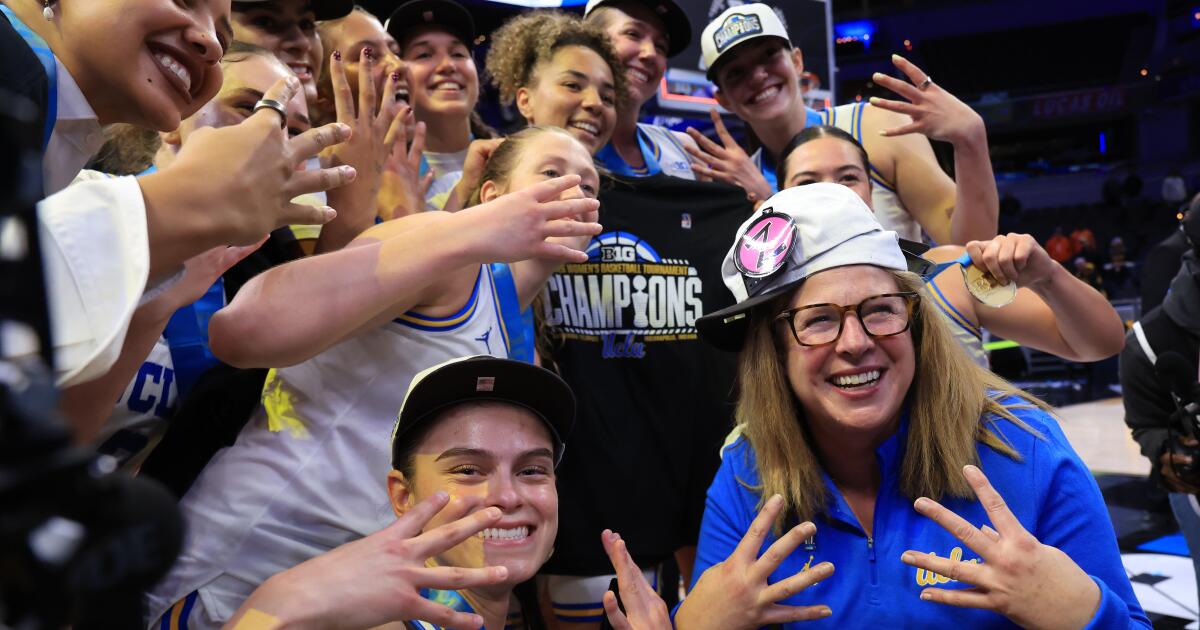
snubbed

UCLA was snubbed by women’s NCAA tournament selection committee

Welcome to UCLA Unlocked, our weekly newsletter featuring all things Bruins athletics. To sign up to get this newsletter delivered every Monday to your inbox, click here.

UCLA coach Cori Close has said all the right things all season, hammering the importance of winning each day and making the most of every practice.

After watching her team struggle during the Final Four last season, she also urged the Bruins to remember the joy of their journey together was far more important than the final tournament results.

She continued to run the John Wooden playbook on Selection Sunday, brushing away the suggestion that UCLA was snubbed by the NCAA tournament selection committee.

Sign up for UCLA Unlocked

A weekly newsletter offering big game takeaways, recruiting buzz and everything you need to know about UCLA sports.

By continuing, you agree to our Terms of Service and our Privacy Policy.

“Everybody else can talk about whatever they want,” Close said. “We’re going to talk about what that takes, and we are completely committed to just being really focused on us and our journey and keeping the main thing, the main thing.”

While she rightly is focusing on her team, there is no denying UCLA got a bad draw.

Not only were the Bruins denied the No. 1 overall seed despite playing a much tougher schedule than overall No. 1 seed UConn, the Bruins will have to fight through the toughest regional to reach the Final Four in Phoenix.

LSU was the highest rated No. 2 seed and Duke was the highest rated No. 3 seed. Both were assigned to the same regional as UCLA. No. 5 Ole Miss, led by Ohio State transfer and dynamic SEC newcomer of the year Cotie McMahon, is another potent team slotted in the Bruins’ side of the bracket.

“The Sacramento region with UCLA, they absolutely have the toughest region when you look at the LSU-Duke matchup — the No. 1 two seed, the No. 1 three seed,” former Notre Dame coach Muffet McGraw said on ESPN. “I don’t know how they ended up with the same bracket as UCLA as the No. 2 overall. … I’m perplexed.”

McGraw has been doing the work Close arguably couldn’t for weeks without coming across as whining. The retired coach questioned the NCAA tournament selection’s committee previous rankings that slotted UCLA behind UConn.

On March 2, McGraw posted on X, “Does anyone else think UCLA deserved the overall [No. 1] seed? Undefeated regular season Big Ten champs, beat 11 ranked teams, six of which are currently in the committee’s top 16. They have 14 Quad 1 wins, more than anyone in the country, and their only loss was to another [No. 1] seed. And what about SEC champ South Carolina as the [No. 2] overall?

“UConn is certainly good enough to win the national championship, but UCLA and South Carolina have had as much success against a much tougher schedule.”

UConn fans were quick to point out McGraw’s losing record against Huskies coach Geno Auriemma and their bad blood, but the former Notre Dame coach was armed with notable stats that are supposed to be the basis for the selection committee’s bracket.

McGraw made her case before No. 2 UCLA (31-1) beat No. 9 Iowa (26-6) by 51 points in the Big Ten tournament championship game.

It wasn’t enough to help the selection committee ignore the score that seemed to matter the most — a 85-51 UCLA loss to UConn in last season’s Final Four.

“We watched a lot of UConn, we watched a lot of UCLA,” NCAA tournament committee chair Amanda Braun said on ESPN. “The way we watched UConn win throughout the year from beginning to the end, UCLA did a lot of winning too, but ultimately we gave UConn the edge.”

The Bruins have said every team is tough in the NCAA tournament and they must simply focus on being their best each day. Surviving a challenging regional will only make their success sweeter.

And UCLA can take solace that at least one team had a worse draw than it did on Sunday. Crosstown rival USC was awarded a No. 9 seed and will play No. 8 seed Clemson in Columbia, S.C., a short commute for the Tigers’ fans. If the Trojans survive, they most likely will face No. 1 seed South Carolina on the Gamecocks’ notoriously hostile home court.

Survey says

We asked, “How far will the UCLA women advance in the NCAA tournament?”

After 460 votes, the results:

They win it all: 80.8%
They lose in the title game: 14.6%
Just like last year, they lose in the Final Four: 3.5%
A surprising elimination in the Sweet 16: 0.9%
A shocking upset in the first or second round: 0.2%
They lose in the Elite Eight: No votes

Survey time

How far will the UCLA men advance in the tournament?

They lose in the first round
They lose in the second round
They lose in the Sweet 16
They lose in the Elite Eight
They lose in the Final Four
They lose in the title game
They win it all

Click here to vote in our survey

In case you missed it

‘We know what it takes to get there.’ No. 1 UCLA ready to begin NCAA title chase

UCLA men’s basketball earns No. 7 seed, to face No. 10 UCF in Philadelphia

NCAA men’s and women’s basketball tournament brackets: A look at every matchup

How Gabriela Jaquez became a breakout shooting star for No. 2 UCLA

UCLA star Jordan Chiles helps Bruins win her final home meet, knocking out rival Utah

UCLA falls to Purdue in Big Ten semifinal without injured Tyler Bilodeau

UCLA stuns Michigan State to advance to Big Ten tournament semifinals

Donovan Dent achieves Big Ten tourney history in UCLA win over Rutgers

UCLA won a Big Ten tournament title with a group of ‘Pac-12 Avengers’

Have something Bruin?

Do you have a comment or something you’d like to see in a future UCLA newsletter? Email newsletters editor Houston Mitchell at houston.mitchell@latimes.com. To get this newsletter in your inbox, click here.

Source link

South Carolina snubbed Bernie Sanders in 2016. A lot has changed

This state was such a lost cause for Bernie Sanders the last time he ran for president that the candidate stopped coming here in the crucial stumping days before the 2016 primary election. He got crushed, losing by 47 percentage points.

So the Rev. Al Sharpton on Wednesday morning found himself doing a double take to be here, of all places, introducing the Vermont senator at his candidate breakfast as the nationwide Democratic front-runner.

“Many never thought ‘Bernie Sanders’ and ‘front-runner’ would be in the same sentence,” said Sharpton, the civil rights activist whose blessing is eagerly sought as Democratic candidates seek inroads with black voters.

At a time when Sanders’ rivals are in a full state of panic over his momentum and have shifted from ignoring the democratic socialist to putting all their energy into trying to stop him, they are particularly alarmed by the traction he has been getting in this state, where some 60% of Democratic primary voters are African American.

It reflects the depth and durability of the Sanders coalition, which has exploded in size with his success.

“The question black folks in the South were asking before was: ‘Who is Bernie Sanders?’” said Justin Bamberg, a South Carolina lawmaker and civil rights attorney supporting Sanders. “Now, it is not ‘Who is Bernie Sanders?’ It is ‘Why not Bernie Sanders?’”

Sanders may not win here in South Carolina; the latest polls continue to show Joe Biden winning and holding the largest share of African American voters. But there’s little question that Sanders has drawn substantially more support from black voters this time around than four years ago. His message hasn’t shifted at all. His appeal to nonwhite voters has.

“We have come a long, long way” in South Carolina, Sanders told a raucous crowd at a rally here Wednesday.

T Bernie Sanders and Hillary Clinton in 2016

Hillary Clinton and Bernie Sanders debate in January 2016 in Charleston, S.C. Sanders lost the state by 47 percentage points that year.

(Timothy A. Clary / AFP-Getty Images)

Only 53% of black voters nationwide had a favorable view of Sanders at this point in the last presidential race, according to Gallup, nearly 30 percentage points lower than for opponent Hillary Clinton. But a recent NBC News/Wall Street Journal poll found black voters this cycle just as inclined to vote for Sanders as for any other candidate — a turnabout from months ago, when the same poll had Sanders far behind.

In South Carolina, the Sanders campaign absorbed the lessons of the senator’s flop here in 2016. In the intervening years, Sanders and surrogates have returned to the state again and again, visiting its small towns and urban centers, knocking on doors, networking with local officials, just listening. In this state, politics is as much about who you know as what you know. And the Sanders operation got to know a lot of communities.

“He has learned from his mistakes,” said Antjuan Seawright, a South Carolina political consultant not aligned with any candidate in the primary. “He’s learned how to engage, how to prioritize certain communities, where to make investments. His team on the ground has figured out where votes are and who they can activate.”

The success Sanders has had in the few states that have voted already also plays big, but that momentum only goes so far. Sanders learned that in 2016, after his shellacking of Clinton in New Hampshire did nothing for him here and in other Southern states. And Pete Buttigieg, the former mayor of South Bend, Ind., is learning that lesson anew as he struggles to translate strong showings in Iowa and New Hampshire into votes in the South.

The Sanders campaign and Our Revolution, the progressive organization launched by his backers, never stopped building infrastructure here after 2016. They doubled down on efforts to reach potential voters who weren’t politically engaged. The Sanders staff here is twice the size it was in 2016. At this point in that election cycle, Sanders had just five endorsements from state lawmakers here. Now he has racked up at least 36.

At his rally Wednesday, Sanders boasted that his campaign has knocked on 200,000 doors in South Carolina this cycle.

As rival campaigns pursue consultant-driven strategies centered on ads, news releases and press conferences designed to cast doubt on Sanders’ ability to go the distance, the senator’s grass-roots approach has been drawing in voters like Rebecca Bentley.

Bentley didn’t vote for Sanders in 2016; she didn’t vote for anyone. “I didn’t have any political views,” she said. “I was completely uninvolved.”

The 29-year-old who has been on Medicaid much of her life and has also lived in federally subsidized housing was inspired to register to vote by Sanders’ agenda on healthcare and other social programs.

“It really resonated with me that someone was actually listening,” said Bentley, who described herself as Hispanic and Native American.

It is a familiar story in this state, where the Republican leadership refused to participate in the expansion of Medicaid that was offered to states by the Affordable Care Act.

“The issues Sanders is talking about are resonating here,” said Bruce Ransom, a political science professor at Clemson University. “The Trump administration is talking about how well the economy is doing, and folks here are not doing that well. They are living in a state where the Medicaid expansion did not take place. Many of them would like to make $15 an hour,” as Sanders is proposing for the minimum wage.

As rivals focus intensely on branding Sanders as unelectable in November, many voters aligning with him for the first time are seeing just the opposite.

Among them is Dawn Pemberton, who supported Hillary Clinton in 2016 and is now all in for Sanders.

“That moderate, middle box just doesn’t seem to be working for our country,” said Pemberton, 48, who recently left a job in real estate.

Gerry Elliot also supported Clinton in 2016. “My more pragmatic head took over,” he said. “I thought Hillary could win. I didn’t think Sanders could win.”

Now, the 51-year-old pastry chef is not so sure. He is wavering between Sanders and Massachusetts Sen. Elizabeth Warren. “I’m looking for something different,” he said. “I just want change in the status quo.”

Biden’s poor showing in the states that have voted so far has some voters reconsidering their initial instinct to align with a pragmatist establishment candidate who had seemed best equipped to beat Trump.

“A former vice president, particularly one under Barack Obama, should not be getting crushed in any state,” Bamberg said. “You should not be getting blown out. People here have eyes and ears. They see it. They want someone they feel can win long term.”

So some voters in South Carolina are giving Sanders a fresh look.

The campaign officials and volunteers who in 2016 would encounter a voter already aligned with Hillary Clinton at nearly every door they knocked on tell a very different story now. Sanders is just as much a household name.

Actor Kendrick Sampson, an Angeleno and Texas native who was here campaigning for Sanders in 2016, said he understood the skepticism voters had at the time.

“You don’t come into Texas talking about nothing — I don’t care how much I agree — if we don’t know or trust you,” he said. “Especially if you are not from Texas. People [in South Carolina] just didn’t know who he was.”

Sampson is back again talking to voters at their houses, at barbershops, in restaurants, and the reception is different. “Now they know who he is, and they know his brand,” Sampson said. “And now they trust him.”

Source link