
'Charlie's Angels' soars to a golden milestone
Kate Jackson, Jaclyn Smith and Cheryl Ladd reunited this week at PaleyFest to celebrate the 50th anniversary of ABC’s iconic detective series.
Source link
Kate Jackson, Jaclyn Smith and Cheryl Ladd reunited this week at PaleyFest to celebrate the 50th anniversary of ABC’s iconic detective series.
Source link

The TWZ Newsletter
Weekly insights and analysis on the latest developments in military technology, strategy, and foreign policy.
The question of what kind of gun should be issued to aircrew for survival, should they be brought down for whatever reason, potentially behind enemy lines, is one that air forces have long grappled with. The highly specific demands of the role, coupled with the fact that the gun needs to be compact enough to fit in a cramped cockpit (and in many cases, on the aircrew themselves), mean that there have been a wide variety of solutions to the problem, some more successful than others.
Of course, for an aircraft as extraordinary as the U.S. Air Force’s SR-71 Blackbird spy plane, it would make sense that a highly specialized aircrew survival weapon might be developed for it.

Thanks to a recent social media post from firearm manufacturer Smith & Wesson, our attention was drawn to just such a weapon, although many questions remain about the degree to which it was actually fielded.
For an in-depth video tour of the Blackbird’s front and rear cockpits, follow this link to our previous article, and watch the video below.

SR-71 Cockpit Checkout
With the world of historic firearms being particularly subject to counterfeits and other kinds of imitations, we should also be cautious about whether all of the claims about it stack up.
According to Smith & Wesson, however, in March 1967, the Air Force placed an order for “30 special Model 41 pistols for SR-71 Blackbird pilot survival kits.”
In March 1967, the U.S. Air Force ordered 30 special Model 41 pistols for SR-71 Blackbird pilot survival kits.
Equipped with threaded 5-inch barrels, slide locks, “sound depressors,” and extra magazines, they were designed to give downed pilots a quiet way to defend themselves. pic.twitter.com/Tvjm0S6N9T
— Smith & Wesson Inc. (@Smith_WessonInc) March 26, 2026
The manufacturer describes the gun as coming “equipped with threaded five-inch barrels, slide locks, ‘sound depressors,’ and extra magazines.” In this case, “sound depressor” seems to be a reference to a suppressor — a device to reduce the acoustic intensity of the gunshot.
The result was “designed to give downed pilots a quiet way to defend themselves or forage behind enemy lines.”
Before looking at just why this is such a surprising choice for an aircrew personal defense weapon, it’s worth looking at the basic Model 41 pistol in more detail.
Smith & Wesson introduced its semi-automatic Model 41 pistol after World War II, and it was tailored primarily as a competitive target firearm.

The End of an Era | Smith & Wesson® Model 41
Prototypes began to be tested in 1947, and after a long period of refinements, the Model 41 went on sale in 1957. The gun quickly established itself as a popular choice, especially for competitive shooters, and, although its manufacture was briefly ended in 1992, it soon returned to production, and the last examples were only completed in 2025.
As for the Model 41 pistol in military hands, Smith & Wesson did develop a ‘no-frills’ version, known as the Model 46, specifically for the Air Force. In 1959, the service selected the Model 46 for basic marksmanship training. A 10-year production run followed, but it doesn’t seem to have found any commercial uptake.

Considering the iconic nature of the SR-71 and its dramatic missions, it’s more than a little surprising that the ‘Blackbird Model 41’ isn’t better known.
Last year, however, a reference to a special version of the Model 41 appeared on Smith & Wesson Forums. A post on the forum describes the gun as being delivered to the Air Force with “suppressors and extra magazines,” and issued as part of the SR-71 pilot survival kits.
The post explains that the unusual attachment seen in one of the few photos of the weapon is a “factory-fitted Oxford white-dot illuminated sight, a cutting-edge innovation for its time, installed by Olympic gold medalist Art Cook, who was responsible for precision military modifications under contract.”
The same post draws attention to an undated auction lot on the website of the Wyoming-based LSB, a well-known gun-broker, which details one of these ‘Blackbird Model 41s’ sold for $5,404. The gun is described by LSB as a “Model 41 .22 LR SR-71 Pilot Survival Pistol 1967” with the serial number 78009.
The auction posting provides more detail on the Art Cook-installed sights, described as “extremely rare.” It notes that Cook, a gold medalist in smallbore rifle at the London Olympics in 1948, was “known for high-level precision firearms work for U.S. military contracts during the Cold War and developed custom mounts for the Oxford sight used in these pistols.”
Perhaps most relevant in this context is the fact that the gun in question was auctioned together with factory and historical documentation. The factory letter from Smith & Wesson historian Roy Jinks confirms the government contract details and was included with a copy of the original factory invoice documenting the 1967 sale to the Air Force.
Also part of the sale was a copy of the original serial number list for the contract batch of 30 pistols and further “original S&W historical paperwork related to the contract order.”
The provenance of the pistol is further underscored, LSB says, since it came from the collection of Kevin Williams, a respected firearms historian and author of U.S. General Officer Pistols: A Collector’s Guide.
LSB’s assessment was that the auctioned gun was “an extraordinary example of Cold War weapons history,” while “Cook’s involvement, paired with the factory’s precision and the pistol’s purpose-built configuration, makes this one of the most unique .22 pistols ever issued by the U.S. government.”
While the description of the special Model 41 as a “quiet, accurate, and discreet sidearm paired with the most advanced aircraft of its era” might be accurate, it still seems surprising that an adapted target firearm would be selected for SR-71 crews (which comprised a pilot at the front and a Reconnaissance Systems Officer, or RSO, behind them).

A pistol chambered in a .22 Long Rifle has some advantages. The very low recoil makes it easy to control, its ammunition is cheap and widely available, and it is typically far quieter than other calibers, especially when loaded to reduce sound signature. It is also light and has a low muzzle flash.
The Air Force did procure some other smaller-caliber firearms for its pilots, including the M6 aircrew survival weapon, first issued in the 1950s, and combining a .22 Hornet rifle barrel with a .410 bore shotgun barrel in an unusual ‘over-under’ configuration.
Today’s gun comes as a tool of survival. The M6 Aircrew Survival Weapon. The foldable Shotgun/Rifle hybrid chambered in .410 bore and .22 hornet FMJ was designed by Ithaca shortly after WW2 but found continued use even into Vietnam. It’s stock also allowed for easy ammo storage. pic.twitter.com/nkMg3tB3LS
— Doc Strangelove (@DocStrangelove2) December 18, 2021
The predecessor to the M6 was the M4 survival rifle, developed from the Harrington & Richardson bolt-action M265 sporting rifle, adapted to a sheet metal frame with a telescopic wire buttstock and a detachable barrel, again chambered for .22 Hornet ammo. The M4 and M6 were both intended for the killing of game for food under emergency survival conditions.

H&R M4 Survival Rifle: Handy But Short-Lived
Overall, the .22 caliber is hardly an obvious choice for a personal defense weapon. It has limited stopping power compared to common defensive calibers like 9×19mm, and even less potent ones of the era, and may not consistently penetrate deeply enough to reach vital organs, especially through clothing or at odd angles.
It seems likely, then, that the gun was primarily intended to help SR-71 crews defend themselves clandestinely if their aircraft went down.
This is supported by the claim by Smith & Wesson that the special Model 41 was “designed to give downed pilots a quiet way to defend themselves.” It is also in line with the much higher likelihood that SR-71 pilots and RSOs, were they to eject, would find themselves operating deeper behind the lines than most downed aircrews.
There are also accounts suggesting that the Blackbird survival kit included either an Air Force version of the Smith & Wesson Model 12 or a Colt Aircrewman (based on the civilian Cobra). Both of these were lightweight aluminum revolvers, chambered for .38 Special, with much more stopping power than a Model 41. Confusingly, they both carried the designation M13.

Colt M13 Aircrewman Revolver: So Light it was Unsafe
Mach 3+ Cowboys
The Blackbird’s survival kit included a very rare aluminum gun!
Yes, you read it right! The gun was made of aluminum to keep it lightweight. My Father, Col Richard (Butch) Sheffield, former SR-71 Reconnaissance Systems Officer (RSO), told my husband, Rodney… pic.twitter.com/KWLEdxNmVo
— Habubrats SR-71 (@Habubrats71) November 21, 2024
At this point, it seems there is considerable evidence that the Air Force did buy a batch of special Model 41 pistols for SR-71 Blackbird pilot survival kits.
There is no evidence immediately available suggesting that Blackbird crews took these weapons on their remarkable Mach-3 flights over and around some of the most hostile airspace ever seen. What we do know is that, with no SR-71 being brought down by enemy action in the course of over 3,500 operational spy flights, their crews never had to call upon sidearms of any kind.

We have reached out to Smith & Wesson and the National Air and Space Museum to try to get to the bottom of this intriguing story. If any readers know more about these pistols and whether they were actually issued to aircrew, let us know in the comments below, or shoot me an email.
Contact the author: thomas@thewarzone.com

WASHINGTON — Three fired FBI agents sued on Tuesday to try to get their jobs back, saying in a class-action lawsuit that they were illegally punished for their participation in an investigation into President Trump’s efforts to overturn his 2020 election defeat.
The federal lawsuit adds to the mounting list of court challenges to a personnel purge by FBI Director Kash Patel that over the last year has resulted in the ousters of dozens of agents, either because of their involvement in investigations related to Trump or because they were perceived as insufficiently loyal to the Republican president’s agenda.
The lawsuit in federal court in Washington was technically filed on behalf of just three agents but may have much broader implications given that its request for class-action status could open the door for agents fired since the start of the Trump administration to get their jobs back.
The three agents — Michelle Ball, Jamie Garman and Blaire Toleman — were fired last October and November in what they say was a “retribution campaign” targeting them for their work on the investigation into Trump. The agents had between eight and 14 years of “exemplary and unblemished” service in the FBI and expected to spend the remainder of their careers at the bureau but were abruptly fired without cause and without being given a chance to respond, the lawsuit says.
“Serving the American people as FBI agents was the highest honor of our lives,” they said in a statement. “We took an oath to uphold the Constitution, followed the facts wherever they led and never compromised our integrity. Our removal from federal service — without due process and based on a false perception of political bias — is a profound injustice that raises serious concerns about political interference in federal law enforcement.”
The investigation the agents worked on culminated in a 2023 indictment from special counsel Jack Smith that accused Trump of illegally scheming to undo the results of the presidential election he lost to Democrat Joe Biden in 2020. Smith ultimately abandoned that case, along with a separate one accusing Trump of illegally retaining classified records at his Mar-a-Lago estate in Palm Beach, Fla., after Trump won back the White House in 2024, citing Justice Department legal opinions that prohibit the federal indictments of sitting presidents.
The lawsuit notes that the firings followed the release by Sen. Chuck Grassley, the Republican chair of the Senate Judiciary Committee, of documents about the election investigation — known as Arctic Frost — that he said had come from within the FBI. Those records included files showing that Smith’s team had subpoenaed several days of phone records of some Republican lawmakers, an investigative step that angered Trump allies inside Congress.
The complaint names as defendants Patel and Atty. Gen. Pam Bondi, accusing them of having orchestrated the firings despite being “personally embroiled” either as witnesses or attorneys in some of the legal troubles Trump has faced.
Patel, for instance, was subpoenaed to appear before a federal grand jury investigating Trump’s retention of classified documents at Mar-a-Lago and had his phone records subpoenaed, while Bondi was part of the legal team that represented Trump at his first impeachment trial, which resulted in his acquittal.
“And now, by virtue of presidential appointment to the pinnacle of federal law enforcement, Defendants are abusing their positions to claim victories that eluded them on the merits,” the lawsuit states.
Spokespeople for the FBI and the Justice Department declined to comment on the ongoing litigation. Patel and Bondi have said the fired agents and prosecutors who worked on Smith’s team were responsible for weaponizing federal law enforcement, a claim that was also asserted in their termination letters but that the plaintiffs call defamatory and baseless.
Dan Eisenberg, a lawyer for the agents, said in a statement that his clients were fired without any investigation, notice of charges or chance to be heard.
“This lawsuit seeks to reaffirm fundamental constitutional protections for FBI employees, ensuring they can perform their duties without fear or favor. We all benefit when law enforcement officers’ only loyalty is to facts and the truth,” said Eisenberg, who is with the firm of Emery Celli Brinckerhoff Abady Ward & Maazel.
The lawsuit asks for the agents to be reinstated to their positions and for a court declaration affirming that their rights had been violated. It also seeks to represent a class of at least 50 agents who have been terminated since Jan. 20, 2025, or will be. Those agents also stand to recover their jobs in the event the case is successful and the requested class-action status is granted.
Other fired employees who have sued include agents who were photographed kneeling during a racial justice protest in 2020; an agent trainee who displayed an LGBTQ+ flag at his workspace; and a group of senior officials, including the former acting director of the FBI, who were terminated last summer.
The firings have continued, with Patel last month pushing out a group of agents in the Washington field office who had been involved in investigating Trump’s hoarding of classified documents. Trump has insisted he was entitled to keep the documents when he left the White House and has claimed without evidence that he had declassified them.
Tucker writes for the Associated Press.

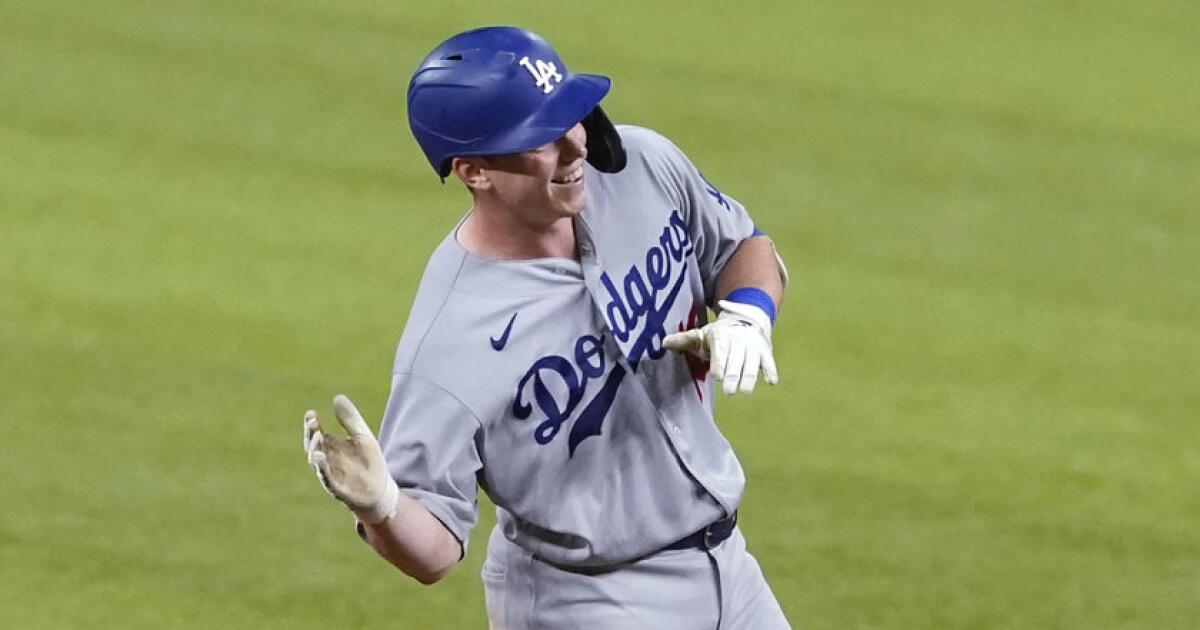
Freeze frame. There’s Dodgers catcher Will Smith’s follow-through as he watches the ball he just crushed travel toward the wall Saturday.
Now, split screen. Pull up an image of the bobblehead the Dodgers gave out before the game, commemorating Smith’s Game 7 World Series-winning home run. It’s a mirror image.
On his bobblehead night and 31st birthday, Smith delivered a two-run home run in the eighth inning as the Dodgers swept their season-opening series against the Arizona Diamondbacks with a 3-2 victory Saturday at Dodger Stadium.
Cue an aerial shot of the Hollywood sign.

“When you talk about big hits, clutch, Will’s right at the top of the list,” manager Dave Roberts said.
Roberts originally planned to sit Smith. The catcher played in the first two games of the series, and an off day on Sunday would have given him two straight days of rest early in a grueling season.
“We always talk about stuff,” Smith said. “He was going to give me the day off, I just kind of dropped the bobblehead card [for Saturday] and he let me in there.”
A key edit to the script.
Roberts made a few tweaks to the lineup ahead of the Dodgers facing a left-handed starter for the first time this season. Against Eduardo Rodriguez, Roberts swapped first baseman Freddie Freeman and Smith in the batting order; Smith hit fourth and Freeman fifth.
Santiago Espinal also made his Dodgers debut, starting at third base. Roberts said it wouldn’t be a platoon between Espinal and Max Muncy at third, but he wasn’t sure exactly how the playing-time split would play out.
For the first five innings, no one on the Dodgers did much on offense, except for Freeman.
Freeman went hitless in the first two games of the series despite making hard contact. But he had three hits in four at-bats Saturday, including a double in the sixth inning that drove in the Dodgers’ first run.
“Definitely nice to get off the barrel on the first one and hit a flare up the middle,” Freeman said. “And obviously once you get one, you can just kind of rest easy. And then they played the shift on my third hit, and that was nice, because then I was able to stay on the fastball and hit it to left field down the line.”
That hit cut the Diamondbacks’ lead to one run, thanks to a strong showing from the Dodgers’ pitching staff.

Dodgers pitcher Tyler Glasnow delivers during the first inning against the Diamondbacks on Saturday.
(Gina Ferazzi / Los Angeles Times)
Tyler Glasnow turned in a quality start. Holding the Diamondbacks to two runs over six innings, Glasnow used his curveball as his putaway pitch against right-handed hitters, and two-strike sinkers kept left-handed batters off balance, especially deeper into his start. Glasnow recorded six strikeouts.
The Dodgers’ bullpen continued its scoreless streak for the series, as Alex Vesia, Will Klein and Edwin Díaz shut down the Diamondbacks through the last three innings.
For the second straight night, Díaz entered to a live rendition of Timmy Trumpet’s “Narco,” performed by trumpet player Tatiana Tate.
“When Edwin comes in the game, that means something good’s happening for the Dodgers,” Freeman said. “So I’m a fan.”
Although the Dodgers’ offense was quieter than in their other wins of the series, their lineup again proved to be pesky. In all three games, they fell behind 2-0. In all three, they won.

Dodgers catcher Will Smith, left, celebrates with Tesocar Hernández after hitting a two-run home run in the eighth inning Saturday.
(Gina Ferazzi / Los Angeles Times)
With two outs in the bottom of the eighth inning Saturday, Mookie Betts drew a walk. Then Smith worked a 2-2 count, fouling off three fastballs before he was right on time for one at the top of the strike zone.
“We never feel like we’re out of it,” Smith said. “We keep taking good at-bats, keep believing in each other, keep believing that someone’s going to come up with a big hit.”
On Saturday, it was destined to be Smith.
“Birthday and bobblehead day,” Glasnow said, “It was a magical night.”
Roll credits.

Dodgers utility players Tommy Edman (right ankle surgery recovery) and Kiké Hernández (left elbow surgery recovery) took early batting practice on the field Saturday afternoon.
Roberts has said he expected Edman, on the 10-day injured list, will be an option by at least the end of May. Hernández will be eligible to be activated off the 60-day IL around the same time.
“I’d be shocked if [Hernández] wasn’t ready when that time is up,” Roberts said. “Taking grounders, the way he’s moving, the way he’s throwing, catching, the swing, ball coming off the bat. If I didn’t know any better, I’d think he was in the lineup tonight.”

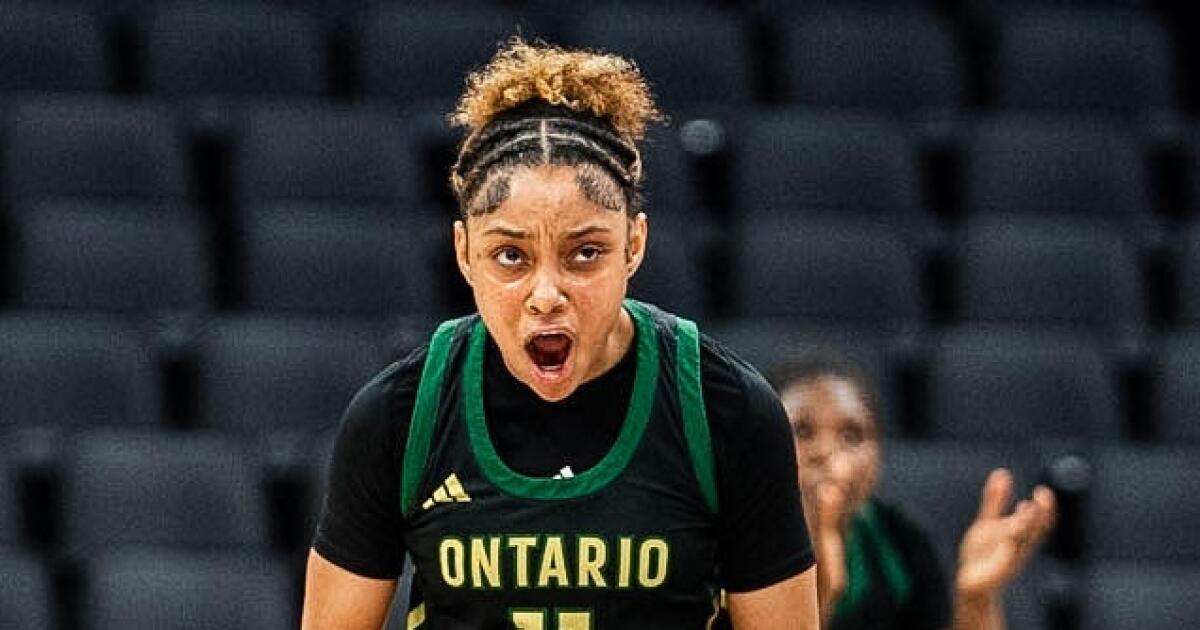
Kaleena Smith averaged 31 points, seven assists and four steals a game this season while playing for the No. 1 program in the Southland, but her expanded leadership role is what earns her the honor of The Times’ girls’ basketball player of the year.
The 5-foot-6 junior point guard marshaled Ontario Christian to the CIF state championships in Sacramento for the first time in the program’s history and along the way her voice spoke almost as loudly as her game — surprising for someone who is not talkative by nature.
“Her numbers speak for themselves but the biggest difference in Kaleena this season has been her leadership,” Knights coach Aundre Cummings, said. “She’s always coming to practice first and leaving last, which teammates respect, but also knowing when to speak up.”
Smith has been nicknamed “Special K” for her talent and charisma, traits that make her one of the top national recruits in the class of 2027. She is garnering attention from multiple college programs. USC women’s coach Lindsay Gottlieb was even on hand to witness Smith score 23 points and contribute six assists in the Southern California regional semifinals against Etiwanda on March 8 and the state championship game against Archbishop Mitty at Golden 1 Center in Sacramento.
“I’m being more vocal, yes, because I’m gonna have to do that in college,” said Smith, who spent countless hours refining her mid-range jumper this winter. “As captain it’s one of my responsibilities.”
One hundred games into her high school career, Smith is living up to the hype thrust upon her when she was named MaxPreps’ national freshman of the Year in 2024. She passed the 2,000-point plateau when she scored 51 points against Esperanza in November.
Smith paced Ontario Christian to the Southern Section Open Division title as a sophomore and although the Knights were denied a repeat (she had 30 points and five assists in a finals defeat to Sierra Canyon) her stats are better in every significant category. Intertwined with her competitive spirit and winning mindset is the maturity and confidence of an upperclassman.
“Her leadership is what stands out,” sophomore teammate Tatianna Griffin said. “She’s a very quiet person. I’m not sure it comes naturally or not but when she says something we listen.”
Griffin’s own game has blossomed because of Smith’s willingness to give her the ball in clutch situations, and Smith has been a mentor to freshman Chloe Jenkins, who led the team in rebounds (11.3 per game).
Adding leadership to her basketball IQ, court vision, defense, quickness, shooting, passing and dribbling has made Smith a complete player, one who is poised for a senior season worth talking about.
Hi, and welcome to another edition of Dodgers Dugout. My name is Houston Mitchell. Today we start a series looking at the NL West, position by position, and we meet our new sports columnist.
It seems like a good time to look at the starting lineups for all the teams in the NL West. The Dodgers are prohibitive favorites to win the division, with some prognosticators thinking they will be the only team in the division to finish above .500.
Baseball Prospectus’ PECOTA projection has the NL West finishing like this.
1. Dodgers, 105-57
2. San Francisco, 81-81
2. San Diego, 81-81
4. Arizona, 79-83
5. Colorado, 61-101
It seems to me at least one other team will finish above .500, but, that’s why they play the games. A lot of projections had Toronto not even making the postseason last year. So take it with a grain of salt.
Now, let’s look at the catchers, ranked from best to worst. Click on the player’s name to be taken to their full stats page.
Dodgers
Will Smith
Last season: .296/.404/.497, 20 doubles, 17 homers, 61 RBIs
Career: .264/.358/.476, 128 OPS+
Smith, who turns 31 on March 28, is the best catcher in baseball and he is a steal at only $14 million a season through 2033. Of catchers who started at least 81 games last season, he was eighth in caught stealing at 25.5%. Some will argue that Cal Raleigh or Alejandro Kirk are better, but when you consider the total package, I put Smith first. Of course, if Raleigh’s huge step up in offense that he took last season is for real, then he could certainly slot ahead of Smith.
Arizona
Gabriel Moreno
Last season: .285/.353/.433, 12 doubles, nine homers, 40 RBIs
Career: .281/.349/.404, 108 OPS+
Moreno has inflammation in his right elbow, but it appears he will be ready for opening day. He has had quite a few injuries the last couple of seasons.
Colorado
Hunter Goodman
Last season: .278/.323/.520, 28 doubles, 31 homers, 91 RBIs
Career: .248/.292/.482, 102 OPS+
Goodman was one of the few bright spots for the Rockies, who lost 119 games last season. Last season was his first good season at the plate. He was an All-Star and won the Silver Slugger award. Earlier this spring training, he had this to say about his defense: “I mean, last year for the whole first half, was kind of like I was in fight-or-flight mode the whole game behind the dish. So just trying to get to where I’m comfortable on the plate and working to get these guys strikes and call better games and stuff like that.”
San Francisco
Patrick Bailey
Last season: .222/.277/.325, six homers, 55 RBIs
Career: .230/.287/.340, 78 OPS+
Bailey is solid defensively, and has proven to be a master at when to challenge a ball/strike call under the new Automated Ball-Strike (ABS) Challenge System (more on that in a future newsletter). Bailey has also focused on his swing in the offseason and has been a much better hitter this spring.
San Diego
Freddy Fermin
Last season: .251/.297/.339, 13 doubles, five homers, 26 RBIs
Career: .264/.309/.376, 91 OPS+
The Padres acquired Fermin from the Royals at the trade deadline last season, and loved how he handled the pitching staff, much like the Dodgers with Ben Rortvedt. He will be backed up Luis Campusano, who hit .336 in triple A but isn’t exactly Johnny Bench behind the plate.
We have a new columnist at The Times, Mirjam Swanson. She will be covering all sports, but here’s guessing she will be writing quite a bit of opinion about the Dodgers. So, let’s get to know her.
Q. Welcome to The Times. What was the road that led you here?
Swanson: Thank you! Oh, it’s been a long and windy road, scenic let’s say. I grew up in Southern California, so it was always my dream to work for the L.A. Times. But journalism is a tough business. And I know I’m not the only mom out there who has turned down and/or taken jobs based on what was best for her children. Plus, I’ve always had this problem of getting really into whatever I’m covering, whether it was action sports or local politics or World Series runs. So while the dream of working at the Times persisted, I was also always happy with what was right in front of me, never desperate to move on. But here I am now, finally, better for the journey, I think.
Q. You will be an all-sports columnist, but we’ll focus on the Dodgers since this is a Dodgers newsletter. Do you have a favorite moment in Dodger history?
Swanson: The moment in Dodgers history that will stick with me most is …
… hmm. The Dodgers’ history books could fill a library — where to start?
I was in the backseat of the family car on a freeway somewhere in Southern California listening to Kirk Gibson put his signature on the improbable 1988 season with his impossibly clutch pinch-hit home run in Game 1 of the World Series. And I was in the ballpark when Gibby met Freddie in 2024, feeling the stadium shake and watching on a TV in the overflow media workspace, feeling awe and angst. Freddie Freeman with grand timing that night, right on deadline.
Watched Shohei Ohtani turn Game 4 of the 2025 NLCS into a Little League game with 10 strikeouts and three home runs. There might never be a greater individual game — or there might be. Put nothing past Ohtani, including the inconceivable.
And I won’t forget my L.A. neighborhood erupting over Miguel Rojas’ “no-way!” ninth-inning solo shot in Game 7 of last season’s World Series.
But all of that is a long and windy way to arrive at this: It’s Andy Pages’ catch.
That’s not recency bias, either. It’s that the play was so confounding, so unexpected, the plot twist no one saw coming. Violent and athletic and hilarious. A whole movie in 10 seconds.
We might not have expected it to be Rojas to hit that season-saving home run, but our brains are trained to accept seeing a home run in such a moment. But an outfielder coming out of nowhere, running down and over his own teammate to make an improbable, impossible season-saving catch for the final out in the ninth inning of Game 7? Wasn’t on my bingo card.
I think about that play daily, it was so cool.
Q. What do you see as the biggest obstacle for the team this season?
Swanson: The answer is health, of course. But the Dodgers are so deep, they’ve done as much as a club can to fortify itself against inevitable injuries and ailments throughout a season, so it feels like less of a concern than it’s supposed to be.
So it’ll be mental. Having to handle the weight of trying to three-peat, of everyone either desperately wanting to see them do it or rooting desperately against them doing it. Every other team is going to treat their games against the Dodgers like it’s the World Series. That should make for good baseball, but it also will test these guys’ psychological stamina.
Manager Dave Roberts said the other night that he felt more pressure to repeat than three-peat, and that at this point, the Dodgers are playing with house money. That might be true, but there’s no ignoring the historic opportunity, either. Heady stuff for a team that’s set up as well as a team can be to do it if players can keep their edge.
Q. I get quite a bit of email from fans saying Roberts is overrated and that anyone could manage this team to the World Series. What are your thoughts on Roberts as a manager?
Swanson: I know some of these people.
And I hope they’re on no one’s jury, because evidence evidently means nothing to them.
A guy I know, an otherwise relatively rational dude, told me after the Dodgers repeated: “The only bad thing about this is Dave Roberts is going to be around longer.”
As if there was any bad thing for fans of the team about the Dodgers’ repeating. You really have to want to be unhappy about something if you’re anti-the manager who has won three World Series crowns in six seasons.
As if it’s automatic to pilot a team with so many talented players, to keep them happy and motivated and locked in, to manage these millionaires with understandable egos. That’s actually so much harder to do than to coach up a team of prospects with modest expectations.
And to pull so many of the right levers along the way, too?
Yeah, Roberts is elite at what he does. And apparently his haters are elite at what they do too.
Q. Is a lockout inevitable after the season, and does baseball need a salary cap?
Swanson: Sigh.
Yes, probably.
No, probably not.
All the salary cap is going to do is save the smarter-than-you Dodgers’ ownership group money while everyone keeps chasing them. It won’t level the playing field, but it will give owners cover for not paying their players as much as they could — and possibly cost us all priceless opportunities to watch Ohtani play baseball while the owners and players arm wrestle over finances offstage.
Sigh.
Q. Lastly, how many games will the Dodgers win this season?
Swanson: Fewer than 100.
Yes, they’re the most talented team money could buy. But every other team is going to give everything it has in every game against the Dodgers. And the Dodgers aren’t going to match that energy every time out — or 117 times out, if you’re hoping the major league record + World Series three-peat combo is on the menu.
The regular season isn’t what it’s really about for the Dodgers. They’ll be conservative with their approach, they won’t push anyone to do anything that could diminish their performance in the postseason. They’re going to play it cool … until they’re not.
And it’s going to drive observers along the way nuts, because it will cost them some games. But let’s try not to fret too much, Dodgers fans. Try not be too hard on Roberts.
Because only one number really matters: Three.
The Dodgers agreed to a deal granting Uniqlo naming rights to the field at Dodger Stadium. Though not officially announced by the Dodgers, the name likely will be Uniqlo Field at Dodger Stadium.
Uniqlo is a Japan-based clothing brand. This is just another example of the revenue the Dodgers are generating because of Shohei Ohtani.
But here’s guessing that no one will call it Uniqlo Field at Dodger Stadium.
Dave Roberts said Monday that Yoshinobu Yamamoto will be the opening day starter on March 26 against Arizona at Dodger Stadium. It will be the second straight opening day start for Yamamoto, and after all he did in the postseason last year, it is much deserved.
Some of you who haven’t seen any spring training games have asked what numbers the new Dodgers are wearing.
Edwin Díaz is wearing No. 3, last worn by Chris Taylor and also worn by such Dodger luminaries as Steve Sax, Willie Davis and Billy Cox. He becomes the 40th Dodger to wear No. 3.
Kyle Tucker is wearing No. 23, last worn by Michael Conforto (I hope that’s not a bad omen) and also worn by, among others, Adrián González, Eric Karros, Kirk Gibson, Jim Wynn, Claude Osteen and Don Zimmer.
Yoshinobu Yamamoto named Dodgers’ opening-day starter for second straight season
Dodgers star Shohei Ohtani apologizes for ‘shortcomings’ in Japan’s early exit from WBC
Dodgers reportedly agree to deal with Uniqlo for naming rights to Dodger Stadium field
Swanson: Yoshinobu Yamamoto might not wear a cape, but he has super powers
‘Bigger than baseball.’ Why being in Puerto Rico for WBC meant so much to Kiké Hernández
Blake Snell throws first bullpen session of spring training, taking key step forward
Dodgers prospect James Tibbs III attempts to show staying power after multiple trades
Kyle Tucker hits his first home run with the Dodgers. Watch and listen here.
Have a comment or something you’d like to see in a future Dodgers newsletter? Email me at houston.mitchell@latimes.com. To get this newsletter in your inbox, click here.

The pair’s exchange has become a running in-camp gag in the build-up to England’s final-round meeting with France on Saturday, with Smith, 5ft 11in, 13st 13lb and 15 caps, joking that he and Itoje, 6ft 5in, 18st 8lb, 101 caps, would settle a difference of opinion physically, rather than verbally, next time.
“I thought it was funny,” said Smith. “Me and Maro have been joking about it this week and I told him if he shouts at me like that again, I’m going to punch him!”
Itoje, usually a composed presence on and off the pitch, insisted his raised voice was not a lost temper.
“I didn’t really lose it!” he laughed. “You don’t often see me with a mic. I’m not always mic’d up but maybe I’m portraying a false image.
“Fin is my guy. The way I try to do things is to hear what my key decision-makers think of what is going on, and whoever plays 10 will obviously have an important role in that.
“It’s a good thing that people in the team feel they can express a view, and in sport, if anything, that’s the most kosher of fallouts that the world has ever seen.
“We have had far more blunt conversations between ourselves and other team-mates.”
England have had cause for frank discussions during this Six Nations after three successive defeats left their title aspirations in tatters.
Another against France would mean England finish with a return of one win from a Six Nations campaign for the first time since the tournament expanded in 2000.
England have only lost four games in a single edition of the 143-year-old championship twice previously – in 1972 and 1976.
Smith, who made his first England start in the victory over France last year at the beginning of a 12-match winning streak, is in an unfamiliar position.

A video circulating online appears to show signature collectors paying people to sign initiative petitions under other people’s names, according to officials, and now the state has opened an investigation.
The video, filmed by videographer JJ Smith, shows a long queue leading to a table set up at 6th and Mission streets in San Francisco. A man in line says they are being offered $5 to sign petitions. At the table, where there are lists with the information of apparent registered voters, a woman confirms the payment and — using a highlighter — instructs a person on the name and address that she is supposed to use.
“I get $5 too?” the videographer asks.
“Yeah,” says the woman.
“And what is it?”
“Just sign it,” she says.

Share via
Petitions connected to at least three ballot campaigns — including the billionaire-backed effort to thwart California’s proposed billionaire tax — appear in the video.
“I approached some people and asked them what they were there for,” Smith told The Times. “They told me they didn’t know what they were signing for, that they just wanted the $5.”
Smith said he watched the scene for hours and estimated that a few hundred people cycled through the line over roughly two hours.
Those running the table did not ask for anyone’s identification and gave no explanation of what was actually being signed, he said.
The video showed voter data from San Luis Obispo County that was both visible and, as details were spoken aloud, audible in the footage.
The county acted immediately after becoming aware of the video and initiated an investigation through the fraud unit of the California secretary of state’s office, said Erin Clausen, public information officer for the San Luis Obispo county clerk’s office.
Clausen noted that, although voter registration data can be legally requested from county election offices, the data in this case may have been used inappropriately. The county is also planning on reaching out directly to voters who were specifically mentioned or identified in the video, according to Clausen.
“The activity shown in the video, if verified, would violate California election law,” County Clerk-Recorder Elaina Cano said in a formal statement released Wednesday morning.
The secretary of state’s office confirmed it had opened a formal investigation.
“Under California law, it is illegal to give money or other valuable consideration to another in exchange for their signature on an initiative petition,” a spokesperson said in a statement. “ Those who abuse our system will be held accountable.”
The office is working with local officials and encouraged anyone with information to file a complaint.
One political committee, Californians for a More Transparent and Effective Government, confirmed its petitions were among those whose signature gatherers were allegedly paying people to sign and moved quickly to distance itself from the activity.
“Under no circumstance do we tolerate this type of activity in the signature gathering process,” said spokesperson Molly Weedn. “We’ve taken immediate action and have demanded that the signature gathering firm identify these circulators and reject their petitions.” Weedn said the collectors were subcontractors, not campaign employees, and that attorneys were contacting authorities.
That committee is funded by another group, Building a Better California, which was also among campaigns that appeared in the video. The other was for a proposed initiative called the Retirement and Personal Savings Protection Act of 2026. Representatives for the latter two have not responded to requests for comment.
Smith said this was not the first time he had witnessed this type of activity in the area.
“I saw something similar with ballots three days ago,” he said.
The investigation is ongoing. Anyone with information can submit a complaint to the Office of the California Secretary of State or contact their local county elections office.
Times staff writer Seema Mehta contributed to this report.

There’s a hidden door in Downtown Disney. Only this one isn’t meant to be walked through.
Flanking a stage near the monorail station, you’ll find a glistening white tower, the work of artist and activist Nikkolas Smith, who has adopted the term “artivist.” At first glance, the tower — one of Downtown Disney’s most striking works — appears to be a nod to Disneyland’s Midcentury art, for its curved lines and space-age optimism wouldn’t be out of place in Tomorrowland.
That’s there, says Smith, but there are also a number of more subtle inspirations.
The tower is a nod to five Black architects, trailblazers whose creations sometimes went unnoticed or overlooked. And that’s why at the base of the structure is a looping opening meant to signify a half-open doorway.

Downtown Disney’s Legacy Tower touches on the styles of different Black architects as it rises into the sky.
(Gary Coronado / For The Times)
Smith shares a distressing anecdote. “They had to learn how to read drawings upside down, because they weren’t allowed to sit next to the white clients,” Smith says, adding they also had to endure unequal pay. “So I was incorporating things like the half doorway to symbolize their struggle.”
Officially designated as the Legacy Tower, Smith himself fixates on that word — “legacy.” The term, he says, represents a thematic constant across his work. A regular collaborator on a number of Walt Disney Co. projects and a former architect with Walt Disney Imagineering, the division of the company focused on theme park experiences, Smith is something of a connector. His canvas art, full of fast-moving brush work, is often rooted in the past while urgently seeking to draw links to the present.

Artist Nikkolas Smith went viral for his portrait of Martin Luther King Jr. in a hoodie, a tribute to slain teenager Trayvon Martin.
(Nikkolas Smith)
His 2025 children’s book, “The History of We,” tells the story of how humanity can trace its roots to Africa. And one of his best-known pieces is of Martin Luther King Jr. in a hoodie, meant to evoke the image of Trayvon Martin, the slain 17-year-old whose death inspired a social justice movement. The work went viral in 2013 while Smith was still working for Imagineering. It altered his career trajectory.
“It was like, ‘I cannot just make art about churros and rides right now,’” Smith says. “There’s a time for that, and there’s also a time to talk about this.” He references his portraits related to the killings of Black men, many at the hands of police officers, such as Philando Castile and Michael Brown.
“At the end of the day, Disney understood that,” Smith adds. “They understood that I needed to make art that was extremely important at the moment, about justice or the lack of justice.”
Smith left Disney in 2019 after 11 years but has maintained a close relationship with the company, so much so that Imagineering called upon Smith to design the tower, which opened in 2023.

Artist Nikkolas Smith, left, chats with guests Ricky Yost and Martina Yost of Aubrey, Texas, who recognized Smith from a recent Disney cruise excursion.
(Gary Coronado / For The Times)
As the Legacy Tower spirals toward the sky, its patterns and and lattice work nod to the likes of James H. Garrott, Robert A. Kennard, Roy A. Sealey, Ralph A. Vaughn and Paul Revere Williams. All were active in Los Angeles — Williams, for instance, was a pivotal designer on the LAX Theme Building — and Smith interlaces decorative flourishes in varying styles that twist around one another to work up the Legacy Tower’s pointed spheres.
The door of the Legacy Tower symbolizes perseverance, Smith says. “They made it through, despite all of the obstacles they had to go through.”
Smith had studied the architects while a student at Hampton University, and has documented on his Instagram their various stylings, which range from restrained to whimsical to ornate. A section referencing Vaughn is modern minimalism, whereas an area dedicated to Sealey is full of jagged, pointed linework. All of it is held together via a coiling design that feels full of movement.

The patterns of the Legacy Tower are nods to the likes of James H. Garrott, Robert A. Kennard, Roy A. Sealey, Ralph A. Vaughn and Paul Revere Williams.
(Gary Coronado / For The Times)
“How can I show humanity’s interconnected future? That’s the idea,” Smith says. “There’s this African theme of Sankofa. If we look toward our future, we have to look at the past and value and appreciate the past. I thought it would be great if I could really commemorate some Black designers and architects as the foundation and backstory of the tower. And I was also thinking about these breezeway block patterns that you see in Leimert Park.”
And yet it also feels like something that belongs in the park. Smith says he looked at some Tomorrowland designs.
“A Midcentury Modern vibe was Walt,” Smith says, referring to park patriarch Walt Disney. “That was Walt’s thing. It all connects. I love that people can hopefully now connect both things. You can connect Tomorrowland and Walt with Paul Revere Williams.”
It’s clearly Smith’s favorite design of his for Disney, although it’s not the only space at the resort that features his artistry. During his decade-plus with Imagineering he regularly worked on teams that focused on projects at Disney California Adventure, which this year is celebrating its 25th anniversary. He was heavily involved, he says, in the evolution of Avengers Campus, contributed to a small promenade stage in Pixar Pier and helped envision the facade of Guardians of the Galaxy — Mission: Breakout!, which transformed the former Tower of Terror into a sci-fi structure.

Nikkolas Smith says elements of Downtown Disney’s Legacy Tower symbolize perseverance.
(Gary Coronado / For The Times)
Smith looks back fondly at his years at Imagineering, specifically calling out his time on the Guardians project. The former fake hotel is now full of glistening bronze pipes, a retro futurist look that former Imagineer Joe Rohde, who led the design, has said takes influence from the high-tech aesthetic of architect Renzo Piano, who worked on France’s Pompidou Centre.
“How much can we add to it? How much can we get away with gluing onto this thing?” Smith says of the Guardians facade. “What is the right amount of ‘Guardians of the Galaxy,’ without being too much? Without scaring people on the freeway?”
Today, Smith continues to focus on social justice work, and has also collaborated with filmmaker Ryan Coogler, such as completing concept designs for his Oscar-nominated film “Sinners.” Smith’s 2023 children’s book “The Artivist” documents the importance of creating art that’s in conversation with the world, believing it’s not only a source for education but for empathy. Smith’s weekly paintings speak out often against the current administration, and Smith has been particularly vocal on the ICE raids.

A selection from “The Artivist,” an illustrated book from Nikkolas Smith.
(Nikkolas Smith)
“Some people say that all art is activism, but I feel that some of the best art that is created is art that has a message,” Smith says. “And hopefully that message has to do with the humanity of all people, and for me, I like to focus on marginalized communities, and how we can value the humanity of everybody. That’s why I make picture books about the origins of humanity and the origins of this country.”
The Leimert Park resident says his wife and young son regularly visit the Disneyland Resort. And when he does, Smith says, he always takes a moment to stop by the Pixar Pier stage that he contributed to, which is often used for character meet and greets.
“They were team projects, and I do go up to them with so much pride,” he says. “I go up to the Pixar Pier promenade stage, and I just go up to it and touch it. … The beautiful thing about Disney is these creations are usually around for a lifetime.”
It turns out you can take the artivist out of Disney, but you can’t fully take the Disney out of the artivist.