Trump heads weakened into a season of tough political challenges
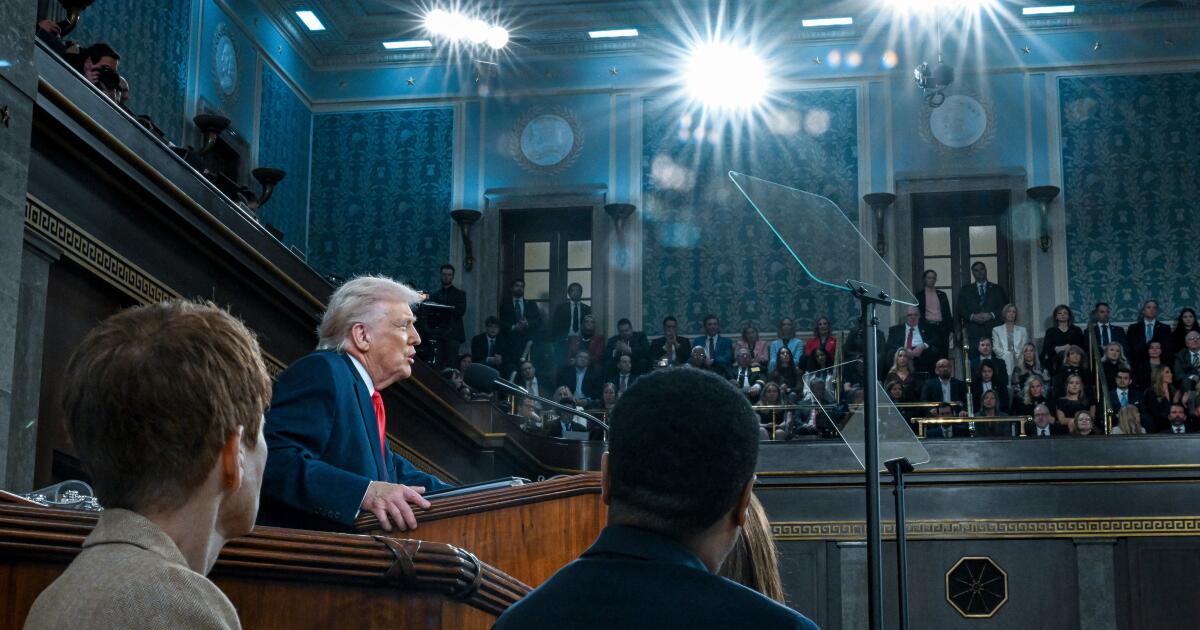
President Trump headed into Tuesday night’s State of the Union speech projecting confidence in his personal power to “Make America Great Again,” despite the woes he says he’s been saddled with by his Democratic predecessors.
He also stood in a uniquely precarious position — facing some of his lowest approval ratings ever, plummeting support on his signature issue of immigration, unrelenting pressure from the slow rollout of the Epstein files, a sluggish economy, mounting international tensions and looming midterm elections in which Democrats appear poised to make gains, possibly even retaking control in Congress.
Trump remains popular among his base and remarkably infallible in the eyes of his loyalist administration and still commands extraordinary deference from many leaders in his party. Many of his supporters share his confidence and suggest polls showing slipping support are bogus.
“This is what ‘America first’ looks like,” said Paul Dans, former head of the conservative Project 2025 playbook, which Trump has largely adopted. “The last year has been phenomenal. He has done more in one year than most presidents would accomplish in a whole term.”
Nonetheless, political observers see a landscape of vulnerabilities for the second-term president heading into the 2026 elections.
“He stands at a moment of rapidly declining political capital,” said Rob Stutzman, a Republican consultant in California. “From a historical perspective, a president in year six, heading into what looks like a rough midterm, is probably not going to rise any higher again, in terms of their political equity — so he’s probably past his peak of power.”
Trump is in “about as weak a position” as any president heading into a State of the Union address in recent memory, agreed Bob Shrum, a longtime Democratic strategist and director of the Dornsife Center for the Political Future at USC. “I don’t think the country sees Trump as the solution to anything at this point.”
At the same time, however, Trump is not acting like other weakened presidents, Shrum noted.
Instead of taking stock and turning away from unpopular policies, including on immigration and the economy, he is signaling that he simply won’t accept major midterm losses for his party — which leaves the nation in “completely uncharted waters,” Shrum said.
“We have a president who by all traditional standards has been weakened seriously, but who acts as though he had maximum strength,” he said. “We have a president who is deeply unpopular, who by every measure should see his party do very poorly in the midterms, but who seems determined to interfere in the midterm elections in any possible way that he can.”
In the polls
A Washington Post-ABC News-Ipsos poll released Sunday showed 60% of Americans disapprove of Trump’s job performance, with 39% saying they approve. The last time Trump fared so poorly in that poll was shortly after the Jan. 6, 2021, attack on the U.S. Capitol.
A CNN poll by SSRS released Monday found that Trump’s job approval rating stood at 36%, with a 19-point drop in approval among Latinos in the last year, an 18-point drop among Americans younger than 45, and a 15-point drop to just 26% approval among political independents — the lowest it has ever been during either of his terms.
Shrum said such sharp declines in support among Latino and independent voters do not bode well for Trump or for other Republicans on the ballot in November — especially given that the president, who often dismisses polling not in his favor, does not appear inclined to alter his policies.
Dans, who is running for Senate in South Carolina against Republican incumbent Sen. Lindsey Graham, dismissed Trump’s slumping polling numbers as “fake or engineered,” and said if anything, the president should “go full Trump” — doubling down on his agenda.
On immigration
Trump has polled well on immigration in the past. But his heavy-handed crackdown — with Immigration and Customs Enforcement and other federal agents arresting people without criminal records, detaining U.S. citizens and legal immigrants and killing U.S. citizens in Minneapolis — has shifted that. The Washington Post-ABC News-Ipsos poll found 58% of adults disapprove of his handling of immigration.
Stutzman said Trump and his team obviously realize their approach has rubbed voters the wrong way, which is why they recently shuffled the leadership team in Minneapolis. But the broader policy has remained in place and “the numbers are still cratering on them,” he said.
Shrum said that if Trump “were intent on improving his situation, he would change the way ICE behaves, and might put some different faces on the effort that he’s making, and might focus on people who are actually convicted criminals,” but instead, he and other administration officials “seem determined to plow ahead.”
Dans said Trump received “a clear mandate in 2024 with respect to the mass migration, and it was to reverse and end that flow,” and that’s what he’s doing. “Everyone is going back home.”
On Epstein
Trump has repeatedly denied any wrongdoing involving the late disgraced financier and convicted sexual abuser Jeffrey Epstein, a onetime acquaintance. However, questions about Epstein’s ties to Trump and other powerful men have persisted as evidence from multiple investigations into Epstein’s abuses continue to be released.
Republicans in Congress broke with the president and joined Democrats to pass a bill requiring the records’ release last year. Justice Department officials have slow-walked the release by redacting and withholding records, further dragging it out.
The records contained unproven accusations of wrongdoing by Trump, which he has denied. Democrats and Republicans alike have argued more records need to be released.
On the economy
Trump was dealt a blow last week when the U.S. Supreme Court blocked a sweeping set of tariffs he’d imposed on international trading partners.
Trump has said his administration will use other legal authorities to impose similar or even stiffer tariffs, despite polls showing his tariffs are unpopular.
The Washington Post-ABC News-Ipsos poll, which was taken before the court ruling, found that 57% of respondents disapproved of Trump’s managing of the economy, and 64% disapproved of his handling of tariffs.
Dans said that Trump has already tempered inflation and that “the economy is ready to take off like a rocket ship,” especially if Congress gives the president the space to continue rolling out policies aimed at returning jobs to the U.S. that long ago went overseas.
“We’re really focused on reindustrialization,” Dans said. “This isn’t going to happen overnight, but all the building blocks are being put in place.”
Looking ahead
Stutzman said there is already evidence that Trump “doesn’t quite have a grip on Congress” like he used to, given recent votes on the Epstein files and tariffs, and that the conservative-leaning Supreme Court is still willing to rule against him, as it did on his tariffs.
If Democrats win back control in the midterms, Trump will see his influence wane even further as “the next two years turn into a quagmire,” with Democrats stymieing his agenda and launching one investigation after another, Stutzman said.
Dans said people standing in Trump’s way, including in Congress, need to clear out, because they’re “flouting” the will of the electorate. “It’s always about what the people want, and that’s what he’s going to deliver.”
Shrum said Trump trying to avoid losing power by interfering with the vote, including through the handling of mail-in ballots, is a major concern, as is Trump entering the U.S. into an armed conflict overseas in a “Wag the Dog” move — a reference to a 1997 movie of the same name in which an unpopular president uses a foreign war to salvage an election.
However, Shrum said he doesn’t think the latter would actually benefit Trump — “I don’t think that at this point another foreign incursion would make any president more popular” — and that, interference or not, a Republican drubbing in November is likely.
Trump, then, “will just try to govern by executive order,” will get sued and will have his agenda mired in court battles straight through the end of his presidency, Shrum said — a product, in part, of his confident despite all indications, “my way or the highway” approach to governing.