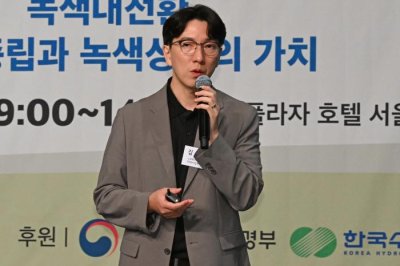
Kim Hyun-tae, executive director of product planning and strategy for LG Energy Solution’s energy storage system business division, speaks Friday at the second Asia Today Environment Forum at The Plaza Seoul. Photo by Asia Today
May 29 (Asia Today) — LG Energy Solution sees the electric vehicle slowdown as an opportunity to expand its energy storage system business as artificial intelligence data centers drive surging electricity demand, a company executive said Friday.
Kim Hyun-tae, executive director of product planning and strategy for LG Energy Solution’s energy storage system business division, said the EV “chasm” has created risks but also opened a path for the company to shift more aggressively into ESS.
“In the carbon-neutral era, we must move beyond simply increasing renewable energy and improve both grid stability and energy efficiency,” Kim said.
Kim made the remarks at the second Asia Today Environment Forum held at The Plaza Seoul, where he gave a presentation titled “LG Energy Solution’s vision for power grid stabilization and decarbonization.”
He outlined LG Energy Solution’s strategy for shifting toward ESS and responding to electricity infrastructure needs in the AI era.
Kim said South Korea’s battery industry had built large-scale production bases in the United States, viewing it as a core automotive market. But the market contracted after the second Trump administration took office and reduced electric vehicle subsidies while changing related policies.
“We secured new business plans by proactively converting U.S. plants from EV-centered production to ESS production,” Kim said.
LG Energy Solution produces ESS products in South Korea, Europe and the United States, Kim said. Its ESS production capacity in North America is now about 50 gigawatt-hours, and the company plans to expand that to more than 80 gigawatt-hours by next year.
“The United States has the highest ESS demand after China,” Kim said. “An ESS boom is taking place in the United States because investment subsidies of at least 30% and as much as 60% are provided when ESS and renewable energy facilities are built.”
Kim said the spread of AI data centers is also driving ESS demand.
“AI data centers are called a hippopotamus that eats water and electricity because they consume enormous amounts of power,” Kim said. “Nvidia’s next-generation Rubin graphics processing unit is expected to consume about four times more power than the Blackwell chip currently being sold, so securing stable power is essential.”
Kim said global Big Tech companies are focused on “time to power,” or how quickly new power capacity can be secured.
“Because connecting to existing power grids takes a long time, demand is growing for quickly building onsite and off-grid power sources that combine solar power, ESS and small gas turbines,” he said.
Kim also proposed an ESS-based distributed power grid model as an alternative to delays in building new transmission networks.
“Large-scale electricity demand sites are increasing, such as the Yongin semiconductor cluster, but building new transmission networks or high-voltage direct current systems usually takes six to seven years,” Kim said.
“For example, a realistic alternative could be storing electricity generated from renewable energy in the Honam region in ESS and then using existing transmission networks to distribute it to demand centers,” he said.
In the medium and long term, Kim said sodium-ion batteries, sometimes called “salt batteries,” could become a game changer in the ESS market.
“When renewable energy’s share expands to about 50%, large-scale ESS will be needed to offset intermittency, but costs are currently high,” Kim said. “LG Energy Solution plans to test sodium-ion batteries that can replace lithium in the United States in 2027 and pursue large-scale commercialization in 2029.”
Kim also said the global ESS market is being reshaped around domestic protectionism.
“The United States is encouraging the use of U.S.-made products through subsidy policies based on the Inflation Reduction Act, and Europe is also pursuing the introduction of the Industrial Accelerator Act, which is being called a European version of the IRA,” Kim said. “In a blocked supply chain environment, policy consideration is also needed to protect domestic industries and strengthen supply chain competitiveness.”
Kim said LG Energy Solution is building a decarbonization system that includes its supply chain and recycling operations as it works toward achieving RE100 by 2030 and carbon neutrality across its value chain by 2050.
— Reported by Asia Today; translated by UPI
© Asia Today. Unauthorized reproduction or redistribution prohibited.
Original Korean report: https://www.asiatoday.co.kr/kn/view.php?key=20260529010008771