Olympic dreams on hold: Swiss bobsledder opens up about cancer fight
CORTINA D’AMPEZZO, Italy — World-class athletes, thrilling events, stirring medal ceremonies, I will remember all of those from the Winter Olympics. But what I experienced Sunday on my 45-minute bus ride from my hotel to Cortina will stay with me longer.
There was a young woman sitting across the aisle. She looked to be in her mid-20s, about the age of my daughter, and was wearing a knit cap with a Switzerland logo. Her dark hair was in long, thin braids and framed her friendly face.
“How’s it going?” I asked, setting down my backpack.
“Nervous,” she said with a faint smile.
That started the conversation, one that would have me repeatedly wiping my eyes with my sleeve.
Her name was Michelle Gloor. She’s 25 and from a small town outside of Zurich. Her boyfriend, Cedric Follador, is pilot of the Swiss bobsled team and has races throughout the week. She was heading to watch him practice.
Michelle knows all about the sport. In fact, she had been the brake woman on the Swiss national team and had hoped to be competing in these Olympics herself. She grew up as a track-and-field athlete, a sprinter, and only took up bobsled in 2022.
Women’s bobsled — or bobsleigh, as Europeans call it — is a two-person operation with a pilot in front and brake woman in back.
“The first responsibility is pushing the sled as fast as I can, together with my pilot,” she said in a German accent and near-flawless English. “I have to sit still and count the curves until we reach the finish line, when I have to pull the brakes. I’m responsible that the sled won’t crash into something.”
Her best friend had made the transition from track to bobsled, was looking for a brake woman, and convinced Michelle to give it a try.
“My first bobsleigh ride was in St. Moritz and I was so nervous,” said Gloor, a third-year law student at the University of Zurich. “I think I was crying in the back of the sled because I’d never felt anything like that, all the G-forces and you don’t have any cushion in the sled. It all hurts.
“But after the second run, I felt the adrenaline and it was great. It caught me from then. It took me two runs.”
She was 22 and the future was bright. They entered the Swiss championships and won. Michelle got serious about her new sport, training every day, eating right, building muscle.
Immersed in that world, she met Cedric but for the first 1½ years they were just casual friends. Their conversations were all bobsled-related.
“Then in spring 2024 he texted me and asked, ‘How are you?’” she said. “More personal stuff.”
They had been dating for about six months when a discovery would dramatically change their lives.
In November 2024, during a routine check-up, a gynecologist found evidence of cancer in Michelle’s ovaries. If there were signs she was ill, Michelle hadn’t noticed them. She had been tired the prior summer, yes, but she attributed that to her training.
“It was pretty advanced,” she said of the cancer. “I went to the women’s doctor every year and they couldn’t explain why they couldn’t see it earlier. I don’t know. I’m not questioning that anymore. It’s just … yeah.”
There was no time to wait. By December, she was in surgery. Doctors opened her abdomen from her breast bone down, looking for more growths. They deemed the operation a success, and six months of chemotherapy began in February.
“I lost my hair,” she said. “I had long, black hair. Losing that wasn’t bad. But I lost the hair on my face — my eyebrows, my eyelashes — that was hard. But I always knew it just had to be.”
Her doctor told her her cancer was Stage 3.
“That means it’s on the other organs too,” she said. “But the difference between Stage 3 and Stage 4 is it’s not in my lungs. It’s in my tummy area but not more upwards.”
“Women or even men my age, you live in your world, you are following your dreams. And you don’t think about something happening in your life.”
— Michelle Gloor, on being diagnosed with cancer at a young age
Cedric was by her side.
“I asked him after the diagnosis if he wants to join me in this journey or not,” she said. “I can understand if he won’t because we were together not even half a year, and I can understand if he said, ‘Hey, it’s too much for me. I can’t do that.’
“Then he took time for himself, and he came back and said he wants to stay with me. He wants to support me in every imaginable way.
“He drove me to therapy when he was in town because he had a bobsleigh season going on from November until March, in my toughest time. Every time he was home, he was there for me. When he wasn’t there, we were phoning every day. He was there all the time, even when he wasn’t there physically.”
Her parents and younger brother were there for her too, of course, but she wanted to give them some time to themselves. Cedric was her rock.
There are elements in his job as a driver that both help him in his sport, and her in her disease.
“As a driver, you really need to focus on what’s going on straight ahead of you,” she explained. “You can’t really switch away your thoughts. You have one minute of full concentration. I think you can compare it to Formula One because you only see the next curve in front of you.
“He’s very calm and I think that helps him in a sporting way to not overreact emotionally and stuff like that. But also for me as a partner, I’m very emotional. When I’m too excited or too sad or too angry, he can calm me down to a normal level. On a stress-less level, and to be stress-free is very important for someone who has cancer.”

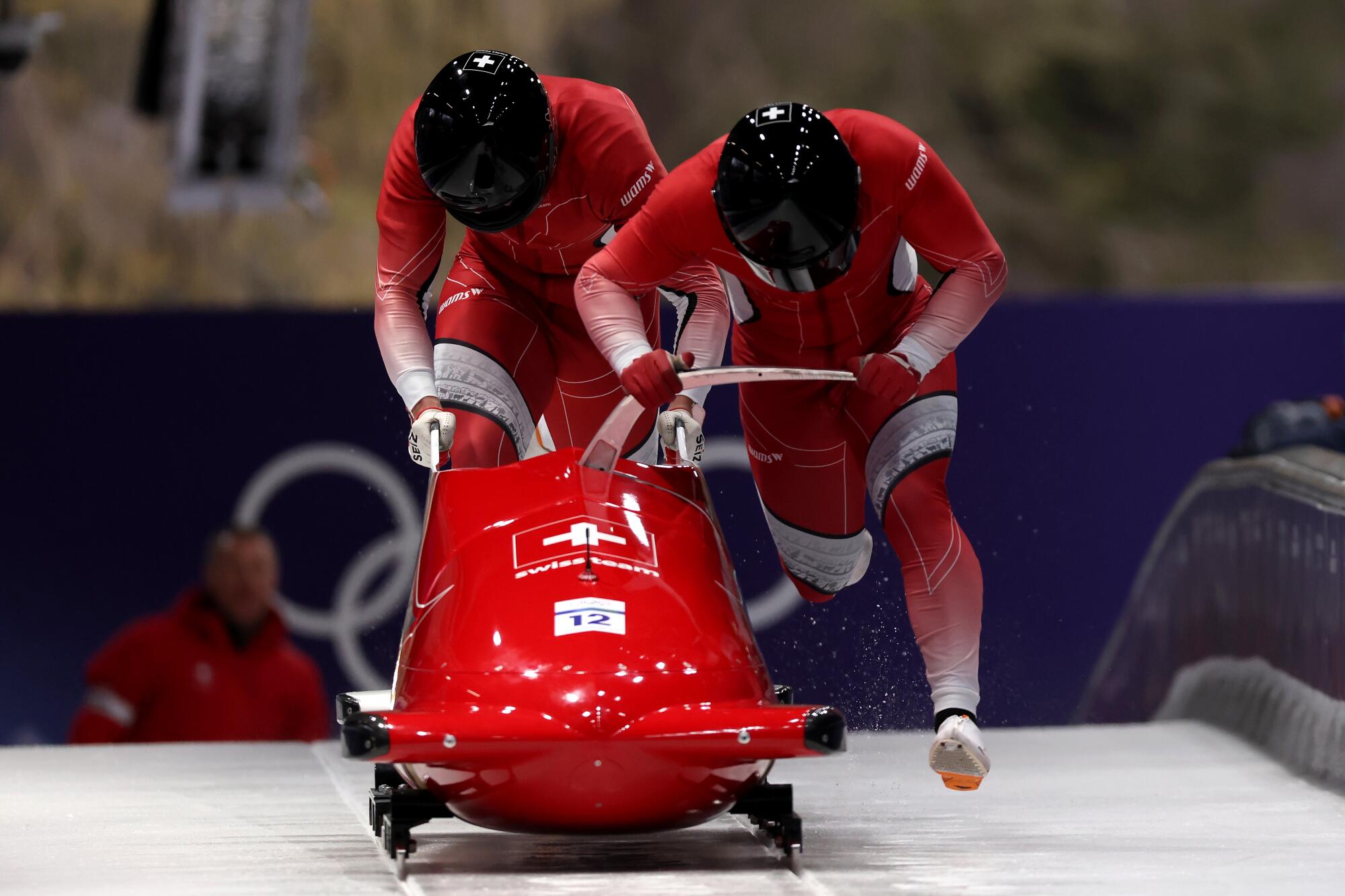
Switzerland’s Cedric Follador, right, and Luca Rolli compete in two-man bobsled at the Milan-Cortina Olympics on Monday.
(Richard Heathcote / Getty Images)
Michelle, petite and pale, has lost about 40 pounds over the past year. Mostly muscle.
“I was avoiding sugar in the beginning of the illness,” she said. “You read so much stuff. But after losing so much weight, doctors told me just eat what you want to eat. Because having energy is more important than eating too much sugar.”
In August, doctors discovered more cancer in her. Another surgery to open her abdomen.
“They said it’s still there,” she said. “Those microcells which they couldn’t remove because they couldn’t see them, they grew. But once all those microcells have grown up and been removed, or have been killed by therapy and medication, there won’t be any new cells because the ovaries have been removed, so they don’t produce any more.”
She tries not to Google her illness anymore. It doesn’t help her frame of mind. She’s changed in other ways, too.
“I was a very direct person before my illness,” she said. “Now I’m even more direct and straight-forward. I say no, and I don’t explain myself. If I don’t want to do something, I don’t have to. I just say no.
“Before that, I had a bad feeling about myself and explained myself just because I say no. I don’t do that anymore.”
In December, she began radiation. She has another scan after the Olympics.
There are times she just can’t believe this is happening.
“Women or even men my age, you live in your world, you are following your dreams,” she said. “And you don’t think about something happening in your life. I only know young people in Switzerland, so I can only speak for them. But they don’t talk about that.
“They are not sensible about what can happen, and that’s why it’s important for me to speak out about it. For example, with a women’s doctor, you have to go. It can happen to anyone.
“I’m a young woman. I do sports since I’m 10 years old. I don’t drink alcohol. I don’t smoke. But it still can happen.”
Her illness has shined a spotlight on her friendships. Lots of her old friends showed concern at first, then went on with their lives. A handful checked in on her frequently. Some are new.
“I got in touch with a woman during chemotherapy, she was there too,” Michelle said. “She has breast cancer. She saw my cross necklace, and we were talking about faith and how it helped in those hard times.
“We are still in contact now. We are writing letters to each other. We’re not texting or phoning, just writing letters and sending postcards. She’s as old as my mom, but it’s very cool to have someone with almost the same story.”
How will that story end? Michelle has her hopes, this fearless young woman who took to bobsledding on her second time down the track.
“My goal is to be in the Olympics in four years,” she said. “I’ll be 29 by then. The age is still good — even better than now for a bobsleigh athlete. And I have a great team. My bobsleigh pilot is very supportive and she said she always has a place for me in the sled.”
This week, Michelle is supporting Cedric — just a sliver, she said, of the way he has supported her. They got engaged in December. It happened at sunset in his little hometown in the Swiss Alps.
“He was talking about himself and us, and then he proposed to me,” she said. “I said yes. Of course.”