L-39NG Skyfox Jets Could Give Ukraine A Critical New Russian Drone Hunting Capability
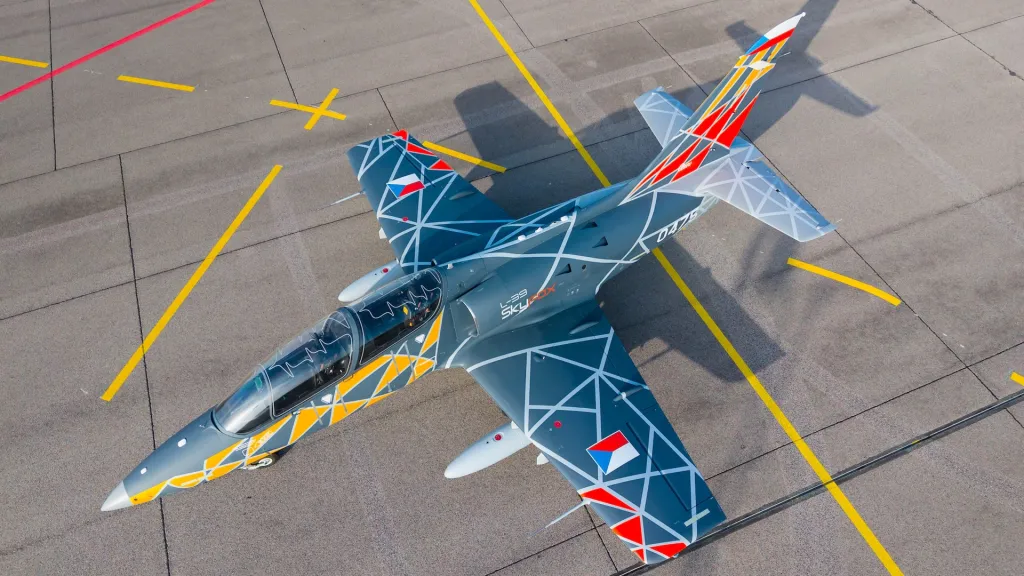
The Czech Republic could supply Ukraine with up to 16 Aero L-39NG Skyfox aircraft, potentially giving Kyiv another option for countering Russia’s Shahed-type attack drones. The proposal includes four aircraft previously agreed for transfer and 12 more that Czech officials are now discussing with their Ukrainian counterparts.
Czech Deputy Prime Minister and Industry and Trade Minister Karel Havlíček raised the expanded arrangement during a visit to Kyiv yesterday, where he met Ukrainian Prime Minister Serhiy Koretskyi. Havlíček described the discussions as encouraging but did not announce a finalized agreement for the additional aircraft.

Skyfox is based on the Cold War-era Aero L-39 Albatros jet trainer, a rugged and reliable Soviet aircraft that was produced in the thousands and served all over the globe. The new L-39NG was reworked and modernized in the 2010s in an effort to recapture jet trainer market share that had waned as the Soviet design was increasingly passed over for more modern alternatives. Many L-39s are also flown by privately in the United States and are used for contracted air support services for the U.S. military. One of the firms that uses them, Draken International, actually assisted in the L-39NG project and acted as a U.S. anchor for the program.
The Skyfox’s redesigned structure makes use of modern materials, reducing weight and increasing structural lifespan to 15,000 flight hours. The American Williams FJ44-4M turbofan, a very widely used jet engine that is found on many private jets, replaces the original Soviet-designed engine, offering far better fuel efficiency, digital engine control, updated ejection seats and improved maintenance support. In contrast to the old Albatros, the Skyfox has a modern glass cockpit and an updated flight control system. The Skyfox has a maximum speed of approximately 560 miles per hour, a service ceiling of 38,000 feet, and five external hardpoints for carrying weapons and other mission equipment. Like its predecessor, although primarily a jet trainer, it also has light combat capabilities.

L-39NG – Nová generace
Its potential counter-drone role is tied to Aero Vodochody’s Drone Hunter concept, which is being developed specifically to engage uncrewed aerial vehicles. The proposed L-39NG configuration features an electro-optical targeting system and launchers for 70mm laser-guided rockets. Gun pods would be another potential option for the counter-drone role.
Drone Hunter would provide Ukraine with a reliable airborne platform for rapidly engaging attack drones, reducing reliance on more expensive surface-to-air missiles and conventional fighter aircraft. However, the system has not yet entered operational service, and its effectiveness will depend on the results of further testing and integration work. Aero Vodochody is working with Belgian defense company Thales on the guided rocket system.

A dedicated counter-drone aircraft in this class would also help preserve Ukraine’s more capable fighter fleet for other missions. Its F-16s, along with the country’s remaining MiG-29 Fulcrums, Su-27 Flankers, and French-supplied Mirage 2000s, are needed for a much wider range of tasks, including counter-air operations, air-to-ground strikes, and intercepting more challenging Russian cruise missiles and jet-powered one-way attack drones. Using these aircraft extensively to hunt relatively inexpensive and slower one-way attack drones adds flight hours, increases maintenance demands, and consumes finite stocks of air-to-air weapons.
Ukraine’s F-16 fleet is already under considerable strain. As TWZ recently reported, more than half of the aircraft were reportedly stuck in maintenance limbo, while shortages of AIM-9 Sidewinder and AIM-120 AMRAAM missiles were further complicating operations. The fighters have also been increasingly tasked with countering Russia’s expanding use of faster, jet-powered attack drones. A separate aircraft optimized for engaging slower uncrewed targets could help ease some of that burden.

The potential economic advantage is also significant. Laser-guided 70mm rockets are a much less expensive means of engaging drones compared to conventional air-to-air missiles. Already, Ukraine appears to have introduced the U.S.-made 70mm Advanced Precision Kill Weapon System II (APKWS II) rockets to the arsenal available for its F-16s. The Thales 70mm laser-guided rocket is very similar, as you can read about here, and is already being employed by Ukraine in ground-based applications.
As we have reported in the past, guided rockets offer clear cost advantages over traditional air-to-air missiles:
Each APKWS II consists of three core components: a 70mm rocket motor, one of several standard warhead options, and a guidance and control section in between. The guidance and control element is by far the most costly of the three, with a unit price of around $15,000. The warhead and motor add another few thousand dollars to the total cost, which is generally in the $20,000 to $25,000 range. By comparison, current-generation variants of the AIM-120 are in the $1 million unit cost range, with the latest versions of the AIM-9X also being priced at around $500,000.

Aside from the effectors, operating the Skyfox is an entirely different cost proposition than the F-16, for example.
Aero Vodochody puts the Skyfox’s operating costs at approximately $1,700 to $2,300 per flight hour, compared with around $22,000 for an F-16-class fighter. The Skyfox also requires a much less demanding maintenance and logistical support footprint than a frontline fighter. It can fly from rough strips and roadways with ease and can be more readily hidden from view due to its small size.
Ukraine has also previously shown that it is more than willing to adopt less-conventional aerial platforms for countering the drone menace.
One notable example is the Antonov An-28 twin-engine turboprop utility aircraft that has been adapted into a Shahed hunter. The aircraft has been equipped with M134 Miniguns and, more recently, underwing launchers for Ukrainian-made interceptor drones. This approach allows the aircraft to act as an airborne launch platform, bringing interceptors closer to incoming threats while using its own sensors and crew to help locate them. The An-28’s relatively long endurance and short takeoff and landing capabilities also make it well suited to sustained patrols from austere airfields.

The Skyfox would offer a different approach, using a jet-powered platform and guided rockets and gun pods rather than relying on trainable guns or air-launched interceptor drones.
In terms of crewed aircraft being used or considered for counter-drone missions, the L-39NG Skyfox would occupy something of a middle ground. At the higher end are aircraft like the F-16 and other combat jets, which offer substantially greater performance and broader combat capabilities but are also more valuable assets that require much greater levels of support. At the lower end are platforms such as the An-28, helicopters, and even repurposed propeller-driven training aircraft, which offer relatively inexpensive ways to patrol for and engage slower-moving drones.
The requirement for additional counter-drone capabilities is becoming more pressing as Russia continues to evolve its Shahed-family weapons. Alongside the familiar propeller-driven Geran-2, which was derived from the Iranian Shahed-136, Moscow has increasingly employed jet-powered variants, including the Geran-3 and newer Geran-4 and Geran-5. These drones fly faster and at higher altitudes, making them significantly more challenging to engage with the relatively inexpensive interceptor drones Ukraine has relied on heavily.

The Geran-4, for example, is reported to reach speeds of around 280 to 310 miles per hour and operate at altitudes of up to 26,000 feet. Newer variants are also incorporating improved navigation, cameras, and communications equipment, potentially allowing for greater autonomy and more flexible targeting. Russia’s growing use of these weapons is placing additional pressure on Ukraine’s already stretched air-defense network.
Speaking to TWZ, Justin Bronk, Senior Research Fellow for Airpower and Military Technology at RUSI, noted that the L-39NG “offers an unusually attractive combination of attributes as a dedicated counter-drone interceptor; being fast enough to easily intercept Geran-3 and Geran-4 jet-powered drones, very cheap and simple to operate compared to frontline fighters and even other advanced trainer jets, already having targeting pod, gunpod and rocket pod options integrated, and being available quickly due to a small existing order book.”
“It also has impressive endurance for an aircraft of its size and weight, so it can stay on station longer than most other jet options without air-to-air refuelling,” Bronk added.
This is largely thanks to its FJ44 engine and is critical to being able to rapidly respond to new inbound threats while remaining airborne for extended periods during raids.
However, Bronk also pointed to its primary limitation: having a radar. “While this makes it harder to acquire the drones during an intercept, it is not as problematic in Ukraine given the extensive existing network of radar-equipped ground-control stations to help guide interceptors to the rough vicinity of the target,” he said.
In addition, Ukraine already has large numbers of pilots and maintenance personnel who are familiar with the previous-generation L-39, so training should be very straightforward to operate the L-39NG. Ukraine’s L-39s have even flown combat operations during the war.

The new Czech proposal follows Ukraine’s unsuccessful effort to obtain L-159 ALCA light combat aircraft from Prague. Czech President Petr Pavel previously supported transferring some of the aircraft to Kyiv, and the Czech military indicated it could release up to four. However, Prime Minister Andrej Babiš’s government rejected the proposal, arguing that the aircraft were needed by the Czech Armed Forces.

The L-159 has a radar, the Italian FIAR Grifo L, which was eyed as a highly beneficial tool for crews independently detecting and engaging inbound drones, even in all weather conditions. But as Bronk explained, this can be overcome to a degree thanks to Ukraine’s vast drone detection and tracking network.
Already in service with the Czech Republic, Hungary, and Vietnam, the Skyfox is also on order for Angola and Armenia.

Aero Vodochody currently produces approximately 12 Skyfox aircraft annually, with the potential to increase output to 18. However, the company’s production schedule was reportedly booked through the second quarter of 2027, potentially complicating deliveries to Ukraine.
Whatever happens next, the development is indicative of how drone-hunting aircraft are increasingly becoming a feature of the evolving air defense landscape, as militaries look for more economical ways to counter the proliferation of one-way attack drones. It also highlights the possibility that other trainer types could be used to help reduce costs and save the higher-end fighters for more complex missions. Such a strategy could become more widely adopted globally as the threat of one-way attack drones continues to metastasize.
Contact the author: thomas@thewarzone.com