skating

Winter Paralympics 2026: Why is figure skating not at Milan-Cortina?

Fans tuning into the Winter Paralympics will have spotted figure skating missing from the programme at Milan-Cortina despite it being one of the most popular sports at the Olympics.

There are just six sports at the Games: Para-Alpine skiing, Para-biathlon, Para-cross-country skiing, Para-ice hockey, wheelchair curling and Para-snowboard.

For skating to be included in the Winter Paralympics, the International Skating Union (ISU) needs to become recognised by the International Paralympic Committee (IPC).

The IPC would also need to approve a range of conditions affecting how the sport is run – including venues, costs and deciding classification categories for competing athletes.

But there are growing calls from skaters for the sport to be included and the IPC says it is keen to expand the Paralympic programme.

No new sports have been added since Para-snowboard in 2014.

Speaking before Milan-Cortina, IPC chief Andrew Parsons said: “We have not reached the limit as per our agreement with the IOC (International Olympic Committee) in terms of the number of athletes in sports. But it is not only about the limit, it is about obviously the quality of the sport at an international level.”

“For example, we don’t have skating sports, we don’t have short course, we don’t have figure skating, because these sports are not on an international level,” he added.

Source link

Olympic gold medalist skater Alysa Liu inspires new mural in Gardena

U.S. figure skater Alysa Liu made quite an impression at the Milan-Cortina Olympics with her unique style, her compelling backstory and, of course, her gold medals in the women’s singles competition — the first for an American woman since 2002 — and in the team event.

Her feats captured the attention of local artist Gustavo Zermeño Jr. He wanted to be sure to capture all of it in his new mural paying tribute to the 20-year-old athlete in Gardena.

“Obviously her winning gold was the main factor” in his choosing to paint Liu, Zermeño said.

But once the Mexican-American artist learned more about the Chinese-American skater, he found inspiration in other aspects of her life as well. That includes the Oakland native’s two-year retirement from the sport starting at age 16, her enrollment at UCLA and her decision to express herself in her own way.

“She’s first-generation American, just like myself,” Zermeño said. “So I feel like that tie, her going to UCLA, her stopping skating for awhile and then jumping back in and more being herself — you know, growing up in Venice, I feel like that’s what kind of made me an artist. Venice allowed me to be myself, be wacky on the boardwalk, artists, performers, stuff like that.

Alysa Liu smiles and leans forward as she pretends to take a bite out of a gold medal, with a U.S. flag around her shoulder

U.S. figure skater Alysa Liu poses with the gold medal she won in the women’s singles Feb. 19 at the Milano-Cortina Winter Olympics.

(Matthew Stockman / Getty Images)

“So I feel like there were a lot of connections beyond her just winning the gold medal. But ultimately, I think she just deserves her flowers, man. She accomplished something, and I feel like her personality is what’s really garnering all this support from people.”

Zermeño was driving to get dinner near his home earlier this week and noticed a wall he thought would be perfect for his Liu-inspired project outside the Coe’s Glass & Mirror building at 15532 Crenshaw Blvd. It turned out that Zermeño casually knew the business owner, although Alex Lopez said he never realized his former next-door neighbor was a mural artist.

Still, Lopez approved the project immediately upon seeing samples of Zermeño’s work and a digitally created version of his idea for the Liu painting.

“I mean, I probably should have gone up the chain of command and asked the landlord’s permission, but I knew it was going to come out amazing,” Lopez said. “I just said, ‘Let’s go for it.’ The landlord came by this morning and loved the piece. He was really glad that we did it.”

Artist Gustavo Zermeno Jr. stands in front of a mural in progress that is dedicated to Olympic gold medalist skater Alysa Liu

Artist Gustavo Zermeno Jr. said he was inspired to paint a mural dedicated to U.S. skater Alysa Liu for reasons ‘beyond her just winning the gold medal.’

(Ronaldo Bolanos / Los Angeles Times)

Zermeño started painting Tuesday and hopes to be finished early next week. The mural will feature three images of Liu, including two of her skating, but the centerpiece is a larger-than-life headshot of her from the women’s singles medal ceremony.

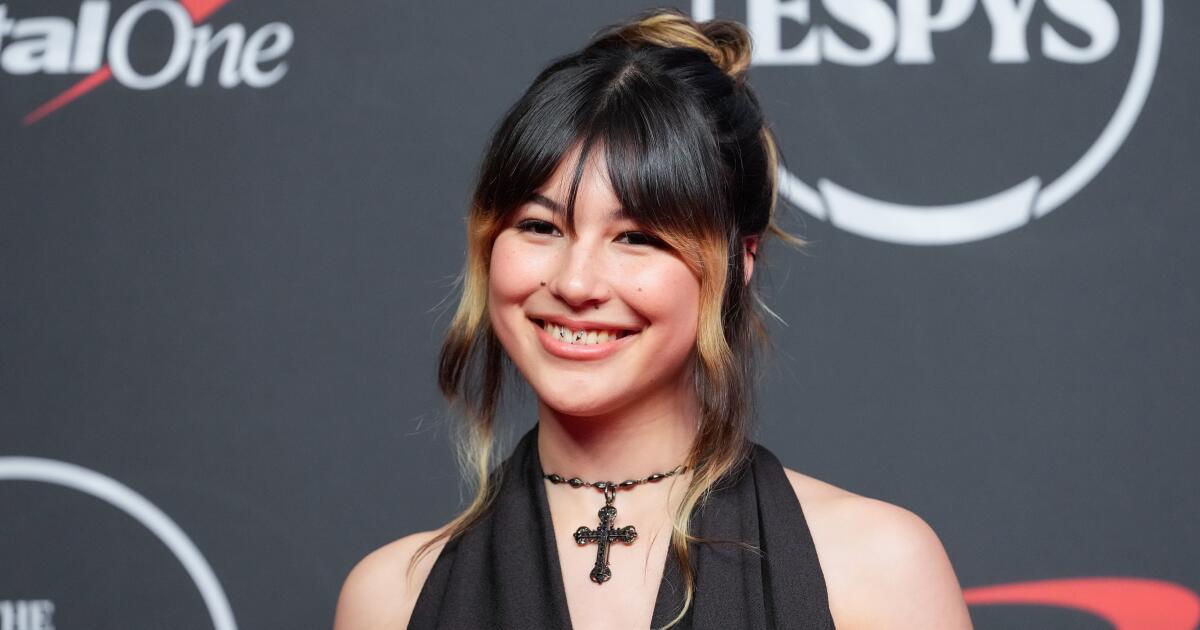
In it, the halo-haired athlete smiles broadly as she pretends to take a bite out of her gold medal, putting on full display her now-famous “smiley” piercing in the tissue connecting her upper lip to her gums.

Artist Gustavo Zermeno Jr. spray paints a mural dedicated to Olympic gold medalist skater Alysa Liu

‘I think it really represents her personality and where she’s from, the Bay Area,’ artist Gustavo Zermeño Jr. said of his mural dedicated to U.S. skater and Oakland native Alysa Liu.

(Ronaldo Bolanos / Los Angeles Times)

“I like that it’s a little rough around the edges, but beautiful at the same time,” Zermeño said of the portrait. “I think it really represents her personality and where she’s from, the Bay Area. And so I feel like it just looks, you know, a little hood but at the same time, her being a figure skater, has that softness to it. And that’s kind of what I wanted.”

Lopez added: “I love it. Just her in general, as a person, I think she’s great. What she was able to accomplish in the Olympics is amazing for the United States and just for California. I’m honored to have her mural here. I feel like it represents the community and our business really well.”

Source link

L.A. designer Lisa McKinnon creates U.S. figure skating dresses

When women take the ice for Thursday’s Olympic free skate in the global fashion capital of Milan, five skaters will compete in dresses made by Los Angeles-based designer Lisa McKinnon.

McKinnon has become the must-have name in figure skating couture, dressing the entirety of the U.S. and South Korea women’s teams. Americans Alysa Liu, Amber Glenn and Isabeau Levito wore McKinnon’s designs in the short program and will do so again in the free skate.

And one of those dresses may be featured on the medal podium. Liu stands in third place after Tuesday’s short program, while Levito is in eighth and Glenn tumbled to 13th with the free skate still to come.

McKinnon knows exactly how clothing needs to fit on bodies moving across the ice — for spins, for jumps, for everything it takes to win. The fabric must be able to stretch in all directions, which necessitates a four-way stretch fabric. Design with a two-way stretch and a skater might not be able to lift their arm. Dress skaters in spandex, power mesh and stretch velvet, and they’ll move like they do in training.

American Amber Glenn competes in the figure skating short program at the Winter Olympics in Milan on Tuesday.

American Amber Glenn competes in the figure skating short program at the Winter Olympics in Milan on Tuesday.

(Robert Gauthier/Los Angeles Times)

McKinnon sources most of the fabric locally from the fashion district in downtown L.A.

“It’s really great to just go in person because sometimes it’s the fabric that can inspire you to create something with,” McKinnon said.

McKinnon’s time on the ice that taught her how to create fashion for an athlete tailored for movement and aesthetic appeal. She grew up as a competitive figure skater in Sweden, and she started making bodysuits and dresses — which she wore to practice — for herself at age 11 or 12. By 16, she was designing dresses for elite skaters in her hometown, Mariestad, Sweden, including a Swedish national champion. At the time, they shared a coach, and the coach asked McKinnon to design a dress for the skater.

“They had seen the dresses that I made for other skaters,” she said. “They were just — you know — putting their faith in my hands that I could do this.”

After high school, McKinnon skated in tours in Europe and then North America. In the United States, she first settled in Las Vegas, where she designed dresses for local skaters. When she moved to L.A., bigger name skaters started calling. She designed for Ashley Wagner, three-time U.S. champion, and Karen Chen, who competed in her dresses at the 2018 Olympic Games. McKinnon says they were the ones who “got her noticed.” Noticed to the point that Milan is by no means the designer’s Olympic debut. In 2018, she outfitted pairs gold medalists Aljona Savchenko and Bruno Massot from Germany.

Since then, McKinnon has become the go-to designer for elite women’s figure skaters in the United States. At U.S. nationals in St. Louis in January, eight of the 18 senior women competed in McKinnon’s dresses. In the final warm-up alone — composed of the six skaters leading after the short program — five wore McKinnon designs. There, Glenn, Liu and Levito stood on the podium in her dresses.

In St. Louis, McKinnon hand delivered a dress to Liu, the reigning world champion who debuted a long-awaited Lady Gaga free skate routine. Liu practiced in the dress and McKinnon was able to make on-the-spot adjustments.

Surprisingly, hand delivery isn’t the norm for the dresses that run from $3,000-$8,000, averaging around $5,000 (McKinnon charges by the hour). Because McKinnon designs for skaters who train all over the country — Liu in Oakland, Glenn in Colorado Springs, Colo., and Levito near Philadelphia in southern New Jersey — FedEx shepherds the dresses across the country. Skaters make sure the dresses fit OK before McKinnon and her four-person seamstress team add sparkle, which usually means a crystal count in the thousands. Beads, paillettes and pearls are often mixed into the shine. Each crystal is hand affixed with E6000 glue.

American Christina Carreira and partner Anthony Ponomarenko compete during the ice dancing free skate.

American Christina Carreira and partner Anthony Ponomarenko compete during the ice dancing free skate at the Winter Olympics on Feb. 11 in Milan.

(Robert Gauthier/Los Angeles Times)

McKinnon affixed faux rose pedals to a dress for American ice dancer Christina Carreira to debut during the skater’s own Olympic debut. Midway through the skating season, Carreira and partner, Anthony Ponomarenko, returned to their free dance from two years ago, “Perfume: The Story of a Murderer.” They needed new costumes to differentiate from their performances two years ago, and McKinnon had already designed costumes for the team’s rhythm dance to La Bouche’s “Sweet Dreams.” McKinnon made the new dress in a little over a week, and it was set to arrive three days before Carreira left her training base in London, Canada, for the Games.

Except the dress didn’t arrive.

McKinnon learned that the package was stuck at a FedEx facility in Memphis, Tenn., after Winter Storm Fern pummeled the region.

“We would call and sometimes they’d say it’s in L.A., sometimes they’d say it’s in Memphis, so we didn’t know where it was,” Carreira said. “We weren’t getting answers, but going on social media actually helped.”

Carreira woke up after her flight to Milan to find an Instagram message with a photo of her dress. A woman told Carreira that her husband had found the package and put it on the first plane to Detroit, where Carreira’s coach, Scott Moir, retrieved the package to bring to Milan.

Carreira first tried on the dress in Milan. “It fit perfectly,” she said. “Lisa has never met me. She’s only seen me over FaceTime, and the two dresses she’s made fit perfectly.”

Carreira and Ponomarenko placed 11th in their Olympic debut.

“I wanted a dress that made me feel special at the Olympics,” Carreira said. “And both of those dresses did that.”

Carreira came to McKinnon’s designs through Glenn, who skated her short program to Madonna’s “Like a Prayer” wearing a McKinnon design based on the 1989 music video. After admiring McKinnon’s designs, Carreira talked it over with Glenn at an early season competition in Oberstdorf, Germany.

“She said Lisa was super easy to work with,” Carreira said. “The dresses fit perfectly.”

McKinnon designs from her studio, which occupies the first floor of her apartment in West Hollywood. There, McKinnon and her team watch their dresses take the runway in Milan. Except the runway is made of ice and the skaters will do much more than walk.


Source link

Alysa Liu shines, while Amber Glenn makes big mistake in figure skating

She’s the only U.S. skater still in medal contention. Alysa Liu is the last person to care.

The unbothered 20-year-old is the only American who finished in the top six of the women’s short program Tuesday and is holding the weight of an Olympic medal drought that’s as old as she is. But after placing third in the short program, she said she hadn’t even looked at the standings. She is angling more for an invitation to the post-competition gala than a medal.

“A medal?” Liu asked with a sarcastic scoff and giggle. “I don’t need a medal. I just need to be here, and I just need to be present. And I need people to see what I do next.”

Next will be the women’s free skate Thursday, where Liu will try to be the first U.S. woman to stand on an Olympic podium for singles figure skating since Sasha Cohen in 2006.

The United States entered the Milan-Cortina Games with three strong contenders to end the drought, but will need comeback performances from the other two “Blade Angels.”

Alysa Liu strikes a pose with her left arm overhead and right arm outstretched to the right.

Alysa Liu is the top hope for the U.S. in women’s singles figure skating after finishing third in the short program.

(Robert Gauthier / Los Angeles Times)

Isabeau Levito skated cleanly in her Olympic debut but finished the short program in eighth with 70.84 points, almost eight points back from leader Ami Nakai’s 78.71.

Amber Glenn appeared poised to join Liu in medal contention after she started her “Like a Prayer” program with a steady triple axel. Looking inspired from a good luck message from Madonna this week, Glenn executed a strong triple-triple combination with her second jumping pass. The crowd at Milano Ice Skating arena roared.

Then Glenn popped her last planned triple jump. She earned zero points on the element. Her face fell immediately.

Glenn went through the motions of her step sequence but she looked lifeless, and after her program, she clutched the necklaces on her burgundy lace dress and knelt at center ice. She broke down in tears when she hugged her coach.

“I had it,” Glenn said through sobs.

With 67.39 points in 13th place, the three-time national champion is well outside the medal race led by Nakai and three-time world champion Kaori Sakamoto, who is in second with 77.23 points. Levito, skating in her mother’s hometown and paying homage to iconic Italian actress Sophia Loren with her short program, is less than six points out of podium position behind Liu’s 76.59 points.

Snoop Dogg and Martha Stewart, wearing bedazzled headphones in a booth at the top of the arena, were shown on the video screen after Glenn’s skate clapping for her performance. U.S. teammate Ilia Malinin cheered behind them.

Malinin could empathize as Glenn held back tears on the ice. The United States won the team figure skating competition with a dramatic one-point victory but hasn’t secured any of the individual gold medals that appeared likely. Malinin, whose free skate collapse was one of the most stunning moments of the Milan-Cortina Games, cited the intense Olympic pressure.

Isabeau Levito competes during the women's short program Tuesday.

Isabeau Levito competes during the women’s short program Tuesday.

(Robert Gauthier / Los Angeles Times)

After a shaky performance in the team competition, Glenn tried to escape the spotlight by training with U.S. teammates at a facility in Bergamo, 50 minutes outside of Milan. She tried to commit to rest and recovery and shy away from social media. She said after training Monday that she felt physically strong and had refocused enough to make the competition feel like any other world championship.

Knowing how hard it was for Glenn to get one jump away from putting herself into medal contention made the sight of her mistake all the more painful for Liu.

“She works so freaking hard,” Liu said after seeing Glenn’s skate on TV screens in the interview area. “Genuinely, such a hard worker, and she’s overcome a lot, and I just want her to be happy.”

Liu received some of the loudest applause of the night. Before beginning her program, she skated by the boards and high-fived both of her coaches, who hugged and hopped for joy when Liu executed her tricky triple lutz-triple loop combination jump. After hitting her ending pose, Liu covered her face to hide the tears that often well up in her eyes after her program set to “Promise.”

The reigning world champion returned to her second Olympics seemingly oblivious to any sort of pressure after a two-year retirement changed her perspective on skating. In Beijing, she was a 16-year-old who skated as she was told. She executed the jumps, performed to the music and wore the costumes that she was given.

But she laid the road to Milan all by herself and on her own terms.

One strong free skate away from her first individual Olympic medal — and second overall after helping the United States to team gold last week — Liu can’t be bothered to fret about how she’ll prepare for her last Olympic competition. Instead, she said she wants fans to see her new gala program.

A new dress just arrived and the choreography is almost done. All she needs is an invitation.

Source link

2026 Winter Olympics: What has gone wrong for British short track speed skating?

Eight years later, the latest UK Sport funding allocation of just under £2m has been presented as a total for short track, figure and long track speed skating.

So short track is caught in the situation which befalls many Olympic sports in Britain – they need to perform at the Games to get more funding, but without the funding they struggle to achieve success.

Asked what work is being done to fix short track, British Olympic Association (BOA) chair Dame Katherine Grainger told BBC Sport: “As much potential as we have in that team, there is more untapped.

“It is not a sport we have a legacy in, so that opens the door – we need to learn from other countries where we can.”

Add in the fact that there are few sports in the world more chaotic and unpredictable than short track.

Christie was Britain’s most recognisable speed skater a decade ago when she won three gold medals at the 2017 World Championships, but a series of crashes and disqualifications ruined her Olympic dreams in 2014 and 2018.

And this year, Treacy’s luck was also out. Take his 1,000m final – usually this event would have six racers, but in Milan had nine because three athletes were advanced to the medal race after being illegally hindered in their semi-finals.

Would Treacy, who was running in third when he tangled with Liu, have won a medal if there were fewer men on the track? Ultimately, hypotheticals do not put cash in the bank.

Treacy could not hide his funding frustrations when speaking to the BBC following that final.

“If we only had a bit more support going through the Olympic cycle,” he said. “In the UK we don’t even have an ice centre which is safe enough for competitions.

“In the UK we have to look at ourselves and see we need a facility where we can train at the top level, instead of having to go to other countries.”

Treacy is correct that there is no venue in Britain that could host an international short track event, because there are no rinks with the soft boards needed around the border to protect racers when there are crashes.

Source link

Winter Olympics: Ilia Malinin, U.S. win gold in team figure skating

Believe in the Quad God.

Ilia Malinin’s clutch free skate that scored 200.03 points gave the United States its second consecutive team figure skating gold medal Sunday at the Milan-Cortina Olympic Games.

After Amber Glenn fought through a shaky free program that finished third and lost the United States its two-point lead, Malinin stepped up as only he could. He executed five quad jumps and won by nearly six points, even if he did not perform his signature quad axel. He even put his hand down after a jump, but the mistake only seemed to fuel him as he finished with a flourish, changing the back-half of his program to earn back extra points.

His U.S. teammates, cheering from the sideline box rose to their feet and pumped their fists after each of Malinin’s jumping passes. When he landed his back flip, skating flawlessly through one foot, the packed crowd at Milano Ice Skating Arena roared.

While Japan’s Shun Sato scored a season’s best to finish the competition, he could not match the technical prowess of Malinin, who is also the favorite to win individual gold this week.

In front of a raucous home crowd, Italy held off Georgia for the bronze medal behind a dazzling free skate from Matteo Rizzo, who dropped to his knees on the ice and cried after his performance had fans chanting “Italia!” before he even finished. He cried into the Italian flag in the kiss-and-cry after his season’s best 179.62 points.

With the first figure skating medal of the Milan-Cortina Games on the line, every skater fought for every fraction of a point. U.S. pairs skater Ellie Kam went deep into a one-legged squat to hold on to the first throw jump. The United States led by five points entering the final day, but still had no room for error as Japan finished first in qualifying in all of Sunday’s disciplines. With the dominance of Japan’s Riku Miura and Ryuichi Kihara in pairs, Kam’s partner Danny O’Shea knew the strategy for the U.S. pair was to simply try to stay as close as possible.

Ellie Kam and Danny O'Shea perform in pairs figure skating during the team competition at the Milan-Cortina Games.

Ellie Kam and Danny O’Shea perform in pairs figure skating during the team competition at the Milan-Cortina Games on Sunday.

(Stephanie Scarbrough / Associated Press)

Kam fought for the landing on a throw loop so hard that she could feel her leg cramping.

“I was like, ‘I’m not going down,’” Kam said, “I got this. We got this.”

They looked at each other before their next element and said “calm.” Their message cut through the energized crowd that cheered louder and louder with each jump. At the end, Kam’s and O’Shea’s celebratory screams simply joined the crowd’s roar. As they saluted the crowd, O’Shea pointed toward Kam to acknowledge her effort.

The pair’s fourth-place finish in the free program was a one-point improvement from their qualifying spot, earning a slim, but vital cushion entering the men’s and women’s free skates.

Instead of sending world champion Alysa Liu back for the free skate after she performed the short program, the U.S. selected the three-time national champion Glenn. The 26-year-old was making her Olympic debut.

On the Olympic stage for the first time, Glenn has tried to embrace the opportunity while treating the competition as if it were any other one. But the larger stage has created additional stress for Glenn after she was asked in a news conference about President Trump’s approach to the LGBTQ+ community in recent years and how it’s affected her personally.

U.S. figure skater Amber Glenn competes during the team competition on Sunday at the Milan-Cortina Games.

U.S. figure skater Amber Glenn competes during the team competition on Sunday at the Milan-Cortina Games.

(Ashley Landis / Associated Press)

Glenn, who identifies as bisexual and pansexual, encouraged people in the queer community to “stay strong in these hard times” and recognized that it wasn’t the first time the community had to unite to “fight for our human rights.” Glenn then received threats on social media after the news conference and posted on Instagram that she would be taking a break from social platforms to focus on the competition.

But it wasn’t the social media hate that rattled Glenn, she insisted. She was simply tired, sore and disoriented from the unfamiliar Olympic team competition format.

All of Glenn’s other competitors did the short program portion of the competition on Friday. She came in with several good days of training at the venue, but did not get the same kind of opportunity to get used to the stage. Glenn fought through a shaky triple axel to open her program and stepped out of a triple flip that prevented her from completing a planned combination for her second jumping pass.

Waiting in the kiss-and-cry, Glenn bowed her head and stared at the ground. She struggled to muster even a fake smile.

“I’m grateful that the team is so supportive.” said Glenn, who finished behind Japan’s Kaori Sakamoto and Italy’s Lara Naki Gutmann. “But I do feel guilty that I could be the reason that we don’t win the gold, and I don’t know how I will ever apologize for that.”

Glenn clasped her hands in her lap waiting for Sato’s score after the Japanese skater performed a clean program that had his teammates in tears. But his technical score was about five points less than Malinin’s. Glenn was the first skater to hug Malinin in the United States’ team celebration, lifting him off the ground as he extended arms out wide.

Source link