skating

L.A. designer Lisa McKinnon creates U.S. figure skating dresses

When women take the ice for Thursday’s Olympic free skate in the global fashion capital of Milan, five skaters will compete in dresses made by Los Angeles-based designer Lisa McKinnon.

McKinnon has become the must-have name in figure skating couture, dressing the entirety of the U.S. and South Korea women’s teams. Americans Alysa Liu, Amber Glenn and Isabeau Levito wore McKinnon’s designs in the short program and will do so again in the free skate.

And one of those dresses may be featured on the medal podium. Liu stands in third place after Tuesday’s short program, while Levito is in eighth and Glenn tumbled to 13th with the free skate still to come.

McKinnon knows exactly how clothing needs to fit on bodies moving across the ice — for spins, for jumps, for everything it takes to win. The fabric must be able to stretch in all directions, which necessitates a four-way stretch fabric. Design with a two-way stretch and a skater might not be able to lift their arm. Dress skaters in spandex, power mesh and stretch velvet, and they’ll move like they do in training.

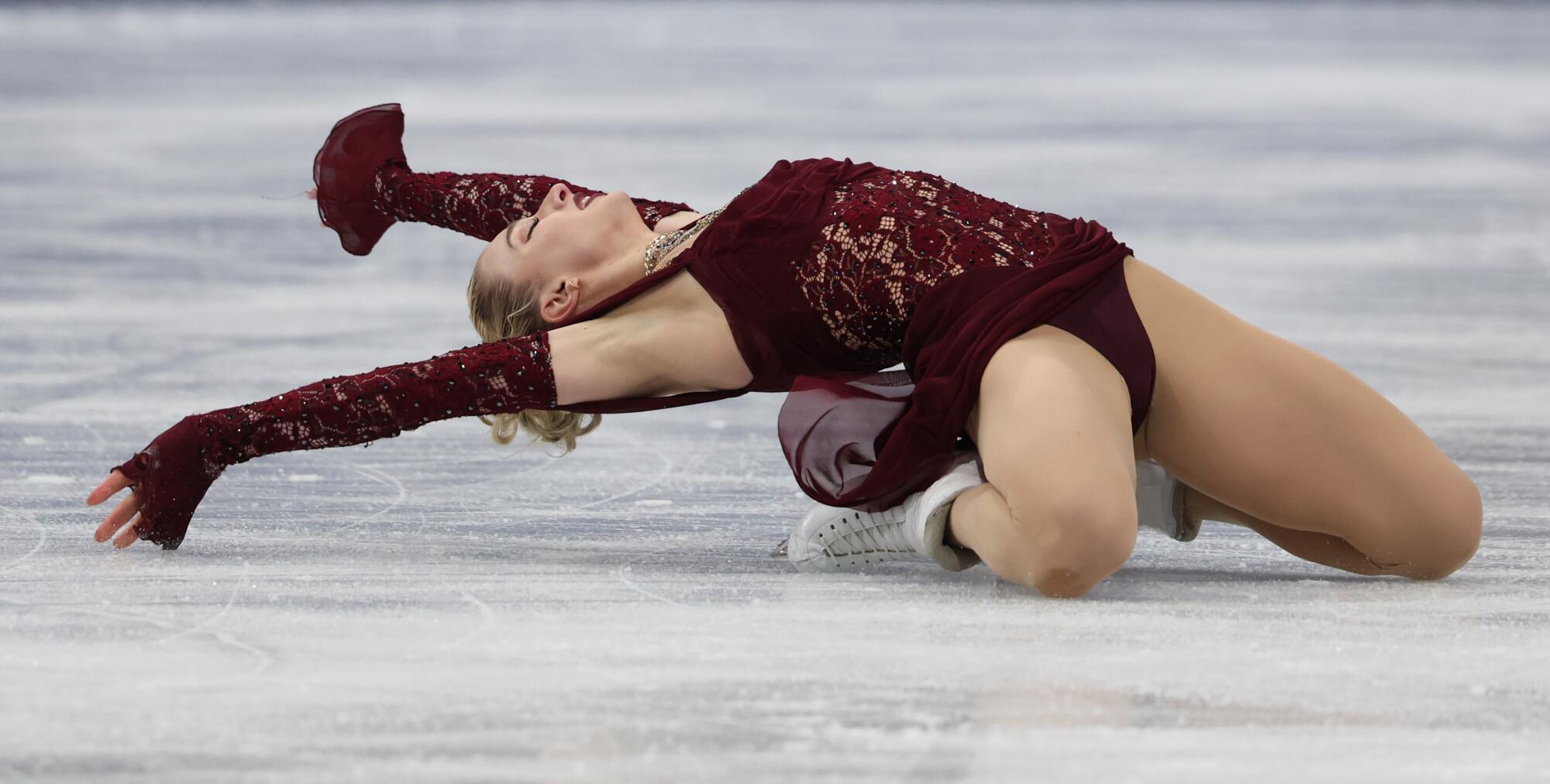
American Amber Glenn competes in the figure skating short program at the Winter Olympics in Milan on Tuesday.

American Amber Glenn competes in the figure skating short program at the Winter Olympics in Milan on Tuesday.

(Robert Gauthier/Los Angeles Times)

McKinnon sources most of the fabric locally from the fashion district in downtown L.A.

“It’s really great to just go in person because sometimes it’s the fabric that can inspire you to create something with,” McKinnon said.

McKinnon’s time on the ice that taught her how to create fashion for an athlete tailored for movement and aesthetic appeal. She grew up as a competitive figure skater in Sweden, and she started making bodysuits and dresses — which she wore to practice — for herself at age 11 or 12. By 16, she was designing dresses for elite skaters in her hometown, Mariestad, Sweden, including a Swedish national champion. At the time, they shared a coach, and the coach asked McKinnon to design a dress for the skater.

“They had seen the dresses that I made for other skaters,” she said. “They were just — you know — putting their faith in my hands that I could do this.”

After high school, McKinnon skated in tours in Europe and then North America. In the United States, she first settled in Las Vegas, where she designed dresses for local skaters. When she moved to L.A., bigger name skaters started calling. She designed for Ashley Wagner, three-time U.S. champion, and Karen Chen, who competed in her dresses at the 2018 Olympic Games. McKinnon says they were the ones who “got her noticed.” Noticed to the point that Milan is by no means the designer’s Olympic debut. In 2018, she outfitted pairs gold medalists Aljona Savchenko and Bruno Massot from Germany.

Since then, McKinnon has become the go-to designer for elite women’s figure skaters in the United States. At U.S. nationals in St. Louis in January, eight of the 18 senior women competed in McKinnon’s dresses. In the final warm-up alone — composed of the six skaters leading after the short program — five wore McKinnon designs. There, Glenn, Liu and Levito stood on the podium in her dresses.

In St. Louis, McKinnon hand delivered a dress to Liu, the reigning world champion who debuted a long-awaited Lady Gaga free skate routine. Liu practiced in the dress and McKinnon was able to make on-the-spot adjustments.

Surprisingly, hand delivery isn’t the norm for the dresses that run from $3,000-$8,000, averaging around $5,000 (McKinnon charges by the hour). Because McKinnon designs for skaters who train all over the country — Liu in Oakland, Glenn in Colorado Springs, Colo., and Levito near Philadelphia in southern New Jersey — FedEx shepherds the dresses across the country. Skaters make sure the dresses fit OK before McKinnon and her four-person seamstress team add sparkle, which usually means a crystal count in the thousands. Beads, paillettes and pearls are often mixed into the shine. Each crystal is hand affixed with E6000 glue.

American Christina Carreira and partner Anthony Ponomarenko compete during the ice dancing free skate.

American Christina Carreira and partner Anthony Ponomarenko compete during the ice dancing free skate at the Winter Olympics on Feb. 11 in Milan.

(Robert Gauthier/Los Angeles Times)

McKinnon affixed faux rose pedals to a dress for American ice dancer Christina Carreira to debut during the skater’s own Olympic debut. Midway through the skating season, Carreira and partner, Anthony Ponomarenko, returned to their free dance from two years ago, “Perfume: The Story of a Murderer.” They needed new costumes to differentiate from their performances two years ago, and McKinnon had already designed costumes for the team’s rhythm dance to La Bouche’s “Sweet Dreams.” McKinnon made the new dress in a little over a week, and it was set to arrive three days before Carreira left her training base in London, Canada, for the Games.

Except the dress didn’t arrive.

McKinnon learned that the package was stuck at a FedEx facility in Memphis, Tenn., after Winter Storm Fern pummeled the region.

“We would call and sometimes they’d say it’s in L.A., sometimes they’d say it’s in Memphis, so we didn’t know where it was,” Carreira said. “We weren’t getting answers, but going on social media actually helped.”

Carreira woke up after her flight to Milan to find an Instagram message with a photo of her dress. A woman told Carreira that her husband had found the package and put it on the first plane to Detroit, where Carreira’s coach, Scott Moir, retrieved the package to bring to Milan.

Carreira first tried on the dress in Milan. “It fit perfectly,” she said. “Lisa has never met me. She’s only seen me over FaceTime, and the two dresses she’s made fit perfectly.”

Carreira and Ponomarenko placed 11th in their Olympic debut.

“I wanted a dress that made me feel special at the Olympics,” Carreira said. “And both of those dresses did that.”

Carreira came to McKinnon’s designs through Glenn, who skated her short program to Madonna’s “Like a Prayer” wearing a McKinnon design based on the 1989 music video. After admiring McKinnon’s designs, Carreira talked it over with Glenn at an early season competition in Oberstdorf, Germany.

“She said Lisa was super easy to work with,” Carreira said. “The dresses fit perfectly.”

McKinnon designs from her studio, which occupies the first floor of her apartment in West Hollywood. There, McKinnon and her team watch their dresses take the runway in Milan. Except the runway is made of ice and the skaters will do much more than walk.


Source link

Alysa Liu shines, while Amber Glenn makes big mistake in figure skating

She’s the only U.S. skater still in medal contention. Alysa Liu is the last person to care.

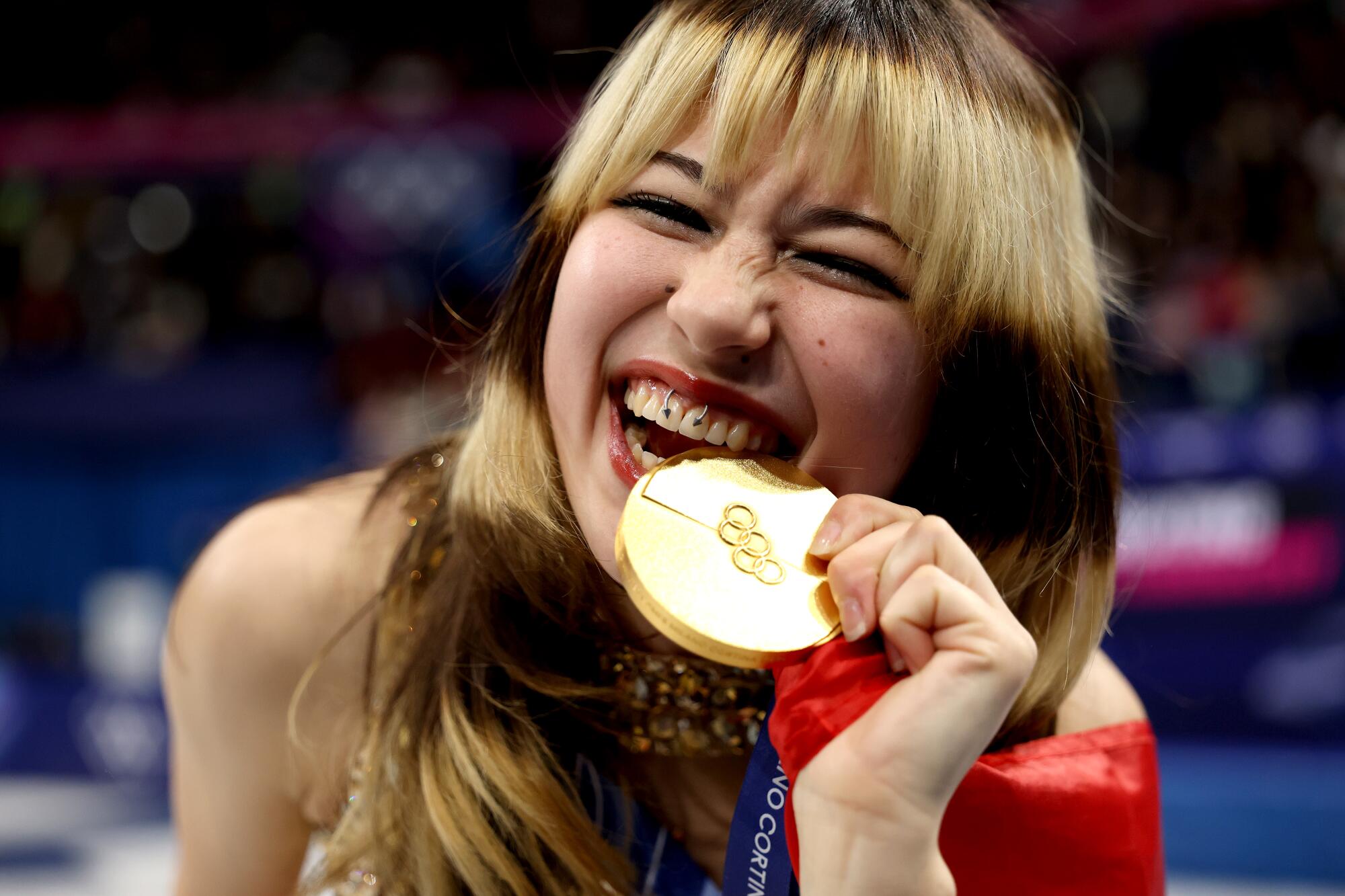
The unbothered 20-year-old is the only American who finished in the top six of the women’s short program Tuesday and is holding the weight of an Olympic medal drought that’s as old as she is. But after placing third in the short program, she said she hadn’t even looked at the standings. She is angling more for an invitation to the post-competition gala than a medal.

“A medal?” Liu asked with a sarcastic scoff and giggle. “I don’t need a medal. I just need to be here, and I just need to be present. And I need people to see what I do next.”

Next will be the women’s free skate Thursday, where Liu will try to be the first U.S. woman to stand on an Olympic podium for singles figure skating since Sasha Cohen in 2006.

The United States entered the Milan-Cortina Games with three strong contenders to end the drought, but will need comeback performances from the other two “Blade Angels.”

Alysa Liu strikes a pose with her left arm overhead and right arm outstretched to the right.

Alysa Liu is the top hope for the U.S. in women’s singles figure skating after finishing third in the short program.

(Robert Gauthier / Los Angeles Times)

Isabeau Levito skated cleanly in her Olympic debut but finished the short program in eighth with 70.84 points, almost eight points back from leader Ami Nakai’s 78.71.

Amber Glenn appeared poised to join Liu in medal contention after she started her “Like a Prayer” program with a steady triple axel. Looking inspired from a good luck message from Madonna this week, Glenn executed a strong triple-triple combination with her second jumping pass. The crowd at Milano Ice Skating arena roared.

Then Glenn popped her last planned triple jump. She earned zero points on the element. Her face fell immediately.

Glenn went through the motions of her step sequence but she looked lifeless, and after her program, she clutched the necklaces on her burgundy lace dress and knelt at center ice. She broke down in tears when she hugged her coach.

“I had it,” Glenn said through sobs.

With 67.39 points in 13th place, the three-time national champion is well outside the medal race led by Nakai and three-time world champion Kaori Sakamoto, who is in second with 77.23 points. Levito, skating in her mother’s hometown and paying homage to iconic Italian actress Sophia Loren with her short program, is less than six points out of podium position behind Liu’s 76.59 points.

Snoop Dogg and Martha Stewart, wearing bedazzled headphones in a booth at the top of the arena, were shown on the video screen after Glenn’s skate clapping for her performance. U.S. teammate Ilia Malinin cheered behind them.

Malinin could empathize as Glenn held back tears on the ice. The United States won the team figure skating competition with a dramatic one-point victory but hasn’t secured any of the individual gold medals that appeared likely. Malinin, whose free skate collapse was one of the most stunning moments of the Milan-Cortina Games, cited the intense Olympic pressure.

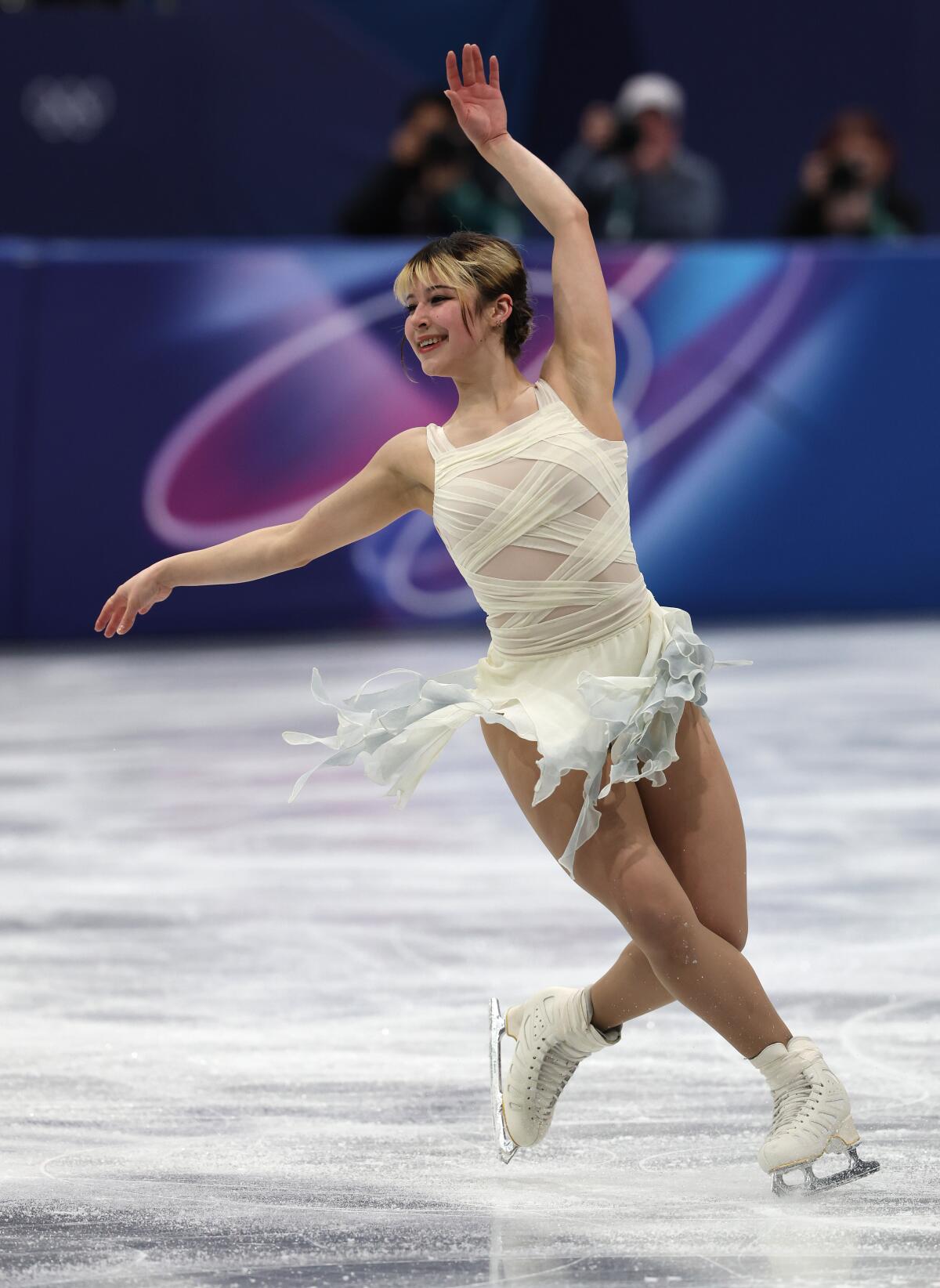
Isabeau Levito competes during the women's short program Tuesday.

Isabeau Levito competes during the women’s short program Tuesday.

(Robert Gauthier / Los Angeles Times)

After a shaky performance in the team competition, Glenn tried to escape the spotlight by training with U.S. teammates at a facility in Bergamo, 50 minutes outside of Milan. She tried to commit to rest and recovery and shy away from social media. She said after training Monday that she felt physically strong and had refocused enough to make the competition feel like any other world championship.

Knowing how hard it was for Glenn to get one jump away from putting herself into medal contention made the sight of her mistake all the more painful for Liu.

“She works so freaking hard,” Liu said after seeing Glenn’s skate on TV screens in the interview area. “Genuinely, such a hard worker, and she’s overcome a lot, and I just want her to be happy.”

Liu received some of the loudest applause of the night. Before beginning her program, she skated by the boards and high-fived both of her coaches, who hugged and hopped for joy when Liu executed her tricky triple lutz-triple loop combination jump. After hitting her ending pose, Liu covered her face to hide the tears that often well up in her eyes after her program set to “Promise.”

The reigning world champion returned to her second Olympics seemingly oblivious to any sort of pressure after a two-year retirement changed her perspective on skating. In Beijing, she was a 16-year-old who skated as she was told. She executed the jumps, performed to the music and wore the costumes that she was given.

But she laid the road to Milan all by herself and on her own terms.

One strong free skate away from her first individual Olympic medal — and second overall after helping the United States to team gold last week — Liu can’t be bothered to fret about how she’ll prepare for her last Olympic competition. Instead, she said she wants fans to see her new gala program.

A new dress just arrived and the choreography is almost done. All she needs is an invitation.
Source link

2026 Winter Olympics: What has gone wrong for British short track speed skating?

Eight years later, the latest UK Sport funding allocation of just under £2m has been presented as a total for short track, figure and long track speed skating.

So short track is caught in the situation which befalls many Olympic sports in Britain – they need to perform at the Games to get more funding, but without the funding they struggle to achieve success.

Asked what work is being done to fix short track, British Olympic Association (BOA) chair Dame Katherine Grainger told BBC Sport: “As much potential as we have in that team, there is more untapped.

“It is not a sport we have a legacy in, so that opens the door – we need to learn from other countries where we can.”

Add in the fact that there are few sports in the world more chaotic and unpredictable than short track.

Christie was Britain’s most recognisable speed skater a decade ago when she won three gold medals at the 2017 World Championships, but a series of crashes and disqualifications ruined her Olympic dreams in 2014 and 2018.

And this year, Treacy’s luck was also out. Take his 1,000m final – usually this event would have six racers, but in Milan had nine because three athletes were advanced to the medal race after being illegally hindered in their semi-finals.

Would Treacy, who was running in third when he tangled with Liu, have won a medal if there were fewer men on the track? Ultimately, hypotheticals do not put cash in the bank.

Treacy could not hide his funding frustrations when speaking to the BBC following that final.

“If we only had a bit more support going through the Olympic cycle,” he said. “In the UK we don’t even have an ice centre which is safe enough for competitions.

“In the UK we have to look at ourselves and see we need a facility where we can train at the top level, instead of having to go to other countries.”

Treacy is correct that there is no venue in Britain that could host an international short track event, because there are no rinks with the soft boards needed around the border to protect racers when there are crashes.

Source link

Winter Olympics: Ilia Malinin, U.S. win gold in team figure skating

Believe in the Quad God.

Ilia Malinin’s clutch free skate that scored 200.03 points gave the United States its second consecutive team figure skating gold medal Sunday at the Milan-Cortina Olympic Games.

After Amber Glenn fought through a shaky free program that finished third and lost the United States its two-point lead, Malinin stepped up as only he could. He executed five quad jumps and won by nearly six points, even if he did not perform his signature quad axel. He even put his hand down after a jump, but the mistake only seemed to fuel him as he finished with a flourish, changing the back-half of his program to earn back extra points.

His U.S. teammates, cheering from the sideline box rose to their feet and pumped their fists after each of Malinin’s jumping passes. When he landed his back flip, skating flawlessly through one foot, the packed crowd at Milano Ice Skating Arena roared.

While Japan’s Shun Sato scored a season’s best to finish the competition, he could not match the technical prowess of Malinin, who is also the favorite to win individual gold this week.

In front of a raucous home crowd, Italy held off Georgia for the bronze medal behind a dazzling free skate from Matteo Rizzo, who dropped to his knees on the ice and cried after his performance had fans chanting “Italia!” before he even finished. He cried into the Italian flag in the kiss-and-cry after his season’s best 179.62 points.

With the first figure skating medal of the Milan-Cortina Games on the line, every skater fought for every fraction of a point. U.S. pairs skater Ellie Kam went deep into a one-legged squat to hold on to the first throw jump. The United States led by five points entering the final day, but still had no room for error as Japan finished first in qualifying in all of Sunday’s disciplines. With the dominance of Japan’s Riku Miura and Ryuichi Kihara in pairs, Kam’s partner Danny O’Shea knew the strategy for the U.S. pair was to simply try to stay as close as possible.

Ellie Kam and Danny O'Shea perform in pairs figure skating during the team competition at the Milan-Cortina Games.

Ellie Kam and Danny O’Shea perform in pairs figure skating during the team competition at the Milan-Cortina Games on Sunday.

(Stephanie Scarbrough / Associated Press)

Kam fought for the landing on a throw loop so hard that she could feel her leg cramping.

“I was like, ‘I’m not going down,’” Kam said, “I got this. We got this.”

They looked at each other before their next element and said “calm.” Their message cut through the energized crowd that cheered louder and louder with each jump. At the end, Kam’s and O’Shea’s celebratory screams simply joined the crowd’s roar. As they saluted the crowd, O’Shea pointed toward Kam to acknowledge her effort.

The pair’s fourth-place finish in the free program was a one-point improvement from their qualifying spot, earning a slim, but vital cushion entering the men’s and women’s free skates.

Instead of sending world champion Alysa Liu back for the free skate after she performed the short program, the U.S. selected the three-time national champion Glenn. The 26-year-old was making her Olympic debut.

On the Olympic stage for the first time, Glenn has tried to embrace the opportunity while treating the competition as if it were any other one. But the larger stage has created additional stress for Glenn after she was asked in a news conference about President Trump’s approach to the LGBTQ+ community in recent years and how it’s affected her personally.

U.S. figure skater Amber Glenn competes during the team competition on Sunday at the Milan-Cortina Games.

U.S. figure skater Amber Glenn competes during the team competition on Sunday at the Milan-Cortina Games.

(Ashley Landis / Associated Press)

Glenn, who identifies as bisexual and pansexual, encouraged people in the queer community to “stay strong in these hard times” and recognized that it wasn’t the first time the community had to unite to “fight for our human rights.” Glenn then received threats on social media after the news conference and posted on Instagram that she would be taking a break from social platforms to focus on the competition.

But it wasn’t the social media hate that rattled Glenn, she insisted. She was simply tired, sore and disoriented from the unfamiliar Olympic team competition format.

All of Glenn’s other competitors did the short program portion of the competition on Friday. She came in with several good days of training at the venue, but did not get the same kind of opportunity to get used to the stage. Glenn fought through a shaky triple axel to open her program and stepped out of a triple flip that prevented her from completing a planned combination for her second jumping pass.

Waiting in the kiss-and-cry, Glenn bowed her head and stared at the ground. She struggled to muster even a fake smile.

“I’m grateful that the team is so supportive.” said Glenn, who finished behind Japan’s Kaori Sakamoto and Italy’s Lara Naki Gutmann. “But I do feel guilty that I could be the reason that we don’t win the gold, and I don’t know how I will ever apologize for that.”

Glenn clasped her hands in her lap waiting for Sato’s score after the Japanese skater performed a clean program that had his teammates in tears. But his technical score was about five points less than Malinin’s. Glenn was the first skater to hug Malinin in the United States’ team celebration, lifting him off the ground as he extended arms out wide.

Source link

U.S. takes early lead in Olympic figure skating team competition

Alysa Liu glided past her boards and held her hand out. She high-fived her coaches with a wide smile on her face.

She was ready.

Liu calmly skated through minor technical missteps on two jumps in her short program of the team competition at Milano Ice Skating Arena to finish second and earn nine points for the United States that leads the team competition after the first day.

Led by 10 points from rhythm dance leaders Madison Chock and Evan Bates, the United States has 25 points entering Saturday’s men’s short program to lead over second-place Japan (23 points) and third-place Italy (22). Japan’s Kaori Sakamoto finished first with a score of 78.88 ahead of Liu’s 74.90.

After the men’s short program, the top five teams advance to the long program portion. The United States selected two-time world champion Ilia Malinin to skate in the men’s short program.

Liu, competing in her second Olympics, was selected for the team competition for the first time. The reigning world champion worked through slight errors, including on her tricky triple lutz, triple loop combination. Her coach Phillip Diguglielmo grabbed the arm of choreographer Massimo Scali nervously as Liu floated through the air on the crooked loop. When she finished her program to a loud ovation, Diguglielmo wiped his brow in relief.

Liu was the second world champion competing for the United States on Friday. Chock and Bates edged out French pair Laurence Fournier Beaudry and Guillaume Cizeron by less than two points in an early showdown of individual gold medal contenders.

In March 2025, Fournier Beaudry and Cizeron rocked the ice dance world by announcing their partnership. He was the reigning Olympic champion. She was a former Canadian champion. But it wasn’t just that the pair became instant gold medal contenders 11 months before the Olympic Games. The reason for the sudden pairing caused a stir.

Madison Chock and Evan Bates of the U.S. finished first in the ice dance portion of the team competition Friday.

Madison Chock and Evan Bates of the U.S. finished first in the ice dance portion of the team competition Friday.

(Stephanie Scarbrough / Associated Press)

In October 2024, Fournier Beaudry’s partner Nikolaj Sorensen was suspended by Skate Canada for at least six years for alleged sexual assault. The pair competed for both Denmark and Canada over their decade-long partnership, winning three Danish championships and a Canadian national title and placing ninth in the 2022 Olympics.

Cizeron hadn’t skated since 2022. He and his ice dance partner of 20 years Gabriella Papadakis announced their retirement in December 2024, but wanted to return to competition. He had trained in Canada for more than a decade and maintained a friendship with Fournier Beaudry. The opportunity was open, but it would be complicated.

After pairing with Fournier Beaudry to launch Cizeron’s comeback, the new team expressed support for Sorensen in an interview with Canadian French-language newspaper La Presse. Fournier Beaudry continues her romantic relationship with Sorensen.

When asked of the allegations Friday, Fournier Beaudry said she did not have anything to add to her previous comments. The pair proceeded through the mixed zone.

Since teaming up, Fournier Beaudry and Cizeron have won five of six competitions, a nearly inconceivable rise for such a new pair. The only blemish is a silver medal finish at the Grand Prix Final.

Chock and Bates’ 15-year partnership has yielded three world championships, a record seven U.S. titles and four trips to the Olympics. On one of the most talented teams the United States has ever sent to an Olympic Games, Chock and Bates still stand out for their experience. Of the 14 other U.S. figure skaters, only Liu has participated in the Games before.

“I think we have the best generation of figure skaters within the U.S. right now,” said pairs skater Danny O’Shea, who finished fifth with his partner Ellie Kam to earn six position points toward the team total. “Amazing people helping each other, supporting each other, and Madi and Evan leading the charge being the just experienced elders.”

O’Shea, making his Olympic debut at 34, laughed as he clarified Chock, 33, is younger than him.

Source link

Alysa Liu 2.0: How retirement, perspective helped the U.S. star

Alysa Liu wore a hollow smile on the ice. She had achieved a dream, skating at the Beijing Olympics at just 16, but in a mostly empty arena, few were there to see the moment.

Perhaps that was what Liu secretly wanted.

“It’s not that I didn’t want to be seen,” Liu said. “It’s just I had nothing to show.”

The 20-year-old now proudly presents Alysa Liu 2.0.

Four years after shocking the sport by retiring as a teenage phenom, the Oakland native could win two gold medals at the Milan-Cortina Olympics. She is a title contender in her individual event that begins Jan. 17 as the United States tries to end a 20-year Olympic medal drought in women’s singles figure skating, and she will skate Friday in the women’s short program of a team competition the United States is favored to win.

Armed with a new perspective from her two-year retirement, Liu now smiles genuinely on and off the ice, no matter if there’s a medal around her neck or not.

“I have so much I want to express and show, whether that’s through skating or just through my presence,” said Liu, who placed sixth in Beijing. “It’s exciting to think about that being seen.”

When she made her Olympic debut, Liu didn’t feel like her career belonged to her. Her father, Arthur, was a driving force in her skating career. In a sport where coaches and choreographers often call the shots for young athletes, Liu entered the Olympic stage with programs she didn’t like and clothes she didn’t pick. She was behind a mask and couldn’t express herself. She barely knew how to.

Skating had consumed her entire life. She felt “trapped and stuck” in the sport. So she left.

After retiring following the 2022 world championships — where she won a bronze medal — Liu got her driver’s license. She hiked to Mount Everest base camp with friends. She went shopping for not-skating clothes, played Fortnite until 4 a.m. with her siblings and enrolled at UCLA. She loved studying psychology.

“I found what I like and what I didn’t like,” said Liu, who took time off from UCLA to prepare for the Olympics but hopes to return before her friends graduate. “Really got to know myself, because [when] I had skating, I didn’t really know myself. I couldn’t know myself. I only ever did one thing.”

Alysa Liu practices in Milan on Thursday ahead of the Olympic team competition, which starts Friday.

Alysa Liu practices in Milan on Thursday ahead of the Olympic team competition, which starts Friday.

(Robert Gauthier / Los Angeles Times)

After a casual ski trip reminded her of the joys of skating, Liu made the decision to return to the sport that shaped, and nearly stole, her childhood. But she would only do it on her terms.

The choreography, the music and the costumes would all be her choice. She doesn’t compete to win. She skates to show her art, she said.

In the process, she’s winning more than ever.

She won the world championship in 2025, becoming the first U.S. woman to win the world title since 2006. She won the Grand Prix final in Japan in December, the last major international competition before the Milan-Cortina Games to announce herself as a potential Olympic champion.

The day before her last performance at the U.S. championships, the final competition that would decide her Olympic bid, Liu ran to a St. Louis salon to dye her hair to match a new skating dress. Unbothered by the pressure of the moment, she debuted a Lady Gaga free skate that brought fans to their feet and earned her a silver medal.

“When you are an Olympic athlete that has a chance in front of the world every four years, it literally is your life’s work that’s on the line,” NBC analyst and two-time Olympian Johnny Weir said. “And she has found a way to compartmentalize that and put it down. … I just think it’s so wonderfully healthy and brave and strong to be doing what she is, because it takes a lot of bravery to put down the pressure that the sport naturally has.”

Liu is just a natural talent in the sport, 2022 Olympian Mariah Bell said. Bell remembered during the Stars on Ice tour in 2022 when the skaters rolled into a new city, tired, groggy and sore from the long bus ride, Liu, dressed in a baggy hoodie and billowing sweatpants, could go on the ice and throw perfect jumps without warning. Bell stood in awe.

U.S. figure skater Alysa Liu practices on Thursday in Milan.

U.S. figure skater Alysa Liu practices on Thursday in Milan.

(Robert Gauthier / Los Angeles Times)

After Liu’s short program at the U.S. championships last month set a national championship record, Bell was blown away for different reasons.

“She’s so sophisticated and mature and emotional,” Bell said. “When she was younger, she was incredible. But when you’re 13, you don’t skate the way that you do like how she did the short program [at the U.S. championships].”

Skating to Laufey’s “Promise,” a haunting piano ballad, Liu glided through a flawless short program that she said nearly moved her to tears. Fans showered her with stuffed animals.

Liu has always commanded attention in the sport. She was the youngest skater to perform a triple axel in international competition at 12, became the youngest U.S. champion at 13 and followed with another national title at 14. She was the first U.S. woman to complete a quad lutz in competition, doing so in the 2019 Junior Grand Prix in Lake Placid, N.Y.

Six years later, back in that same arena for Skate America in 2025, Liu told her coaches she didn’t remember her historic accomplishment.

“It feels like I’m watching or I got someone else’s memories,” said Liu, who had similar, disconnected, but overall positive memories of her Olympic experience in Beijing. “It feels like a totally different person, but we are definitely the same person.”

U.S. figure skater Alysa Liu practices in Milan on Thursday as she prepares for the team competition, which starts Friday.

U.S. figure skater Alysa Liu practices in Milan on Thursday as she prepares for the team competition, which starts Friday.

(Robert Gauthier / Los Angeles Times)

Exchange the delicate, ballerina-like skating dresses with bold, modern asymmetrical designs. Undo the tight, slicked back bun and bring in halo dyed hair, dark eyeliner and the piercing she did herself on the inside of her upper lip. With three horizontal stripes dyed into her hair, each layer represents a year of the new life Liu is finally happy to put on display.

“I want to be seen more because I like what I have going on,” Liu said. “I like what I’m doing.”

Source link

Spanish figure skater can use Minions music at the Olympics

Who’s ready for a Minions happy dance?

Spanish figure skater Tomàs-Llorenç Guarino Sabaté said Tuesday that he may be able to skate his Minions-themed program at the Olympics after all. He shared on Instagram that Universal is allowing him to use the music from its popular animated franchise for the “special occasion” and said he is working to clear the remaining hurdles.

“There are still a couple things to be tied up with the other 2 musics of the program but we are so close to accomplishing it!” Guarino Sabaté wrote in his update thanking his supporters. “I’m so happy to see that the minions hitting Olympic ice is becoming real again!! I’ll keep you posted!”

A six-time Spanish national champion, Guarino Sabaté said on Monday that he had been informed Friday — exactly a week before the opening ceremony of the Milan-Cortina Games — that the medley of “Minions” music he had skated to, while dressed in blue overalls and a yellow shirt, through the entirety of the season could not be used at the Olympics due to copyright issues. This meant that Guarino Sabaté, who had been set to make his Olympics debut with his Minions-themed short program on Feb. 10, would need to change his plans last minute. How bananas.

The cheery yellow creatures are a signature of Universal and Illumination’s “Despicable Me” film franchise. NBCUniversal owns the U.S. media rights to the Olympics.

“Finding out about this … so close to the most important competition of my life, was incredibly disappointing,” Guarino Sabaté wrote in his post sharing the initial news. “This season I competed with my Minions short program to bring joy and playful style to the ice while still meeting every required element to show that skating as a male Olympic figure skater can be fun. … Nevertheless, I will face this challenge head on and do my best to make the best of it.”

The Olympian said then that he had followed the proper procedures and submitted his music through the International Skating Union’s recommended rights clearance system in August. The situation has brought to attention to the complexities of music licensing and how it affects artistic sports like figure skating. Contemporary music is not in the public domain and skaters are responsible for clearing their own music.

For now, fans will just have to remain hopeful that Guarino Sabaté’s dream of bringing joyous Minion mayhem to the Olympic ice will come true in the end.


Source link

How Tai Babilonia’s career shattered barriers in figure skating

The seventh in an occasional series of profiles on Southern California athletes who have flourished in their post-playing careers.

Tai Babilonia’s life changed forever when she was asked to hold a boy’s hand.

At first she resisted.

“I didn’t want to,” she remembered. “He’s a yucky boy.”

But Mabel Fairbanks, Babilonia’s skating coach, wouldn’t take no for an answer, bribing the 8-year-old with stickers and a Barbie doll if she would just reach out and grab the hand of 10-year-old Randy Gardner.

It would be another 40 years before she let go.

By then Tai Babilonia and Randy Gardner had become one of the most decorated pairs in U.S. figure skating history, their individual names eventually melding into one.

“My last name is ‘and Randy,’” Babilonia said. “And I embrace it.”

U.S. pairs figure skating duo of Tai Babilonia and Randy Gardner in 1979.

U.S. pairs figure skating duo of Tai Babilonia and Randy Gardner in 1979.

(Tony Duffy / Getty Images)

As a pair “Tai and Randy” won five U.S. championships, medaled in three world championships and qualified for the Olympics twice, all before Babilonia’s 21st birthday. Their success also pushed open doors that had long been closed since Babilonia, Black on her mother’s side and part Filipino and Native American on her dad’s side, was the first U.S. skater from any of those ethnic groups to compete in the Olympics or win a world title.

Among those to follow her were Debi Thomas, a two-time U.S. champion and a bronze medalist at the 1988 Winter Olympics, and Elizabeth Punsalan, a two-time Olympian and five-time national champion in ice dancing.

At about the same time Babilonia and Gardner were moving from competitive skating and the Olympics to the Ice Capades, another young girl was just starting to pursue her own Olympic dreams. Tiffany Chin would go on to win a national championship, two Skate America titles and just miss a medal in the 1984 Winter Games, retiring before she was old enough to legally drink.

In that brief but brilliant career, Chin changed U.S. figure skating forever. She was the country’s first Asian American national champion and first Chinese American Winter Olympian, paving the way for Olympic medalists Kristi Yamaguchi, Nathan Chen, Michelle Kwan and siblings Alex and Maia Shibutani.

After retiring from skating, Babilonia, now 66, dabbled in coaching and sportswear design, became a motivational speaker, an activist and, most importantly, a grandmother. But the legacy Babilonia and Chin created will be on display in Italy this month when the U.S. fields one of the most eclectic Olympic figure skating teams ever, with 12 of the 16 athletes having immigrant parents.

Five of the six singles skaters — Alysa Liu, Isabeau Levito, Ilia Malinin, Maxim Naumov and Andrew Torgashev — are first-generation Americans while the other, women’s national champion Amber Glenn, identifies as pansexual. Pairs skaters Emily Chan, Spencer Howe and Ellie Kam and ice dancers Anthony Ponomarenko, Christina Carreira, Vadym Kolesnik and Emilea Zingas are also immigrants or first-generation Americans while Madison Chock, the reigning Olympic champion in ice dancing, has Hawaiian, Chinese, German, English, Irish, French and Dutch ancestry.

At a time when diversity, equity and inclusion programs are being dismantled, immigrants are being attacked and diversity is labeled a weakness, America’s Olympic figure skaters have come to mirror the country at large.

“It’s wonderful and so important,” said Babilonia. “Especially now.”

Nearly 60 years after Babilonia and Gardner skated together for the first time, the decision to pair them seems inspired, even providential.

It was neither. Fairbanks, Babilonia learned later, simply needed a couple to skate in a club show at the Culver City Ice Arena.

“We just happened to be similar in height. And I guess we were cute,” Babilonia said last month during a lengthy interview at the Colonial Revival-style mansion in the West Adams District that houses the LA84 Foundation.

Gardner was already an excellent skater, as strong and athletic as he was outgoing and friendly; Babilonia was shy and far less steady on the ice. But that wasn’t the only thing that made their pairing unusual.

Gardner was white and Babilonia was Black. And in 1968, asking them to hold hands in public was scandalous, even in Culver City. However, Fairbanks, a legendary coach who had spent much of her life pushing back against convention, didn’t see color. She focused only on talent.

Randy Gardner and Tai Babilonia roller skating together in May 1979.

Randy Gardner and Tai Babilonia roller skating together in May 1979.

(Tony Duffy / Getty Images)

“Mabel was the coach who taught all races, Hispanic, Black, mixed, Jewish,” Babilonia said. “Mabel broke down that wall.”

Fairbanks, who was Black and Seminole, was born in the Deep South at a time when ice rinks were segregated. Even after moving to New York, where she bought a pair of skates for $1 at a pawn shop, then taught herself how to use them, she skated mostly in nightclub shows, where she was limited to jumps and moves that wouldn’t show up the white skaters.

She soon moved to Los Angeles, touring internationally with the Ice Capades and Ice Follies, before becoming a coach and mentoring hundreds of young skaters, including Olympic medalists Scott Hamilton, Yamaguchi and Thomas.

“If it weren’t for Mabel Fairbanks, you wouldn’t have any color in the predominantly white skating world,” said Babilonia, who is shopping a biopic of Fairbanks, who died in 2001.

“People don’t really know her. She’s like a hidden figure.”

Yet three years after Fairbanks made Tai and Randy a pair, they left her for John Nicks, who was coaching at the Paramount Iceland.

“He took our skating to a whole different level. And it happened really quick,” said Babilonia, who still calls her former coach Mr. Nicks. “That’s when we started winning and improving and just really became a great pair of skaters.”

Two years later Babilonia and Gardner won the U.S. junior nationals and three years after that they won the first of five national championships, qualifying for the 1976 Winter Olympics in Austria, where they finished fifth. Gardner wasn’t old enough to vote and Babilonia didn’t have a driver’s license. But together they were holding their own against the best pairs skaters in the world.

“Such an incredible year,” Babilonia said. “We won our first U.S. title, became Olympians, I got my learner’s permit and had a crush on Peter Frampton.”

But they were just getting started. Gardner and Babilonia wouldn’t lose in the U.S. championships for the rest of the decade. And 11 months before the next Olympics, they won their first world championship, then celebrated by skating for the queen of England at Wembley Stadium.

Tai Babilonia and Randy Gardner compete at the World Figure Skating Championships in Tokyo in March 1977.

Tai Babilonia and Randy Gardner compete at the World Figure Skating Championships in Tokyo in March 1977.

(Tony Duffy / Getty Images)

With the Winter Games coming back to the U.S. at Lake Placid, the Americans were favored to keep the Soviet Union off the top step of the medal platform for the first time since 1960, the last time the Olympics were held in the U.S.

Only they never made it to the ice.

Nicks had moved his skaters from Paramount to the Ice Capades Chalet, a buff-colored concrete-block building in Santa Monica, five blocks from the Pacific Ocean. During a training session there, Gardner inflamed a groin injury that had plagued him for months.

It got worse when they got to Lake Placid and Gardner had a Xylocaine injection, but the anesthetic was too strong and it only made things worse; the pain was gone, but now Gardner couldn’t feel his leg at all. They pulled out of the competition moments before it was supposed to begin.

The next morning, with the skaters, their parents and their coach perched on the stage at a high school auditorium for a hastily arranged news conference, hundreds of reporters tried to get a shattered Babilonia to turn on her partner. She didn’t take the bait.

“She totally had my back,” Gardner said. “There was so much camaraderie and trust and love between the two of us. She understood that it was a major injury and it was devastating. It changed the path of our career.”

“I’m not going to say it ruined it,” he added. “It just changed the path.”

Two months after leaving Lake Placid in sorrow, Gardner and Babilonia, who had gone from “Tai and Randy” to the “Heartbreak Kids,” turned pro, signing a three-year contract with the Ice Capades that included endorsement deals.

They never skated in the Olympics again. And while the money was good, the pace was punishing, with eight shows a week on a 30-week tour.

“You’re performing every night, weekends two shows a day,” Babilonia said. “If you don’t pace yourself, which I didn’t, it will rock your world in a negative way.

“You can’t do all the tricks you did as a teenager every night.”

American figure skating duo Randy Gardner and Tai Babilonia in action.

Tai Babilonia and Randy Gardner skating in 1979, the same year they won the pairs world championship.

(Tony Duffy / Getty Images)

Babilonia had never truly dealt with the emotional pain of the Olympic withdrawal. Now she was also dealing with the strain and fatigue of the ice show schedule as well as an identity crisis.

“Randy figured out how to put Tai and Randy in a box and leave them there and go on with his life,” Babilonia said. “I didn’t know how to separate them from me.”

So she sought answers in amphetamines, heavy drinking and a number of brief but high-profile romances before hitting rock bottom just before her 29th birthday, when she tried to kill herself with an overdose of sleeping pills. Her recovery started seven months later with an emotional first-person account of her fall in People magazine.

“I did it because I knew I had to,” Babilonia, still fit and youthful, said of a confession in which she blamed no one but herself. “I had to stop what I was doing and this was part of my recovery process. I couldn’t say yes quick enough.

“Something inside of me said, ‘This is your moment. Get it out. It may help some people,’” she continued. “And it did.”

The magazine cover story was followed 19 months later by the prime-time NBC movie “On Thin Ice,” which went over much of the same territory, with Babilonia and Gardner playing themselves in many of the skating scenes.

“It took me a while to watch the whole thing. Some scenes were hard,” said Babilonia, who speaks in a confident, careful cadence. “It was just part of my recovery process.”

She’s been sober 17 years and her relationship with Gardner, who came out as gay in 2006 — also in People magazine — has lasted longer than her marriage. Along the way, Babilonia matured from the shy withdrawn child who refused to hold a boy’s hand into a bold, strong and confident woman.

“She’s totally mature. She is worldly. And she’s an advocate for equality in sports, people of color and all that,” said Gardner, 68, whose home in Manhattan Beach is about 10 miles from the Culver City ice rink where he and Babilonia learned to skate once stood.

The former teammates still meet at least once a month and talk on the phone frequently, although they haven’t been on the ice together since Gardner underwent surgery on his back a year ago.

Flames from a olympic torch passes in front of Tai Babilonia at LA84 Foundation in January.

Flames from a olympic torch passes in front of Tai Babilonia at LA84 Foundation in January.

(Ronaldo Bolanos / Los Angeles Times)

When she stopped skating Babilonia tried coaching, but that didn’t work because she didn’t know how to teach the moves she had so easily mastered. Instead, she launched a clothing line, became a motivational speaker, volunteered with various groups promoting diversity on and off the ice, co-hosted a TV interview show taped in Santa Barbara and, for the last nine years, has co-hosted a holiday skate party for kids from the Union Rescue Mission. She also continues to skate in charity events.

All that in addition to her work with Atoy Wilson, a former U.S. novice champion, on the Mabel Fairbanks biopic, tentatively titled “Black Ice: The Mabel Fairbanks Story.”

“I want to try everything,” she said. “I want to experience everything.”

But her real job, she quickly adds, is being a grandmother to Ryett, her son’s 2-year-old boy in Arizona.

“I love being a grandmother,” she said. “Absolutely love it.”

She is also a prolific presence on social media, where most of her posts are either trenchant comments on the politics of today or black-and-white photos from back in the day, when she and Gardner — Tai and Randy — were winning medals and opening doors, helping to change U.S. figure skating forever.

“I appreciate what we did more as I get older,” Babilonia said. “We were pretty good and we made our mark. We worked hard. We became two-time Olympians. We met the queen of England.

“It’s just wild.”

Source link