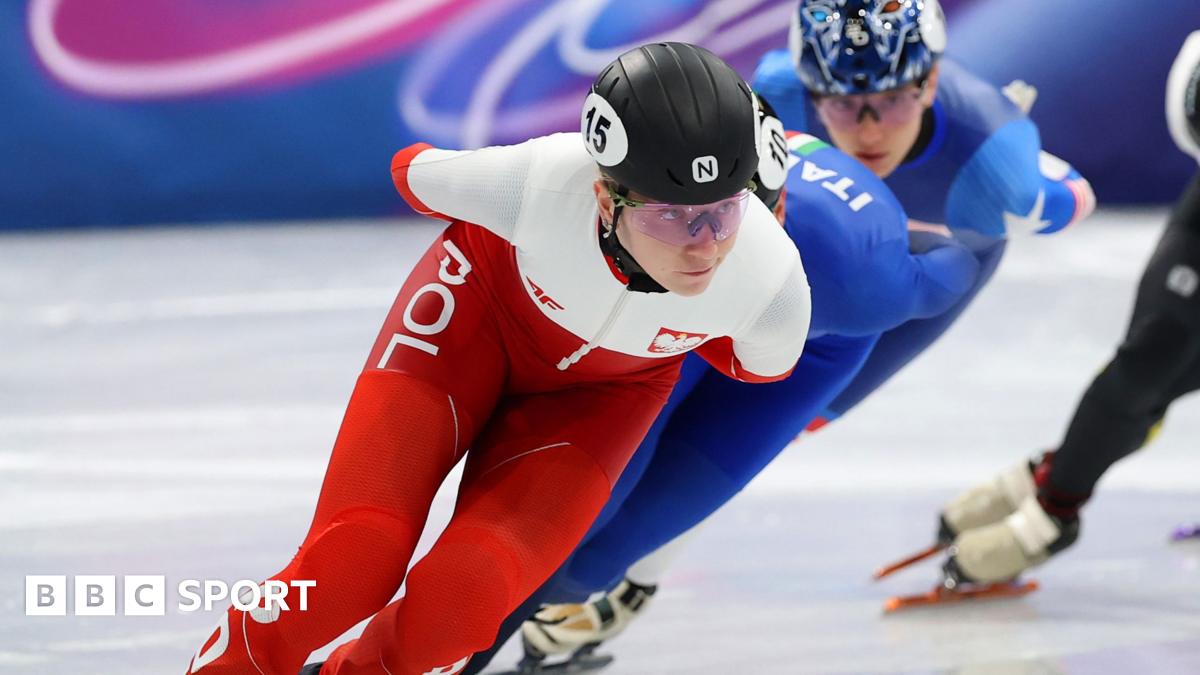
Polish short track speed skater Kamila Sellier has undergone surgery after she was struck in the face by a blade in a serious crash at Milan-Cortina 2026.
Sellier was racing in the quarter-finals of the women’s 1500m on the final night of short track competition at the Milano Ice Skating Arena.
She was brought down along with 14-time Olympic medallist Arianna Fontana of Italy and American Kristen Santos-Griswold, who was penalised for attempting an illegal pass that contributed to the crash.
As Santos-Griswold fell, her skate caught Sellier and sliced her under her left eye.
Racing was paused while Sellier received attention behind the privacy of a white sheet. She was then stretched off the ice, managing to give a thumbs up to the crowd as she left.
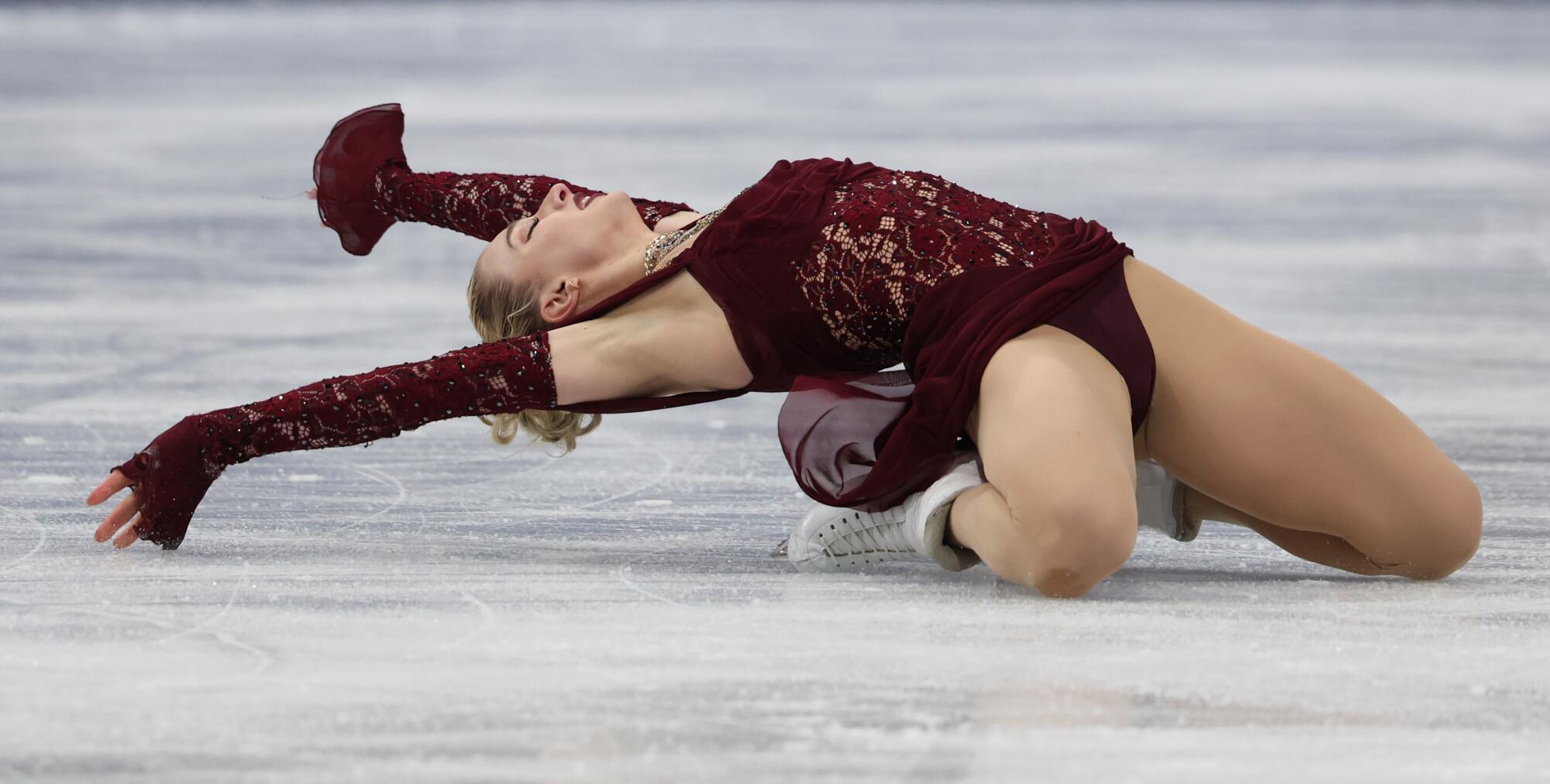
When women take the ice for Thursday’s Olympic free skate in the global fashion capital of Milan, five skaters will compete in dresses made by Los Angeles-based designer Lisa McKinnon.
McKinnon has become the must-have name in figure skating couture, dressing the entirety of the U.S. and South Korea women’s teams. Americans Alysa Liu, Amber Glenn and Isabeau Levito wore McKinnon’s designs in the short program and will do so again in the free skate.
And one of those dresses may be featured on the medal podium. Liu stands in third place after Tuesday’s short program, while Levito is in eighth and Glenn tumbled to 13th with the free skate still to come.
McKinnon knows exactly how clothing needs to fit on bodies moving across the ice — for spins, for jumps, for everything it takes to win. The fabric must be able to stretch in all directions, which necessitates a four-way stretch fabric. Design with a two-way stretch and a skater might not be able to lift their arm. Dress skaters in spandex, power mesh and stretch velvet, and they’ll move like they do in training.
American Amber Glenn competes in the figure skating short program at the Winter Olympics in Milan on Tuesday.
(Robert Gauthier/Los Angeles Times)
McKinnon sources most of the fabric locally from the fashion district in downtown L.A.
“It’s really great to just go in person because sometimes it’s the fabric that can inspire you to create something with,” McKinnon said.
McKinnon’s time on the ice that taught her how to create fashion for an athlete tailored for movement and aesthetic appeal. She grew up as a competitive figure skater in Sweden, and she started making bodysuits and dresses — which she wore to practice — for herself at age 11 or 12. By 16, she was designing dresses for elite skaters in her hometown, Mariestad, Sweden, including a Swedish national champion. At the time, they shared a coach, and the coach asked McKinnon to design a dress for the skater.
“They had seen the dresses that I made for other skaters,” she said. “They were just — you know — putting their faith in my hands that I could do this.”
After high school, McKinnon skated in tours in Europe and then North America. In the United States, she first settled in Las Vegas, where she designed dresses for local skaters. When she moved to L.A., bigger name skaters started calling. She designed for Ashley Wagner, three-time U.S. champion, and Karen Chen, who competed in her dresses at the 2018 Olympic Games. McKinnon says they were the ones who “got her noticed.” Noticed to the point that Milan is by no means the designer’s Olympic debut. In 2018, she outfitted pairs gold medalists Aljona Savchenko and Bruno Massot from Germany.
Since then, McKinnon has become the go-to designer for elite women’s figure skaters in the United States. At U.S. nationals in St. Louis in January, eight of the 18 senior women competed in McKinnon’s dresses. In the final warm-up alone — composed of the six skaters leading after the short program — five wore McKinnon designs. There, Glenn, Liu and Levito stood on the podium in her dresses.
In St. Louis, McKinnon hand delivered a dress to Liu, the reigning world champion who debuted a long-awaited Lady Gaga free skate routine. Liu practiced in the dress and McKinnon was able to make on-the-spot adjustments.
Surprisingly, hand delivery isn’t the norm for the dresses that run from $3,000-$8,000, averaging around $5,000 (McKinnon charges by the hour). Because McKinnon designs for skaters who train all over the country — Liu in Oakland, Glenn in Colorado Springs, Colo., and Levito near Philadelphia in southern New Jersey — FedEx shepherds the dresses across the country. Skaters make sure the dresses fit OK before McKinnon and her four-person seamstress team add sparkle, which usually means a crystal count in the thousands. Beads, paillettes and pearls are often mixed into the shine. Each crystal is hand affixed with E6000 glue.
American Christina Carreira and partner Anthony Ponomarenko compete during the ice dancing free skate at the Winter Olympics on Feb. 11 in Milan.
(Robert Gauthier/Los Angeles Times)
McKinnon affixed faux rose pedals to a dress for American ice dancer Christina Carreira to debut during the skater’s own Olympic debut. Midway through the skating season, Carreira and partner, Anthony Ponomarenko, returned to their free dance from two years ago, “Perfume: The Story of a Murderer.” They needed new costumes to differentiate from their performances two years ago, and McKinnon had already designed costumes for the team’s rhythm dance to La Bouche’s “Sweet Dreams.” McKinnon made the new dress in a little over a week, and it was set to arrive three days before Carreira left her training base in London, Canada, for the Games.
Except the dress didn’t arrive.
McKinnon learned that the package was stuck at a FedEx facility in Memphis, Tenn., after Winter Storm Fern pummeled the region.
“We would call and sometimes they’d say it’s in L.A., sometimes they’d say it’s in Memphis, so we didn’t know where it was,” Carreira said. “We weren’t getting answers, but going on social media actually helped.”
Carreira woke up after her flight to Milan to find an Instagram message with a photo of her dress. A woman told Carreira that her husband had found the package and put it on the first plane to Detroit, where Carreira’s coach, Scott Moir, retrieved the package to bring to Milan.
Carreira first tried on the dress in Milan. “It fit perfectly,” she said. “Lisa has never met me. She’s only seen me over FaceTime, and the two dresses she’s made fit perfectly.”
Carreira and Ponomarenko placed 11th in their Olympic debut.
“I wanted a dress that made me feel special at the Olympics,” Carreira said. “And both of those dresses did that.”
Carreira came to McKinnon’s designs through Glenn, who skated her short program to Madonna’s “Like a Prayer” wearing a McKinnon design based on the 1989 music video. After admiring McKinnon’s designs, Carreira talked it over with Glenn at an early season competition in Oberstdorf, Germany.
“She said Lisa was super easy to work with,” Carreira said. “The dresses fit perfectly.”
McKinnon designs from her studio, which occupies the first floor of her apartment in West Hollywood. There, McKinnon and her team watch their dresses take the runway in Milan. Except the runway is made of ice and the skaters will do much more than walk.
MILAN — He raised up the Quad King. He refined the jump that defined the Quad God.
From a sprawling ice facility in Irvine, Rafael Arutyunyan could just be the “Quad Maker.”
The 68-year-old figure skating coach is renowned as one of the best technicians in the world. He trained Olympic champion Nathan Chen starting when the “Quad King” was 10 years old. Four years after Chen became the first U.S. man to win singles Olympic gold since 2010, Arutyunyan could have a second consecutive pupil on top of the Olympic podium.
Ilia Malinin, who has worked with Arutyunyan part time since 2021, is the only person in the world to land a quad axel and is the overwhelming favorite for men’s gold at the Milan-Cortina Olympic Games.
American Ilia Malinin celebrates with his coaches, including Rafael Arutyunyan to the right, during the world skating championship in March 2025.
(Maddie Meyer / Getty Images)
The walls in Arutyunyan’s office at Irvine’s Great Park Ice, where he is the head coach of the high performance team, are plastered with photos of stars including Chen, Michelle Kwan, Adam Rippon and Ashley Wagner. They each came to his door with dreams of perfecting their performances, making it to the Olympics or, in some cases, revolutionizing the sport. They scribbled messages over their pictures saying: “I couldn’t have done it without you.”
“Rafael is more like the dream maker,” said Rippon, the 2016 U.S. champion and 2018 Olympic team bronze medalist. “… Rafael is able to take each of his students’ individual goals on a case-by-case basis, and he’s able to help the athletes go after whatever that goal is they’re trying to achieve.”
Malinin came with a lofty goal. Even his father Roman Skornikov — an Olympian for Uzbekistan who coaches his son with his wife, Tatiana Malinina — thought the idea of doing four-and-a-half revolutions in one jump was crazy.
Arytyunyan assured him Malinin could do the quad axel.
The coach of nearly 50 years just looked at the 5-foot-9 Malinin and could tell. It was his slender body type, natural athleticism and strong technique that made Arutyunyan know the jump many thought was impossible could be done. They discussed small technical tweaks to Malinin’s entry. A short two to three months later, Malinin, who trains primarily with his parents in his native Virginia, sent a video of him landing the quad axel in practice.
“The way he explains is really good. And he explains in like, metaphors and analogies that you’re surprised to hear,” said Malinin, who debuted the quad axel in 2022 when he was 17. “They work really well because it helps you get a different perspective on a technique or how he explains.”
Arutyunyan instructed Malinin to think of himself as a slingshot while approaching his jumps. Skaters know to gain power from deep edges that carve circles into the ice, but Artutyunyan describes it like a person riding a motorcycle: The rider tilts side to side just like a skater’s blade glides over the ice. Over time as he gets more familiar with a skater, Arutyunyan communicates through hand signals to show how their blades are interacting with the ice. Learning to manipulate the blade with Arutyunyan made Rippon feel as if he truly learned how to skate.
“He is a genius,” said Mariah Bell, a 2022 Olympian and U.S. champion.
Nathen Chen celebrates with coach Rafael Arutyunyan after competingin the 2020 U.S. Figure Skating Championships Greensboro, N.C.
(Matthew Stockman / Getty Images)
With the exception of Chen, many of Arutyunyan’s students came to him later in their careers. It takes a special eye and tenacity for a coach to rewire decades of bad habits, Bell said.
Arutyunyan loves it.
“I am emergency room for skaters,” he said. “Many people comes to me as emergency and I start to fix it.”
Arutyunyan is equipped to solve the most dire skating situations because after nearly 50 years as a coach, he’s seen it all already. Arutyunyan, who began coaching in his native Armenia, was first trained in the Soviet style that relied on biomechanics and physiology to unlock efficient jumping techniques. European and American teachings focused more on compulsory figures, the basic patterns skaters would trace across the ice that give the sport its name.
Arutyunyan, who came to the United States in 2000 from Russia, blended both into a signature style that has top skaters traveling from all corners of the globe seeking his help.
“Why I think he’s one of the best coaches in the world,” Rippon said, “is that he’s never not learning.”
After a promising juniors career in which he was named junior national champion in 2015 and competed at the 2020 world junior championships, Andrew Torgashev knew he had competitive ability and presentation. But wanting to step up his senior career, Torgashev, 24, knew he needed to tame his wild technique. Performing his programs felt like “going to the casino,” Torgashev said.
“Red or black,” Torgashev said with a smile, “who knows what’s going to happen?”
Since relocating to California from Colorado in 2019, Torgashev, a Florida native whose parents were both elite international figure skaters, reworked every aspect of his skating with Arutyunyan. He was always skating on his toes when he should have been on his heels. They changed his three-turn — one of the first things skaters learn when skating on one foot — to find more power. They tinkered with his crossovers and his camel spin.
It took years. Much of it was disheartening.
“I felt like, ‘what’s the point of this? I’m losing jumps, he’s ruining me,’” Torgashev said. “But he always has a method to his madness.”
The method finally yielded results after two years. Injuries kept Torgashev out of competition for two seasons. But he finished second at the 2023 Eastern Sectional Championships and ahead of the 2023 U.S. championships, he was performing his programs more consistently than ever in practice.
After finishing on the podium at U.S. championships in three of the last four years, including two consecutive silver medals, Torgashev will make his Olympic debut in Milan.
“He’s forced me to be very resilient and independent and trust myself, trust what I’ve learned from him, and try to take that with me to competition,” Torgashev said. “I think it’s the best move I made in my life.”
Arutyunyan’s ability to take established, struggling skaters and put them into the podium conversation is how he believes he first started getting respect in the United States. When he emigrated from Russia, he was searching simply for freedom, he said.
He never thought it would turn into a hall of fame career.
Arutyunyan was inducted into the U.S. Figure Skating Hall of Fame in January at the U.S. Championships. At the induction ceremony in St. Louis, Arutyunyan waved toward a packed crowd and bowed his head. He looked forward to the ceremony because it was a chance to see his students again. What thrilled him most was getting to rub elbows with other Hall of Famers such as Brian Boitano, Dorothy Hamill and Scott Hamilton. The Olympic and world champions were Arutyunyan’s idols, he said giddily.
After 50 years of helping skaters achieve their dreams, the man who was always behind the scenes got to live his.
“Huge thank you to everyone who reposted, shared and supported,” Sabate said.
“Because of you, Universal Studios reconsidered and officially granted the rights for this one special occasion.
“There are still a couple of things to be tied up with the other two music of the program, but we are so close to accomplishing it! And it’s all thanks to you.
“I’m so happy to see that the Minions hitting Olympic ice is becoming real again!”
The routine in Sabate’s short program – the first of two routines in singles figure skating – has proved a hit in competitions, including in Sheffield at this year’s European Figure Skating Championships, where he finished 18th but became a fan favourite.
Sabate, a six-time Spanish champion set to make his Olympic debut in Milan, said he followed all required procedures and submitted the music through the International Skating Union’s (ISU) ClicknClear system in August.
If he is unable to perform to the Minions mix, he may use music by the Bee Gees for his short program, as this was the routine he performed to in 2024-25.
The men’s event starts in Milan on Tuesday.
“As soon as we have more details on this specific case, we will share them as appropriate,” read an ISU statement.
“Copyright clearances can represent a challenge for all artistic sports.”
Spanish figure skater Tomàs-Llorenç Guarino Sabaté said Tuesday that he may be able to skate his Minions-themed program at the Olympics after all. He shared on Instagram that Universal is allowing him to use the music from its popular animated franchise for the “special occasion” and said he is working to clear the remaining hurdles.
“There are still a couple things to be tied up with the other 2 musics of the program but we are so close to accomplishing it!” Guarino Sabaté wrote in his update thanking his supporters. “I’m so happy to see that the minions hitting Olympic ice is becoming real again!! I’ll keep you posted!”
A six-time Spanish national champion, Guarino Sabaté said on Monday that he had been informed Friday — exactly a week before the opening ceremony of the Milan-Cortina Games — that the medley of “Minions” music he had skated to, while dressed in blue overalls and a yellow shirt, through the entirety of the season could not be used at the Olympics due to copyright issues. This meant that Guarino Sabaté, who had been set to make his Olympics debut with his Minions-themed short program on Feb. 10, would need to change his plans last minute. How bananas.
The cheery yellow creatures are a signature of Universal and Illumination’s “Despicable Me” film franchise. NBCUniversal owns the U.S. media rights to the Olympics.
“Finding out about this … so close to the most important competition of my life, was incredibly disappointing,” Guarino Sabaté wrote in his post sharing the initial news. “This season I competed with my Minions short program to bring joy and playful style to the ice while still meeting every required element to show that skating as a male Olympic figure skater can be fun. … Nevertheless, I will face this challenge head on and do my best to make the best of it.”
The Olympian said then that he had followed the proper procedures and submitted his music through the International Skating Union’s recommended rights clearance system in August. The situation has brought to attention to the complexities of music licensing and how it affects artistic sports like figure skating. Contemporary music is not in the public domain and skaters are responsible for clearing their own music.
For now, fans will just have to remain hopeful that Guarino Sabaté’s dream of bringing joyous Minion mayhem to the Olympic ice will come true in the end.