The Other Bennet Sister ending and who Mary ends up with explained – The Mirror
Need to know
The Other Bennet Sister is streaming on BBC iPlayer and fans are desperate to know who Mary Bennet ends up with in the Pride and Prejudice-inspired drama
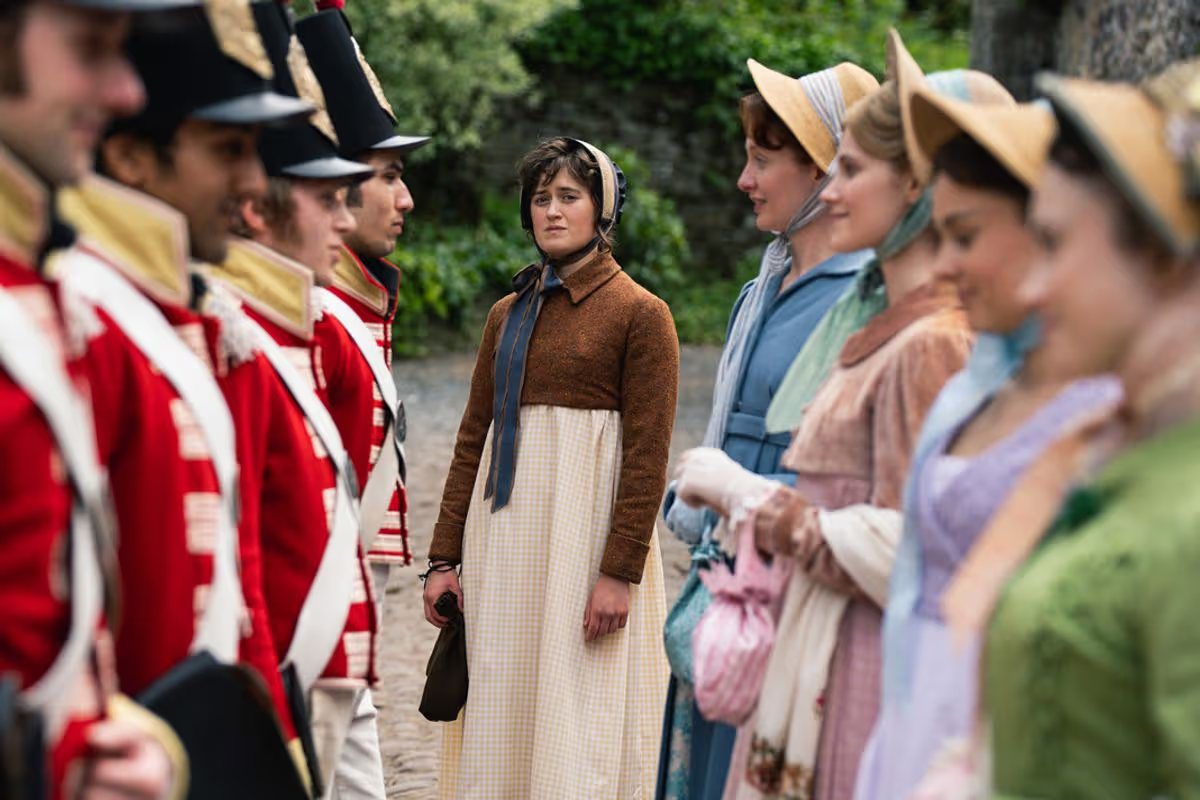
Mary Bennet is the unlikely heroine of The Other Bennet Sister(Image: BBC)
Everything you need to know about who Mary ends up with in The Other Bennet Sister
The Other Bennet Sister has been enthralling viewers since it first aired in March. Now, with the second half of the series finally dropping on BBC iPlayer, audiences are eagerly racing through the new episodes, desperate to discover the fate of Mary Bennet (played by Ella Bruccoleri). WARNING: This article contains major spoilers from The Other Bennet Sister.
Mary ultimately finds love with unassuming lawyer Mr Tom Hayward (Dónal Finn), who travels back from Yorkshire to get down on one knee. His return was prompted by a letter from Miss Bingley (Tanya Reynolds), who disclosed that Mary harboured feelings for him. Mr Hayward had hurriedly left when the group was at the Lakes, after Mr Ryder (Laurie Davidson) discovered he was set to inherit Lady Catherine de Bourgh’s fortune and intended to propose to Mary.
Mr Hayward confessed to Mary that he “stepped aside” because he felt unable to provide her with the same standard of living she deserved when compared to Mr Ryder’s newly acquired wealth. Mary was, quite understandably, livid that both men had taken it upon themselves to decide what was best for her without so much as consulting her on such a momentous matter.
She confirmed to Mr Hayward that she’d always loved him and that Mr Ryder was simply her friend. She’d also rejected Mr Ryder’s marriage proposal, despite her mother Mrs Bennet (Ruth Jones) attempting to pressure her into reconsidering. Mary had encouraged Mr Ryder to travel to Italy in search of a life beyond society’s constraints, with Miss Bingley even following him to the continent hoping for a marriage proposal.
Mary and Mr Hayward wed on their own terms in an intimate ceremony with their dear friends the Gardiners. They intended to build a fresh life together. Mary had even penned a book entitled Advice for a Young Woman, drawing from her own experiences in London and discovering herself after departing the sheltered rural world of Longbourn.
HOLLYWOOD actress Vanessa Hudgens’ sister was keen to make a bold impression with her latest selfie.
The influencer sister of Vanessa, Stella, left little to the imagination as she showed off her very full bust in a lacy bodysuit.
Sign up for the Showbiz newsletter
Thank you!
Vanessa Hudgens’ sister Stella put on a very busty display in new picturesCredit: Instagram / stellahudgensThe star showed off her body in a variety of snapsCredit: Instagram / stellahudgensShe wore a lacy bodysuit for the snapsCredit: Instagram / stellahudgens
Stella’s plunging number featured a translucent design that made sure all eyes were on her.
The glam star’s hips were also on show thanks to the bodysuit number which showed off her snatched waistline.
Stella struck a variety of poses for her Instagram upload which included her appearing to playfully writhe around her seat as she enjoyed a few cocktails at a bar.
In one shot, she manovered her arms to squeeze her chest as well as flashing a model-like post with her hand behind her head in another.
Stella’s fans were quick to react to the jaw-dropping selfies.
One fan wrote: “Baddest ever.”
Another added: “My heart just stopped.”
A third went on to state: “Hot as hell.”
Before a fourth wrote: “Them hips don’t lieeeee babyyyy.”
Stella is best known for her online career as a social media influencer as well as being a regular live-streamer.
She has broadcast her life on Twitch since 2022 as well as hosting her own podcast, That’s Crazy, as she aims to follow in her sister’s famous footsteps.
Stella has also attempted to carve out an acting career with minor appearances in a number of films since 2016.
Vanessa is best known for her roles in the High School Musical franchise.
She has since held a number of high-profile acting roles as well as a successful music career.
Stella appeared to be having an epic nightCredit: Instagram / stellahudgensShe struck her best model like posesCredit: Instagram / stellahudgensStella is the sister of actress VanessaCredit: GettyShe often gets racy onlineCredit: Instagram / stellahudgens
“Everyone is at least a dormant ballet nerd,” declares 22-year-old Eden Lim, while sitting for an interview in the suburban Dallas studio where she and her sister, Jordan, 24, film and edit their popular YouTube channel “Ballet Reign.”
Judging from the near-universal backlash to Timothée Chalamet’s recent bad-mouthing of ballet, Eden’s summation of the central tenet of their show may be true. With 67,000 subscribers in 166 countries and growing, the Lim sisters are mixing Gen Z humor and exuberance with astounding erudition to bring ballet to a new generation and fire up older, longtime fans.
With episode titles such as “Addictive Ballet Moments to Alter your Brain Chemistry” and promises like “This will increase your lifespan and double your morale,” they are on a mission to ensure that ballet not only survives but thrives.
Share via
Mirthfulness is the Lim sisters’ medium, but their message is serious. During each show, they parse video clips of great performances, often by explaining the history of the piece and giving detailed behind-the-scenes stories. They dissect the most famous pas de deux with trenchant insight and introduce their audience to the greatest dancers, including Natalia Osipova and Roberto Bolle. With signature, irrepressible enthusiasm, the sisters help viewers see precisely what makes the shows and dancers so extraordinary.
Eden, left, and Jordan Lim of YouTube channel “Ballet Reign” trained as professional dancers before deciding to focus on their show full time.
(Larsen & Talbert / For The Times)
A video clip featured in the “Addictive Ballet” episode shows New York City Ballet principal dancer Ashley Bouder launching herself into a jeté so high she seems to leave Earth’s gravity. In midair she manages to turn herself 180 degrees before being caught by her partner, despite her momentum seeming to drift into his arms like a feather blown by a breeze.
While watching the singular feat, Eden exclaims, “Call the news channels! We found a person who can actually levitate!”
Jordan says the goal is to make viewers feel equipped to say, “I understand what’s going on, and I can appreciate it, and I can appreciate that this was done well.”
“Ballet Reign” launched three years ago with modest hopes. The sisters sought a mere toehold in the YouTube universe, aiming for a narrow niche audience of fellow ballet fanatics (“ballet nerds”) ages 16 to 25. To their initial astonishment, they have attracted a far wider viewership spanning all ages, even followers who hitherto had only scant interest in ballet. They have drawn in many young children and older adults, with those 65 and up now their third-largest subscriber group.
The show has rapidly won acclaim from within and outside of the ballet world — perhaps because the depth and breadth of their knowledge makes it hard to shake the suspicion that they secretly are Ivy League professors.
The Lim sisters speak with sophistication about classic ballets and dancers they love — delivering their message through a whimsical show that has attracted fans of all ages.
(Larsen & Talbert / For The Times)
They comment with equal sophistication on ballet steps, choreography, history, musicology and the minute details of costume design. Eclectic references pop out of nowhere — a metaphor from quantum physics, an aside that the flute is the instrument whose sound is closest to a sine wave, that a serinette is an 18th century music box used to teach caged canaries to sing.
Even actual professors laud the show.
Nicolas Krusek routinely shows “Ballet Reign” episodes in his classes for adults on ballet history at Simon Fraser University in Vancouver. Krusek says what makes the show compelling “is the spirit of the videos, just the sense of joyousness and benevolence that they communicate, and a real sense of reverence for the art and the artists.”
John Meehan, a Vassar College professor of ballet and former principal dancer with American Ballet Theatre, calls their episode on Igor Stravinsky’s “The Firebird” ballet “amazing,” adding that it conveys at least as much information in much more palatable form than a “dry” university lecture.
Julie Cronshaw, director of the Highgate Ballet School in London, says even for learned, longtime balletomanes the show opens up a whole new realm of understanding and appreciation. For those weighed down by adult concerns, watching an episode leaves them feeling uplifted.
This is why Jordan believes “Ballet Reign” has attracted a significant older audience — and also because the sisters honor tradition.
“They’re looking at the content and saying, ‘These are pieces that I grew up watching. And these are the dancers that I adored when I was younger,’” Jordan says.
Eden says she hopes “it’s because our content, and the way we deliver it, is able to touch hearts.”
The Lim sisters keep a disciplined schedule, turning out polished, deftly produced episodes 52 weeks a year.
(Larsen & Talbert / For The Times)
The show also benefits from its high production values, with expertly edited clips from performances, clever blurbs of text and quirky cutaways to, say, a pole vaulter as an allusion to how high a dancer jumps.
Episodes generally begin the same way, with the sisters sitting behind a table with an old-fashioned radio-days microphone nicknamed “Mike-elangelo” between them. Eden kicks things off by announcing, “Ladies and gentlemen, this is Ballet Reign.”
A flash of superimposed text identifies them as “*Very certified*, extremely serious ballet experts.”
Jordan and Eden revel in each other’s company, finish each other’s sentences and play off each other with insightful or witty interjections.
“We grew up best friends from the beginning, and that’s never changed,” Jordan says.
They keep a disciplined, grueling schedule, turning out polished, deftly produced episodes 52 weeks a year.
Comments validating their efforts come in frequently. “You really helped me through a dark time,” reads one. Another notes, “I was going through a really difficult life transition and having your videos helped me get through.”
Jordan says, “That’s a sort of impact that I genuinely did not see coming.”
The sisters are openhearted and enjoy revealing ballet’s best-kept secrets, but they have kept a remarkably mysterious online profile. Until now, they have never even disclosed their last names, let alone anything about their background, education or experience.
There is also nearly nothing on the internet, and fans have long wondered about their credentials, including whether they are professional dancers themselves.
On the show the sisters certainly come across as if they were. Surprisingly, the answer is no — with an “almost” caveat.
The oldest of four siblings, Jordan and Eden spent nearly all of their childhood in Ottawa. From the time they were small the sisters beelined toward becoming professional ballet dancers. Jordan says when she was 4 she got up at the crack of dawn every day and put in a VHS tape of a ballet class that her mother, Mary Lim, had bought. With fierce determination, she performed tendus and relevés along with the older students on the tape.
Eden’s ballet fascination quickly followed. Mary says she soon realized she had no choice but to send them to ballet school.
“Obviously, if you look at a 4-year-old doing ballet at 7 a.m. every single day, you’re like, OK, let’s try lessons,” Jordan says.
Eden, left, and Jordan Lim of “Ballet Reign” are the oldest of four siblings and spent nearly all of their childhood in Ottawa before relocating to Texas to pursue their careers.
(Larsen & Talbert / For The Times)
By 2015, the girls needed a better ballet school than was available in Ottawa. Their parents packed up the family and moved to Dallas, where the pair enrolled in the Ballet Academy of Texas. Aside from ballet classes they were entirely homeschooled, but they had plenty of experience dancing in school performances, ballet competitions and with real companies.
Mary says the intent was “to give them an opportunity to move and carve their own path … We wanted them to find their passions.”
The moment the sisters had worked for all their lives arrived in 2020, when the time came to set off around the country — and the world — to audition for ballet companies. But the COVID-19 pandemic hit just as they got started, and almost everything in the ballet world shut down.
Jordan says the hiatus led them to reflect for the first time on whether their lifelong ambition was truly what they wanted. At the same time they groped for a way to put their passion for ballet to temporary use.
For years the sisters had fantasized, half-seriously, about having their own YouTube channel. Eden convinced an initially reluctant Jordan it was time to make the daydream real, and “Ballet Reign” premiered on Dec. 21, 2022.
The sisters say they convinced themselves they were using the show to take “a gap year” while waiting out the pandemic. As the first months passed, and their audience widened and sent glowing feedback, they began to realize they were having a big impact and touching lives. It dawned on them that this wasn’t just an interlude but their calling.
In an agonizing twist, just as the show had gotten underway, Jordan received word she had been accepted by a professional ballet company. She turned down the offer.
“It was one of the hardest decisions I’ve ever had to make,” Jordan says, but in retrospect the right one.
KIM Kardashian has been accused of editing her sister Khloe’s face by fans as the family enjoy a trip to Japan.
The sisters have been living their best lives in Tokyo over the past week, along with Kim’s children, Saint, Psalm and Chicago and Khloe’s daughter True.
Sign up for the Showbiz newsletter
Thank you!
Kim Kardashian has been accused of editing her sister Khloe’s faceCredit: InstagramThe sisters are enjoying a trip to Tokyo with their children, including Kim’s son SaintCredit: InstagramFans think Khloe’s face looks different in the snapCredit: Instagram/Khloe Kardashian
The Skims founder, 45, took to Instagram on Saturday to share a photo dump of their trip but soon came under fire for allegedly using editing tools to change the appearance of hers and Khloe’s faces.
In one snap, the pair are seen standing in front of a toy claw machine, as Khloe, 41, holds a stuffed toy in her arms.
The sister duo look flawless with their skin glowing and their make-up on fleek, but fans think she may have altered the pictures.
One person commented: “The amount of facetuning on khloe gaadammmm.”
Another social media user expressed: “We saw you at the Oscar party. We know you don’t look anywhere close to this. Nor does your sister.”
Somebody else said: “Ya’ll do not look like this in person. Kim embrace your age and imperfections. Especially Khloe.”
Yet another penned on Reddit: “Why does khloe look photoshopped in. It looks like she’s been pasted in and resized to be around Kim’s height lol.”
While a fifth added: “I hope those Instagram filters get overtime pay cuz they be working hard af.”
Most read in Entertainment
Kim’s new man Lewis Hamilton was spotted with the group in Tokyo earlier this week, before the start of the Japanese Grand Prix.
Things appear to be heating up for the pair as she introduced him to three of her children.
“It’s more than just a casual connection. It takes a lot to capture Kim’s interest and she’s definitely intrigued,” an insider told People.
“He’s just an easygoing guy with great energy.
“Her family likes him and Kim’s very into him. They are both busy with their careers, but see each other as much as possible.”
On Sunday, Kim and Lewis took a stroll around the streets of Tokyo before being sighted by fans.
Fans pointed out Kim’s alleged editing fail on social mediaCredit: instagram
Surrounded by security, Kim waved back as she walked in a full-body grey dress.
Linking arms with BF Hamilton, the American offered some PDA for those watching on.
Kim’s romance with Lewis became public knowledge after The Sun revealed she flew in from Los Angeles on her £100million private jet to spend an evening with him.
On January 31, the couple enjoyed a brief stay at the exclusive Estelle Manor in the Cotswolds, with insiders saying they had the spa to themselves, before enjoying a meal in a private room.
A source told The Sun: “It all appeared to be very romantic. Kim and Lewis made use of all the facilities on offer.
“She had two bodyguards with her and Lewis had a close protection officer but they remained in the background.
“Two of the three stood guard outside the door to their room, so no one could disturb them.”
Lewis was friends with her rapper ex Kanye West, who she divorced in 2022.
A source added: “They had a couple’s massage booked in and had full use of the facilities for just the two of them.
“It was all kept very quiet – they clearly wanted to have some time for just the two of them.”
They hard-launched their romance at the Super Bowl last month, when they were spotted in the stands alongside her sister Kendall Jenner.
Kim’s new man Lewis Hamilton was spotted with the group in TokyoCredit: Shutterstock
A loving husband and wife desperately want to start a family but struggle with infertility. A mother bears the weight of twin sons who are destined to be at severe odds with one another. Two sisters fall in love with the same man.
These stories may sound like soapy twists in a Taylor Sheridan drama or cable TV movie, but they actually come straight from one of the bestselling books of all time — the Bible.
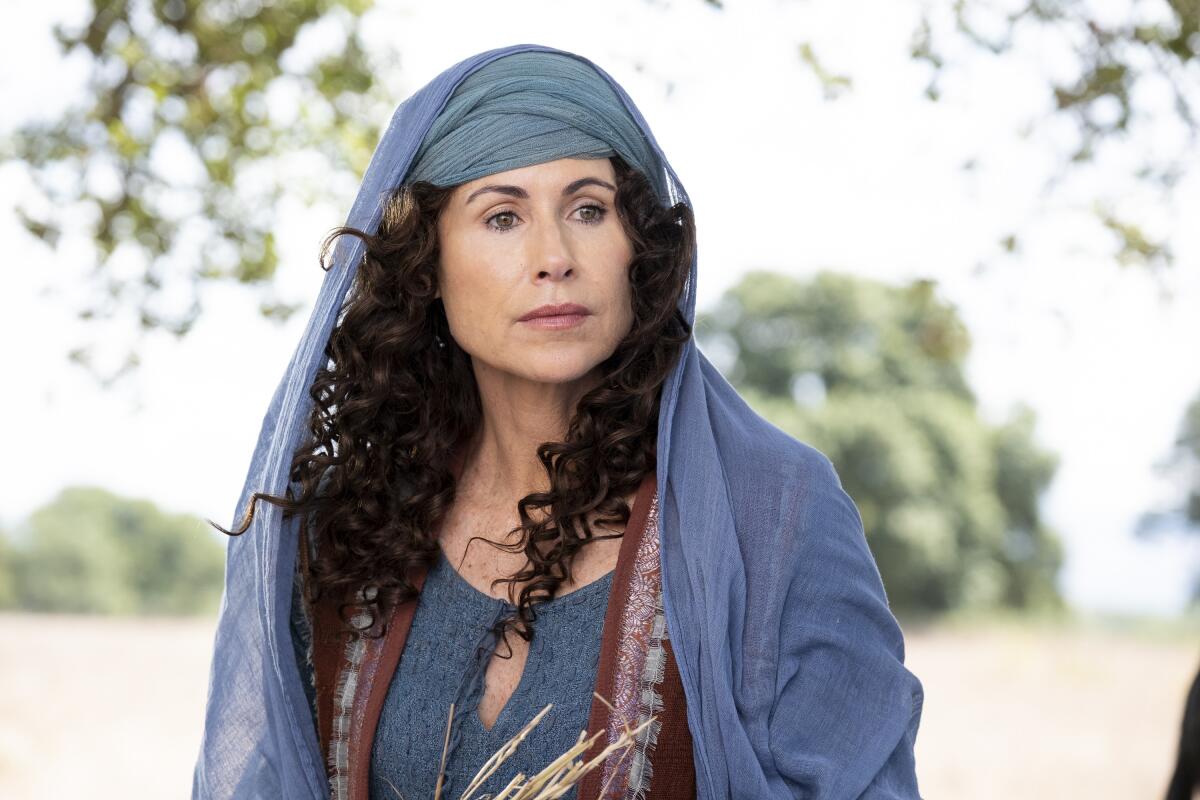
The sacred text is jam-packed with compelling and highly relatable stories, but Fox’s “The Faithful: Women of the Bible,” a three-part event series, aims the spotlight on the primary matriarchs of the Book of Genesis — Sarah, Hagar, Rebekah, Leah and Rachel. The first installment consists of two episodes airing Sunday, with subsequent double episodes airing over the next two weeks, and begins with the story of Sarah (Minnie Driver), who is regarded as the first matriarch for building the nation of Israel with her husband, Abraham (Jeffrey Donovan), the first patriarch.
“These are three generations of women who passed the baton of what was set in motion by Sarah and Abraham and the episodes are all in a way portraits of different types of marriages,” says René Echevarria, who wrote the first installment and is the series’ showrunner.
However, like the Bible’s many miracles, “The Faithful” coming together in the first place is divine considering executive producing partners Carol Mendelsohn and Julie Weitz were actually not planning to pitch it when they were in a meeting with Fox TV executives on one fateful day.
“The Faithful” begins with the story of Sarah (Minnie Driver) and Abraham.
(Moris Puccio / Fox)
“Julie gave me one instruction, ‘We can talk about all of our projects but do not talk about the Bible,’” recalls Mendelsohn. But then Fox President Michael Thorn asked Mendelsohn what her passion project was and “It was like I was hit by the burning bush!”
So “The Faithful” was pitched and a green light was given for the show. “I guess it was divinely ordered,” Mendelsohn says, laughing.
Crafting a Bible-based event series may initially seem like a stretch for Mendelsohn, known for producing the massively popular “CSI” crime drama franchise and, since partnering with Weitz over a decade ago, contemporary dramas where God wasn’t a part of the story. However, with “The Faithful,” the common thread with their previous projects was very clear. “Everything that we do together comes from characters that we fall deeply in love with and we love to do stories about women,” says Weitz. “We were thinking of doing something in this world when “The Chosen” [the Prime Video series about Jesus Christ] came out and became a huge hit.”
Mendelsohn and Weitz brought Echevarria on board and once they dug into the respective stories of these influential women, “it became clear that we should give two hours to each of these matriarchs and tell that story, which is the genesis of not just Judaism, but Islam and Christianity, the three largest, most prominent religions of mankind,” says Weitz, who is also grateful for Fox’s programming strategy for the episodes. “It worked nicely because they are giving us Sunday Nights leading right through Passover and into Easter so it just made sense to [Fox] too.”
For varying perspectives, the show utilized both Christian and Jewish scholars, which backed up their storytelling objectives, given that these age-old stories traditionally didn’t always flesh out women as much as men, so leaning into an interpretation of text was not taboo. “Our Jewish scholar mentioned, ‘what you’re doing is called midrash, an ancient tradition in Judaism to look at these stories and read between the lines,’” says Echevarria.
That interpretive freedom can be seen in the show’s first installment, which explores Genesis 16 where Sarah, barren for years despite God having told Abraham that she would bear a child in her older age, enlists former Egyptian slave Hagar (Natacha Karam) to sleep with her husband in the hopes she’ll give them a child. Driver says Sarah’s story is one that many women can connect with, but as far as who the real woman was, there’s a lack of true definition. “Who knows what Sarah was like? We don’t know. She doubted and, to some people, she thwarted God, but actually to me, she was just a woman who wanted to have a baby, loved her husband very much and was very strong,” she says.
Natacha Karam plays Egyptian slave Hagar, who bears Abraham’s child.
(Stefano Cristiano Montesi / Fox)
Donovan notes that Sarah suggesting Abraham lie with Hagar in Genesis 16 initially comes across as a straightforward and simple sentence. “But there’s so much to unpack in that one line from the Bible,” he says. “The complex struggles that these three people must have had that people today are still having 4,000 years later? We’re still going, ‘I can’t have a baby. Let’s have her have our baby. But do you like her? Is she better than me?’”
But as much as Sarah’s plight with infertility is relatable, other moments in the story took more work to get there, like the moment where Abraham talks with God. “I can only imagine what it would feel like to speak to God,” Donovan says.
To grapple with that notion before shooting this particular scene, the actor, dressed in his character’s tunic and waiting on the crew to set up, found a spot to sit on under a tree and thought about Abraham’s daily life and how impactful a message from God would be. “He’s a shepherd that got up with the sun and watched his flock and tried to survive,” Donovan says. “‘How do I not die today? How do I feed my family?’ For me to give the respect to the character, that deserves a couple of hours of solace and solitude.” He calls it the most difficult scene in the series for him.
And while the show explores Sarah and Abraham’s marriage, it also dives into the relationship between Sarah and Hagar, which begins when a captive Sarah is freed and she takes slave Hagar with her to give her a better life.
“Hagar finds herself pulled into this story that’s far larger than anything that she could ever have imagined for herself,” says Karam, adding that the two women grow close but conflicts also arise. “Originally, the relationship is defined by hierarchy and necessity and then there’s this complicated dependence that bounds them together for life.”
The actor expressed her satisfaction that the story of Sarah and Hagar is given a positive portrayal since that’s not always been the case. “There are versions of that story that are read through a lens of reprimanding both of these women, which I want to say is shocking but it was actually quite predictable to spin it so that it ends up being, ‘Oh, look what these two women did when they tried to take control,’” she says.
“Hagar finds herself pulled into this story that’s far larger than anything that she could ever have imagined for herself,” says Natacha Karam, left, with Minnie Driver and Jeffrey Donovan.
(Moris Puccio / Fox)
The spin from the cast and crew on the production itself was that with all “The Faithful” episodes filming in the ancient city of Rome, the series benefited from what the city had to offer in terms of scenic authenticity. Also, the unforgiving heat while shooting outdoor scenes wasn’t fun but also wasn’t a total negative, says Driver. “I’ve never been outside in 100-plus degree heat for 10 or 11 hours a day. It was brutal, but it definitely lent to the veracity of the story like where you were so beyond hot and exhausted,” she says. “There’s a generosity of its history that you’re invited in. It was this fever dream, the whole experience of being there.”
And while the Sarah-Abraham-Hagar story fills out the first episode, the March 29 installment continues the drama with the introduction of Rebekah (Alexa Davalos), who marries Sarah and Abraham’s son, Isaac (Tom Mison). Also barren for many years, she eventually receives a message directly from God that she will have twin sons and that her youngest son will one day rule. With the arrival of Esau (Ben Robson), who is born first, and Jacob (Tom Payne), she’s faced with a burden to ensure God’s message stays on course at any cost. “The story becomes about how she almost destroys her family because she’s been told that this is the way, this is the destiny,” says Weitz.
The April 5 finale, airing on Easter Sunday, moves forward as a now-exiled Jacob returns to his hometown and meets two sisters, Leah (Millie Brady) and Rachel (Blu Hunt), and sparks fly. Teases Echevarria, “tonally the episode is a little bit different and it’s a little more scandalous but certainly contemporary.” Adds Weitz, “Jacob falls in love with both of the sisters for different reasons and at different times so it becomes a story about sister rivalry for the love of the same man.”
Love is something audiences have been feeling in recent years for faith-inspired programs, which keeps this three-week event from feeling like a television anomaly. For example, Prime Video’s “The Chosen” has been exploring the life of Jesus Christ (Jonathan Roumie) for five seasons with a sixth season centered on Jesus’ crucifixion coming later this year. Also, on March 27, Prime Video launches the second season of “House of David,” which follows the journey of young shepherd David (Michael Iskander) from slaying a certain giant named Goliath to becoming the king of Israel. And earlier this month, faith-centric streamer the Wonder Project wrapped the first season of its contemporary drama series, “It’s Not Like That,” starring Scott Foley as a widowed minister raising his kids and finding love again. Plus, no Easter holiday would feel right without ABC’s annual broadcast of the 1956 classic film “The Ten Commandments,” airing April 4.
Why is faith TV having a moment now? The appetite for this kind of programming by audiences could reflect the often-bleak world of the 21st century we live in, offers Karam. “These are stories about people who are in the middle of impossible circumstances, who can’t see what the lesson is yet, or whether there’s light on the other side,” she says. “But historically, there always was and there always is [light on the other side] so I think that’s what people are hungry for right now is a framework to make sense of things.”
As long as this hunger continues and audiences show up for “The Faithful,” the producers have a wealth of stories to tell beyond the great matriarchs.
“The difference from a regular TV show is that we do have this extraordinary IP and this different perspective,” says Echevarria. “Our hope is that ours will always be a little different and we’d come at it from a different angle.” Sounds like the faith is definitely being kept.
KATIE Price’s furious sister Sophie has revealed her true thoughts on the glamour model’s whirlwind marriage to Lee Andrews – admitting she was left shocked over the nuptials.
Katie Price’s sister has revealed the star ‘ruined my year’ with her shock wedding to Lee Andrews – which left her family blindsidedCredit: @KatiePriceYoutube/BackgridKatie married Lee in January just ten days after meeting him in a Dubai ceremony, shocking family and fans back homeCredit: wesleeeandrews/instagramWe revealed earlier this year how Sophie and Katie’s mum Amy were concerned for the star over Lee’s intentionsCredit: Instagram
As they spoke about their mum Amy, Sophie added that Katie had “traumatised” the whole family with her shock romance.
The pair then moved on to other news throughout the episode as Sophie said she “didn’t want to hear it” when it came to conversation surrounding Lee.
Katie and her sister took almost two months away from recording their podcast following the wedding, with the former admitting she didn’t blame her family for being ‘angry’Credit: InstagramAnd in the new episode, Sophie described her sister as a ‘pain in the a**’The former glamour model returned home earlier this month after spending several weeks in DubaiCredit: wesleeandrews/Instagram
HILARY Duff broke down in tears as she laid bare the heartbreaking feud with her sister.
The So Yesterday hitmaker – who is in the midst of a huge pop revival with new album Luck … Or Something – admitted the pair “don’t speak”.
Sign up for the Showbiz newsletter
Thank you!
The heartbreaking moment Hilary Duff broke down in tears over her years-long feud with her sister has been captured on a new podcastCredit: YouTube/Jay Shetty PodcastThe So Yesterday chart star admitted she and elder sibling Haylie Duff ‘don’t speak’Credit: GettyHilary opened up on the ‘raw’ nature of their bond on Jay Shetty’s On Purpose podcastCredit: YouTube/Jay Shetty Podcast
Hilary, 38, first referenced bad blood with her actress and singer sibling Haylie, 41, in her album track We Don’t Talk.
The track also tellingly samples Gotye song Somebody That I Used To Know.
In a new podcast chat with Jay Shetty, she explained the delicate situation and how the ongoing drama is a “raw part of my existence”.
Hilary, who previously starred with her big sister on the pair’s infamous Lizzie McGuire TV show, fought back tears as she told the On Purpose podcast: “My sister and I don’t speak.
“And I think in my adulthood I’ve come across more and more people that are having this experience”.
She branded the situation as “a very raw part of my existence’ before she added: “I hope it’s not forever, but it’s for right now”.
Hilary said: “As painful as it feels to share, when I decided to make this record, I could only talk about the things that I’ve gone through.
“Like there would be no purpose to make a record after 10 years than to face, you know, what it’s been like.
“That’s my truth.
“And I really worked hard to lyrically make sure that I’m just speaking about my experience, you know?”
The sisters haven’t been seen together in public since 2019.
Mum of four Hilary is re launching her pop careerCredit: GettyHer new album Luck … or something features track We Don’t TalkCredit: GettyShe has confirmed the track centres on their strained relationsCredit: Getty
During her recent concert in London, Hilary introduced fans to the new song, We Don’t Talk.
In a clip of her performing the song on stage, she sung: “Don’t know when it happened / Not even sure what it was about,” alluding to their broken down relationship.
She continued: “Cause we come from the same home, same blood.
“People ask me how you’re doing / I wanna say amazing, but the truth is that I don’t know / What I always end up saying is how … ”
For the chorus, Hilary sung: “We don’t talk, we don’t talk about it / We don’t talk about anything anymore.”
It is in the second verse that Hilary alluded to sibling rivalry.
“And if it’s ’cause you’re jealous / God knows I would sell it all, then break you off the bigger half,” she sung.
A fan then took to social media to put: “WOWW… Hilary Duff just sung We don’t talk and it’s 100% about Haylie. But not mean at all. Basically telling her to reach out.”
Another agreed and put: “I think Hilary misses her sister!”
In another interview, she confirmed the spat was the source material for her track.
“Yeah, it is. It’s definitely about my sister,” Hilary admitted.
After years of silence, back in November Hilary seemingly addressed the feud between her and her sister while chatting about “family drama”.
Speaking to Rolling Stone about her musical comeback, the star said she feels “ready to fill in the blanks and share with people and connect with them on the level of now”.
She then told the outlet how she and her fans have gone through twists and turns and “have gone through a lot of the same things”.
“Whether that’s complicated relationships, anxiety, raising kids, divorces, trying to find yourself in adulthood, family drama…
“Finally I felt safe enough and comfortable in my own family to step outside and open that part of myself up again,” she explained.
Chatter previously swirled that the pair, who were once very close, weren’t getting along because of differing political views.
However, social media gossip page DeuxMoi claimed that the sisters fought over Hilary’s husband,Matthew Koma, butting heads with Haylie’s husband, Matthew Rosenberg.
The pair haven’t been seen together in public for yearsCredit: GettyRumours have suggested Hilary’s husband Matthew Koma does not get on with her sister’s spouseCredit: GettyThe bubblegum pop singer has released a new album and tourCredit: Getty