“Sinners” entered the night with the record for the most Oscar nominations for a single film, with 16.
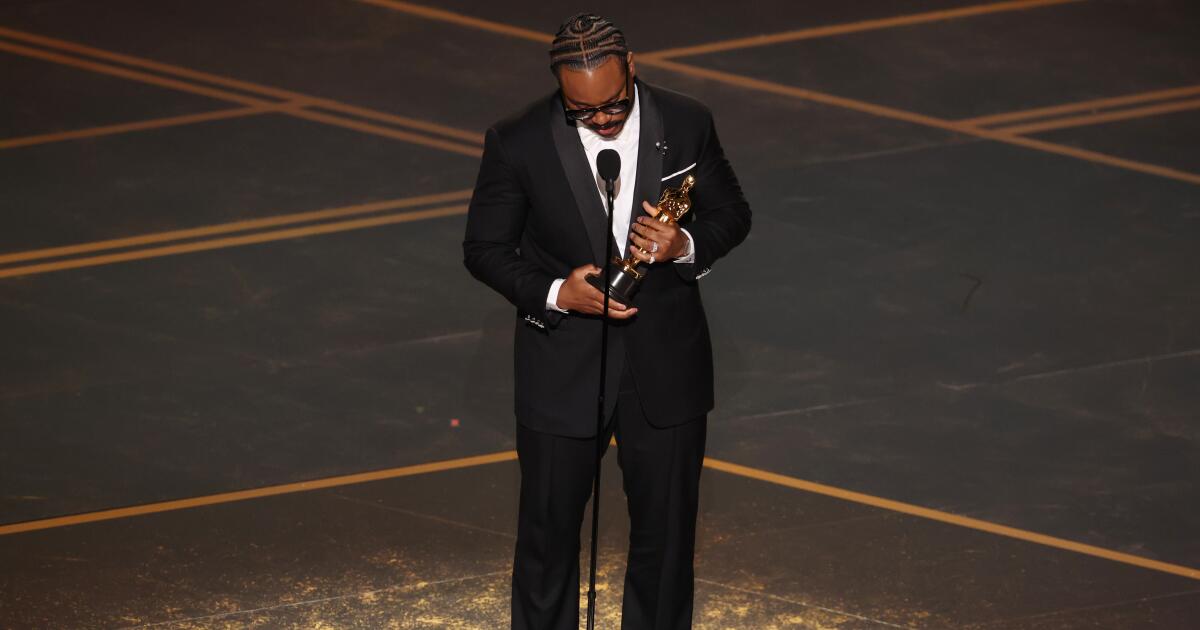
It leaves with four awards, won by Ryan Coogler for original screenplay, Michael B. Jordan for lead actor, Autumn Durald Arkapaw for cinematography and Ludwig Göransson for score. Arkapaw became the first woman to ever win in her category.
It seemed every time the film’s title came up during the broadcast there would be cheers and a swell of emotion from the audience. The live performance of the nominated song “I Lied to You” re-created the fantastical moment from the film in which generations of musicians collide, weaving together past, present and future.
Since its release in April of last year, the film has been a cultural touchstone and point of extended conversation on its way to some $370 million in worldwide box office. Among this year’s best picture nominees, only “F1” earned more, with $631 million. When Oscars host Conan O’Brien mentioned the name of the film in his opening monologue, it generated a huge ovation from the room.
Directed and written by Coogler, the film tells the story of twin brothers, Smoke and Stack, both played by Jordan. On the opening night of their juke joint in 1930s Mississippi, they are beset by a small band of vampires, intent on turning everyone inside into bloodsuckers.
In accepting his lead actor award, Jordan thanked Warner Bros. executives Mike De Luca and Pam Abdy “for believing in this dream, this vision of Ryan Coogler and betting on the culture and betting on original ideas and original artistry.” (Including its Oscars for “One Battle After Another” and “Weapons,” Warners Bros. ended the night with an 11-Oscar tally, tying the record for most wins by a single studio.)
Across what seemed an extremely long awards season — a run that was even longer for “Sinners” due to its spring release date — the film had many ups and downs. But its momentum seemed to be peaking at just the right time, as seen with the crucial wins for Jordan and the cast at the Actor Awards on March 1.
Regardless of how one feels about its final tally at the Academy Awards, the movie has already firmly established its continued relevance. As The Times’ Greg Braxton recently wrote, “‘Sinners’ is now being increasingly hailed in Hollywood as a groundbreaking symbol of Black artistic excellence, as well as a timely pushback to the divisive political climate that has reached fever-pitch proportions.”
The already highly decorated “Sinners” was among the top winners at the 78th Writers Guild Awards on Sunday in New York City.
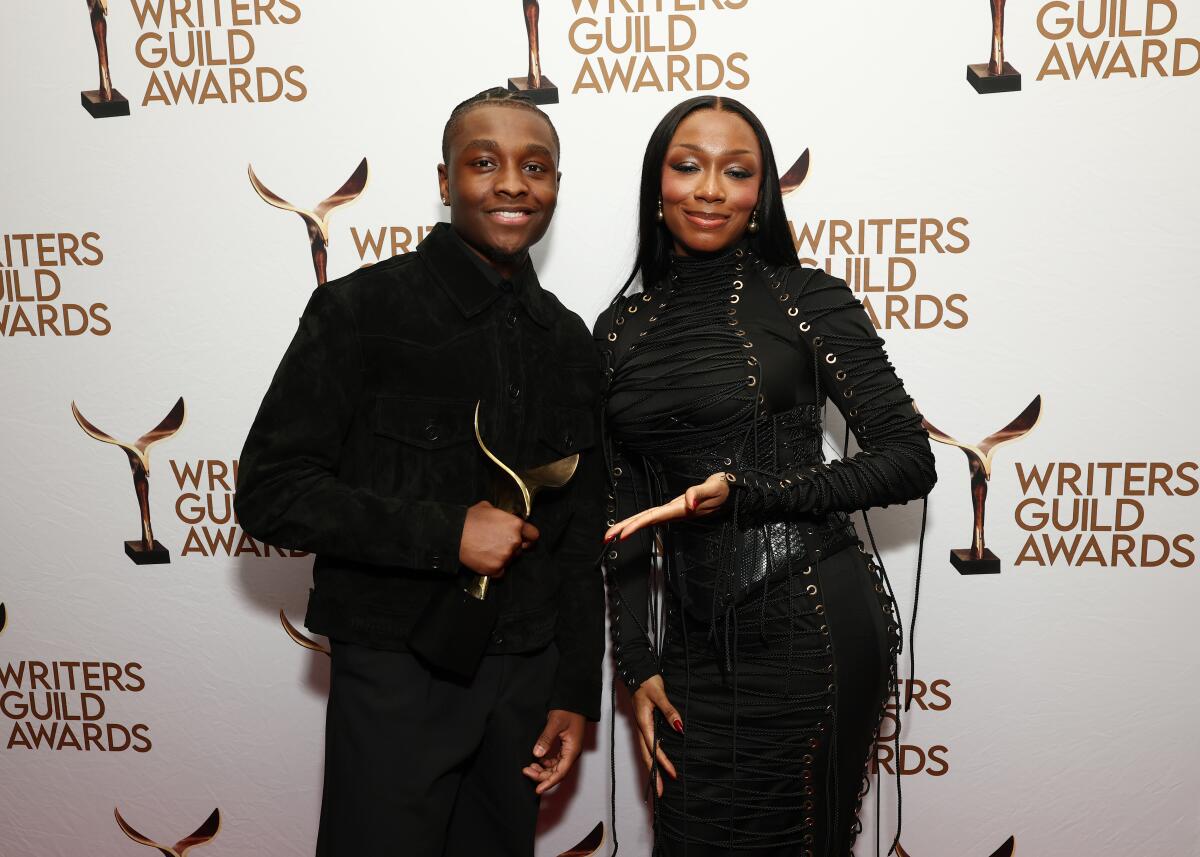
The Ryan Coogler-directed horror film won the award for original screenplay, and its primary Oscars best picture opponent, Paul Thomas Anderson’s “One Battle After Another,” clinched the win for adapted screenplay. “Sinners” star Miles Caton accepted the award for the former, and “One Battle” cast member Shayna McHayle for the latter.
“Sinners” star Miles Caton and “One Battle After Another” actor Shayna McHale accepted the awards for original and adapted screenplay, respectively.
(Cindy Ord / Getty Images for Writers Guild of America East)
In the TV realm, “The Pitt” made a splash with awards for drama series, new series and episodic drama.
As for lifetime achievement honors, Robert Smigel presented Stephen Colbert with the Walter Bernstein Award for critiquing the power elite on his late-night show, which will air its final episode in May. Terry George received the Ian McLellan Hunter Award for Career Achievement from Don Cheadle, and Diana Son the Richard B. Jablow Award for Devoted Service to the Guild from last year’s recipient, Kathy McGee.
Most years, the Writers Guild holds simultaneous ceremonies in New York and Los Angeles. But the East Coast edition became a solo affair after WGA West canceled its ceremony amid an ongoing strike by its own staff union, who claimed guild management had “surveilled workers for union activity, terminated union supporters, and engaged in bad faith surface bargaining.”
The L.A. ceremony was set to honor James Cameron with the Laurel Award for Screenwriting Achievement, Don Reo with the Paddy Chayefsky Laurel Award for Television Writing Achievement and Mstyslav Chernov with the Paul Selvin Award for “2,000 Meters to Andriivka,” which won the award for documentary screenplay Sunday evening.
While WGA West’s board of directors said the ceremony was postponed to give members “an uncomplicated celebration of their achievements,” the Writers Guild Staff Union characterized the cancellation as an attempt to sow division between management and unionized staff, which is ill-timed given upcoming contraction negotiations between the WGA and the Alliance of Motion Picture and Television Producers, which represents Hollywood studios and streamers. In 2023, the WGA went on its longest-ever strike, lasting 148 days.
Comedian and Emmy-nominated producer Roy Wood Jr., who this year hosted the WGA’s East Coast ceremony for the third time, during his opening monologue offered (in jest) his predictions for the negotiations, which begin later this month.
“First, I predict somebody’s gonna lose their s—,” the host said. “Cooler heads are gonna prevail, and then somebody else is gonna lose their s—.”
Here is the full list of Writers Guild Award winners:
Original screenplay: “Sinners,” written by Ryan Coogler; Warner Bro. Pictures
Adapted screenplay: “One Battle After Another,” screenplay by Paul Thomas Anderson, screen story by Paul Thomas Anderson, inspired by the novel “Vineland” by Thomas Pynchon; Warner Bros. Pictures
Documentary screenplay: “2,000 Meters to Andriivka,” written by Mstyslav Chernov; Frontline Features
Drama series: “The Pitt,” written by Cynthia Adarkwa, Simran Baidwan, Valerie Chu, R. Scott Gemmill, Elyssa Gershman, Joe Sachs, Noah Wyle; HBO Max
Comedy series: “The Studio,” written by Evan Goldberg, Alex Gregory, Peter Huyck, Frida Perez, Seth Rogen; Apple TV
New series: “The Pitt,” written by Cynthia Adarkwa, Simran Baidwan, Valerie Chu, R. Scott Gemmill, Elyssa Gershman, Joe Sachs, Noah Wyle; HBO Max
Limited series: “Dying for Sex,” written by Sheila Callaghan, Harris Danow, Madeleine George, Elizabeth Meriwether, Amelia Roper, Kim Rosenstock, Sasha Stewart, Sabrina Wu, Keisha Zollar; FX/Hulu
TV & Streaming Motion Pictures: “Deep Cover,” written by Derek Connolly and Colin Trevorrow; Prime Video
Animation: “Shira Can’t Cook” (“Long Story Short”), written by Mehar Sethi; Netflix
Episodic drama: “7:00 A.M.” (“The Pitt”), written by R. Scott Gemmill; HBO Max
Episodic comedy: “Prelude” (“The Righteous Gemstones”), written by John Carcieri, Jeff Fradley, Danny R. McBride; HBO Max
Comedy/variety series – talk or sketch: “Last Week Tonight with John Oliver,” senior writers: Daniel O’Brien, Owen Parsons, Charlie Redd, Joanna Rothkopf, Seena Vali; writers: Johnathan Appel, Ali Barthwell, Tim Carvell, Liz Hynes, Ryan Ken, Sofía Manfredi, John Oliver, Taylor Kay Phillips, Chrissy Shackelford; HBO Max
Comedy/variety specials: “Marc Maron: Panicked,” written by Marc Maron; HBO Max
Quiz and audience participation: “Celebrity Jeopardy!”, head writer: Bobby Patton; writers: Kyle Beakley, Michael Davies, Terence Gray, Amy Ozols, Tim Siedell, David Levinson-Wilk; ABC
Daytime drama: “The Young and the Restless,” associate head writers: Jeff Beldner, Marla Kanelos, Dave Ryan; writers: Susan Banks, Amanda L. Beall, Marin Gazzaniga, Rebecca McCarty, Madeleine Phillips; CBS/Paramount+
Children’s episodic, long form and specials: “When We Lose Someone” (“Tab Time”), written by Sean Presant; YouTube
Short form streaming: “The Rabbit Hole with Jimmy Kimmel,” writers: Jimmy Kimmel and Jesse Joyce; YouTube
Documentary script – current events: “Trump’s Power & the Rule of Law” (“Frontline”), written by Michael Kirk and Mike Wiser; PBS
Documentary script – other than current events: “Forgotten Hero: Walter White and the NAACP” (“American Experience”), written by Rob Rapley; PBS
News script – regularly scheduled, bulletin or breaking report: “Devastating Flooding in Texas” (“World News Tonight with David Muir”), written by David Muir, Karen Mooney and Dave Bloch; ABC News
News script – analysis, feature or commentary: “Remembering Palestinian Journalists Killed by Israeli Forces” (“Ayman”), written by Lisa Salinas; MSNBC
Digital news: “An Isolated Boarding School Promised to Help Troubled Girls. Former Students Say They Were Abused.,” written by Sebastian Murdock and Taiyler Mitchell; HuffPost
Radio/audio documentary: “Jerry Lewis’ Lost Holocaust Clown Movie” (“Decoder Ring”), written by Max Freedman; Slate
Radio/audio news script – regularly scheduled, bulletin or breaking report: “ABC News Radio Top of the Hour News”, written by Robert Hawley; ABC News Radio
Radio/audio news script – analysis, feature or commentary: “The Life and Legacy of Jimmy Carter,” written by Gail Lee; CBS News Radio
On air promotion: “CBS Comedy,” written by Dan Greenberger; CBS
Times staff writers Stacy Perman and Cerys Davies contributed to this report.
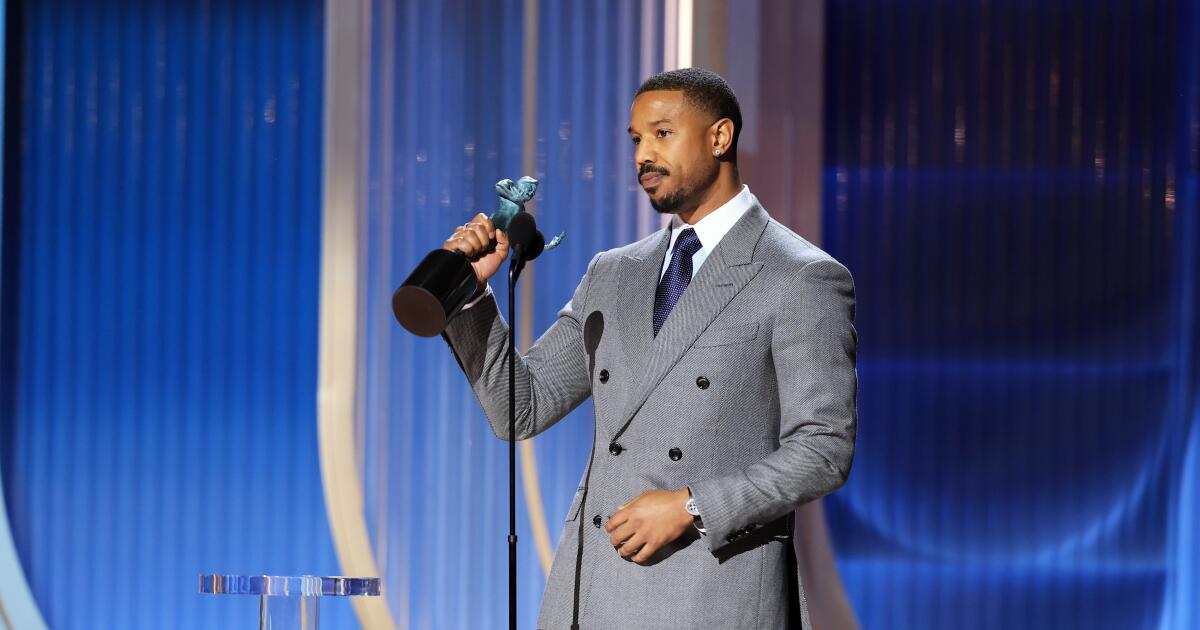
The “Sinners” star won the Actor Award for lead actor for portraying the film’s twin ex-mob enforcers turned juke joint owners, Smoke and Stack.
“I wasn’t expecting this at all,” Jordan said as he accepted his award Sunday evening. “I’m so honored and privileged to be nominated in categories with people and actors and humans that I love.”
“I love their work and what you contribute to to our craft, and this ride has been unbelievable,” he said. “So thank you for welcoming me in and making me feel seen.”
Jordan went on to reminisce about his time as an entry-level SAG-AFTRA member, aspiring toward truly belonging to “this club that I wanted to be in so bad.”
“Those guys that were talking on stage with the awards and nice suits, talking, being in fancy places like that,” the actor said. “That’s what I always wanted and that kid from Newark, New Jersey’s standing here right now.”
The “Creed” alum went on to thank his mother for driving him to his earliest auditions and director Ryan Coogler for “giving me the opportunity to show what I can do and to be fearless and to create a safe space for us to find the truth.”
Finally, Jordan extended gratitude to his fellow actors and his fans, “who’ve seen me grow up in front of the camera and in these rooms.”
Jordan’s triumph over his fellow nominees, particularly “Marty Supreme” star Timothée Chalamet, is a positive sign as the actor looks toward the Academy Awards later this month.
“Sinners” received a record 16 nominations, many of which are sure to turn into wins at the March 15 ceremony.
When the Screen Actors Guild gathers to present its annual awards for the 32nd time on Sunday at 5 p.m. at the Shrine Auditorium in L.A., the event will have a new name: the Actor Awards presented by SAG-AFTRA. The new moniker aligns with the name of the statuette that’s been presented to winners since 1995 (but a lot of folks are still referring to them as the SAG Awards). The show will stream live on Netflix, with Kristen Bell hosting for the third time, after previous gigs in 2018 and 2025.
In the film categories, just two weeks before the Academy Awards, the top contenders are “One Battle After Another” and “Sinners.” Paul Thomas Anderson’s political thriller led all films with seven nominations, including cast in a motion picture and individual recognition for actors Leonardo DiCaprio, Chase Infiniti, Teyana Taylor, Benicio del Toro and Sean Penn.
“One Battle’s” toughest competition will likely be Ryan Coogler’s Southern vampire horror-musical, “Sinners,” which earned five nominations. Michael B. Jordan, Wunmi Mosaku and Miles Caton each earned individual nominations, as well as nods for the film’s cast and stunt ensembles.
Timothée Chalamet, nominated for male actor in a leading role for “Marty Supreme,” could be the first performer to win in consecutive years after taking home the Actor last year for his portrayal of Bob Dylan in “A Complete Unknown.” “Marty Supreme” has three nominations overall, including Odessa A’zion for female actor in a supporting role and performance by a cast in a motion picture.
In television, Apple TV’s “The Studio” scored the most nominations, with five, including one for performance by an ensemble in a comedy series. The show’s individual nominees are Seth Rogen, Kathryn Hahn, Ike Barinholtz and the late Catherine O’Hara.
HBO’s “The White Lotus” and Netflix’s “Adolescence” followed with four nominations each. The latter’s nominees include 16-year-old Owen Cooper, who would be the youngest performer to win an individual Actor Award. Currently, the youngest winner is Kate Winslet, who was 20 when she won for female actor in a supporting role for “Sense and Sensibility” in 1996.
Harrison Ford will be presented the SAG-AFTRA Life Achievement Award during the telecast. Recent honorees include Jane Fonda, Barbra Streisand and Sally Field.
Follow along as we update the list live throughout the evening. Nearly everyone in attendance will go home with an actor, but who will take home an Actor statuette?
Miles Caton, “Sinners” Benicio del Toro, “One Battle After Another” Jacob Elordi, “Frankenstein” Paul Mescal, “Hamnet” Sean Penn, “One Battle After Another”
Kathryn Hahn, “The Studio” Catherine O’Hara, “The Studio” Jenna Ortega, “Wednesday” Jean Smart, “Hacks” Kristen Wiig, “Palm Royale”
Performance by a male actor in a comedy series
Ike Barinholtz, “The Studio” Adam Brody, “Nobody Wants This” Ted Danson, “A Man on the Inside” Seth Rogen, “The Studio” Martin Short, “Only Murders in the Building”
Britt Lower, “Severance” Parker Posey, “The White Lotus” Keri Russell, “The Diplomat” Rhea Seehorn, “Pluribus” Aimee Lou Wood, “The White Lotus”
Performance by a male actor in a drama series
Sterling K. Brown, “Paradise” Billy Crudup, “The Morning Show” Walton Goggins, “The White Lotus” Gary Oldman, “Slow Horses” Noah Wyle, “The Pitt”
Performance by a female actor in a television movie or limited series
Claire Danes, “The Beast in Me” Erin Doherty, “Adolescence” Sarah Snook, “All Her Fault” Christine Tremarco, “Adolescence” Michelle Williams, “Dying for Sex”
Performance by a male actor in a television movie or limited series
Jason Bateman, “Black Rabbit” Owen Cooper, “Adolescence” Stephen Graham, “Adolescence” Charlie Hunnam, “Monster: The Ed Gein Story” Matthew Rhys, “The Beast in Me”
Action performance by a stunt ensemble in a motion picture
“Sinners,” the blockbuster film that has been a major contender during awards season, was the dominant winner at the 57th NAACP Image Awards.
The film scored trophies for outstanding motion picture and most of the acting awards, including breakthrough performance, awarded to Miles Caton. Michael B. Jordan, who won for actor in a motion picture, also won entertainer of the year.
Before the ceremony, Ryan Coogler won writing and directing honors, while Wunmi Mosaku and Delroy Lindo won the supporting actress and actor awards, respectively.
But the ceremony was not only about honoring Black excellence in entertainment. The event was also flavored by several remarks from celebrities addressing the divisive political climate and recent events that have targeted and affected Black entertainers.
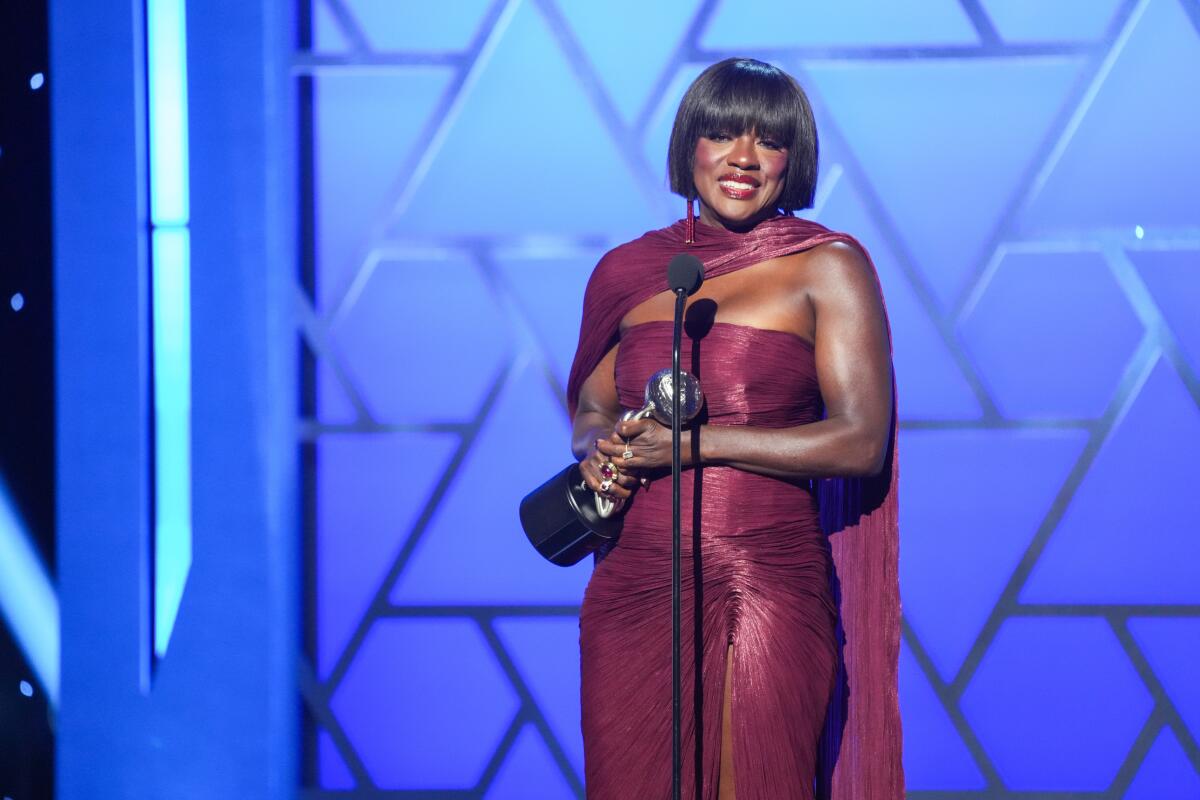
Viola Davis received the chairman’s award during the 57th NAACP Image Awards on Saturday.
(Chris Pizzello / Chris Pizzello/invision/ap)
Host Deon Cole kicked off the ceremony by welcoming the audience to “the Trump Image Awards. Because you know he wants his name on everything.”
Asking permission to “buy a curse word,” he made a joke that was bleeped out during the live stream, but was apparently aimed at federal ICE agents. The comment sparked a standing ovation from the predominantly black-tie audience, many of whom wore anti-ICE pins.
“I don’t want to see no ICE ever again,” he said. “When I looked at the guest list, I took off Ice Cube, Ice-T, Ice Spice. I don’t want no ice cream, I don’t want no ice in my drink.”
Utilizing one of Jackson’s trademark slogans, Jackson said, “We will not be erased from this country’s history because I am somebody.”
And in accepting the award for actor in a drama series for “Paradise,” Sterling K. Brown added, “Like Sam said, they can’t erase us because there is no country without us.”
The event also continued to put a spotlight on the uproar surrounding the shouting of a racial slur during the BAFTA Awards last week.
Jordan and Lindo were presenters during the BAFTA Awards, which took place at London’s Royal Festival Hall. As they were introducing the visual effects category, a member of the audience shouted the N-word. The two actors paused momentarily before continuing.
Director Ryan Coogler, left, and actor Delroy Lindo presenting the award for actress in a motion picture. The pair addressed the incident at the BAFTAs in their remarks.
(Chris Pizzello / invision/AP)
Later, awards host Alan Cumming addressed the outburst, referencing the nominated film “I Swear,” which is about Scottish campaigner John Davidson, who has Tourette syndrome and shouted the racist slur from the audience. Cumming apologized, while Davidson, an executive producer for the BAFTA-nominated film, left his seat midway through the ceremony. BAFTA later issued an apology to the actors.
Cole delivered a comic prayer referencing the incident: “Lord, if there are any white men out there with Tourette’s, I advise you to tell them to read the room tonight, Lord. It might not go the way they think.”
Actor Rebecca Hall early in the awards show said she wanted to pay tribute to “two kings. Thank you for your grace.”
Lindo later in the ceremony said, “We appreciate all the support we’ve been shown in the aftermath of what happened last weekend. It is an honor to be here among our people this evening … It’s a classic case of something that could have been very negative becoming very positive.”