sinks

Five people rescued after Indonesia boat sinks, at least 20 still missing | News

The survivors were found clinging to a fish trap and floating debris at sea three days after the boat sank.

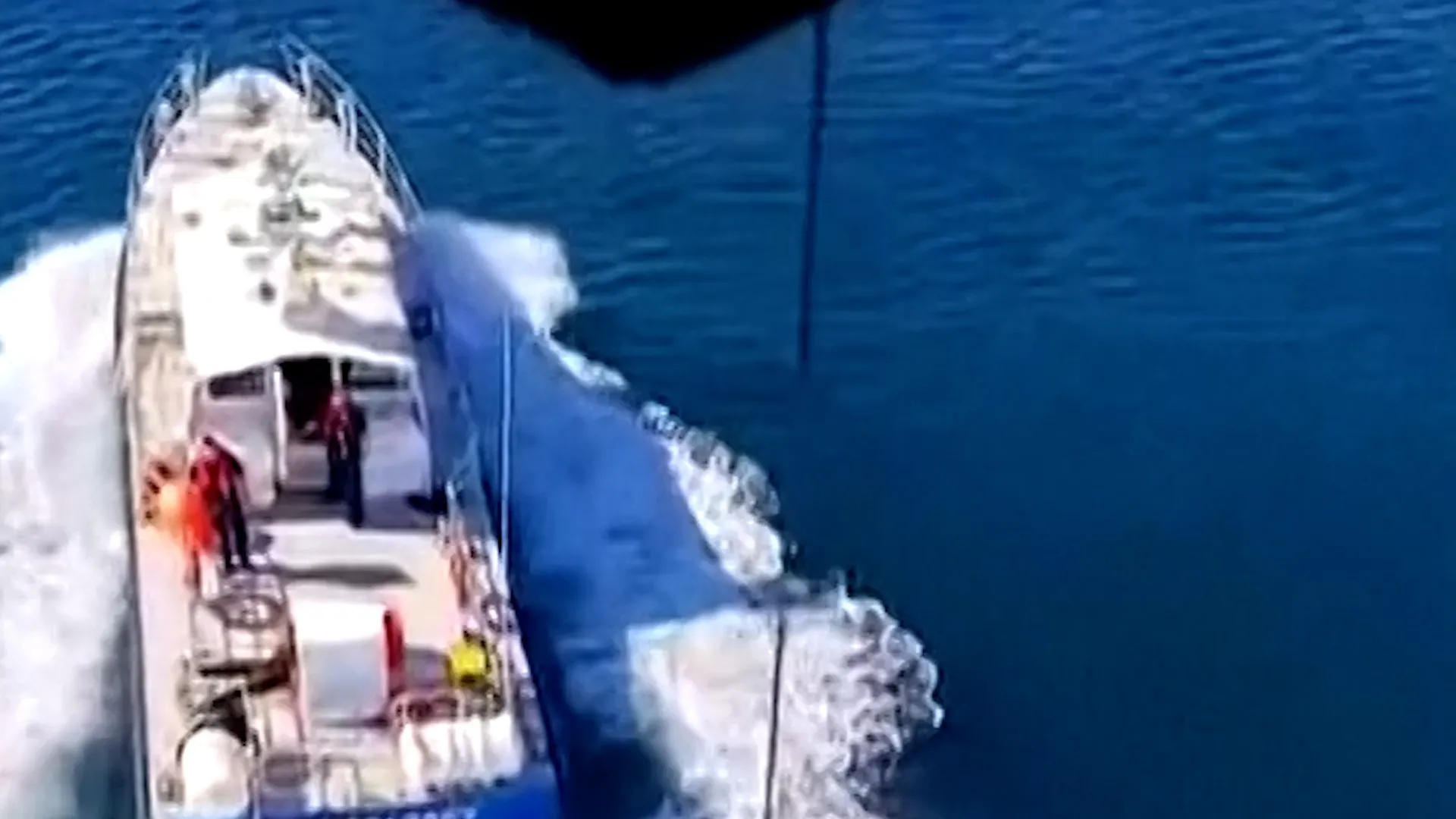
Five people have been rescued, including a seven-year-old girl, who were stranded at sea off the Indonesian coast for three days after their boat sank south of Sulawesi. A search is ongoing for at least 20 others.

The five survivors – one man, three women and the girl – were located by a fishing boat before dark on Saturday near Matallang Island off the coast of Sulawesi and taken to a search-and-rescue vessel.

Recommended Stories

list of 3 itemsend of list

They had stayed afloat by clinging to a fish trap and buoyant debris after the KM Nurul Salsa suffered engine failure and sank on Wednesday with 78 passengers and crew members on board.

“After the ship sank, each of them saved themselves using whatever equipment or makeshift flotation they could find,” local search-and-rescue official Muhammad Arif Anwar said.

“They rigged together jerry cans and pieces of cork tied up with rope, then climbed on top of them.”

They told rescuers they had been part of a group of 25 people, but during their ordeal they were separated from the others by strong winds.

Local media reported 47 people had been rescued the day after the boat sank, and one person is known to have drowned.

Five large ships, a reconnaissance aircraft and a helicopter are being used in ongoing search efforts for those still missing.

The KM Nurul Salsa was en route from Jampea Island to the port of Benteng on Selayar Island in South Sulawesi province. It sank about 43 nautical miles (79km) from the port.

Passenger boats are a common form of transport in Indonesia, an archipelago with more than 17,000 islands. Lax safety standards and problems with overcrowding frequently result in accidents.

Earlier this month, at least six people died and dozens went missing after a ferry carrying 65 people sank off Indonesia’s resort island of Bali.

Source link

Japanese yen sinks to 40-year low against the US dollar as intervention looms

Published on

The Japanese yen fell to around 162.4 per dollar in Asian trading on Tuesday morning, its lowest level since 1986.


ADVERTISEMENT


ADVERTISEMENT

The drop extends a punishing run for the yen, which has kept weakening despite the Bank of Japan’s efforts to support it, and now revives the prospect that the authorities will step into the market directly.

Japan’s finance minister, Satsuki Katayama, has already responded to the situation by stating that the government was ready to take “appropriate” and even “decisive” action against excessive currency moves, adding that she had confirmed with Washington that such a step remained an option.

Traders are now watching closely for any sign that Tokyo is selling US dollars to prop up the yen, as it did in the spring.

At the heart of the weakness is the current wide gap between Japanese and American interest rates.

Even after the Bank of Japan raised its benchmark to 1% in mid-June, its highest since 1995, Japanese yields remain far below those in the US, where ten-year government bonds have recently paid around 4.5%, compared with roughly 2.6% in Japan.

That gap sustains the so-called carry trade, in which investors borrow cheaply in yen to buy higher-yielding assets elsewhere, continually pushing the currency down.

A robust dollar has compounded the pressure.

The greenback has drawn safe-haven demand from tensions around the conflict involving Iran, while expectations that the US Federal Reserve could raise rates later this year, even as the Bank of Japan moves cautiously, have widened the divide further.

Japan’s heavy reliance on imported energy, which is costlier amid elevated oil prices, has also added to demand for US dollars.

A test for Tokyo

The renewed slide is a headache for policymakers who have already thrown considerable firepower at the problem.

Between April and May, Japan spent a record ¥11.7 trillion (€63.3bn) intervening in currency markets, the largest such effort on record, yet the Japanese yen has continued to weaken.

Domestic politics has not helped, with the big-spending, growth-focused agenda of Prime Minister Sanae Takaichi raising doubts about Japan’s fiscal discipline.

Analysts say the immediate risk of intervention is high, given that speculative bets against the Japanese yen have climbed to multi-year peaks and a fresh four-decade low tends to sharpen political anxiety in Tokyo.

However, many doubt that buying the currency would reverse its course for long, since the underlying rate gap remains firmly against it.

The Bank of Japan’s next policy decision, due on 31 July, is now in sharp focus, with further rate rises seen as the more durable route to stemming the decline.

For now, the Japanese yen remains at the mercy of forces its central bank has struggled to control.

Source link

Oil sinks further as Trump and Pezeshkian sign deal to end Iran war

Oil fell sharply in early trading after US President Donald Trump and his Iranian counterpart, Masoud Pezeshkian, put their names to an initial accord to halt hostilities, a move expected to restore the flow of crude through the Strait of Hormuz, one of the world’s most important shipping arteries.


ADVERTISEMENT


ADVERTISEMENT

At the time of writing on Thursday morning, the front-month contract on WTI, the US benchmark, was down by 2.3% to $75 a barrel, while Brent crude, the international gauge, traded 2% lower at around $78 a barrel.

Both remain above the roughly $70 level seen before the conflict, but they have fallen well below the peaks of more than $100 reached only weeks ago.

The deal sets a 60-day window for the two sides to negotiate a final settlement on Iran’s nuclear programme, with Tehran agreeing in the interim to dilute its stockpile of highly enriched uranium.

Crucially for energy markets, it lifts US-backed sanctions, allowing Iran to resume selling its oil freely, and clears the way for tankers to move crude out of the Persian Gulf once more.

US President Donald Trump has said the strait will be fully open by Friday and operate without transit charges, a pledge that has encouraged traders to bet on easing supply pressures.

After signing the memorandum of understanding, Trump stated, “oil down, stocks up”, with hand motions.

An oil market still running on depleted reserves

The optimism arrives against a strained backdrop.

In its June Oil Market Report, the International Energy Agency said strategic oil reserves across advanced economies had slipped to their lowest level since 1990, with government stockpiles in OECD countries down by 163 million barrels since the conflict began as emergency releases accelerated.

The agency also trimmed its outlook for global demand, which it now expects to contract through 2026 as elevated fuel prices and supply disruptions bite, before recovering next year.

It cautioned that any rebound in supply may be gradual, citing the slow clearance of mines and continued disruption to shipping routes even with the interim deal in place.

Flows through the Strait of Hormuz had already begun to recover, rising from a May low to around 12 million barrels a day in early June.

Stocks mixed after the Fed signals possible hikes

Equities offered a patchier picture following Wednesday’s losses on Wall Street, where the S&P 500 fell 1.2% after fresh Fed projections showed nearly half of policymakers expect at least one interest rate hike this year.

The Dow Jones Industrial Average shed 1%, and the Nasdaq Composite slid 1.3%.

In his first press conference as Fed chair, Kevin Warsh declined to forecast where rates would end the year and signalled a rethink of how the central bank communicates, dropping the customary hints about future policy direction from its statement.

US President Donald Trump, who had long pressed Warsh’s predecessor to cut rates, was unusually relaxed about the outcome.

“It’s all right. Whatever,” Trump told reporters in France as he attended the G7 meeting.

Asked about the prospect of a hike, he said it was “hard to believe” but that, with Warsh now in place, he was “guided by what he wants.”

US stock futures pointed higher early on Thursday, with contracts on the S&P 500 up 0.9% and on the Nasdaq Composite around 1.4% higher.

In Asia, Tokyo’s Nikkei 225 and South Korea’s Kospi both jumped 2.3%, helped by hopes for an end to the Iran war and strong demand for technology shares.

European trading was more subdued, with the Euro Stoxx 50 rising 1% but the broader pan-European Stoxx 600 trading flat.

The UK’s FTSE 100, Germany’s DAX 30, Italy’s FTSE MIB, Spain’s IBEX 35, the Netherlands’ AEX, and Switzerland’s CH20 all traded between 0.4% and 0.8% higher than their Wednesday close.

France’s CAC 40 led the pack and jumped roughly 1.3%.

Additional sources • AP

Source link

Poor shooting sinks Sparks in loss to Aces

Coming off a dreadful loss in Connecticut to the worst team in the WNBA, the Sparks needed a strong response.

In their first home game after the road trip, that did not happen until far too late.

The Sparks were always just out of reach in their 79-69 loss to the Las Vegas Aces on Tuesday night, despite Rae Burrell’s career-high 22 points and a late comeback bid. It was the fewest they have scored in a game since Aug. 9 of last season when they scored 59 points.

Last time the Sparks faced the Aces on May 23, they went into Las Vegas and scored 29 points in the fourth quarter for a tremendous road win, powered by Kelsey Plum.

But Plum, who leads the WNBA with 26.8 points per game, is still out with a right ankle sprain, and the Sparks (4-5) offense suffered for it. Other than Burrell’s scoring, the rest of the Sparks offense combined to shoot 12-for-51.

They also entered the night with the league’s worst defense. It’s always going to be difficult to stop A’ja Wilson (25 points), but the Sparks had few answers for Jackie Young (16 points, nine assists) who spaced out the Aces (6-3) offense.

It still was far from their worst defensive showing of the season, and mostly they couldn’t claw their way back with a paltry 30.8% from the field. In fact, the Aces scored just 15 points in the fourth, giving the Sparks a window to come back, but they shot 29.4% in the frame.

The Sparks fell into a 15-point hole in the second after going nearly three minutes without scoring. Burrell scored seven of her points in that frame, though, to ignite a 20-point quarter and the Sparks trailed 37-30 at the half.

But the Aces quickly earned a 13-point lead early in the third and stayed up double digits until near the end of the fourth when Burrell made it a seven-point game.

Plum missed her fourth consecutive game since injuring her right ankle in practice. She participated in shootaround Tuesday even after being ruled out, and head coach Lynne Roberts said she was day-to-day.

But the Aces were also shorthanded, without Dana Evans, Jewel Loyd and Chennedy Carter, who is second on the Aces in scoring despite coming off the bench. That forced the Aces to run some sets with Wilson at small forward and a much-larger front court in front of her before NaLyssa Smith ran into foul trouble.

The Sparks forwards struggled with that, with Dearica Hamby, Nneka Ogwumike and Cameron Brink combining to shoot six-for-27, including an 0-for-7 night from Hamby.

The Sparks next host Dallas (6-3) on Friday night.

Source link