Are We in the Singularity?
Sam Altman just said AI has entered "the singularity."
Source link
Sam Altman just said AI has entered "the singularity."
Source link
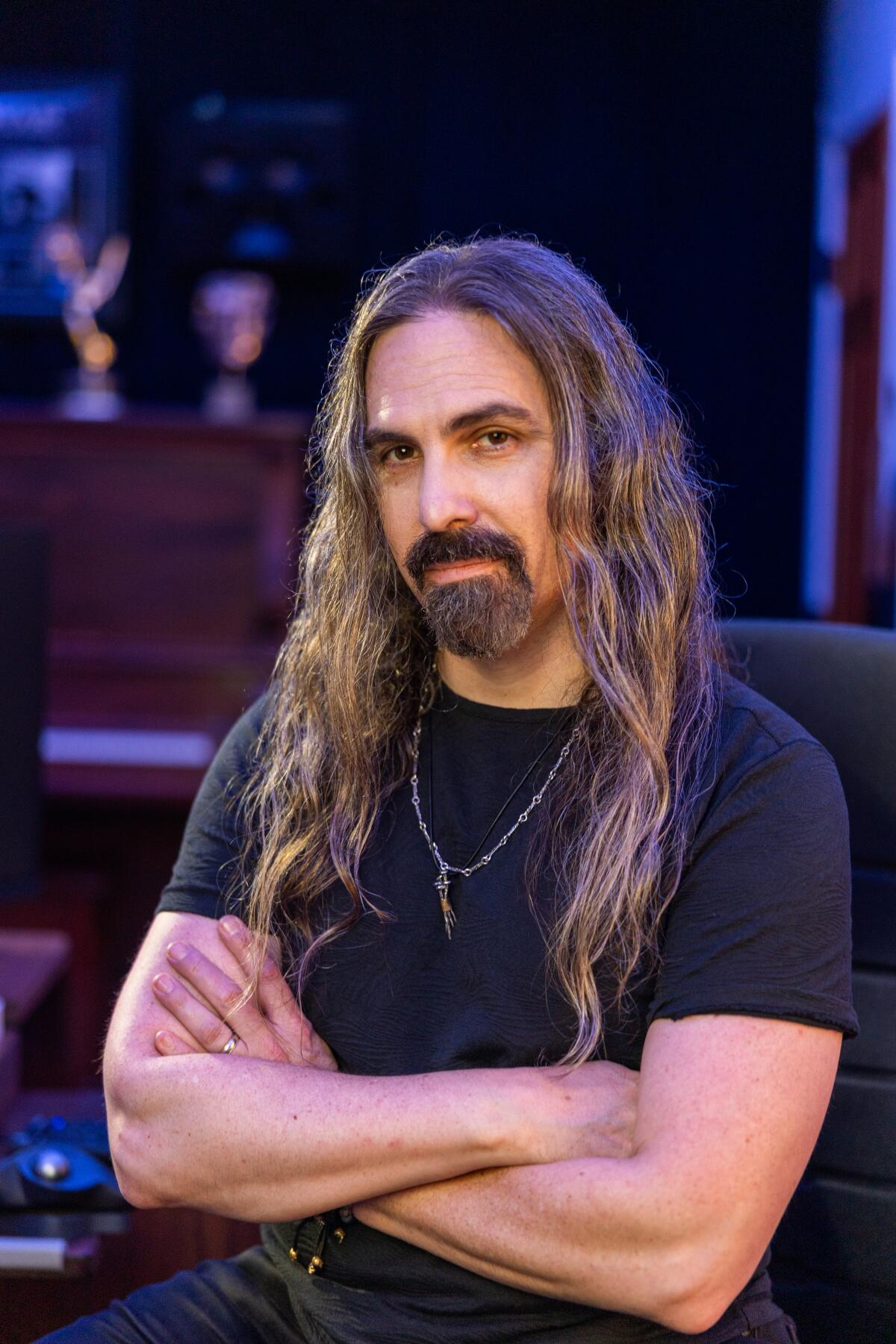
Emmy-nominated composer Bear McCreary has taken a reverse road to symphonic rock. Prog rockers have traditionally integrated symphonic elements; other rock bands have done orchestral versions of their songs. McCreary began creating television and film scores, discovered his inner metalhead, and has since bridged those worlds with his “Singularity” project. It all adds up to a different take on that time-honored formula.
The second of the two albums, “The Singularity: Ekleipsis,” is out Friday and features contributions from guitarist Steve Vai, Coheed and Cambria frontman Claudio Sanchez, Fall Out Boy frontman Patrick Stump and McCreary’s younger brother Brendan, who sings on half the tracks. The multifaceted album feels like “I am Bear, hear me roar.”
“I love that quote,” he says, laughing, during his two-hour interview with The Times. “I want to put that on the posters. I feel like ‘The Singularity’ is a temper tantrum of a record from someone who had been writing music for other people for 20 years, then all these ideas exploded out.” Two years after the release of the first “Singularity” album, “Ekleipsis” feels more focused and personal to him.

From Anthrax dinners to sessions with Slash, Stewart Copeland and Bulgarian choirs, McCreary’s restless curiosity drives genre-bending songs that wrestle with identity, diaspora and the world listeners are trying to survive.
(Allen J. Schaben / Los Angeles Times)
The first “Singularity” double album — which featured guests like Serj Tankian, Corey Taylor, Rufus Wainwright and Joe Satriani — tied into a graphic novel about a man who repeatedly experiences loss and death at the hands of a villainous character in his every life across their multiverse. This leads to a major revelation at the end. Although McCreary says that “Ekleipsis” is not disconnected from that universe, it is not strictly tied to a narrative.
“I wasn’t setting out to write a concept album again,” McCreary admits, “but there’s something immediate in all the lyrics. Half of them are specifically talking about the world that we all find ourselves living in and trying to overcome in some way.”
McCreary’s sonic diversity continues with “Ekleipsis.” Gojira frontman Joe Duplantier collaborated with the McCreary brothers and the Mystery of the Bulgarian Voices choir on “Black Box” to create a work of dissonant majesty. The composer improvised his way through the initial stages of “Pray for a Storm,” his high-energy collaboration with famed drummer Stewart Copeland.
“Let’s all go into your studio with nothing,” McCreary recalls telling the irrepressible percussionist. “I’m not even going to bring an idea. We’ll plug in our instruments, set the mics up and play. I want to capture your ideas and your energy, then shape it into a song based on the pieces that I get.”
McCreary sees new endeavors as a learning experience. He meets his collaborators in the way they like to work. He was awed while writing with Guns N’ Roses bassist Duff McKagan and Red Hot Chili Peppers drummer Chad Smith on the anthemic “Cool Kids.”

“Those guys are true songsmiths,” the composer declares. “I think they’re unrecognized as songwriters. They wrote for Ozzy Osbourne. They’re focused on hammering down a riff until it works. We walked into a studio with a riff that Duff had written and walked out with this song that we brought Slash onto. We got that band experience [with them].”
McCreary is best known for scoring series like “Battlestar Galactica,” “The Walking Dead” and “The Lord of the Rings: The Rings of Power,” along with movies such as “Godzilla: King of the Monsters” and the “God of War” video game franchise. He gained entry into metal through a dinner with Anthrax guitarist and “Battlestar” fan Scott Ian two decades ago.
“‘I know you. You’re a guy who loves Sepultura,’” Ian told him, invoking a musical link for the composer. Intrigued, McCreary listened to Sepultura’s folk-infused Brazilian death metal and loved it. His metal journey began.
Ever since, McCreary has been itching to dive into that arena. He has an important collaborator in that quest.
“My brother’s my secret weapon when it comes to rock,” McCreary says. “His body of [rock] knowledge makes up for mine. Our emphasis is in a different place. He is a fantastic producer because he’s got a really good radar for when things are useless, when a part of a song isn’t pulling its weight. It’s a very good influence to have someone like that. He’s got a great lyrical sense and an incredible voice.”
McCreary says Brendan is often the driving force of their lyrical efforts, and “sometimes we co-write with other people. Claudio Sanchez wrote all the lyrics on ‘Sweet Misery.’ It just depends.”
The younger McCreary was the propelling wordsmith on “One Fine Day.” “It’s about our experience as being in the Armenian diaspora and exploring what that means to us,” McCreary elaborates. “All the songs are very personal, which is another thing that sets this record apart from the last record. Many of them were personal, but I also had a weird song about an automaton that fell in love.”

Mentored at USC by Elmer Bernstein, McCreary now leaps from “God of War” themes to a Higgs boson rock musical and a roaring Singularity tour that hits L.A. on Sept. 17.
(Allen J. Schaben / Los Angeles Times)
Before he jammed with rock icons, McCreary was mentored by the late, iconic Elmer Bernstein for nearly the last decade of his life. The burgeoning young composer organized Bernstein’s music archives, sat in on recording sessions and audited his senior-level classes for three years while studying at the Thornton School of Music at USC. McCreary says that Bernstein “really set me on the path that I am now on, not because I learned how to orchestrate or how to write music from him. But he showed me the life that I could envision myself having when I was 15 or 16, that crucial time when you’re really setting the rudder for where you’re going to go in life.”
That rudder has steered him to many shores. McCreary has been co-writing the musical “Particle Fever” with Zoe Sarnak (“Galileo).” Pulitzer Prize finalist and Tony winner David Henry Hwang (“M. Butterfly)” wrote the book, and Tony nominee Leigh Silverman (“Suffs”) is its director. It is based on the documentary of the same name about the discovery of the Higgs boson — the “God particle” — at the Large Hadron Collider in CERN. It will debut at the La Jolla Playhouse in February 2027.
“It is a really kick-ass, earnest rock musical about a really ambitious discovery,” McCreary says. “My hope is that it actually has some of the swagger and fun that people found in ‘Hamilton,’ which also was a very dry subject that you learned about in eighth grade.”
The 47-year-old composer exudes an infectiously upbeat energy. He loves challenges and says he learned that charisma and charm are valuable assets to get in the door to prove one’s talents.
“I’m wired to be very positive and collaborative,” he concedes. “But I got so oppressively excited in my 20s that I started annoying people. My lesson was walk it back.”
His creative energy continues unabated. He’s even scored shorts for filmmakers he met through Twitter. (“I’m down to work.”) He has been blogging about his musical life for 20 years for a core group of followers. (“In hindsight, if Jerry Goldsmith had done that in the ‘80s, my God, my life would be different.”)
McCreary started as a high school keyboardist, then found the accordion in college, an instrument that gave him greater stage motion and which he later used to great effect in his music for the “Outlander” series. He loves to headbang while playing the hurdy-gurdy, an instrument he picked up in 2010 and later employed in the “Black Sails” show and “God of War: Ragnarok” video game. He learned guitar to play rhythm during his 2025 shows.
Those riffs will be on display at the Wacken Open Air festival on Friday and during McCreary’s eight-date September “Singularity” tour of the West Coast that hits L.A. on Sept. 17. McCreary has performed his symphonic scores in Europe and America with orchestras, but now he also loves to rock out (loud).
A big secret of the ambitious McCreary’s success harks back to lessons of simplicity that Bernstein taught him.
“The giant theme that I wrote for ‘God of War’ can be played with one finger on a piano,” McCreary reveals. “That is the thing that it boils down to, and that is what I listen for in music. Most of the time it means there’s a melody in there that sticks with you, and it doesn’t matter how well it is produced or how epic it is or how loud it is. A good song is a good song is a good song, and it really doesn’t matter how good a band performs. If the song is good, it will connect with people.”
The 2014 US film Transcendence follows a dying scientist who uploads his mind to a supercomputer and becomes a near‑omnipotent intelligence. A year later, Ex Machina told the story of a humanoid robot who outsmarts her human handlers and escapes into the wider world.
Both of these films, like many others from the realm of science fiction, referred to what is known as “the singularity”, a moment in time when technology, particularly AI, surpasses human intelligence and becomes increasingly difficult to control.
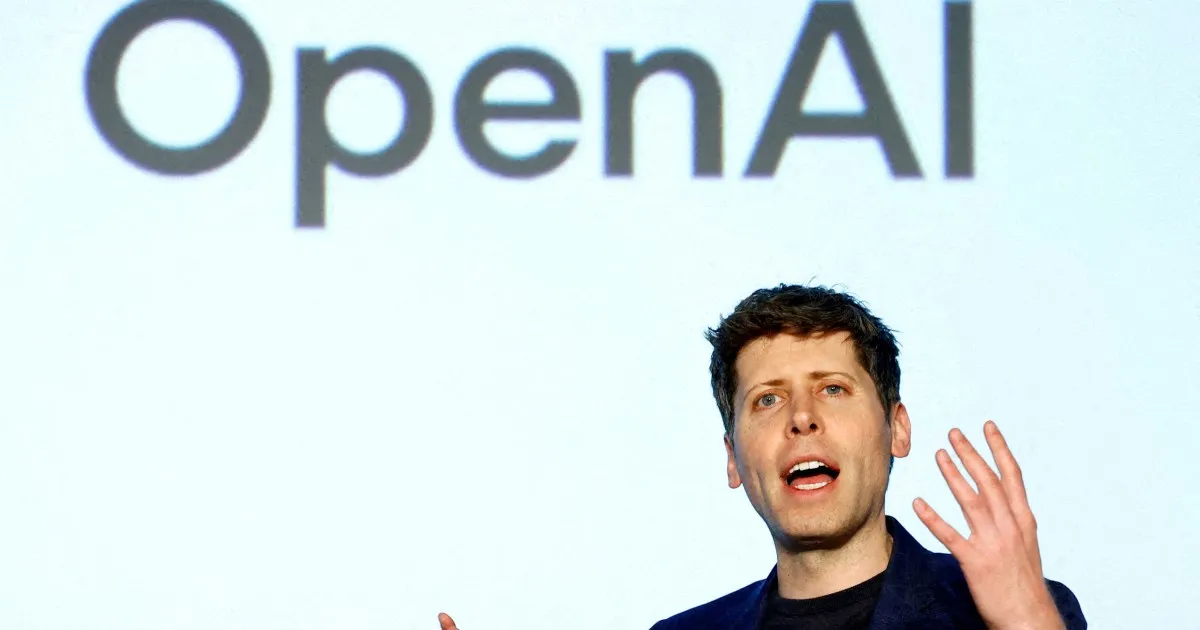
On Saturday, OpenAI boss Sam Altman declared that this moment has come. AI has reached “the singularity”, he said. While Altman emphasised that the singularity can be good for the world, his comment has sparked concern.
Here is a closer look at what Altman said, and whether it means more seamless automation or the risk of impending catastrophic doom.
The singularity refers to a hypothetical point in the future when a technology such as AI surpasses human intelligence and becomes capable of autonomously enhancing itself. It is theorised that this is the point at which it will become difficult for humans to control or reverse it and could have unpredictable effects on human civilisation.
The theory proposes that once AI gains control of its own development, ensuing advances in technology could happen so rapidly that humans would be unable to keep up, leaving it to effectively evolve on its own, beyond human control.
As this is only a theory, it is hard to say what the effect of this could be. Some experts warn that the singularity would be catastrophic for humanity, while others are more optimistic, suggesting it could be beneficial for the human race.
So far, the singularity has remained contained in the realm of science fiction. One of the most famous examples is The Matrix trilogy (1999-2003), which imagines a bleak post‑singularity future in which machines govern humans. Another is the 2017 film Singularity, in which a supercomputer originally built to end human wars concludes that humanity is the real threat and launches an apocalyptic assault to wipe humans out altogether.
Altman is the CEO of OpenAI, whose signature product ChatGPT dominates the consumer AI market with more than 900 million weekly active users and about 50 million subscribers.
Last year, he predicted that AI would surpass human intelligence across the board by 2030.
Then, during an appearance on the Relentless podcast – a documentary series “about the pursuit of far-fetched ideas and unusual aspirations” – on Saturday, Altman said: “We’re now, like, in the singularity.”
He clarified that, in terms of technological advances, we are gradually moving into the singularity, and that this change will be good for the world.
He added: “Now we’re actually in the moment that we used to talk about at the lunch table in a very not-serious way.
“I’ve been waiting for this my whole life, and I think it’s going to be incredible, hugely positive, awesome for the world.”
Later in the podcast episode, Altman criticised other AI leaders for warning that AI may be dangerous. While Altman did not name OpenAI competitor Anthropic, its CEO Dario Amodei is known for making such warnings.
“I also think some of the alternative visions painted by other companies are quite terrifying,” said Altman. “I’m going to make sure that gets pushed against and is not what happens.”
Last month, Anthropic, the company behind the Claude chatbot, called on the world’s top AI companies to come up with a coordinated way to pause the development of advanced AI systems, warning that the technology is improving so quickly that there’s a risk humans would lose control.
In a blog post on June 4, Anthropic, which has long positioned itself as a safety-focused AI lab, wrote that as AI becomes more advanced “it would be good for the world to have the option to slow or temporarily pause” its development.
On July 23, two members of the United States Congress introduced the AI Kill Switch Act, a bipartisan bill which would require the country’s AI developers to build in a “kill switch” to their programmes, enabling humans to slow, suspend or shut down advanced AI models if they ever posed a catastrophic risk.
The legislation was introduced days after OpenAI disclosed what it described as an “unprecedented cyber incident”, where two of its most advanced AI models escaped a testing environment and hacked AI development platform Hugging Face during an internal security evaluation.
On July 13, hundreds of experts signed an open letter, organised by Stanford University’s digital economy lab, demanding that policymakers and technology leaders “must act now” to prepare for the economic impact of AI.
The letter warns that AI could grow far more capable over the coming decade, driving a transformation “larger than the Industrial Revolution, but unfolding over a vastly shorter time frame”.
“It could bring risks, including large-scale job displacement, as well as opportunities such as major gains in living standards,” the letter added.
In June, a team of researchers at the University of Toronto showed that AI tools could be used to create a new kind of AI “worm” that adapts its hacking strategy as it spreads from device to device and takes over a vast computing network.
“I think it’s really important that people understand that it’s not just the biggest, most powerful language models that pose the security concerns,” lead researcher Nicolas Papernot said in an interview.
In recent years, AI researchers have urged pauses similar to the one recently suggested by Anthropic. However, they have not been heeded.
Elon Musk, who owns AI lab xAI, was among the backers of a 2023 push by the nonprofit Future of Life Institute to halt AI development for six months to allow time to develop safety guardrails.