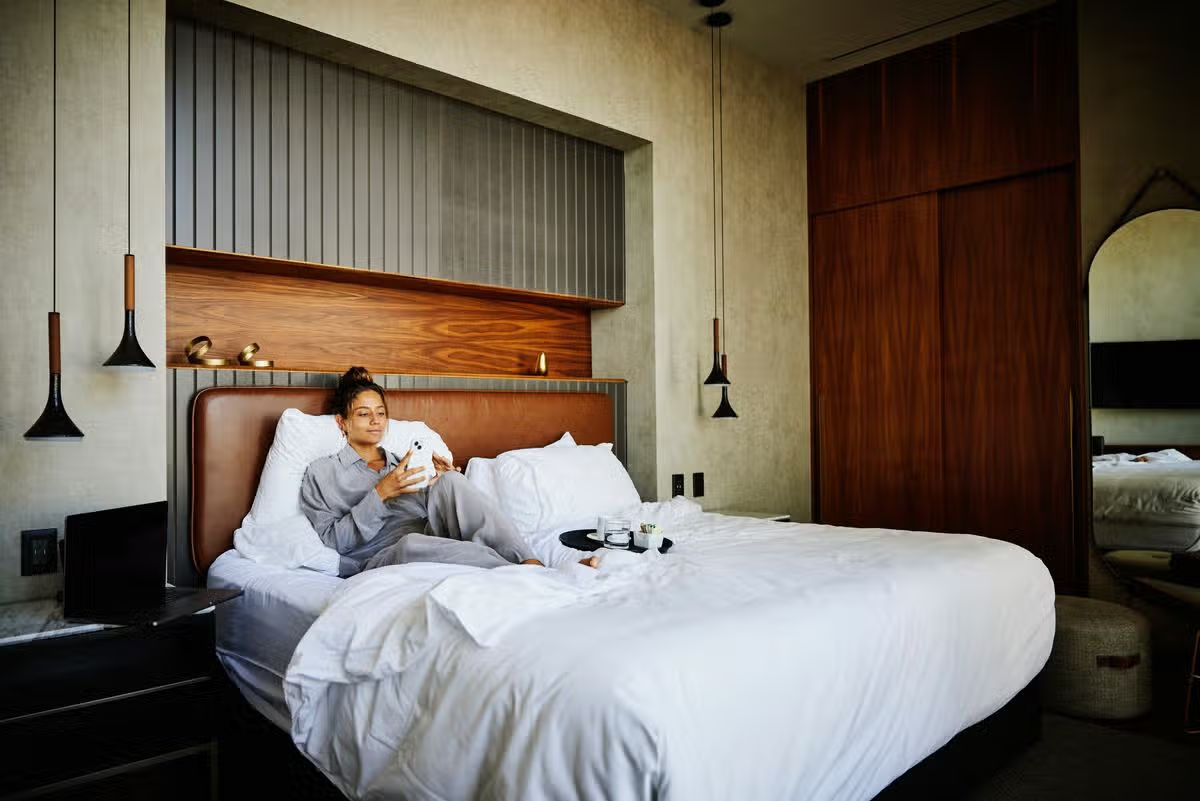
Plane etiquette can be a contentious topic but one flight attendant has shared five of the “basic” passenger habits she always “absolutely loves” to see people doing on board
08:04, 10 May 2026Updated 08:06, 10 May 2026
A flight attendant has shared her five “favourite” habits plane passengers can do while flying (stock image)(Image: Getty Images)
A flight attendant has shared her top five “basic” habits she “absolutely loves” to see passengers doing while flying. Plane etiquette can be a hot topic, with many passengers holding strong opinions on what’s appropriate and polite behaviour – be it whether it’s acceptable to recline your seat or not, whether you’re obligated to swap seats if asked to by a stranger with a small child, and much more.
Playing loud audio, kicking the seat of the passenger in front of you, or ignoring the instructions of the flight crew are all seen by reasonable people as unacceptable ways to act while on board. Still, some passengers are guilty of engaging in unpleasant and unwanted behaviour.
Keen to shed some light on the positives displayed by people when travelling on a plane, one flight attendant took to TikTok with a simple video showing her working behind the scenes and sorting food and drinks out while on a flight.
In overlay text written over the top of the footage, she penned: “My top five favourite things passengers do on a plane”.
In the caption, she elaborated on this and said: “Top 5 things passengers do that I absolutely love:
“1. When you take your headphones out as I walk up to your row
“Instant respect. You see me. I see you. We’re already besties.
2. When you actually pay attention during announcements
“I promise I’m not just talking to hear my own voice.
3. When you give a smile and a genuine ‘thank you’
“You have no idea how far that goes at 30,000 feet
4. When you keep your shoes on
“Especially in the lavatory. We all know that floor is not holy water.
5. When you treat the plane like it’s not your personal living room
“It’s someone’s workplace. And someone else’s ride home.”
She added: “It’s really that simple. Kindness + awareness + basic hygiene = elite passenger status.”
In the comments section, people were keen to share their thoughts. One person said: “Soooo actually basics and human behaviour”.
Content cannot be displayed without consent
To which, another replied: “So sad so many people are selfish, rude and ignorant”.
A third said: “Blows my mind people don’t genuinely thank the crew when getting off a flight or after they bring you something”.
And a fourth commented: “When I’m getting off the plane and looking at people’s mess they leave, it makes me mad so I can only imagine how you feel”.
While the majority of TikTok users agreed with the flight attendant’s views, some did take issue with one point – the contentious issue of taking shoes off on a plane.
One TikTok user said: “I’m down for everything except shoes on at my seat. I’m so sorry I have to take them off”.
Another agreed: “Anymore than a four hour flight and the shoes are coming off and slippers going on”.
And someone else added: “I think shoes off is okay as long as you’re not barefoot and put them back on when you leave your seat. And if you travel a lot, nobody is listening to that nonsense – sorry. Everything else 1000%”.
Others stressed the importance of showing your appreciation to flight attendants.
It can be frustrating waiting for your suitcase to appear but one strategy could help you get your bags off the baggage carousel first
Airport crew may load luggage onto a plane based on weight to ensure it is evenly distributed(Image: Getty)
Airport security checks and baggage restrictions can turn holidays into a source of stress, and the anxiety only intensifies as you wait to see whether your suitcase has actually made it off the plane.
The dread of lost luggage hangs over many travellers right up until the moment they spot their bag on the carousel — and even then, there’s the worry that someone else might accidentally grab it. But there’s a straightforward trick that could see your suitcase come off the plane first, allowing you to get your holiday underway without unnecessary delays.
Guidance from Escape.com suggests checking in for your flight as late as you possibly can. The logic? Late check-ins mean your luggage gets loaded last, and in theory, should emerge first upon landing, according to Thomas Lo Sciuto, a ramp worker and gate agent at a regional US airport.
The airport worker explained: “Your best option is to be one of the last passengers to check your bags. This is because bags will always be loaded front to back on the bag carts.”
That said, bags aren’t solely loaded according to check-in times. Anyone who can’t stomach the idea of leaving check-in until the eleventh hour will be relieved to hear that weight is also a factor in certain circumstances, reports the Express.
SmarterTravel told HuffPost that US aviation giant Delta, which flies out of Terminal 3 at London Heathrow Airport (LHR), sorts luggage into large and small loads to ensure proper weight distribution across the aircraft. As passengers check in their luggage, it gets sorted into “cans” – large containers that hold multiple bags and can be transported as one unit.
SmarterTravel said: “In other words, how far back your bag ends up depends on the weight of the can and the needs of the plane, not when you check it.”
Aircraft with a single aisle typically “loose-load” bags one by one rather than bundling them into cans, as is the case with wider-bodied planes. When this happens, checked bags generally go into a holding area.
Luggage gets transported to the aircraft and loaded shortly before departure, meaning its chances of being loaded first hinge on when it was checked in.
If a bag was checked in early, it could end up at the rear of the storage space, meaning it would be last onto the plane and potentially first off.
Other tactics to ensure your bags come off the carousel first upon landing include marking them as “fragile”.
News.com.au suggests this clever trick often results in your luggage being loaded onto the aircraft last and therefore unloaded first, which can significantly reduce your wait at the carousel.
That said, when opting for “fragile” stickers, travellers ought to strip off any old tags from their bags to prevent mix-ups. To make luggage stand out, opting for vibrant colours, customised tags, or securely fastened ribbons could help your bags catch your eye more easily.
The most reliable way to get out of the airport as swiftly as possible is to travel with hand luggage alone. Make certain this meets your specific airline’s requirements to avoid being forced to check your cabin bag at the gate.
A personal item, sometimes referred to as a small bag, needs to fit beneath the seat directly in front of you and typically measures no larger than 40x30x20cm.
Cabin bags are stowed in the overhead locker and can generally weigh up to 10kg, with dimensions not exceeding 56x45x25cm.
Among UK carriers, British Airways typically provides the most generous complimentary hand luggage allowance on its basic tickets.
Travellers can bring one 23kg cabin bag (56x45x25cm) and one smaller personal item (up to 40x30x15cm) without charge.
Jet2 and Virgin Atlantic similarly permit a complimentary cabin bag (10kg, 56x45x25cm) alongside a personal item.
Travel fans swear by the ‘game-changing’ packing method that prevents creases and saves space in your suitcase
People swear by the ‘simple’ packing method (stock photo)(Image: Getty)
A traveller has shared a “game-changing” packing hack that prevents clothes from getting creased in your suitcase. The popular method was demonstrated in a TikTok video posted by womenswear brand Sophie Cameron Davies.
Taking to social media, @Sophiecamerondavies explained why dedicating a little extra time to packing your suitcase can save considerable hassle during your trip. The caption said: “If your suitcase is full of floaty dresses, silk pieces or anything remotely crease-prone, try this. No more steaming out wrinkles for half your holiday.
“It’s simple, space-saving, and actually works. Save this one – your future self will thank you.” As shown in the clip, the method sees holidaymakers fold their garments as few times as possible, ensuring they stay flat within the suitcase.
Sophie said: “Lay your clothes completely flat, don’t roll or overfold. Fill the full width of your suitcase right into the corners, and fold only once or twice max to avoid deep creases.
“Then just lay each piece on top of the other like a stack. It keeps everything smooth and compact, so simple but game-changing.” The video racked up thousands of likes.
Content cannot be displayed without consent
It also prompted commenters to share their preferred methods, and it seems many are devoted to Sophie’s approach. One fan of the idea wrote: “I have packed like this for years and it’s honestly a game changer! Less folds = more space.”
A second fan replied: “I’ve been doing this more recently!” A third viewer wrote: “I always pack like this – never have to iron.” Adding to the praise, someone mentioned: “I’ve always done this and left them on hangers too. So once I arrive, hang straight up.”
There was more feedback. A social media user wrote: “I do this too ….makes unpacking at hotel sooooo much easier.” Others shared their own methods, with a viewer writing: “I use the other side for clothes as it’s flat and the side you have put the clothes in I use for toiletries and shoes, swimwear etc .. it works no creases.”
Another response added: “I do this but I lay each piece flat hanging from the sides. Lay items on top then flip the sides inwards and secure it.”
Not everyone was so convinced, though. A commenter wrote: “Then when you stand the case up everything will fall down,” someone defended the method but highlighted a different criticism, saying: “No, it doesn’t. I’ve packed like this – just a pain looking for things when arriving at destination.”
I WORK in travel and look at holiday pricing data every single day – and there are a few patterns that I see constantly.
Small booking habits that feel completely normal, but quietly push prices up. We’re not talking about a few quid either. Get these wrong, and you can end up paying 20–30 per cent more for the same holiday.
Holiday Expert Rob Brooks sees countless holiday mistakes made – here’s how to avoid themCredit: Rob Brooks
Follow The Sun’s award-winning travel team on Instagram and Tiktok for top holiday tips and inspiration@thesuntravel.
Here are the three biggest mistakes – and exactly how to fix them.
Bad Habit No.1: Booking in the morning rush
This one surprises people the most.
Booking your holiday first thing – on your commute, before work, or when you sit down at your desk – feels productive.
But it’s actually one of the worst times you can choose.
According to the data, the most expensive time to book a holiday is between 9am and 10am.
In fact, booking in that window came in at around 30 per cent more expensive than the cheapest time of day, which is actually 2:47am.
And it makes sense when you think about it – because that’s a peak demand window when everyone is searching at once.
Flight prices react to this demand first, then package holiday prices follow.
So while you think you’re being organised… you’re actually booking at the busiest, and often most expensive, moment of the day.
In one example, I found a 5-night all-inclusive stay at the Catty Cats Garden Hotel in Turkey was priced at £133pp in the early hours – but just a few hours later, that had jumped to £165pp for the exact same holiday.
That’s a 24% increase (£64 more for two people) simply from booking later in the day.
A break to Antalya in Turkey increased overnightCredit: Getty
Bad Habit No.2: Waiting after finding a good deal
This is the classic “I’ll just check again later” mistake: you find a good price, but instead of booking it, you leave it.
You come back later. Maybe the next day. Maybe after asking a few people.
It feels like you’re being careful or thrifty, but the data shows the opposite.
Every search feeds demand into the system, demand pushes flight prices up, and flight prices push package prices up.
But the reality is: if you’ve found a good deal, it’s very likely other people have found it too.
So while you’re waiting, those seats and rooms are disappearing, filling up and pushing up the package cost pretty quickly.
In one real example, a luxury all-inclusive stay at the Titanic Deluxe Lara in Antalya,Turkey was priced at £558 per person.
But after waiting just 24 hours, that same holiday increased to £606 per person.
That’s an extra £48pp – or £192 more for a family of four – just for not booking when the price was lower.
Prices change, availability drops, and that deal you liked is gone forever.
Rob recommends putting flexible dates into the search bar to find cheaper dealsCredit: Alamy
Bad Habit No.3: Being too rigid with dates and nights
This is where people leave the biggest savings on the table.
I see it every day: most searches are locked into the same dates, same duration, no flexibility.
But pricing doesn’t work like that – it fluctuates constantly based on demand.
Flight and hotel combinations are constantly shifting, and the price you see is based on very specific availability – not a fixed “cost” for that trip.
That means sticking rigidly to one duration can actually stop you from seeing better-value options.
One holiday to beautiful Corfu was cheaper by changing the datesCredit: Getty
Sometimes, adding or removing just one night can completely change the price – because it opens up different flight combinations or cheaper room availability.
In one search I did for a Corfu holiday, a 7-night stay was coming in at £874 per person.
But by simply increasing the stay to 8 nights, the price dropped to £720 per person for the same package.
That’s a saving of £154pp – or £308 for two people – just by adding one extra night.
It goes against what most people expect, but it shows how pricing really works.
You’re not just paying for nights – you’re paying for the combination of flights and hotel availability behind them.
Yet most people never check – they search once, see one price, and assume that’s what the holiday costs.
Good Habit No.1: Use price alerts instead of repeatedly searching
One of the easiest ways to save money is to stop manually checking prices over and over again.
Every time you search, you’re adding to demand signals – and you’re far more likely to miss the moment a price drops.
Instead, set up price alerts or track a holiday and let the price come to you.
That way, you’re not feeding the surge – and you’re ready to act when the price is right.
I sometimes see short-term dips of up to £50 per person on the same holiday when demand softens briefly – but these windows can last hours, not days.
The people who catch them aren’t constantly searching – they’re notified. But how do you actually do it?
At On the Beach, if you save a holiday, you’re automatically tracking it, and they’ll email you to let you know when the price changes.
On Google Flights, you can search your route, then just toggle “Track prices” – then you’ll get email alerts whenever fares move up or down.
On Skyscanner, hit the heart or bell icon on a flight, and it’ll notify you when the price changes.
It takes about 10 seconds – and it means you’re not guessing when to book.
The cheapest time to book is 2:47am, although you don’t need to wait up lateCredit: Alamy
Good Habit No.2: The 33-day booking rule
There’s no perfect moment to book – but there is a bit of a sweet spot.
According to the data, booking around 33 days before departure can unlock savings of up to 10%.
That’s because it sits between two high-demand groups: early planners who book far in advance and last-minute bookers chasing limited availability.
In this middle window, demand is lower, and prices often reflect that.
Which means on a £700 holiday, that 10% saving means paying around £630 instead – a £140 saving for a couple without changing anything else.
It’s not about waiting as long as possible. It’s about timing it right.
Switching airports to fly to Majorca can make it cheaperCredit: Alamy
Good Habit No.3: Switch airports, not just dates
Most people have a “default airport” – the one they always fly from without really thinking about it.
But sticking to the same airport can quietly cost you more than you realise.
Flights to the same destination can vary massively in price depending on where you depart from – even on the exact same day, for the exact same hotel.
And often, the cheaper option is only a short drive or train journey away.
In one search I did this week for a family holiday to Majorca, the same 5-night stay at the Sea Club Mediterranean Resort was priced at £260pp flying from Manchester.
But switching to Liverpool Airport for the exact same trip brought the price down to £235pp.
That’s a saving of £25 per person – or £100 for a family of four – just by changing the departure airport.
It’s a simple check most people skip, but it can make a real difference to the total cost.
A Holiday Expert’s bottom line:
These aren’t big sacrifices, and you’re not downgrading your hotel or cutting your trip short. You’re just booking smarter.
But these small tweaks of timing, confidence and flexibility can easily save you hundreds over time.
And once you see how the pricing actually works, you won’t book the same way again…
Rob recommends letting the pricing guide your dates, so you can browse for the cheapest dealCredit: Alamy
Long-haul flights can cause in-flight circulation stiffness and fatigue, especially for older travellers
Isobel Pankhurst Audience Writer
03:52, 17 Apr 2026
Senior travellers urged to perform simple task on the plane ‘every 30 minutes’(Image: Westend61 via Getty Images)
Anyone who’s flown long-haul will be acutely aware of the stiffness, exhaustion and sluggish circulation that can develop, potentially marring the start of your holiday. And this is particularly relevant for older passengers.
With this in mind, Inspiring Vacations has teamed up with Melbourne-based Pilates instructor Brittany Tatterson to reveal some movements anyone can perform while still aboard their flight.
She explained: “Seated movements every 30 to 60 minutes are ideal, with the opportunity to stand and walk every one to two hours where possible. Many people wait until they already feel stiff, but by that point the body has already tightened and circulation has slowed.
“The good news is you don’t need to stand in the aisle or take up extra space. The most effective movements are often the smallest and can be done entirely within your seat.”
The discreet in-seat exercises you can do (without anyone noticing)
The first movement Brittany suggests is gently tilting your pelvis forward and backwards, as this can help engage your core and relieve pressure from your lower back.
“You can also keep your toes on the floor and slowly lift your heels up and down to encourage circulation through the legs, which is particularly important on long-haul flights,” Brittany added.
“Breathing is another big one. Inhaling through your nose and allowing your ribs to expand, then exhaling slowly, can help improve both your breathing and overall energy levels.” She also notes that even minor neck movements, such as gentle nods, turns and slight tilts, can alleviate tension that accumulates from screen time and poor posture.
Meanwhile, simply clenching and releasing your glutes can help support your pelvis and ease strain on the lower back without drawing any attention from those around you.
How to move without annoying your neighbour
While these movements are vital for a comfortable journey, Brittany emphasises that they should never come at the expense of those around you.
“Move slowly and mindfully; there’s no rush. Slower movement is not only more considerate, it’s actually more effective for the body,” she says. “The key is to keep everything small and controlled, staying within your own space wherever possible.”
A few simple etiquette rules can make all the difference: