North Korea fires short-range ballistic missiles toward East Sea

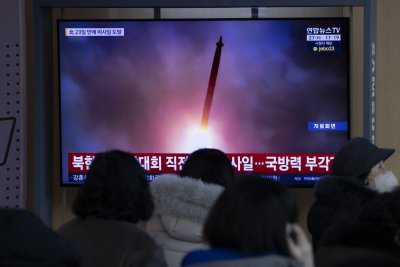
North Korea launched multiple short-range ballistic missiles toward the East Sea on Tuesday afternoon, Seoul’s military said. In this photo, people watch news of the launch at a train station in Seoul. Photo by Jeon Heon-kyun/EPA
SEOUL, Jan. 27 (UPI) — North Korea launched multiple short-range ballistic missiles toward the sea between the Korean Peninsula and Japan on Tuesday afternoon, Seoul’s military said, marking a fresh provocation ahead of a major ruling party congress.
“Our military detected several short-range ballistic missiles launched from an area north of Pyongyang into the East Sea around 3:50 p.m. today,” South Korea’s Joint Chiefs of Staff said in a text message to reporters.
The missiles flew approximately 217 miles, the JCS said, adding that South Korean and U.S. intelligence authorities are conducting a detailed analysis of their exact specifications.
“Under a robust South Korea-U.S. combined defense posture, the military is closely monitoring North Korea’s various movements and maintaining the capability and readiness to overwhelmingly respond to any provocation,” the JCS said.
Japan’s Defense Ministry said it detected two ballistic missiles, both of which splashed down outside Tokyo’s exclusive economic zone.
The launch marked North Korea’s second missile test of the year, following a Jan. 4 firing of what Pyongyang described as hypersonic weapons.
The test took place ahead of the Ninth Congress of the ruling Workers’ Party of Korea, which is widely expected to be convened by early next month. The congress is seen as a forum for the leadership to review policy performance, announce a new five-year economic plan and signal potential shifts in military and foreign policy priorities.
The missile launch also coincided with a three-day visit to South Korea by U.S. Under Secretary of Defense for Policy Elbridge Colby, who traveled on to Japan Tuesday afternoon. During his meetings in Seoul, Colby discussed issues including the security situation on the Korean Peninsula, the transfer of wartime operational control and South Korea’s pursuit of nuclear-powered submarines.
His trip followed the Pentagon’s release of a new National Defense Strategy calling on South Korea to assume primary responsibility for deterring North Korea.
In a statement sent to reporters, U.S. Forces Korea said it was aware of the launch and was consulting with allies and partners.
“Based on current assessments, this event does not pose an immediate threat to U.S. personnel or territory, or to our allies,” the statement said. “The United States remains committed to the defense of the U.S. homeland and our allies in the region.”