short film

A ‘holy grail for movie nerds’ revived, plus the best movies in L.A.

Hello! I’m Mark Olsen. Welcome to another edition of your regular field guide to a world of Only Good Movies.

In another busy week for new releases, the horror-comedy “Forbidden Fruits” is among the standouts. Having just premiered at SXSW, it is the feature debut for director Meredith Alloway, who co-wrote the screenplay with Lily Houghton, adapting Houghton’s play. Diablo Cody is a producer on the film, and the movie shares a sensibility with her beloved “Jennifer’s Body.”

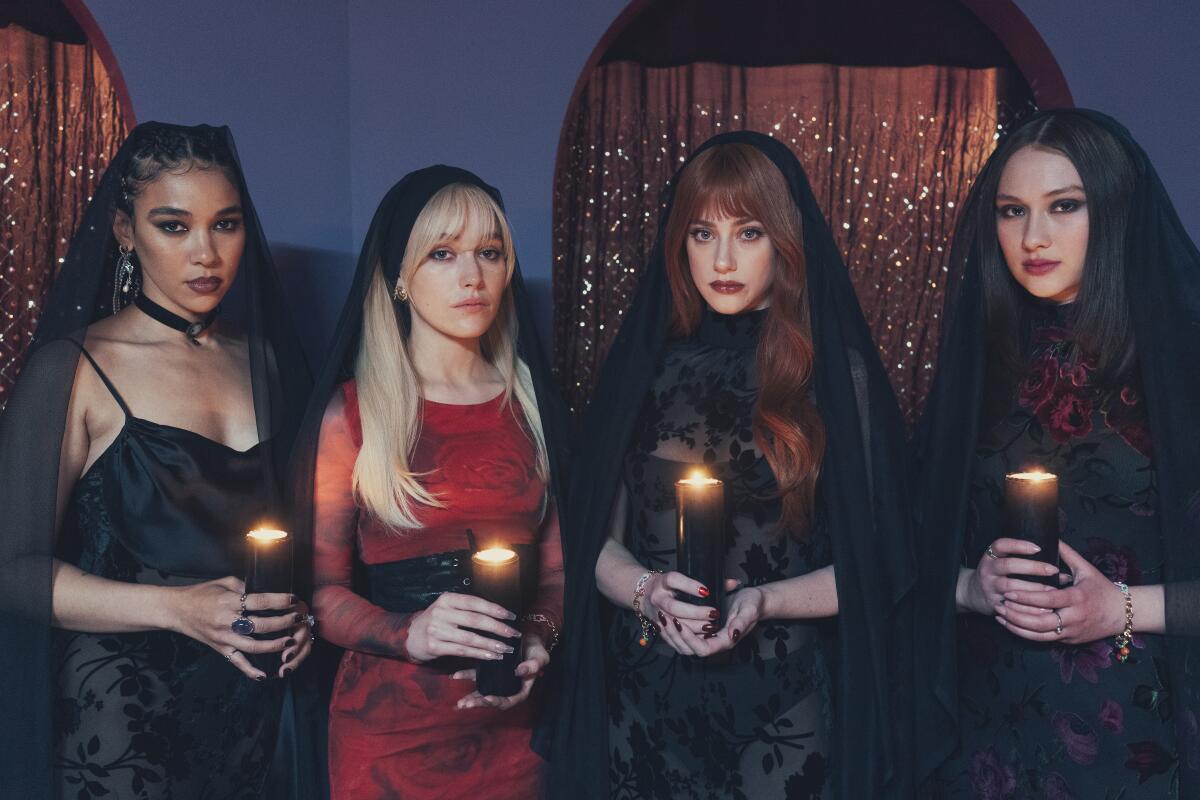
Set at a Texas shopping mall, the plot follows a group of female employees at a boutique who are secretly a coven of witches after hours. They bring a new employee into their fold. Lili Reinhart, Lola Tung, Victoria Pedretti and Alexandra Shipp star.

Four witches hold candles in a ritual.

Alexandra Shipp, from left, Victoria Pedretti, Lili Reinhart and Lola Tung in the movie “Forbidden Fruits.”

(Sabrina Lantos / Independent Film Co. / Shudder)

Though Katie Walsh gave the film a mixed review, declaring it “essentially the fast fashion of girly pop horror,” the film casts a spell when it is working.

Pedretti in particular is a standout, and Malia Mendez spoke to her about the role. “It asks a lot of people to try to step into a world like this one,” Pedretti said of the film’s knowing, campy style. “And as nerve-racking as it may be to take that big swing, you gotta take the big swing.”

Also opening in L.A. this week is Sofia Coppola’s “Marc by Sofia.” The director’s first documentary, it’s more a snapshot than a definitive portrait of the life and career of her longtime friend, fashion designer Marc Jacobs, as he prepares for his spring 2024 collection. While not as in-depth or revealing as one would hope, the film has a warmth and charm all its own. And anyone feeling nostalgic for ’90s New York after watching the recent TV series “Love Story” will get a buzz from this too.

Larry Karaszewski on ‘Last Summer’

Three people sit at a table having a conversation.

Richard Thomas, left, Barbara Hershey and Bruce Davison in the movie “Last Summer.”

(Warner Archive)

The American Cinematheque at the Aero Theatre on Sunday will host the world premiere of a new restoration of the theatrical version of 1969’s “Last Summer,” directed by Frank Perry from a screenplay by Eleanor Perry. Actors Barbara Hershey and Bruce Davison will be there for a Q&A moderated by screenwriter Larry Karaszewski.

“This is one of the holy grails for movie nerds,” says Karaszewski in a recent phone interview. The restoration happened in no small part thanks to his persistent and vocal fandom of the film. Best known for his work with writing partner Scott Alexander (including “Dolemite Is My Name” and “Ed Wood”) and currently a governor in the academy’s writer’s branch, Karaszewski is also a pillar of the repertory scene around Los Angeles, frequently moderating Q&As and an avid moviegoer.

Three people laugh together.

Richard Thomas, left, Barbara Hershey and Bruce Davison in the movie “Last Summer.”

(Warner Archive)

“Last Summer” follows three teenagers (Hershey, Davison and Richard Thomas) whiling away the summer at the beach on New York’s Fire Island. As a certain psychosexual energy escalates among them, winding each other up, they turn their attention to a younger girl (Catherine Burns) and torment her in increasingly sadistic ways.

For her performance, Burns was nominated for an Oscar for supporting actress, while Hershey briefly changed her last name to Seagull after a bird was accidentally injured on set.

In his original July 1969 review, The Times’ Charles Champlin called “Last Summer” “a compelling and disturbing movie, with moments of quite extraordinary power and poignance.”

“This was a movie that people who saw it were just fascinated by,” says Karaszewski. “Even though it came out in ’69, it feels like an important ’70s-style movie, a really rough youth film that used the new freedom that cinema had at that time. But you couldn’t see it.”

A couple walks their dog on the beach.

Director Frank Perry and screenwriter Eleanor Perry during production of “Last Summer.”

(Warner Archive)

Over time, the rights to the movie changed hands, elements went missing and it became a rarity. Due to an intense rape scene, the movie was also briefly released to some theaters with an X-rating, though Karaszewski says the differences to the R-rated version are minimal — a matter of a few frames and a single word. Released on VHS, “Last Summer” has never been on DVD or Blu-ray. (The Warner Archive label will release a disc of the new restoration later this year.) An edited TV version of the film has circulated, and the last few times “Last Summer” has shown in Los Angeles, it has been from a print discovered at an archive in Australia.

Karaszewski has long had a fascination with the film, one that was only fueled by its inaccessibility.

“It became famous as just, ‘Oh, that’s the movie Larry champions, that’s the movie that Larry won’t stop talking about,’ ” he says. Karaszewski jokes that he won’t know what to do with himself now that his longtime obsession with seeing the film revived has been fulfilled.

“I’ve been championing it so long,” he says. “It could have been just like, ‘Oh, Larry’s a little crazy. He loves this movie.’ And that would’ve been fine too. I’m a person that feels like every movie should have its day in the spotlight.”

The complete Akira Kurosawa in 35mm

A cavalry assembles in a valley.

An image from Akira Kurosawa’s “Ran.”

(Rialto Pictures)

On Saturday, the Academy Museum launches “Darkness and Humanity: The Complete Akira Kurosawa,” a comprehensive retrospective of the Japanese filmmaker’s 30 existing features, all of which will screen in 35mm. The series opens with two of Kurosawa’s best-known films, “Seven Samurai” and “Rashomon.” Other highlights include “Throne of Blood,” “Ikiru,” “Hidden Fortress,” “Stray Dog,” “High and Low,” “Dreams” and “Ran.” This is a rare opportunity to take in the true breadth of Kurosawa’s work.

Writing about the filmmaker in 2009 to commemorate the centennial of his birth, Dennis Lim said, “The wonder of Akira Kurosawa’s 50-year career is that it was at once remarkably varied and satisfyingly coherent …. But the constant in his films was the principle of heroism, not as a vaporous ideal but a way of life, an awareness of individual agency and personal responsibility in a world that does not always reward or even allow heroic behavior.”

A smiling samurai looks over a field where men fight.

Toshiro Mifune in Akira Kurosawa’s “Yojimbo.”

(Janus Films)

Kurosawa’s influence on other filmmakers around the world has been widely acknowledged. Upon the news of Kurosawa’s death, Steven Spielberg proclaimed him “the visual Shakespeare of our time” and added, “I am deeply saddened by Kurosawa’s death. But what encourages me is that he … is the only director who right until the end of his life continued to make films that were recognized as, or will be recognized as, classics.”

In 1985, while in Los Angeles for a screening of his film “Ran,” Kurosawa described his own work by saying, “I just make up stories and film them. When I am lucky, the stories have a lifelike quality that makes them appealing to people and the film is successful.”

Points of interest

‘To Sleep With Anger’ in 35mm

An actor and a director smile while shooting an outdoor scene.

Actor Danny Glover and director Charles Burnett during production of “To Sleep With Anger.”

(Samuel Goldwyn Company / Photofest)

To celebrate the release of Ashley Clark’s new book “The World of Black Film: A Journey Through Cinematic Blackness in 100 Films,” the UCLA Film and Television Archive will screen Charles Burnett’s 1990 drama “To Sleep With Anger” in 35mm at the Billy Wilder Theater on Sunday. Clark will be there for a book signing, and Burnett will join him for a Q&A.

Recently included as part of The Times’ ranked list of the 101 best Los Angeles movies, “Anger” stars Danny Glover in a galvanizing performance as Harry, an old friend from the South who arrives for an unexpected visit to a family in South Central L.A., upending their lives.

In his book, Clark describes the film as “a singular work with a distinct yet tantalizingly hard-to-pin-down performance from Danny Glover, who, as the inscrutable Harry, flickers between menace and charm, using all of his six-foot-four-inch stature to dominate the frame.”

In a 1990 Times story by David Wallace, Burnett spoke about how the film was meant to evoke a sense of Black cultural history, saying, “I didn’t appreciate the [storytelling] tradition until it disappeared. I had a sense of who I was because of that experience. … This film was an attempt to go back and deal with the past. To tell a story about a story.”

Added Glover: “I think there is a little of Harry in all of us. We’re constantly in conflict between the good side and the other. Harry’s involvement with the dark side is not that uncommon.”

Clark will also appear at the Academy Museum on Monday for the world premiere of Ngozi Onwurah’s restored 1995 film “Welcome II the Terrordome.”

‘Thank You for Smoking’

A man in a suit and tie gives a statement to press microphones.

Aaron Eckhart in the movie “Thank You for Smoking.”

(Dale Robinette / Fox Searchlight Pictures)

On Saturday, Vidiots will host a 20th anniversary screening of Jason Reitman’s debut feature “Thank You for Smoking” in 35mm, with the filmmaker in attendance for a Q&A. Adapted by Reitman from a novel by Christopher Buckley, the film is media satire that follows the misadventures of a lobbyist (Aaron Eckhart) for Big Tobacco. The cast also includes Katie Holmes, Robert Duvall, William H. Macy and Sam Elliott.

In his original review, Kenneth Turan called the movie “that rare film that actually has a sense of humor,” before adding, “Reitman’s script and direction retain the novel’s rhythms and black comic sensibility while at the same time eliminating and/or rearranging large chunks of its plot. He’s also figured out a way to make the story more conventionally audience-friendly without losing the extraordinary bite that made the book so successful.”

I recall an afternoon spent on the Fox lot talking to Reitman and Buckley together for a piece I wrote in 2006. The political climate that the film examines, one of extreme partisanship, has only heightened in the years since.

“The compliment the book always got,” said Reitman at the time, “which I thought was wonderful, was Democrats always thought it was theirs and Republicans always thought it was theirs. Like all good satire, the book was a mirror. … It doesn’t feel like it’s coming from one way or the other. It’s ridiculing both, and hopefully the film does the same thing.”
Source link

A 1986 documentary meets today’s moment, plus the best movies in L.A.

Hello! I’m Mark Olsen. Welcome to another edition of your regular field guide to a world of Only Good Movies.

If you are anything like me, you felt pretty out of sorts this week, not sure how to process the news that we are suddenly, apparently, a nation again at war. It can make the movies seem frivolous — a glorious, privileged sandbox to stick your head in — but it is also times like these that make them seem most vital and necessary: a place to focus energy and anxiety and maybe figure things out.

I was particularly struck by something New York Times critic Wesley Morris said in an appearance on the podcast “The Big Picture.” He was ostensibly talking about the downside of the Paramount-Warner Bros. merger news (“These people are f— with our dreams here” is how he began) but he landed on why movies matter in their moment, crucial to “how we develop as a culture, how we come to understand ourselves as a people, what this country ought to or should look like 40 years from now.”

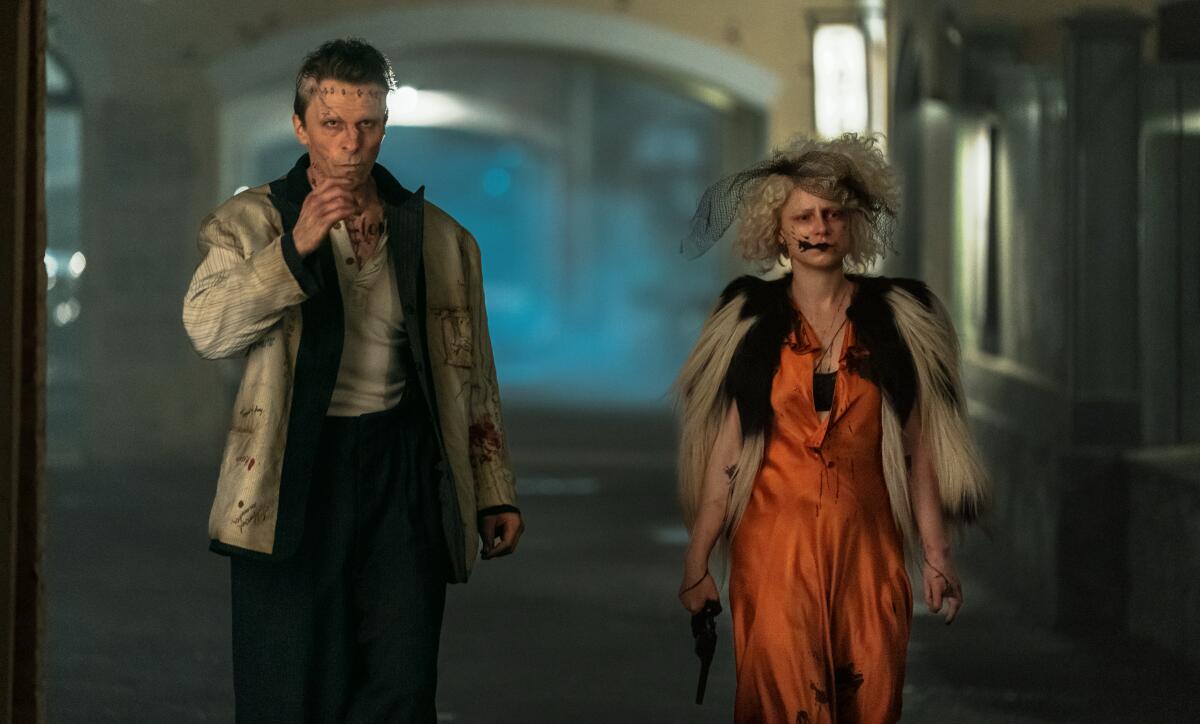
The week’s big new release is Maggie Gyllenhaal’s “The Bride!” a sort-of adaptation of 1935’s “Bride of Frankenstein” starring Jessie Buckley and Christian Bale that is also very much its own thing, purpose-built to drive some people up a tree and already sharply dividing critics.

A man and a woman in a red dress walk at night.

Christian Bale and Jessie Buckley in the movie “The Bride!”

(Niko Tavernise / Warner Bros. Pictures)

In her largely positive review, Amy Nicholson calls the movie “an unhinged scream,” adding, “‘Every wacky second, you’re well aware how perilously close it is to falling apart at the seams. This spiritual sequel to ‘Frankenstein’ is a romantic tale of obsession, possession and fantasy — adjectives that also apply to its filmmaker, Maggie Gyllenhaal, who expends massive quantities of energy jolting it to life. She succeeds by the skin of her teeth.”

I interviewed Gyllenhaal about “The Bride!” — including the significance of that exclamation point in the title. There have been numerous reports about a back-and-forth between the filmmaker and execs at Warner Bros. and Gyllenhaal didn’t shy away from talking about it. She had specific praise for Pam Abdy, co-chair and co-chief executive of Warner Bros. Motion Picture Group.

“Something really alive was born, and I think the movie is better for the work that she and I did together,” Gyllenhaal told me. “I know that’s an unusual thing to say. I know that you have lots of people saying like, ‘Ah, the studio f— my movie up.’ That is not my experience. It’s really not.”

Louis Malle’s ‘…and the Pursuit of Happiness’

Customers stand at an ice cream truck.

A scene from Louis Malle’s documentary “…and the Pursuit of Happiness.”

(Janus Films)

On Saturday, in a co-presentation of 7th House at the Philosophical Research Society and El Cine, the will be a 16mm screening of director Louis Malle’s 1986 “…and the Pursuit of Happiness,” a documentary made for television that explores the immigrant experience in America. The French-born filmmaker traveled across the U.S. interviewing recent arrivals from all walks of life.

Writing about the film in 1988, The Times’ Kevin Thomas called it “an often amusing and always insightful survey of the contemporary emigre experience. … an irresistible array of vignettes depicting cultural accommodation and assimilation in all its variety.”

I got on a video call this week with 7th House programmer Alex McDonald and El Cine founder Mariana Da Silva to talk about why this movie matters now.

The movie is streaming on the Criterion Channel right now. Why was it important to also put this movie in front of audiences right now?

Alex McDonald: I think Mariana and I are on the same page with this. I never let streaming or home video availability deter programming. Growing up, the theater was a holy place, a cathedral of congregation. I feel like these films are meant to be seen with an audience. And thankfully, I feel like our audience recognizes that as well, even if the film is out there. Particularly in our current moment, it’s a very prescient film and it’s one that will be all the more powerful within community.

Mariana Da Silva: I agree fully. One of the biggest things within our program is the communal aspects — just seeing the same people come back, that trust that develops with the audience. The best part I love about going to movie theaters is standing outside with people I maybe would never speak to and having a conversation about a film.

Children sit in a school room.

A scene from Louis Malle’s documentary “…and the Pursuit of Happiness.”

(Janus Films)

Do you respond to a movie like this as a sort of time capsule of how things were, or is it important to you that it is saying something about what’s happening right now?

McDonald: That’s something I’m very conscious of when I program repertory titles. When I program social, politically minded films, a lot of what I’m trying to do is to show that the issues within these things have not really changed — the ways in which things have progressed, the way in which we have regressed. Malle has such a humane view on all of these people in the film. He narrates but he doesn’t really editorialize. He just sort of observes, and in doing so, he’s making the most compelling argument for the richness of diversity and everything that these people contribute to this country, what they lose in assimilation, what they have to give up and what they bring. There’s a complexity to it. There are certainly dissenting voices in it and those resonate differently now.

It wasn’t perfect then. Obviously, there’s always been conflict, but I think there was an open-heartedness that has really shifted. And this is kind of a poignant reminder of what we need to try to get back to and recognize.

Da Silva: If we were able to have these conversations more openly, it would put us all on an even playing field. Humans are flawed. There’s been a lot of miseducation. In this moment, especially for me as somebody who is an immigrant, I feel like there’s so many people who I know who are so liberal and so aware, but then they don’t really understand the experience of the immigrant. And it’s not their fault in any capacity. They just haven’t been exposed to somebody like me before.

I think we can all come together on the things we celebrate, but we also need to be very open and come together on the things that we differ on too.

Points of interest

‘Good Night, and Good Luck’ in 35mm

Newsmen have a conversation in a TV control room.

George Clooney, left, and David Strathairn in the 2005 movie “Good Night, and Good Luck.”

(Melinda Sue Gordon / Warner Independent Pictures)

On Sunday afternoon at the Los Feliz Theater, as part of the American Cinematheque’s ongoing “Sunday Print Edition” series, there will be a 35mm screening of George Clooney’s “Good Night, and Good Luck,” introduced by The Times’ own Rosanna Xia.

Starring David Strathairn as pioneering television journalist Edward R. Murrow at the height of the McCarthy era, the film was nominated for six Oscars, including picture, director, actor and original screenplay.

As Kenneth Turan wrote in his original review, “‘Good Night, and Good Luck’ couldn’t be more unlikely, more unfashionable — or more compelling. Everything about it — its look, its style, even its sound — stands in stark opposition to the trends of the moment. Yet by sticking to events that are half a century old, it tells a story whose implications for today are inescapable. … The son of a TV anchorman, Clooney had the nerve to believe that a drama of ideas could be as entertaining as ‘Desperate Housewives.’ He insisted that a fight for America’s soul, a clash of values over critical intellectual issues like freedom of the press and the excesses of government, had an inherent intensity that would carry everything before it. And it does.”

‘Days and Nights in the Forest’ 4K restoration

A passenger looks out of a car window.

An image from Satyajit Ray’s 1970 drama “Days and Nights in the Forest.”

(Janus Films)

Now playing at the Laemmle Royal in a new 4K restoration undertaken by the Film Foundation is Satyajit Ray’s 1970 “Days and Nights in the Forest.” In this examination of masculinity and class, four male friends drive from the bustling city of Kolkata to a rural village, mixing with the locals with volatile results.

In a special video introduction, Wes Anderson, a longtime admirer of Ray, admits he lifted a scene from “Days and Nights” for one of his own films — 2023’s “Asteroid City” — and says, “Anything by Satyajit Ray must be cherished and preserved, but ‘Days and Nights in the Forest,’ I think you will agree, is one of the special gems among his many treasures.”

‘Grease 2’ returns

A woman stands on the beach in front of a thatched hut.

Michelle Pfeiffer on the set of “Grease 2” in 1981.

(Vinnie Zuffante / Getty Images)

The Cinematic Void series at the American Cinematheque will show 1982’s pastiche musical “Grease 2” on Monday. Directed by choreographer-turned-filmmaker Patricia Birch, the film is, of course, a sequel to 1978’s megahit “Grease” but it is also very much its own thing. Largely dismissed on initial release, it has found a growing following over the years thanks in large part to its extremely engaging young cast, including an on-the-rise Michelle Pfeiffer.

In his initial review (more complementary than one might expect), Kevin Thomas wrote, “There’s so much youthful talent and vitality in ‘Grease 2’ that it’s depressing to discover it is so unblushing and relentless and paean to ignorance. … This is a pity, because Birch displays an organic sense of how to make dance evolve out of the kids’ everyday activities — converging en mass at Rydell High on the first day of school or having fun at the bowling alley. But Birch has scant opportunity beyond letting us know she cares for these ignoramuses, most of who seem likable enough beneath aggressively crude exteriors.”

Anti-fascist films at UCLA

Two people lean against a streetlight.

Ingrid Bergman and Charles Boyer in the 1948 drama “Arch of Triumph.”

(Enterprise-UA / Photofest)

The ongoing series at the UCLA Film and Television Archive titled “From John Doe to Lonesome Rhodes: Anti-fascism from the Archive” hits a real stride this weekend for two nights of restored rarities. On Friday comes a restored 35mm print of 1948’s “Arch of Triumph,” directed by Lewis Milestone and starring Ingrid Bergman, Charles Boyer and Charles Laughton in a romantic drama of refugees in 1938 Paris. Also playing is Arthur Ripley’s rare 1944 emigree drama “Voice in the Wind.”

Much of the press around the film at the time of its release had to do with the challenge of bringing the racier aspects of the novel by Erich Maria Remarque (“All Quiet on the Western Front”) to the screen. As producer David Lewis told The Times’ Philip K. Scheuer, “I promise you that as Joan, Ingrid Bergman will set the town on its ear. They’ll never think of her as anything but sexy again.”

Saturday brings the world premiere of the 35mm restoration of Walter Comes’ 1947 “The Burning Cross,” in which a returning veteran is recruited into the KKK. John Reinhardt’s 1948 “Open Secret,” about antisemitism, will also play in a 35mm restoration.

The series concludes next week with a 35mm screening of Elia Kazan’s 1957 “A Face in the Crowd,” starring Andy Griffith in an examination of the dark side of populist politics and media manipulation.

Source link