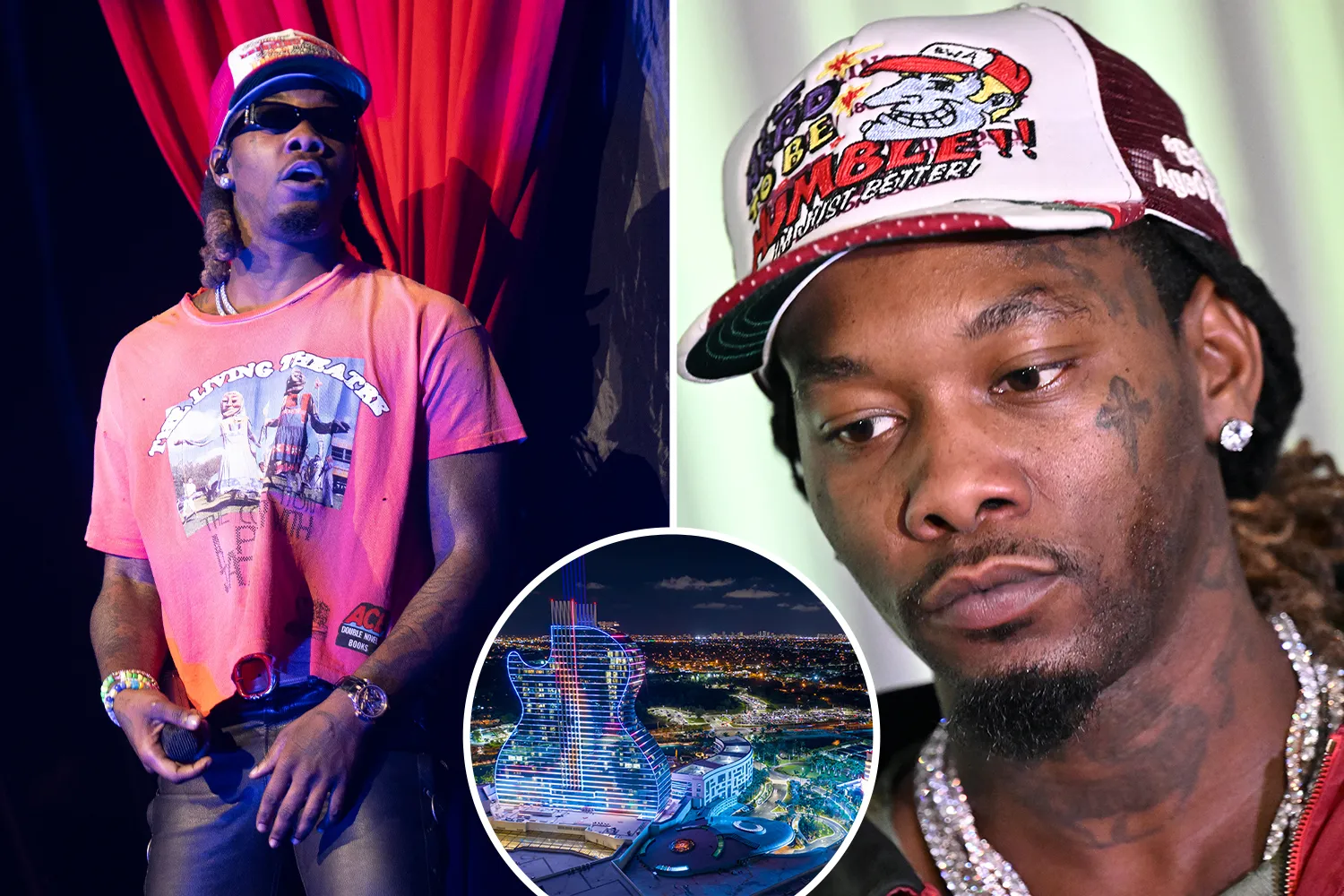
CARDI B’s ex, Offset, has been hospitalized after getting shot near a popular Florida casino.
The 34-year-old rapper was involved in a shooting on Monday.
Sign up for the Showbiz newsletter
Thank you!
Cardi B’s ex Offset has been shot near a Florida casinoCredit: GettyOffset was hospitalized and receiving medical treatment, spokesperson for the rapper told The U.S. Sun in a statementCredit: Getty
“We can confirm he was shot and is currently at the hospital receiving medical care.
“He is stable and being closely monitored,” a spokesperson for the rap star told The U.S. Sun in a statement.
TMZ first broke the news about the incident, which occurred near the Seminole Hard Rock Hotel & Casino in Hollywood.
A rep for the Seminole County Police told the outlet that “two individuals have been detained” and “there is no threat to the public.”
Further details about the shooting are unknown at this time.
It comes nearly four years after Offset’s Migos bandmate Takeoff was fatally shot after an argument erupted outside of a Houston Bowling alley.
Hours before the latest shooting involving the Bad and Boujee rapper, Cardi, 33, shared videos on Instagram of their kids jumping for joy as they hunted for Easter eggs at her home.
The estranged pair share three children: a daughter, Kulture Kiari Cephus, born in 2018; a son, Wave Set Cephus, born in 2021; and a daughter, Blossom, born in September 2024.
Most read in Entertainment
Offset – real name Kiari Kendrell Cephus – is also a father to three other children from other relationships.
Cardi – birth name Belcalis Marlenis Almánzar – filed for divorce from Offset in August after seven years of marriage and is reportedly seeking primary custody of their kids.
The Bodak Yellow rapper had previously accused her ex of cheating, though insiders claimed to Page Six that the reason for their split was they’d “grown apart.”
Aside from their children, the former couple appeared to have abandoned all other connections they’d had to one another.
The U.S. Sun exclusively reported in November that half a Georgia street the duo owns has been left rundown, with rotted homes and no signs of being fixed up.
Offset is also said to be facing financial troubles with more than $2.3 million in tax liens, according to documents obtained by The U.S. Sun.
Cardi was most recently linked to NFL star Stefon Diggs, with whom she welcomed a baby in November.
Days before the New England Patriots’ wide receiver played in the Super Bowl, and Cardi B appeared in the halftime show, rumors circulated that the couple had parted ways.
A week later, Cardi confirmed their split when she appeared to shade the football star during a performance on her Little Miss Drama Tour.
The incident occurred near the Seminole Hard Rock Hotel & Casino in HollywoodCredit: GettyA spokesperson told The U.S. Sun that the rap star is in ‘stable’ conditionCredit: GettyCardi B filed for divorce from Offset in August 2024, though it has not yet been finalizedCredit: Getty
WASHINGTON — Minnesota officials sued the Trump administration on Tuesday for access to evidence they say they need to independently investigate three shootings by federal officers, including the killings of Renee Good and Alex Pretti.
The lawsuit claims that the federal government reneged on its promise to cooperate with state investigations after the surge of federal law enforcement in Minneapolis, and are seeking a court order demanding that the Trump administration comply.
“We are prepared to fight for transparency and accountability that the federal government is desperate to avoid,” Hennepin County Atty. Mary Moriarty told reporters.
The lawsuit marks an escalation in the clash between Minnesota leaders and the Trump administration over the investigations into the high-profile shootings by federal officers that sparked public outcry and protests. The Trump administration has suggested that Minnesota officials don’t have jurisdiction to investigate, but state officials insist they need to conduct their own probes because they don’t trust the federal government to investigate itself.
“There has to be an investigation any time a federal agent or a state agent takes the life of a person in our community,” Moriarty said.
The administration sent thousands of officers to the Minneapolis and St. Paul area for the immigration crackdown as part of President Trump’s national deportation campaign. The Department of Homeland Security considered its largest immigration enforcement operation ever a success but was staunchly criticized by Minnesota’s leaders who raised questions over officers’ conduct.
There continues to be fallout from Operation Metro Surge in the form of a Homeland Security shutdown, as Democrats in Congress hold up funding in an effort to secure restraints on Trump’s immigration agenda.
Minnesota’s lawsuit said the federal government is not permitted to “withhold investigative evidence for the purpose of shielding law enforcement officers from scrutiny where a State is investigating serious potential violations of its criminal laws, targeting its citizens, within its borders.”
Moriarty said Tuesday that the federal government “has adopted a policy of categorically withholding evidence,” calling the practice unprecedented and alarming. She said the lawsuit followed formal demands for evidence after the federal government blocked Minnesota investigators from accessing evidence related to the shootings.
In addition to the Pretti and Good cases, the lawsuit demands access to evidence in the case of Julio Cesar Sosa-Celis, who was shot and wounded in his right thigh by a federal agent in January.
Federal officials initially accused Sosa-Celis and another man of beating an Immigration and Customs Enforcement officer with a broom handle and a snow shovel. But federal prosecutors later dropped all charges against the men and authorities opened a criminal investigation into whether two immigration officers lied under oath about the shooting.
Emails seeking comment were sent to DHS and the Justice Department.
The Justice Department in January said it was opening a federal civil rights investigation into Pretti’s killing but has said a similar federal probe was not warranted in the killing of Good. The decision in Good’s case marked a sharp departure from past administrations, which moved quickly to investigate shootings of civilians by law enforcement officials for potential civil rights offenses.
Deputy Atty. Gen. Todd Blanche has said that the department’s Civil Rights Division does not investigate every law enforcement shooting and that there have to be circumstances and facts that “warrant an investigation.”
Moriarty has said a lack of confidence in the federal government’s review of these incidents makes the state’s independent investigations into the shootings, as well as officers’ actions during the immigration enforcement operation altogether, especially important. The county office received over 1,000 tips from the public on the shootings of Good and Pretti via an online portal they opened to collect evidence. Earlier this month, Moriarty initiated a second portal and said her office was investigating a number of incidents of potentially unlawful action by officers over the course of the immigration enforcement operation.
Fingerhut and Richer write for the Associated Press. Fingerhut reported from Des Moines, Iowa.
Shaun Ryder on the beach in 2000Credit: Denis JonesShaun with wife Joanne and kids, Pearl and Lulu in 2017Credit: Matthew Pover – The SunShaun at a Happy Mondays gig in 2000Credit: Julian Makey
But, then again, putting the potty-mouthed and straight-talking singer on live telly is always a risk.
In an exclusive interview with The Sun, the Mancunian reveals that ITV did not appreciate his story of a drugs raid that happened when he was up for a Brit award in 1996.
Back then, Shaun’s other band, Black Grape, had been nominated for British Breakthrough Act.
Shaun says: “I told him I went to score and the gaff where I went to score got raided by the police as I’m scoring and the cops cottoned on who I was.
“And I’m saying, ‘Oh, I’m getting a Brit Award here’ and they let me go.
“They busted a heroin house and they let me go because I was up for a Brit Award.”
You might think that Shaun, who has already published two autobiographies, has no fresh stories.
But the singer, who has a new memoir out now and who is writing material for Happy Mondays’ first album in 20 years, always has plenty of tales to tell.
In his latest book, 24 Hour Party Person, he recalls facing down what he believes was a killer orangutan, escaping a gun battle and being held hostage by an armed robber.
There are also numerous car crashes from which he somehow escaped alive.
Shaun, who quit drugs aged 40 after 20 years of substance abuse, admits: “I have used up more than nine lives.”
It could all have ended shortly after Happy Mondays’ first album, Squirrel And G-Man Twenty Four Hour Party People Plastic Face Carnt Smile (White Out), came out in 1987.
Shaun, who was not famous at that point, went to Amsterdam to live for a short while.
He remembers: “Some nutcase we knew from Manchester, who was doing armed robberies and was then in Amsterdam, hijacked a load of people, put them in the canal and shot them and then turned up at the gaff where we were staying and held us hostage for a day or two.”
Luckily, Shaun managed to talk the robber into letting them go.
But there was no way of having a nice discussion with a great ape that appeared in front of Shaun on a Barbados beach when he was recording Happy Mondays’ fourth album in 1992.
At the time there were stories in the local Press about a dangerous orangutan, nicknamed Jack the Ripper, on the loose.
Shaun claims: “This thing just dropped out of the trees right in front of me. It was a f***ing big orangutan.”
Telling himself “don’t show any fear”, the musician stood tall and shouted, “Grrr, arrrgh, f*** off, just f*** right off”, at the animal.
Remarkably, the orangutan did as it was told.
Orangutans are not native to the Caribbean, so there is a good chance it was indeed Jack the Ripper.
And Shaun, who was “smoking up to 50 rocks of crack cocaine a day” in Barbados, insists it was not a hallucination.
Bez at a Happy Mondays gig in 2000Credit: Julian MakeyDuring one trip to Jamaica, Shaun and Kermit found themselves in the middle of a gun battle while trying to buy drugs
The album, Yes, Please!, failed to generate enough sales to justify the £150,000 spent making it and the following year the Happy Mondays broke up.
Shaun formed Black Grape in 1993 with his dancer mate Bez and rapper pal Paul “Kermit” Leveridge.
But it did not help keep him out of trouble.
During one trip to Jamaica, he and Kermit found themselves in the middle of a gun battle while trying to buy drugs.
He recalls: “I was going scoring and someone got shot, shot in the head. We just ran for it. If you’re a junkie going scoring, that’s the sort of s**t you come across.”
It was getting together with third wife Joanne which finally helped Shaun give up drugs and stop boozing.
They had dated briefly before Happy Mondays had hits, but he says: “She blew me out.”
Joanne, who now manages the TV part of his career — which has included two appearances on I’m A Celebrity . . . Get Me Out Of Here! — remained in the same circle as him.
The couple got together more than 20 years ago and married in 2010.
They have two daughters, Pearl, 17, and Lulu, 18.
Shaun, who also has four other children with previous partners, says: “She reeled me in and it’s a good job. “She didn’t let me get away with half of the stuff.
“If she hadn’t I’d have just carried on with crashing, but once I hit 40, I was determined to give up drugs anyway.”
His older children had to deal with his absences and spells in rehab.
But the youngest two have grown up in a more stable environment.
Shaun, who is also stepdad to Joanne’s son Oliver, explains: “I’ve still got two kids at home, so for the last 18 years, I’m just Dad.
“They’ve grown up coming and watching us at music festivals, and they’ve seen me in the jungle, but they’ve never seen that Shaun Ryder who’s off his nut.
“I pick them up from college and all that sort of thing, and drop them off. I’m the f***ing taxi service.
“In this house, you know, we don’t even have booze or anything, so, we’ve just been like a normal f***ing mad family for the past 18 years or whatever.”
Shaun says he did not see much of his older children and admits he was not a good dad to them.
But he says: “I’ve had really no trouble off my kids, I’ve been very lucky with the kids.”
This year is going to be an important one for Shaun.
Apart from the book and new album out next year, he is doing a Q&A tour and is on the road with Happy Mondays.
The return to the studio is due to former Creation Records label boss Alan McGee.
Shaun reveals: “I’m writing it now. Alan McGee wanted a new Mondays album, so Alan usually gets what he wants.”
An orangutan like the one Shaun says attacked himCredit: Getty
When it comes out, it will be 40 years since the Manchester group’s first release in 1987.
These days various health problems, including a recent bout of pneumonia, means performing is harder than ever for Shaun.
One legal substance that has helped keep him on the road is the fat jab Ozempic.
Shaun says: “You just raid the medicine cabinet, don’t you, and get on with it, so the show must go on.
“I have an overactive thyroid, so even if I ate f***ing lettuce and tomatoes, I would be big.
“Since I started on the injections my thyroid started to get better.”
If Shaun has his way he will keep performing until the Grim Reaper finally catches up with him.
And the singer would settle for dying on stage, like the comedian Tommy Cooper.
He says: “In this game, you’re doing some Tommy Cooper style, you know what I mean?
“As long as you enjoy it, do what you do, f***ing do it and I still do.
“I’ll still make music and go play music out there until I f***ing drop dead on stage.
“It’s a good place to go, innit? To drop dead on stage, singing Kinky Afro.”
Shaun’s new book 24 Hour Party Person is available from awaywithmedia.com.
Shaun’s new book 24 Hour Party Person is available from awaywithmedia.comCredit: Supplied