Vessels will still be able to transit Strait of Hormuz to and from non-Iranian ports, says CENTCOM; Iran warns any approaching military vessels will be breaching ceasefire.
Published On 13 Apr 202613 Apr 2026
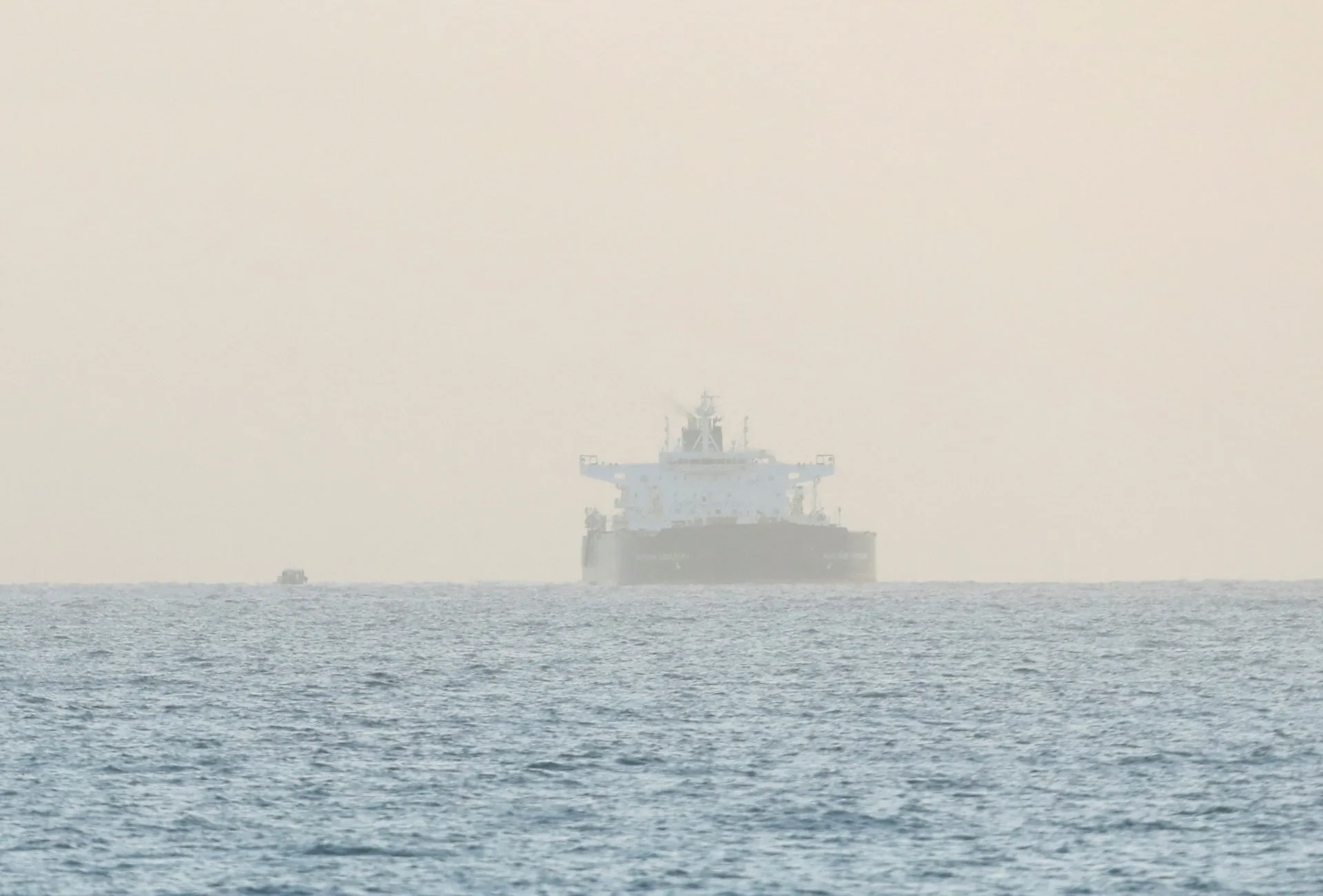
The United States military has announced it will begin blockading all Iranian ports on Monday, its latest move to exert pressure on Tehran after marathon peace talks in Pakistan concluded without a deal.
In a statement on Sunday evening, US Central Command (CENTCOM) said the blockade would apply to “all maritime traffic entering and exiting Iranian ports” from 10am Eastern Time (14:00 GMT) on April 13. That includes “vessels of all nations entering or departing Iranian ports and coastal areas”, including those on the Gulf and the Gulf of Oman.
Recommended Stories
list of 3 itemsend of list
However, US forces “will not impede freedom of navigation for vessels transiting the Strait of Hormuz to and from non-Iranian ports,” CENTCOM said, in an apparent scaling back from President Donald Trump’s earlier threat to blockade the entire strait and pursue ships paying tolls to Iran.
“There are a lot of questions here,” said Al Jazeera’s Heidi Zhou-Castro from Washington, DC, pointing to “conflicting information” coming out of the US side.
“Trump said the blockade would target any and all ships trying to enter or leave the Strait of Hormuz. But CENTCOM is saying this would only target ships going to or from Iranian ports.”
The price of US crude oil jumped 8 percent to $104.24 a barrel after the US blockade threat. Brent crude oil, the international standard, increased 7 percent to $102.29.
Iran has essentially taken control over the Strait of Hormuz, a vital chokepoint for the global energy market, since the US and Israel launched a war against the country on February 28. Traffic through the waterway has since slowed to a trickle, nearly paralysing about one-fifth of the world’s oil and liquefied natural gas shipments.
Iran has continued to move its own vessels through the strait, while allowing limited passage of ships from other countries. Iranian officials have discussed setting up a toll system after the fighting ends.
In a statement responding to Trump’s blockade threat, Iran’s Islamic Revolutionary Guard Corps said any approaching military vessels would be in breach of a US-Iran ceasefire – meant to be in effect until April 22 – and “will be dealt with severely”.
The US-declared blockade appears to be triggered by the failure of the talks in Pakistan’s capital, Islamabad, raising fears of renewed fighting.
Iranian officials blamed the US side for failing to reach a deal, with Minister of Foreign Affairs Abbas Araghchi saying US negotiators shifted the “goalposts” and obstructed efforts when a memorandum of understanding was “just inches away”.
Zohreh Kharazmi, an associate professor at the University of Tehran, said the US “is not in a position to dictate” to Iranians how to behave, or “to choose which vessels may pass”.
“If this blockade becomes a contest between the resilience of the Islamic Republic and the resilience of global markets, it will not take long to see who is losing,” she said, adding that Iran “is ready for a prolonged war”.
“Technically, they [the US] cannot control the situation. With Hollywood-style strategies, they cannot prevail in this battleground.”
Washington and Tehran accuse each other of not honouring truce agreement.
Published On 10 Apr 202610 Apr 2026
Shipping remains at a standstill in the Strait of Hormuz despite the ceasefire agreement between the United States and Iran, dampening hopes for a resolution to one of the worst global energy disruptions in history.
Only a handful of vessels have transited the critical strait since Washington and Tehran on Tuesday announced a two-week pause in fighting, according to ship tracking data.
Recommended Stories
list of 4 itemsend of list
Five vessels crossed the strait on Wednesday, down from 11 the previous day, and seven transited on Thursday, according to data from market intelligence firm Kpler.
More than 600 vessels, including 325 tankers, are still stranded in the Gulf due to the blockage of the strait, according to Lloyd’s List Intelligence.
“While some vessel movement has resumed, traffic remains very limited, compliant shipowners are likely to stay cautious, and safe transit capacity is expected to remain constrained at maximum 10–15 passages a day if the ceasefire holds, without consideration of tolls applied,” Kpler trade risk analyst Ana Subasic said in an analysis on Thursday.
The waterway, which usually carries about one-fifth of global oil and liquefied natural gas (LNG) supplies, typically handled about 120-140 transits before the US and Israel launched their attacks on Iran on February 28.
On Thursday, US President Donald Trump accused Iran of failing to live up to its part of the ceasefire agreement, which includes a commitment to allow “safe passage” through the waterway for two weeks.
“Iran is doing a very poor job, dishonorable some would say, of allowing Oil to go through the Strait of Hormuz,” Trump said in a post on Truth Social.
“That is not the agreement we have!”
Iranian Foreign Minister Abbas Araghchi earlier accused the US of not honouring the deal, warning, in reference to Israel’s ongoing attacks on Lebanon, that it had to choose between a ceasefire or “continued war” via its ally.
“The world sees the massacres in Lebanon,” Araghchi said in a post on social media.
“The ball is in the US court, and the world is watching whether it will act on its commitments.”
After plummeting on the back of the ceasefire announcement, oil prices have begun to tick up as markets digest the reality that maritime traffic remains effectively halted despite the truce.
“This moment requires clarity. So let’s be clear: the Strait of Hormuz is not open,” Sultan Ahmed Al Jaber, the CEO of the United Arab Emirates’ state-run oil company, ADNOC, said in a social media post on Thursday.
“Access is being restricted, conditioned and controlled. Iran has made clear – through both its statements and actions – that passage is subject to permission, conditions and political leverage. That is not freedom of navigation. That is coercion.”
Brent crude, the international benchmark, stood at $96.39 as of 02:00 GMT on Friday, after falling below $95 a barrel on Wednesday.
Asia’s main stock markets opened higher on Friday, following overnight gains on Wall Street driven by hopes of a resolution to the war.
Japan’s benchmark Nikkei 225 was up 1.8 percent in early trading, while South Korea’s KOSPI and Hong Kong’s Hang Seng Index were up about 2 percent and 1 percent, respectively.
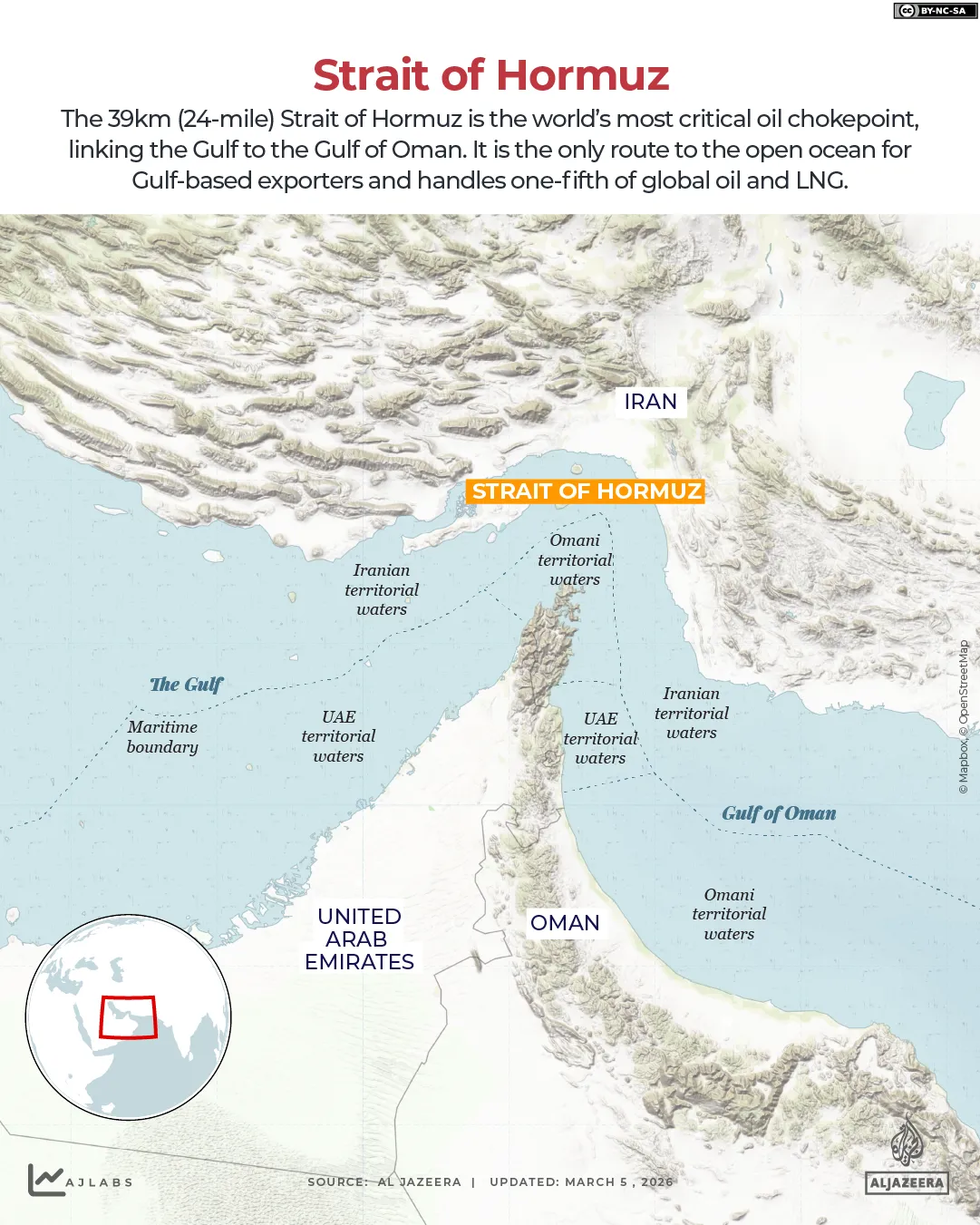
The Strait of Hormuz, which links the Gulf to the Gulf of Oman, has held global attention since Israel and the US began their war on Iran in February.
Until fighting began, the narrow channel, through which 20 per cent of the world’s oil and liquefied natural gas (LNG) supplies are shipped from Gulf producers in peacetime, remained toll-free and safe for vessels. The strait is shared by Iran and Oman and does not fall into the category of international waters.
Recommended Stories
list of 4 itemsend of list
After the US and Israel began strikes, Iran retaliated by attacking “enemy” merchant ships in the strait, effectively halting passage for all, stranding shipping, and creating one of the worst-ever global energy distribution crises.
Tehran continued to refuse to re-open the strait to all traffic at the start of this week, despite US President Donald Trump’s threats to bomb Iran’s power plants and bridges if it did not relent. Trump backed away from his threat on Tuesday night when a two-week ceasefire, brokered by Pakistan, was declared.
That followed a 10-point peace proposal from Iran that Trump described as a “workable” basis on which to negotiate a permanent end to hostilities.
As part of the truce, Tehran has now issued official terms it says will guide its control of the Strait going forward. The US has not directly acknowledged the terms ahead of talks set to begin in Islamabad on Friday. However, analysts say Tehran’s continued control will be unpopular with Washington, as well as other countries.
During the crisis, only a few ships from specific countries deemed friendly to Iran and those which pay a toll have been granted safe passage. At least two tolls for ships are believed to have been paid in Chinese yuan, in what appears to be a strategy to weaken the US dollar, but also to avoid US sanctions. China, which buys 80 percent of Iran’s oil, already pays Tehran in yuan.
Here’s what we know about how shipments will work from now on:
(Al Jazeera)
Who is controlling the strait now?
On Tuesday, Iran’s Foreign Minister Abbas Aragchi said Iran would grant safe passage through the strait during the ceasefire in “coordination with Iran’s Armed Forces and with due consideration of technical limitations”.
On Wednesday, the Islamic Revolutionary Guard Corps (IRGC) released a map of the strait showing a safe route for ships to follow. The map appears to direct ships further north towards the Iranian coast and away from the traditional route closer to the coast of Oman.
In a statement, the IRGC said all vessels must use the new map for navigation due to “the likelihood of the presence of various types of anti-ship mines in the main traffic zone”.
Alternative routes through the Strait of Hormuz have been announced by Iran’s Islamic Revolutionary Guard Corps (IRGC), providing new entry and exit pathways for maritime traffic [Screen grab/ Al Jazeera]
It is unclear whether Iran is collecting toll fees during the ceasefire period.
However, Trump said on Tuesday the US would be “helping with the traffic buildup” in the strait and that the US army would be “hanging around” as the negotiations go on.
The Strait will be “OPEN & SAFE” he posted on his Truth Social media site on Thursday, adding that US troops would not leave the area, and threatening to resume attacks if the talks don’t go well.
It’s not known to what extent US troops are directing what happens in the strait now.
Delhi-based maritime analyst C Uday Bhaskar told Al Jazeera that there is a lot of “uncertainty” about who can sail through the strait, and that only between three and five ships have transited since the war was paused.
How does Iran’s 10-point plan affect the Strait?
Among Tehran’s main demands listed on its 10-point plan are that the US and Israel permanently cease all attacks on Iran and its allies – particularly Lebanon – lift all sanctions, and allow Iran to retain control over Hormuz. The plan has not been fully published but is understood to be a starting point for talks.
Iranian media say Iran is considering a plan to charge up to $2m per vessel to be shared with Oman on the opposite side of the strait. Other reports suggest Iran could charge $1 per barrel of oil being shipped.
Revenues raised would be used to rebuild military and civilian infrastructure damaged by US-Israeli strikes, Tehran said.
Oman has rejected the idea. Transport minister Said Al-Maawali said on Wednesday that the Omanis previously “signed all international maritime transport agreements” which bar taking fees.
What does international law say about tolls on shipping?
Critics of Iran’s plan to charge tolls say it violates international law guiding safe maritime passage, and should not be part of a final ceasefire agreement.
The United Nations Convention on the Law of the Sea (UNCLOS) says levies cannot be charged on ships sailing through international straits or territorial seas.
The law allows coastal states to collect fees for services rendered, such as navigation assistance or port use, but not for passage itself.
Neither the US nor Iran has ratified that particular convention, however.
Even if they had, there could be ways to get around this law anyway. Analyst Bhaskar told Al Jazeera that if Iran instead charged fees to de-mine the strait and make it safe for passage again, that could be allowable under maritime laws.
There is no precedent in recent history of countries officially taxing passage through international straits or waterways.
In October 2024, a United Nations Security Council report alleged that the Iran-backed Houthis in Yemen were collecting “illegal fees” from shipping companies to allow vessels to pass through the Red Sea and the Bab-el-Mandeb strait, where it was targeting ships linked to Israel during the Gaza war.
Last week, a top adviser to Supreme Leader Mojtaba Khamenei suggested the Houthis could shut the Bab al-Mandeb shipping route again in light of the war on Iran.
(Al Jazeera)
How might countries react to a Hormuz toll?
Tolls for passage through the Strait of Hormuz would likely most affect oil and gas-producing countries in the Gulf, but ripple effects will spread to others as well, as the current supply shocks have shown.
Gulf countries, which issued statements calling for the reopening of the passage and praising the ceasefire on Wednesday, would also face a continuing degree of uncertainty, analysts say, as Iran could again disrupt flows in the future.
Before the ceasefire was announced, Bahrain had already proposed a resolution at the UN Security Council calling on member states to coordinate and jointly reopen the passage by “all necessary means”. It was backed by Qatar, the UAE, Saudi Arabia, Kuwait and Jordan. On April 7, 11 of 15 UNSC members voted in favour of that resolution.
But Russia and China vetoed the resolution, saying it was biased against Iran and did not address the initial strikes on Iran by the US and Israel.
Beyond the region, observers say the US is unlikely to accept indefinite toll demands by Iran as part of the negotiations expected to begin on Friday.
A toll to pass through the Strait of Hormuz “is not going to go down well with President Trump and his expectations that the strait should be open for everyone”, Amin Saikal, a professor at the Australian National University, said.
Other major powers have also voiced opposition. Ahead of the ceasefire, Britain had begun discussions with 40 other countries to find a way to reopen the strait.
Practical realities in the strait might see a different scenario play out with ship owners losing millions each day their vessels remain stranded seeking to get them out quickly and undamaged experts say. They are more likely to comply with Iran, at least for now.
“If I were the owner of a VLCC [very large crude carrier] which weighs about 300,000 tonnes, whose value could be a quarter billion dollars…I would believe the Iranians if they said we have laid mines,” Bhaskar said.
The US-Israel war on Iran has sparked a global fuel crisis as thousands of tankers carrying crucial deliveries of oil and liquefied natural gas (LNG) remain stranded on either side of the Strait of Hormuz, currently under a blockade imposed by Iran.
On Saturday, Egypt’s government said it is among the “best-performing” countries in tackling the crisis because of the measures it has implemented to save on fuel.
Here is what we know about the steps Egypt is taking and whether other countries are doing the same.
Why has the Iran war caused an energy crisis?
Pressure on oil and gas markets is mounting due to the almost complete halt to shipping through the Strait of Hormuz as well as air strikes on and around key energy facilities in the Gulf as the United States-Israel war on Iran enters its sixth week.
One-fifth of the world’s oil and LNG is shipped from producers in the Gulf through the Strait of Hormuz in peacetime. This is the only route from the Gulf to the open ocean.
On March 2, two days after the US and Israel began strikes on Iran, Ebrahim Jabari, a senior adviser to the commander in chief of Iran’s Islamic Revolutionary Guard Corps (IRGC), announced that the strait was “closed”. If any vessels tried to pass through, he said, the IRGC and the navy would “set those ships ablaze”. Since then, traffic through the strait, carrying cargoes including 20 million barrels of oil each day, has plunged by more than 95 percent.
Now, Tehran is allowing just a handful of tankers through after reaching agreements with some countries to do so.
Besides this, energy infrastructure in the Middle East has suffered damage over the course of the war.
On March 24, QatarEnergy declared force majeure on some of its long-term LNG supply contracts after an Iranian attack on Qatar’s Ras Laffan LNG facility – the largest in the world – wiped out about 17 percent of the country’s LNG export capacity, causing an estimated $20bn in lost annual revenue and threatening supplies to Europe and Asia.
All of this disruption has sent energy prices soaring. On Tuesday, global oil benchmark Brent crude was around $109 per barrel, compared to around $65 per barrel right before the war started.
How is Egypt tackling the energy crisis?
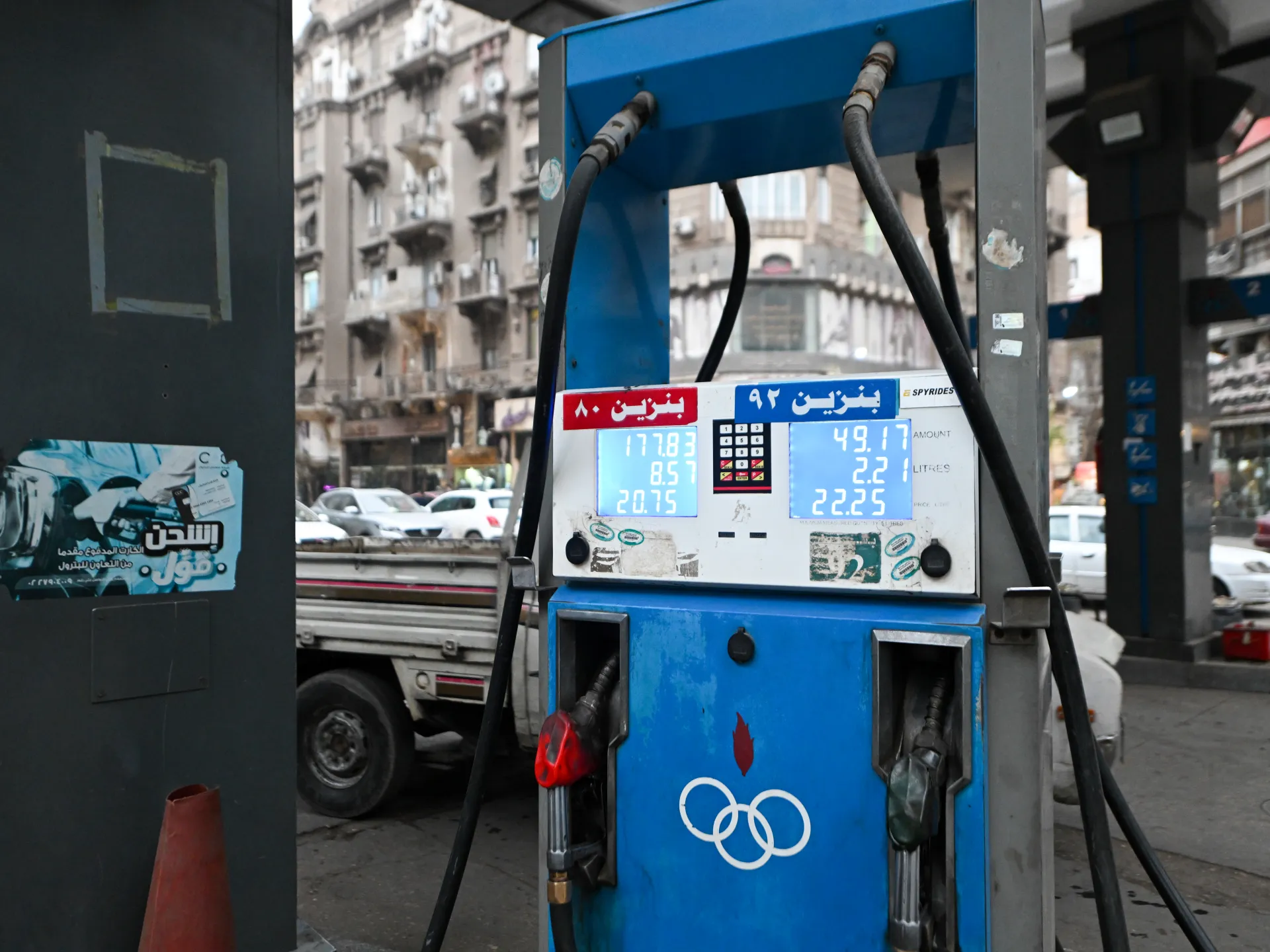
Egypt’s Petroleum Ministry has announced rises in fuel prices ranging from 14 percent to 30 percent.
On March 28, Egyptian Prime Minister Mostafa Madbouly’s office told a press conference that the country’s energy import bill had increased from $1.2bn in January to $2.5bn in March.
Egypt is both one of the region’s largest energy importers and among its most heavily indebted economies. While domestic gas and oil account for the majority of its total energy supply, the country still relies on imported fuels, especially refined oil products and some natural gas, from Israel and the Gulf states.
Madbouly announced measures Egypt is taking to mitigate this and preserve state energy resources.
From March 28, shops, malls and restaurants are closing at 9pm (19:00 GMT) every day for one month, except Thursdays and Fridays.
On Thursdays and Fridays, the closing time will be 10pm (20:00 GMT).
Fuel allocations for government vehicles will be reduced by 30 percent.
Street lighting and street advertisement lighting will be cut by 50 percent.
From April 1, eligible employees will work remotely on Sundays, the first day of the working week. Some essential services, such as pharmacies, grocery stores and tourist facilities, will be exempted from this.
Which other countries have introduced energy conservation measures?
Besides Egypt, other countries are also taking steps to save energy.
Last week, Malaysia ordered civil servants to work from home to save energy in government offices.
In mid-March, it was revealed that government offices in the Philippines had moved to a four-day work week, officials in Thailand and Vietnam were being encouraged to work from home and limit travel, and Myanmar’s government had imposed alternating driving days.
Pakistan, which imports about 80 percent of its energy from the Gulf, announced on Monday of this week that markets and shopping malls would close at 8pm (15:00 GMT) across the country, except in Sindh province. The government’s statement added that food outlets would close at 10pm (17:00 GMT), which is also when marriage ceremonies at private properties and houses must end.
Bangladesh has reduced working hours for government and private workers and banking services hours in a bid to conserve electricity.
In Sri Lanka and Slovenia, authorities have introduced fuel rationing and purchase limits to manage shortages and soaring costs.
Tehran says Iraq will face no restrictions in waterway, praising country’s ‘struggle’ against the US.
Published On 5 Apr 20265 Apr 2026
Iran has announced that Iraqi ships are free to pass the Strait of Hormuz, the latest sign of Tehran easing its stranglehold on the critical conduit for global energy supplies.
Iraq will be exempt from all restrictions in the strait, with controls only applying to “enemy countries”, Iran’s Khatam al-Anbiya Central Headquarters said in a statement on Saturday.
Recommended Stories
list of 4 itemsend of list
“We hold profound respect for Iraq’s national sovereignty,” the military command said in the statement carried by the semi-official Tasnim News Agency.
“You are a nation that bears the scars of American occupation, and your struggle against the US is worthy of praise and admiration.”
Iran’s announcement came as US President Donald Trump reiterated his demands for Tehran to make a deal or relinquish control of the waterway, warning in a social media post that “all hell” would rain down within 48 hours otherwise.
Iran’s Khatam al-Anbiya Central Headquarters rejected Trump’s demand, calling his threat a “helpless, nervous, unbalanced and stupid action”.
Iran has effectively blockaded the strait, which usually carries about one-fifth of global oil and liquified natural gas supplies, since the US and Israel launched their war on the country on February 28.
While maritime traffic has ticked up in recent weeks under a de facto toll booth system imposed by Tehran, it is still down more than 90 percent from normal levels, according to ship tracking data.
According to Lloyd’s List Intelligence, there were 53 transits through the strait last week, up from 36 the previous week and the most since the war began.
The collapse of shipping in the waterway has thrown a wrench in global energy markets, pushing up fuel prices and prompting authorities in many countries to roll out emergency energy conservation measures.
Brent crude, the international benchmark, has hovered above $109 a barrel in recent days, with many analysts predicting prices to surge much higher if the waterway is not unblocked soon.
Iraq’s oil production, which provides most of Baghdad’s revenues, has been hit especially hard by the war.
Iraq’s oil ministry announced last month that production had fallen to 1.2 million barrels a day, down from 4.3 million barrels, amid declining crude shortage capacity due to the effective halt of exports through the strait.
Iraq was the world’s six-biggest oil producer in 2023, accounting for 4 percent of global supply, according to the US Energy Information Administration.
Many international shipping vessels, such as the one pictured in March, have been anchored and idling in the Middle East after Iran closed the Strait of Hormuz to non-Iranian traffic after the United States and Israel engaged in a war there. Friday, Iran allowed vessels linked to France and Japan to transit the Straight for the first time in weeks. File Photo by stringer/EPA
April 3 (UPI) — A French-owned shipping vessel on Friday was the first Western ship permitted to transit the Strait of Hormuz since the United States and Israel started the war in Iran.
The container ship, owned by the company CMA CGM, is one of several that were permitted to transit the Strait after weeks of Iran permitting few, if any, vessels to pass through it.
The French ship sailed under the flag of Malta and is believed to have been idling in the Persian Gulf since early March, similar to many other vessels, after Iran choked off non-Iranian traffic in response to the war.
The ship switched on its transponder and looked to leave the gulf Thursday afternoon after Iran permitted several ships to transit the Strait, Euronews and The Guardian reported.
The other vessels were three tankers, at least one of which was a liquefied natural gas tanker with a Panamian flag that is owned by a Japanese company.
The Strait of Hormuz is one of the busiest trade routes in the world and, among other things that are shipped through it, sees roughly 20% of the world’s oil and gas supply transit daily under normal circumstances.
The United States has discussed sending U.S. Navy vessels to escort ships through the Strait, although that could be expensive, time consuming and put U.S. troops and assets in danger. Other nations — including Britain — were beginning to look for ways to move vessels through the Strait regardless of the war in Iran.
France, for example, struck a deal with South Korea on Friday to work together to secure safe passage for their vessels through the strait.
Both nations rely on oil and gas from the region, on top of other parts of the global supply chain in which they participate, and said they are working together to deal with the economic and energy crises that have been triggered by the war in Iran.
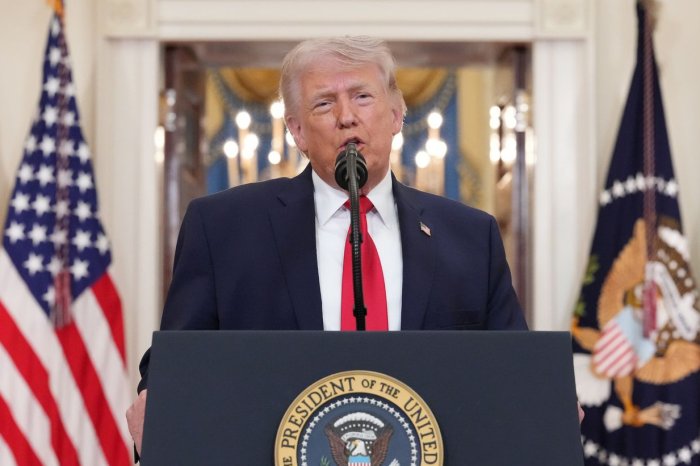
President Donald Trump delivers a prime-time address to the nation from the Cross Hall in the White House on Wednesday. President Trump used the address to update the public on the month-long war in Iran. Pool photo by Alex Brandon/UPI | License Photo
Gurdaspur, Punjab, India – Ramesh Kumar, 42, is anxiously doing the calculations for his crops this year.
Standing at the edge of his wheat field in northwest Punjab’s Gurdaspur, he runs through the numbers in his head, totting up fertiliser costs, expected yield, and market prices.
Then he shifts to more personal concerns: School fees, household expenses, loan repayments and the money he has been saving for his daughter Varsha’s wedding.
“I don’t know if we can afford it this year,” he says. “Everything depends on the crop.”
The uncertainty has crept in quietly.
Fertiliser, once a fairly predictable staple in farming, has become more expensive and harder to secure in time. For Kumar, it is not so much a question of cost as it is the difference between stability and strain.
“If prices go up more, we will have to cut somewhere,” he says. “Maybe delay the wedding. If things get worse … even children’s education becomes difficult.”
School fees for his eldest son, Amit, 12, are due in the coming weeks, and Kumar has been setting aside money for his younger daughter Varsha’s future wedding.
It’s never easily affordable, even in good times. “We somehow manage,” Kumar says. “But if the harvest is weak, then we have to think about what to prioritise, what to delay.”
For farmers like him across South Asia, the United States-Israel war on Iran – unfolding thousands of kilometres away – is not just a matter of distant geopolitics.
It is shaping decisions inside their homes.
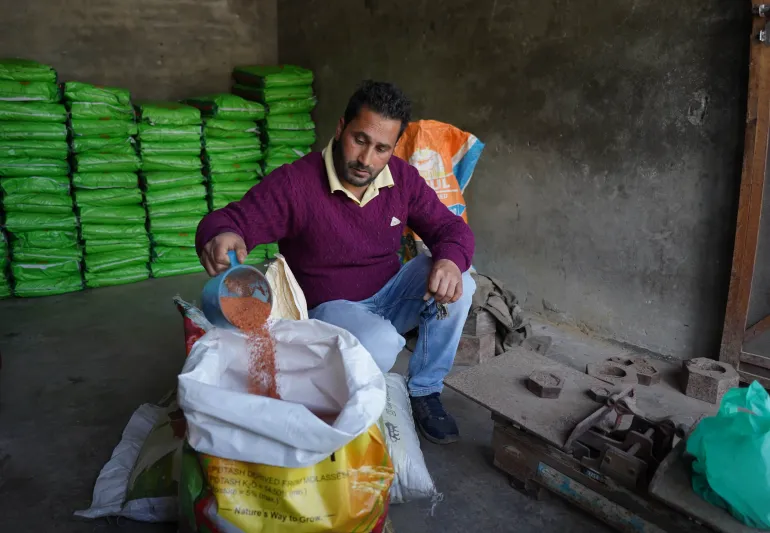
A worker pours fertiliser into a sack at a storage facility in Srinagar, Indian-administered Kashmir [Sajad Hameed/Al Jazeera]
A distant crisis with local consequences
At the centre of the unfolding crisis is the Strait of Hormuz, a narrow shipping lane more than 2,000km (1,240 miles) from India’s northern plains. It lies between Iran and Oman, linking the Gulf and its oil producers to the open ocean and, from there, to global markets.
About one-fifth of the world’s oil and liquefied natural gas (LNG) supplies pass through this body of water, which Iran closed down shortly after the first US-Israeli strikes on Tehran on February 28.
Vast volumes of LNG, essential for manufacturing nitrogen-based fertilisers, are transported from Gulf producers to Asia via this route. Any disruption can delay shipments, push up freight and insurance costs and place a stranglehold on supply.
Interruptions to the supply of fertiliser can ripple quickly, reducing crop yields, increasing costs and raising food prices.
The risks are already being felt thousands of kilometres away.
South Asia, home to nearly two billion people, relies heavily on fertiliser-intensive farming to produce staple crops such as wheat and rice. Over the past few decades, the increasing use of fertilisers – which can hugely boost crop yields – has played a key role in agricultural productivity across the region.
The agriculture sector now employs about 46 percent of the workforce in India, about 38 percent in Pakistan, nearly 40 percent in Bangladesh, and more than 60 percent in Nepal.
A farmer spreads fertiliser around apple trees in an orchard in Baramulla, Indian-administered Kashmir, March 2026 [Sajad Hameed/Al Jazeera]
The degree to which countries in the region depend on the Strait of Hormuz varies, but all rely heavily on the trade in fertilisers that this shipping route facilitates.
In India, the agriculture sector is worth $400bn, according to Indian government and World Bank data, and supports the livelihoods of more than half the population, either directly or indirectly. More than 100 million farming families are directly dependent on the sector.
The country imports a substantial share of its fertiliser requirements and other key raw materials, particularly phosphates and potash, as well as natural gas used to manufacture fertiliser, with about 30–35 percent of these supplies moving through or originating from routes that pass via the Strait of Hormuz.
In Pakistan, the agriculture sector contributes close to 20 percent of gross domestic product (GDP), according to Pakistan government estimates, and employs millions. About 20-25 percent of Pakistan’s fertiliser imports, particularly DAP (diammonium phosphate), pass through the Strait of Hormuz at some point in transit. Additionally, the sector relies on domestic natural gas for the production of urea, a key nitrogen-based fertiliser and, with Gulf natural gas supplies held up in the Strait of Hormuz, the price of natural gas everywhere – even at home – is on the rise.
In Bangladesh, where millions of smallholder farmers rely heavily on imported fertilisers, the agricultural sector accounts for about 12-13 percent of GDP, according to government data. The country’s farming industry relies heavily on imported fertilisers to sustain crops, meaning farmers are highly exposed to international supply shocks and price swings.
Furthermore, roughly 25-30 percent of Bangladesh’s imported fertiliser is shipped via routes passing through the Strait of Hormuz.
Nepal, where agriculture contributes about 24 percent of GDP, imports nearly all of its fertiliser needs, with about 25-30 percent of arriving via India, via the Gulf and the Strait of Hormuz.
A worker handles granular fertiliser at a storage facility in Punjab, northern India, March 2026 [Sajad Hameed/Al Jazeera]
Livelihoods at stake
Overall, even minor disruption in the Gulf – let alone the complete closure of the critical Strait of Hormuz – can have dire consequences for hundreds of millions of people.
The Indian government has sought to reassure farmers that supplies remain secure – for now.
Prime Minister Narendra Modi told Parliament on March 23: “Adequate arrangements have been made for fertiliser supply for the summer sowing season…The government has diversified options for oil, gas and fertiliser imports… Domestic production of urea, DAP and NPK [nitrogen, phosphorus and potassium fertilisers] has been expanded… Farmers now have access to Made in India Nano Urea and are encouraged to adopt natural farming…”
He added: “Under the PM Kusum scheme, more than 22 lakh (2.2 million) solar pumps have been provided, reducing dependence on diesel… I am confident that through joint efforts, India will manage these challenges effectively and continue to support our farmers.”
On the ground, however, confidence is low. Farmers say uncertainty is already influencing decisions.
In Pampore, in the south of Indian-administered Kashmir, 53-year-old mustard farmer Ghulam Rasool says price signals travel faster than supply disruptions.
“We hear about war, about shipping problems,” he tells Al Jazeera. “Even before shortages happen, fertiliser becomes expensive.”
Rasool says farmers often respond early by cutting down on the amount of fertiliser they are using, even before actual shortages emerge.
“If we use less, production will fall,” he says. “But sometimes we have no choice.”
In Pakistan’s South Punjab, wheat farmer Muneer Ahmad, 45, is preparing for the next sowing cycle.
“If fertiliser becomes expensive, it will affect everyone here,” he says.
Government officials have expressed confidence in Pakistan’s fertiliser supply amid the Middle East conflict, and claim the government is fully prepared to ensure adequate supplies during the region’s peak sowing period, which typically begins between April and June, depending on the crop.
According to a statement by Pakistan’s federal secretary for agriculture to Al Jazeera, Federal Minister Rana Tanveer Hussain told a meeting on March 25 that the government has started proactive monitoring, is expanding domestic urea and DAP production and taking steps to ensure fertilisers reach farmers at affordable prices.
However, urea production requires supplies of natural gas, meaning global energy price shocks can still translate into rising production costs.
A farm worker spreads fertiliser across a field as part of routine crop management during the growing season in north India [Sajad Hameed/Al Jazeera]
For farmers, even small increases matter
“We already have loans and expenses,” Ahmad says. “If costs go up, we feel it immediately.”
In Rangpur, northwestern Bangladesh, farmer Mohammad Ibrahim, 41, says fertiliser supplies are already becoming unpredictable.
“Sometimes it is available, sometimes not,” he says. “And when it comes, the price is higher.”
Meanwhile, in Nepal’s Gulmi district, farmer Meghnath Aryal, 38, worries that crops will be reduced if a major supply problem does appear.
“If fertiliser does not arrive on time, the crop suffers,” he says. “If it becomes expensive, we reduce use.”
Bangladesh’s Agriculture Secretary Rafiqul Mohammad told Al Jazeera the government is “closely monitoring the situation” and officials have tried to reassure farmers that fertiliser supplies are sufficient for the coming months.
The government has finalised plans to import about 500,000 tonnes of urea in the near term, while also exploring alternative suppliers such as China and Morocco to secure additional supplies in the longer term.
There is no immediate shortage at present, the Agriculture Ministry says.
Ram Krishna Shrestha, joint secretary at Nepal’s Ministry of Agriculture and Livestock Development, told Al Jazeera that fertiliser distribution within the country remains largely stable for now, with supplies already secured for the upcoming rainy season, particularly for paddy crops such as rice.
However, he warned that there may be delays to contracted shipments as a result of the Middle East crisis.
“We have managed fertilisers for the upcoming season, but there could be challenges in timely supply because of the current situation,” he said, pointing to global price increases and logistical disruptions, including those caused by the closure of the Strait of Hormuz.
Shrestha added that as companies report shortages and rising prices in international markets, the government has asked suppliers to expedite deliveries.
“Authorities are also advising farmers to increase the use of traditional nutrient sources such as farmyard manure, compost, green manuring and azolla [a natural fertiliser] to offset any potential shortfall in chemical fertilisers,” he said.
No immediate new fertiliser subsidies have been announced, he said, though adjustments remain under discussion as the situation evolves.
Mustard farmer Ghulam Rasool scatters fertiliser by hand in a field in Pampore, Kashmir, India [Sajad Hameed/Al Jazeera]
Rising food prices on the horizon
The implications extend beyond individual farmers.
Across South Asia, fertiliser use has been central to maintaining crop yields – and keeping large populations fed. Any reduction in availability or increase in costs can quickly lower production. That, in turn, pushes up food prices, a sensitive issue in a region where households spend a large proportion of their income on food.
For governments, the challenge is complex.
In the past, subsidies have kept fertilisers affordable for farmers, but this becomes a fragile balancing act if global prices rise, placing additional pressure on public finances.
In India, Ramesh Kumar is already making adjustments – but he is walking a tightrope.
He has decided to use less fertiliser this season, even though he knows it could reduce yields.
“It is a risk,” he says. “But what choice do we have?”
Lower production will mean less income and harder decisions at home.
“School fees have to be paid,” he says. “Household expenses cannot stop.” He looks across his field.
“And the wedding… we will see.”
Ultimately, sacrifices will have to be made in his household.
Across borders, the same uncertainty is unfolding.
In Pakistan, Ahmad is worried about rising costs. In Bangladesh, Ibrahim is mostly concerned about the availability of fertiliser and, in Nepal, Aryal fears delays in supply.
For Ramesh Kumar, the stakes are clear.
“For others, this is about war,” he says. “For us, it is about whether we can take care of our family.”
A Russian tanker has delivered enough fuel to meet Cuba’s energy needs for up to 10 days, following a three-month blockade.
Published On 31 Mar 202631 Mar 2026
A Russia-flagged tanker carrying 730,000 barrels of oil has docked in Cuba, marking the first time in three months that an oil tanker has reached the island nation.
The administration of United States President Donald Trump allowed the Anatoly Kolodkin to proceed despite an ongoing US energy blockade. The Aframax tanker entered the Bay of Matanzas – the country’s largest supertanker and fuel storage port – on Tuesday at daybreak.
Recommended Stories
list of 4 itemsend of list
The vessel, under US sanctions, entered Cuban territorial waters late on Sunday, not far from the US Navy base at Guantanamo Bay. The United States said it was allowing the tanker to deliver fuel for humanitarian reasons.
The Anatoly Kolodkin entered the Bay of Matanzas under clear skies and light winds at sunrise. Much of the nearby city – and the majority of Cuba – was without power when the tanker arrived at the port area.
Cuba has not received an oil tanker in three months, according to President Miguel Diaz-Canel, exacerbating an energy crisis that has led to seemingly endless blackouts across the country of 10 million people and brought hospitals, public transportation, and farm production to the brink of collapse.
Cubans, including Energy and Mines Minister Vicente de la O Levy, cheered the ship’s arrival. A shortage of petroleum has exacerbated a deep economic crisis, leaving the population mired in long blackouts and facing severe shortages of food and medicine.
“Our gratitude to the Government and People of Russia for all the support we are receiving. A valuable shipment that arrives amidst the complex energy situation we are facing,” de la O Levy wrote on X.
The fuel, if delivered, would give Cuba’s communist-run government breathing room amid growing pressure from the Trump administration, which has promised change in Cuba.
It will take days before the crude on board the Anatoly Kolodkin can be processed domestically and turned into motor fuel and refined products, such as diesel and fuel oil for power generation.
The ship is carrying Russian Urals, a medium sour crude, which is a good fit for Cuba’s ageing refineries.
Cuba produces barely 40 percent of its required fuel and relies on imports to sustain its energy grid. Experts say the anticipated shipment could produce about 180,000 barrels of diesel, enough to feed Cuba’s daily demand for nine or 10 days.
Cuba used to receive most of its oil from Venezuela, but those shipments have been halted ever since the US attacked the South American country and abducted its leader, Nicolas Maduro, in early January.
The Houthis in Yemen have launched their first attacks on Israel, opening a new front in the month-long regional war. Al Jazeera’s Virginia Pietromarchi explains why the move could raise new risks for oil shipping, and civilians in Yemen.
As the United States-Israeli war on Iran enters its fourth week this weekend, pressure on oil and gas markets continues to mount due to severe disruption to shipping traffic through the Strait of Hormuz as well as attacks on and around key energy facilities in the Gulf.
In peacetime, 20 percent of the world’s oil and gas is shipped from producers in the Gulf through the Strait of Hormuz – the only route to the open ocean – including 20 million barrels of oil per day.
To bridge the shortage its closure has caused, countries in the Middle East are exploring alternative routes to get energy exports out.
In this explainer, we look at three major pipelines in the Middle East that producers may be pinning their hopes on, and whether they can fill the gap.
What has happened in the Strait of Hormuz?
On March 2 – two days after the US and Israel began strikes on Iran – Ebrahim Jabari, a senior adviser to the commander-in-chief of Iran’s Islamic Revolutionary Guard Corps (IRGC), announced that the strait was “closed”. If any vessels tried to pass through, he said, the IRGC and the navy would “set those ships ablaze”. Since then, traffic through the strait has plunged by more than 95 percent.
Iranian officials have most recently stated that the strait is not completely closed – except to ships belonging to the US, Israel and those who collaborate with them – but have also laid down new ground rules. Any vessel must secure Tehran’s approval to transit through the narrow waterway.
As a result, over the past fortnight, countries have been scrambling to do deals with Iran to secure safe passage and a few, mostly Indian, Pakistani and Chinese-flagged tankers have been allowed to pass.
On Thursday, Malaysian Prime Minister Anwar Ibrahim thanked Tehran for granting Malaysian vessels “early clearance” through the strait.
Meanwhile, about 2,000 ships flying the flags of other nations are stuck on either side of the strait.
(Al Jazeera)
Which oil pipelines could serve as alternate routes?
The only alternative to shipping oil is piping it across land or under the sea. Three oil pipelines could work as ways around the Strait of Hormuz, including:
Saudi Arabia’s East-West Pipeline
The East-West pipeline is also known as the Petroline and is operated by Saudi oil giant Aramco. Aramco is one of the world’s largest companies, with a market capitalisation exceeding $1.7 trillion and annual revenues of $480bn. The oil giant controls 12 percent of global oil production, with a capacity of more than 12 million bpd.
It is a 1,200km (745-mile) pipeline which runs from the Abqaiq oil processing centre close to the Gulf in Saudi Arabia to the Yanbu port on the Red Sea, on the other side of the country.
However, the pipeline does not have the capacity to fully make up for the Hormuz closure.
In 2024, about 20 million barrels per day (bpd) passed through the Strait of Hormuz, according to data from the United Nations. Crude oil and condensate made up 14 million bpd of this, while petroleum was the remaining 6 million bpd.
The East-West pipeline has the capacity of transporting up to 7 million bpd. On March 10, Aramco said about 5 million bpd could be made available for exports, while the rest could supply local refineries.
Since the US-Israeli war on Iran began at the end of February, Saudi Arabia has ramped up its oil flow through this pipeline. In January and February, an average of 770,000 bpd flowed through the pipeline, according to data from Kpler, a data and analytics company. By Tuesday this week, this had increased to an average of 2.9 million bpd.
However, using the Saudi pipeline still carries a risk.
The Houthis, an Iran-backed Yemeni armed group whose attacks on ships in the Red Sea caused global shipping chaos during Israel’s genocidal war in Gaza from 2023 to 2025, could target the Bab al-Mandeb Strait, which connects the Red Sea to the Gulf of Aden, and the Indian Ocean beyond.
An unnamed Houthi leader told the Reuters news agency that the Houthis remain ready to attack the Red Sea again in solidarity with Tehran, the agency reported on Thursday.
“We stand fully militarily ready with all options. As for other details having to do with determining zero hour they are left to leadership and we are monitoring and following up with the developments and will know when is the suitable time to move,” the Houthi leader said.
The Bab al-Mandeb is the southern outlet of the Red Sea, situated between Yemen on the Arabian Peninsula and Djibouti and Eritrea on the African coast.
It is one of the world’s most important routes for global seaborne commodity shipments, particularly crude oil and fuel from the Gulf bound for the Mediterranean via the Suez Canal or the SUMED pipeline on Egypt’s Red Sea coast, as well as commodities bound for Asia, including Russian oil.
The Bab al-Mandeb is 29km (18 miles) wide at its narrowest point, limiting traffic to two channels for inbound and outbound shipments.
Iran could open a new front in the Bab al-Mandeb Strait if attacks are carried out on Iranian territory or its islands, Iran’s semiofficial Tasnim cited an unnamed Iranian military source as saying on Wednesday.
(Al Jazeera)
UAE’s Abu Dhabi Crude Oil Pipeline
The Abu Dhabi Crude Oil Pipeline is also called the ADCOP or the Habshan-Fujairah pipeline.
The 380km pipeline runs from Habshan, an oil and gasfield in the southwestern area of Abu Dhabi, United Arab Emirates, to the port of Fujairah on the Gulf of Oman.
The pipeline, which became operational in 2012, has a capacity of about 1.5 million barrels per day (bpd). It is unclear how much is now being transported through the pipeline.
However, oil exports from Fujairah do appear to have risen in the past month despite the closure of the strait, averaging 1.62 million bpd in March compared with 1.17 million bpd in February, according to Kpler analyst Johannes Rauball, who spoke to Reuters.
Iraq-Turkiye Crude Oil Pipeline
The Iraq-Turkiye Crude Oil Pipeline, also called the Kirkuk-Ceyhan Pipeline, links Iraq to the Mediterranean coast of Turkiye.
The pipeline, which has the capacity of 1.6 million bpd, currently carries about 200,000bpd.
Iraq is among the top five global producers of oil and is the second largest within the Organization of the Petroleum Exporting Countries (OPEC), exceeding 4 million bpd.
Can these pipelines replace the Strait of Hormuz?
No. While these pipelines can take on some of the capacity of Hormuz, their combined capacity is only about 9 million bpd, compared with about 20 million bpd for the strait.
Additionally, these pipelines are land-based and within the range of Iranian missiles and drones, which makes them just as vulnerable to attacks and damage in the ongoing conflict as ships travelling through the strait. Throughout the war, energy infrastructure all over the Gulf has suffered strikes.
Are there other options?
Theoretically, oil can be transported on trucks, but this is costly, slow and inefficient.
A standard truck can carry anywhere between 100 to 700 barrels per day, depending on the number of trips. Hundreds of thousands of barrels would be needed to meet needs, requiring thousands of trucks, which could also be targeted in strikes.
Iran’s paralysis of the Strait of Hormuz has led to major disruption in global oil and gas supply and many countries have begun tapping into their strategic oil reserves to evade an economic crisis.
Since the US-Israeli war on Iran began on February 28, Tehran, whose territorial waters extend into the Strait, has blocked the passage of vessels carrying 20 percent of the world’s oil and liquified natural gas (LNG) from the Gulf to the rest of the world. The strait is the only waterway to open ocean available for Gulf oil and gas producers.
Recommended Stories
list of 3 itemsend of list
Last week, the price of Brent crude topped $100 a barrel compared to the pre-war price of around $65.
The United States Trump administration has tried and failed to re-open the strait. First, it called on Western nations to send warships to help escort shipping through the strait – an option all have declined or failed to respond to. Then, on Sunday, Trump gave Iran 48 hours to reopen the strait or face US attacks on its power plants.
However, on Sunday, Iran said it would hit back at power plants in Israel and those in the region supplying electricity to US military assets. And, on Monday, Iran said it would completely shut the Strait of Hormuz if US attacks on its energy infrastructure continue.
Following Iranian attacks on energy infrastructure across the Gulf over the past three weeks, countries including Saudi Arabia, UAE, Iraq and Kuwait have also cut their oil output, raising further concerns about global oil and gas supply.
On Monday, Trump appeared to backtrack on his Hormuz ultimatum when he ordered all US strikes on power plants in Iran to be paused for five days and claimed the US was holding talks with Iran. Iran has denied this.
In the face of chaos, on March 11, the 32 member countries of the International Energy Agency (IEA) agreed to release 400 million barrels of oil from their strategic emergency reserves – the largest stock draw in the agency’s history. It is far higher than the 2022 release of 182 million barrels of oil by the group’s members after Russia invaded Ukraine.
What are strategic oil reserves and which countries hold them?
What is a strategic oil reserve?
A strategic oil reserve or strategic petroleum reserve (SPR) is an emergency stockpile of crude oil which is held by the government of a country in government facilities.
This oil reserve can be drawn on in cases of emergencies like wars and economic crises. Governments generally buy the oil through agreements with private companies in order to keep their reserves filled.
According to the IEA, its members currently hold more than 1.2 billion barrels of these public emergency oil stocks with a further 600 million barrels of industry stocks held by private organisations but under government mandate to be available to supplement public needs.
Other reserves are also held by non IEA members like China.
Which countries have strategic oil reserves? Can they withstand the war in Iran?
China
Beijing is not an IEA member, but holds the world’s largest strategic oil reserve.
According to China’s Ministry of Ecology and Environment, Beijing “started a state strategic oil reserve base programme in 2004 as a way to offset oil supply risks and reduce the impact of fluctuating energy prices worldwide on China’s domestic market for refined oil”.
“The bases are designed to maintain strategic oil reserves of an equivalent to 30 days of imports, or about 10 million tonnes,” according to a 2007 report from Chinese state news agency Xinhua.
These strategic oil reserves are primarily located along China’s eastern and southern coastal regions such as Shandong, Zhejiang and Hainan.
China does not officially publish information about its crude inventories so it is not clear how much oil the country has in reserve. However, according to energy analytics firm Vortexa, in 2025, “China’s onshore crude inventories (excluding underground storage) continued to rise… reaching a record 1.13 billion barrels by year-end”.
According to data from Kpler, China bought more than 80 percent of Iran’s shipped oil in 2025. As the war in Iran escalates, therefore, Chinese companies such as refiner Sinopec have begun pushing for permission to use oil from the country’s reserves according to a Reuters report on Monday.
“We basically won’t buy Iranian oil, this is pretty clear,” Sinopec President Zhao Dong told a company results briefing in March, according to Reuters.
“We believe the government is closely monitoring crude oil and refined fuel inventories and market situations, and will advance policies at the appropriate time to support refinery productions,” he added.
US
Of the IEA members, the US holds one of the largest strategic oil reserves with 415 million barrels of oil. The stores are maintained by the US Department of Energy. It has confirmed that it will release 172 million barrels of oil from its SPR over this year as its contribution to coordinated efforts with the IEA.
On Friday, the Trump’s administration announced that it has already lent 45.2 million barrels of crude from the SPR to oil companies.
The US created its SPR in 1975 after an Arab oil embargo triggered a spike in gasoline prices which badly affected the US economy.
The reserves are located near big US refining or petrochemical centres, and as much as 4.4 million barrels of oil can be shipped globally per day.
The SPR currently covers roughly 200 days of net crude imports, according to a Reuters news agency calculation.
US presidents have tapped into the stockpile to calm oil markets during war or when hurricanes have hit oil infrastructure along the US Gulf of Mexico.
In March 2024, US President Joe Biden announced oil would be released from the reserve to ease pressure from oil price spikes following Russia’s invasion of Ukraine in February 2022 and amid subsequent sanctions imposed on Russian oil by the US and its allies.
Japan
An IEA member, Japan also has one of the world’s largest strategic oil reserves.
According to Japanese media Nikkei Asia, at the end of 2025, the country held about 470 million barrels of in emergency reserves which is enough to meet 254 days of domestic consumption. Out of this amount, 146 days worth of oil are government-owned, 101 days are owned by the private sector, and the remainder is jointly stored by oil-producing countries.
Japan set up its national oil reserve system in 1978 to prevent future economic disruptions following the global oil crisis in 1973. That oil crisis heightened Japan’s vulnerability and dependence on oil from abroad. The country remains one of the world’s largest oil importers, relying on fossil fuels from overseas for about 80 percent of its energy needs.
Japan’s reserves are primarily located in 10 coastal national stockholding bases with major storage sites in the Shibushi base in Kagoshima in southern Japan.
On March 16, Japan announced that it had begun releasing oil from its emergency reserves amid the global energy crisis sparked by the effective closure of the Strait of Hormuz.
Japanese Prime Minister Sanae Takaichi told journalists the country would unilaterally release 80 million barrels of oil from stockpiles amid supply concerns.
UK
As of February 26, according to the UK Department of Energy Security and Net Zero, the UK holds about 38 million barrels of crude oil and 30 million barrels of refined products, as strategic reserves. The reserves are thought to be able to last around 90 days.
The country established its reserves in 1974 following the oil crisis of the 1970s and also to meet its IEA obligations. Members of the organisation are required to maintain at least 90 days of net imports in reserve.
The UK’s strategic reserves are largely held by private oil companies, but are regulated by the government. Milford Haven in South Wales and Humber in northeast England are key locations of reserves.
The country is among the 32 IEA nations releasing oil from its reserve to address the oil crisis amid the war in Iran. The UK government will be contributing 13.5 million barrels as a part of the release.
EU
EU member nations including Germany, France, Spain and Italy, all IEA members, also hold strategic oil reserves.
Germany has 110 million barrels of crude oil and 67 million barrels of finished petroleum products which are held by the government and can be released in a matter of days, according to Germany’s economy ministry.
France reported about 120 million barrels’ worth of crude and finished products in reserve at the end of 2024, the most recent data publicly available. About 97 million barrels of that is held by SAGESS, a government-mandated entity, with a breakdown of about 30 percent crude oil, 50 percent gasoil, 9 percent gasoline, 7.8 percent jet fuel and some heating oil. Another 39 million barrels are held by the country’s oil operators.
On March 16, Spain approved the release of around 11.5 million barrels of oil reserves over 90 days to counter supply shortages caused by the effective closure of the Strait of Hormuz, Energy Minister Sara Aagesen told reporters. This is the country’s contribution to the IEA release. The country has around 150 million barrels of crude oil reserves in total.
Italy, by law, was holding about 76 million barrels of reserves, representing 90 days of Italy’s average net oil imports, in 2024.
The homepage of South Korean shipping company Sinokor Merchant Marine (Janggeum Shipping) is shown in this screenshot. Captured by Asia Today from Sinokor website
March 16 (Asia Today) — A bold bet by a South Korean shipping heir on ultra-large oil tankers is paying off handsomely as the war involving Iran disrupts global energy markets and drives tanker demand sharply higher.
Bloomberg reported that Sinokor Merchant Marine, a major South Korean shipping company, positioned itself to profit from the crisis after securing a large fleet of very large crude carriers (VLCCs) months before the conflict escalated.
The strategy was led by Jeong Ga-hyun, a director at Sinokor Petrochemical and the son of Sinokor Chairman Jeong Tae-soon, according to the report.
Bloomberg described the move as an unprecedented large-scale bet in the global tanker market, executed well before the outbreak of the Iran conflict.
Tankers deployed to Gulf before war
On Jan. 29, weeks before the war erupted in late February, Sinokor reportedly deployed at least six empty VLCCs to the Persian Gulf, positioning them to wait for cargo.
After disruptions in the Strait of Hormuz pushed tanker demand and charter rates sharply higher, the strategy began generating massive returns.
The Strait of Hormuz is one of the world’s most critical energy chokepoints, handling roughly 20% of global oil shipments.
Tanker rates surge to $500,000 a day
With oil exports disrupted and storage facilities across the Middle East filling rapidly, oil producers have increasingly turned to tankers as floating storage units.
According to Bloomberg, Sinokor is now chartering vessels for about $500,000 per day, roughly ten times last year’s average tanker rates.
Industry estimates suggest that by late February the company controlled around 150 VLCCs, representing roughly 40% of available tankers not already tied up in sanctions or long-term contracts.
Quiet heir behind massive shipping strategy
Jeong is known in the shipping industry as the low-profile heir to one of South Korea’s major maritime families.
Bloomberg reported that he rarely appears publicly and is known internally for a military-style management approach. Industry anecdotes even describe him challenging employees and business partners to arm-wrestling contests.
Oil supply disruptions reshape tanker market
The Iran war has dramatically altered global oil transportation patterns, forcing ships to reroute and increasing the need for offshore storage.
Under those conditions, Sinokor’s aggressive tanker acquisition strategy is now being viewed as one of the biggest winners of the crisis, Bloomberg said.
WSJ: Sinokor among winners of Hormuz crisis
The Wall Street Journal earlier identified Sinokor as one of the companies benefiting from the Strait of Hormuz tensions.
According to the newspaper, the company purchased dozens of oil tankers and deployed some of them to the Gulf region even before the conflict intensified.
Sources told the Journal that Sinokor is leasing several vessels to ADNOC, the United Arab Emirates’ state-owned oil company, to be used as floating storage facilities.
These vessels can earn up to $500,000 per day in charter fees, the report said.
As land-based storage in Gulf oil-producing countries approaches capacity, producers have increasingly stored crude at sea. Drilling firms in Iraq and Kuwait have even slowed production due to storage shortages.
The WSJ also noted that Greek shipping magnate George Prokopiou adopted a similar strategy, sending at least five tankers to the Strait of Hormuz through his company Dynacom, which is reportedly earning up to $440,000 per day – about four times pre-war rates.
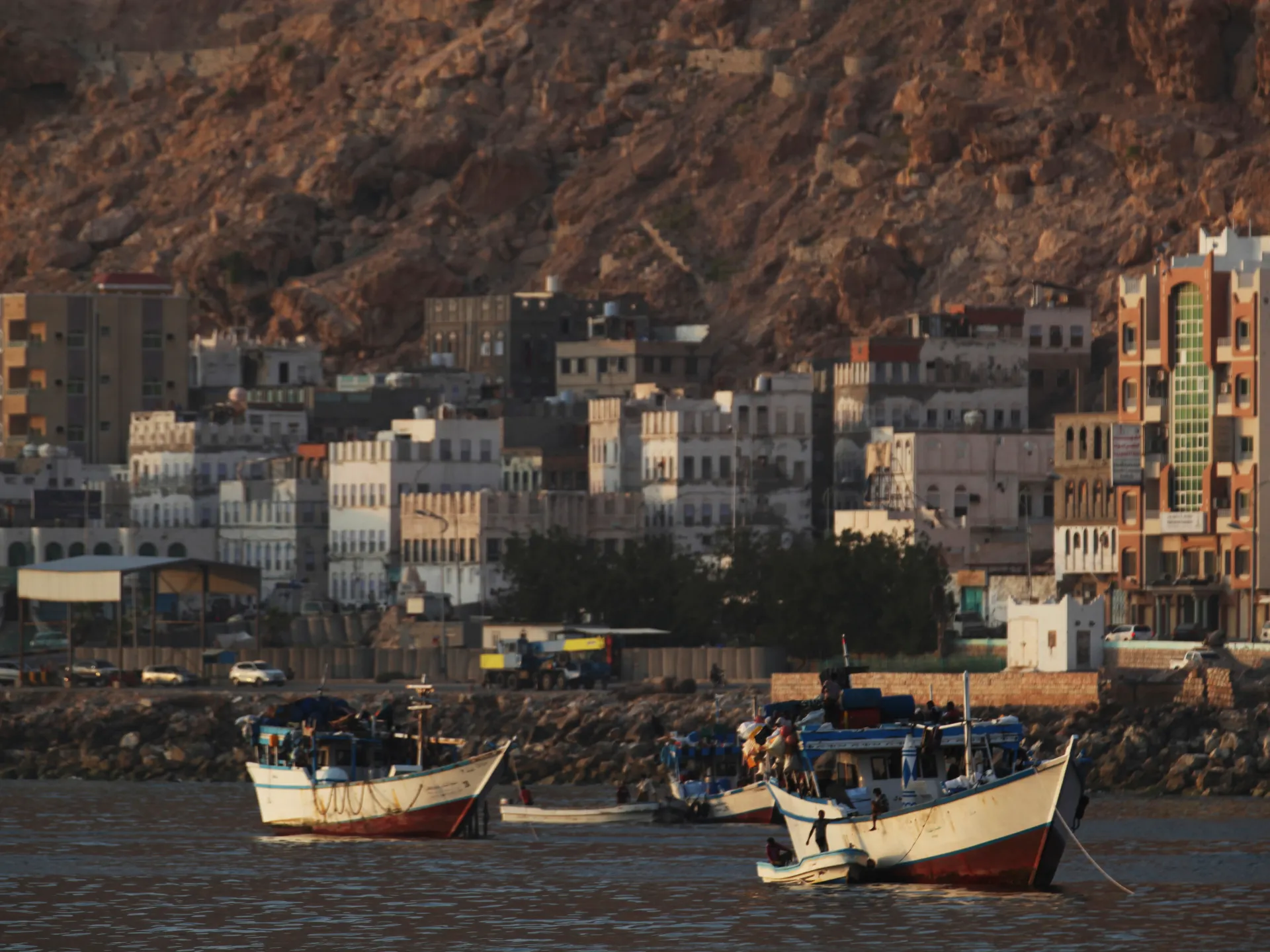
Mukalla, Yemen – A reported decision to impose thousands of dollars in fees on shipping headed for Yemen has experts worried that the price of imported goods and food will increase in the war-torn country, as it starts to feel the economic impact of the United States and Israel’s conflict with Iran.
Local traders and officials have said that international shipping companies informed importers earlier this month of the imposition of new fees of about $3,000 on each container bound for Yemen, described as “war risk” fees. The surprise move prompted government officials to scramble to assess and address its potential repercussions.
Recommended Stories
list of 3 itemsend of list
Because Yemen imports nearly 90 percent of its food and other essential commodities, economists and humanitarian organisations warn that the rise in shipping and insurance costs could quickly translate into higher prices for fuel, food and other goods, further worsening an already dire humanitarian situation.
Mohsen al-Amri, transport minister in Yemen’s internationally-recognised government based in the southern city of Aden, said he had instructed that the fees not be paid by ships already docked at Yemeni ports or those bound for the country, insisting that the ports remain safe.
“Our ports are far from the areas of geopolitical tension in the Gulf and the Strait of Hormuz, making the imposition of ‘risk’ fees on shipments to these relatively safe areas unjustified from both operational and security perspectives,” he said in a social media post last week.
Al Jazeera has reached out to shipping companies to confirm details of the fee, but has yet to receive responses.
For more than a decade, Yemen has been gripped by a bloody war between the Saudi-backed government, based in Aden, and the Iran-aligned Houthi movement, which controls the capital, Sanaa. The conflict has killed and wounded thousands of people and displaced millions, creating what the United Nations once described as the world’s worst humanitarian crisis. Hostilities have significantly declined since April 2022, when the warring parties agreed to a temporary United Nations-brokered truce.
‘High-risk’
Abdulrab al-Khulaqui, deputy chairman of the Yemen Gulf of Aden Ports Corporation, said Yemeni ports have long been classified as high-risk, prompting shipping companies to impose war-risk surcharges. These can reach about $500 per each 20-foot container and $1,000 per each 40-foot container, on top of regular shipping costs.
Al-Khulaqui said that the $3,000 fee now being demanded was “very high and unusual”, but was justified by shipping companies because they regard Yemeni ports as unsafe, despite their distance from Iran.
Although the Houthis are allied to Iran and previously attacked shipping in the Red Sea following Israel’s genocidal war on Gaza, the Yemeni group has yet to intervene in the US-Israel-Iran conflict. Other Yemeni parties are also not involved, making Yemen one of the few regional countries yet to see any violence related to the fighting.
In addition to barring local traders from paying the new charges, the Yemeni government is considering other measures to pressure shipping companies to cancel the fees, including threatening to stop vessels belonging to those companies from docking at Yemeni ports. Authorities may also allow traders to contact exporters directly in countries of origin to negotiate any additional charges.
The new surcharges come as the United Nations has again sounded the alarm over Yemen’s worsening humanitarian situation, saying nearly 65.4 percent of the population – about 23.1 million people – will require urgent humanitarian assistance and protection services this year. This marks an increase of roughly 3.5 million people compared with 2025.
“Yemen continues to face an escalating food security crisis entering 2026,” the World Food Program said in its February Yemen Food Security Update, released on March 5. “January data revealed that 63 percent of households nationwide are struggling to meet their minimum food needs, including 36 percent facing severe food deprivation.”
Bypassing Yemen’s ports
In addition to rising insurance fees on shipments to Yemen, the war in Iran and potential disruptions in the Strait of Hormuz could cut vital supply routes from regional hub ports such as Jebel Ali in the United Arab Emirates.
Mustafa Nasr, head of the Studies and Economic Media Center, told Al Jazeera that shipping companies may begin seeking alternative hub ports to deliver goods to Yemen, which could increase costs and cause delays.
“The closure of Jebel Ali port would force shipping lines to seek alternative ports that may be farther away and involve significantly higher transportation costs,” he said.
Nabil Abdullah Bin Aifan, manager of the government-run Maritime Affairs Authority in Hadramout province and a maritime researcher, said most goods arriving at Mukalla port – the province’s main seaport – are transported on wooden dhows from Dubai.
He said that if disruptions occur in the Strait of Hormuz, traders may turn to alternative regional hub ports such as Salalah in Oman or Jeddah in Saudi Arabia.
“Large ships come to Dubai to unload their containers, and traders then unload the goods from the containers and load them onto those primitive ships, which have no insurance,” Bin Aifan told Al Jazeera.
For now, wheat shipments from Ukraine and goods transported from China to Yemen may see price increases due to rising insurance costs, while products imported from Gulf countries could disappear from the market.
Shipping lines may also consider routing cargo through the Cape of Good Hope rather than the Gulf, Bin Aifan said.
“Even before the recent developments involving Iran, ports in our region were considered high risk. However, after the relative calm that followed the halt to Houthi attacks in the Red Sea, confidence gradually returned and ships began sailing back to the region. Now, the war has brought the problem back again,” he said.
All of this means that Yemenis, already struggling with poverty and hunger after years of war, will likely have to pay more for imported food and goods.
Abdullah al-Hadad, an English teacher from the city of Taiz with 40 years of experience in the profession, said that his monthly salary – less than $80 – is already not enough to cover his basic needs. Meat and fish have become luxuries for his family, and he still owes nearly one million Yemeni riyals (about $670) to a local grocery shop.
To make ends meet, he works additional jobs as a taxi driver and in a grocery store, while his children also work after school to help support the family and pay for medication for his 10-year-old son, who has autism.
“What I suffer from as a government employee is the extremely low salary, which does not even cover basic necessities such as bread, tea, salt and sugar,” al-Hadad told Al Jazeera.
“Other foods that are essential for a healthy diet, like meat or fish, have become a distant dream.”
“The US Navy at this point can’t even get anywhere close to the Strait of Hormuz without being attacked.” Experts are pouring cold water on Pete Hegseth’s claims that the US is working effectively to reopen the world’s most crucial shipping lane.
New York City, United States – Rising prices on the back of US-Israel strikes on Iran are adding to the economic pressure facing US consumers despite efforts by US President Donald Trump to paint the war as a success.
On Wednesday, Trump declared, “We won – in the first hour it was over.”
Recommended Stories
list of 4 itemsend of list
Trump’s declaration comes even as the Strait of Hormuz remains closed, cutting off oil from the Gulf amid warnings from Iran, which continues to strike ships, that oil could reach $200 per barrel.
The magnitude of the economic pressure on consumers will depend on how long the war lasts and, crucially, how soon shipping traffic can return to the Gulf.
“If it drags on and especially if it remains at this intensity, prices will be higher, and more volatile for consumers,” said Rachel Ziemba, an adjunct senior fellow at the think tank Center for a New American Security.
“If it ends quickly, and it’s a credible and stable end, then we could see prices fairly quickly normalising”.
If the war lasts more than a few weeks, however, observers say the US economy is more likely to see deepening impacts, like 1970s-style “stagflation” or a recession.
When might we see a recession?
On Thursday, the International Energy Agency said in a report that “the war in the Middle East is creating the largest supply disruption in the history of the global oil market.”
According to Sam Ori, who directs the Energy Policy Institute at the University of Chicago, in the past, when oil prices have reached 4 percent to 5 percent of gross domestic product and stayed elevated, “that’s always triggered a recession.”
The US will not hit that threshold as quickly as it would have in the 1970s, when its economy was more deeply dependent on foreign oil, Ori said, but added he expected a recession if prices remained about $140 a barrel for most of the year.
Alternatively, “the indefinite closure of the Strait of Hormuz would so vastly exceed that number, it would not take a year,” he said.
Ori, who used to run an oil shock war game for US officials, said he would have been “laughed out of the room” if he had proposed a scenario where the strait was closed for six months, because many analysts see it as “too big to fail”.
Ori says that assessment is still likely, but recent developments “are chipping away at that level of certainty”.
The Gulf, which separates the Arabian Peninsula and Iran, provides more than one-fifth of the world’s oil supply via tanker ships through the Strait of Hormuz.
The severity of that threat to the global economy is the “strongest indicator that this is going to get resolved pretty fast, because it’s impossible to fathom what would happen if it didn’t”, Ori said.
He added that the conflict has now entered a phase in which it may be moving out of US control, especially as some countries have turned off the oil wells as they run out of storage.
While those events have now been baked into oil prices, the things that he is on the lookout for include “successful mining of the strait, some kind of structural blockage, or a battlespace development that binds the US into a longer, drawn out conflict”, outcomes that could signal a total loss of the strait for an unknown amount of time and create the “conditions for a complete meltdown”.
Higher prices
The war is already driving petrol prices up for US consumers.
Patrick DeHaan, who leads petroleum analysis for the app GasBuddy, said that the national average as of Wednesday is now $3.59 per gallon ($0.95 per litre) – up 65 cents since February.
The highest increases are near the coasts, where US petrol, diesel and jet fuel supplies are more easily diverted to meet global demand, according to DeHaan.
An end to the conflict could lower petrol prices within weeks, DeHaan said, but “every week that this goes on, we could see another 25 to 40 cent increase”.
Robert Rogowsky, an adjunct professor at Georgetown University’s School of Foreign Service, said lower-income people in particular, “will pay the price for this inflationary burst”.
As the war continues, it will also nudge up prices for consumer goods.
Peter Sand, chief analyst for freight intelligence platform Xeneta, said the backup at the Strait of Hormuz is already causing congestion at ports worldwide.
In the short term, consumers should not feel much of a pinch, Sand said. But if the conflict lasts for a month, some goods will be delayed, “and of course, the price tag on those goods also goes up.”
The war also means that the Red Sea, mostly closed in 2025 due to Houthi attacks, will likely stay closed throughout 2026, Sand said. It was expected to reopen, which could have lowered consumer prices.
Oil and oil byproducts from the Gulf are also used directly in consumer goods, like plastics, pharmaceuticals and fertilisers. Shortages now may mean higher prices later.
Fertilisers from the Gulf, for example, are needed soon for spring planting. Delays could affect crops next year.
A shortage of helium from the Gulf could also impact semiconductor manufacturing, delaying car manufacturing and other industries, Ziemba said.
The spectre of 1970’s-style ‘stagflation’
Higher consumer prices could increase the risk of “stagflation”, when stagnant economic growth occurs alongside high unemployment and high inflation.
That is how the US economy responded to the oil price shocks of the 1970s.
Severin Borenstein, faculty director of the Energy Institute at the University of California, Berkeley’s Haas School of Business, said, “There’s certainly concern about stagflation again.”
That combination of high inflation plus high unemployment, Borenstein said, “is just really tough for the Fed to deal with”.
“They can either juice the economy or slow it down, and the two problems call for opposite solutions”, Borenstein said.
The Fed can lower interest rates to prompt spending and hiring, which can make inflation worse, or it can raise interest rates to lower inflation, which can slow hiring.
Ziemba said higher oil prices likely point to “inflation remaining stickier, which means it’s harder for the Fed to cut interest rates.”
As a result, “mortgage rates and other long-term interest rates might be stuck at their current levels,” Ziemba said. Mortgage rates, which were at 5.99 percent on February 27, are up to 6.29 percent as of March 12.
Even if the war ends tomorrow, it may already be accelerating longer-term shifts.
Rogowsky called US attacks on Iran “an injection of adrenaline” into a realignment already under way, as middle powers seek to reduce their reliance on the US.
That realignment “will affect our terms of trade, which will have a distinct impact on our economy”, Rogowsky said.
Logistics consultant David Coffey said for some businesses, the war is expediting conversations about risk. “They may have been assuming ‘Yes, there’s risk in the Middle East,’ but they may not have been assuming that this would kick off”, Coffee said.
Making supply chains more secure could raise costs for consumers, he said.
Military spending and the US budget
Meanwhile, Heidi Peltier, a senior researcher at Brown University’s Costs of War Project, said war also means long-term expenses around debt payments and veterans’ healthcare.
“We have spent at least $1 trillion in interest on the Iraq and Afghanistan wars – and rising, because it’s not like we’ve paid off any of that principal”, Peltier said.
Military spending, she said, also tends to create fewer jobs than government investment in education or healthcare. “If we’re spending money on this, what are we not spending money on?” Peltier asked.
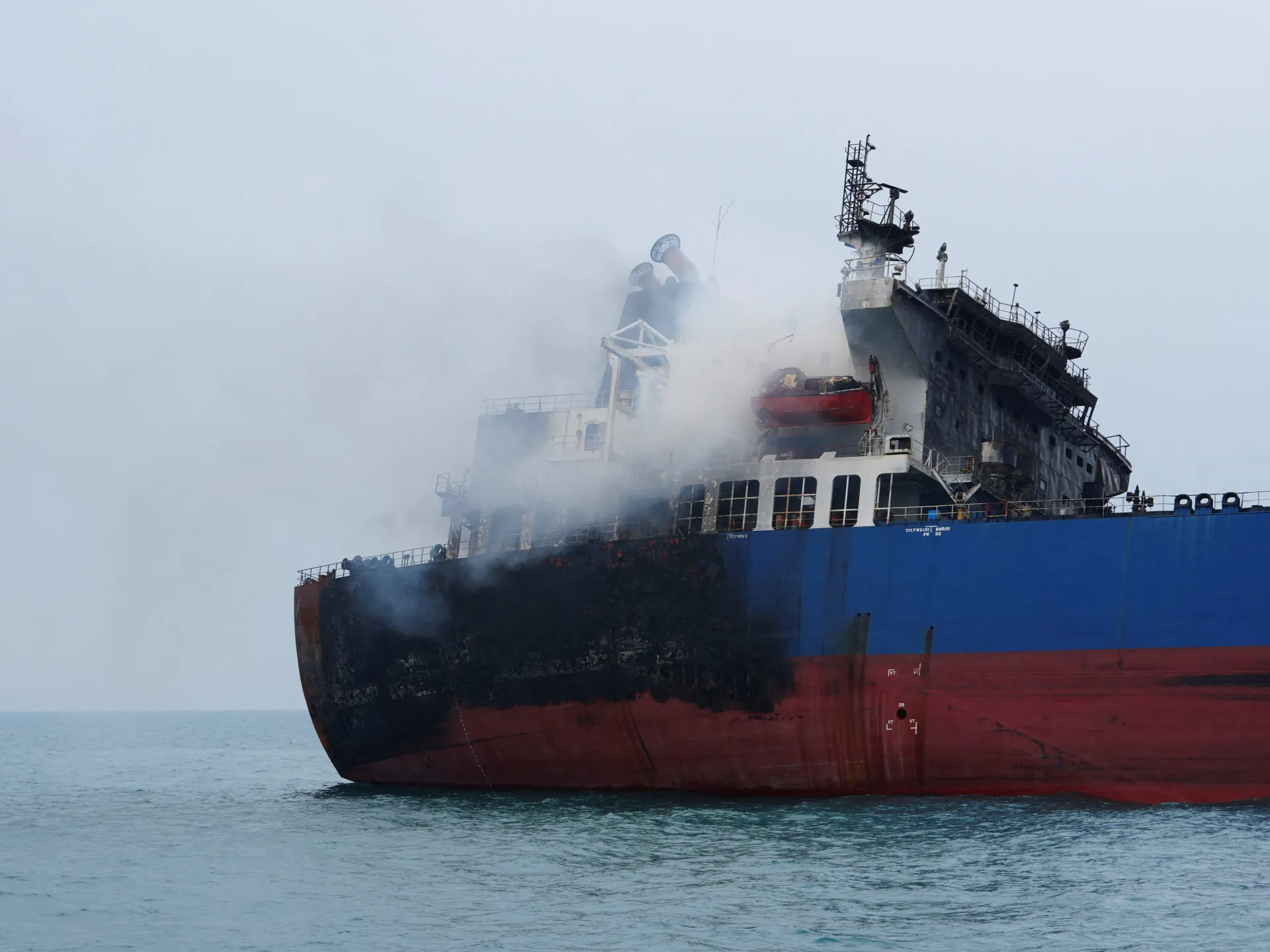
Iranian explosive-laden boats appear to have attacked two fuel tankers in Iraqi waters, setting them ablaze and killing one crew member, after projectiles struck three vessels in Gulf waters, according to reports.
The ships targeted in late-night attacks on Wednesday in the Gulf near Iraq were the Marshall Islands-flagged Safesea Vishnu and the Zefyros, which had loaded fuel cargoes in Iraq, two Iraqi port officials told the Reuters news agency.
Recommended Stories
list of 4 itemsend of list
“We recovered the body of a foreign crew member from the water,” one port security official said, as Iraqi rescue teams continued searching for other missing seafarers. It was not immediately clear which ship that person was linked to.
One Iraqi port security source said Zefyros is flagged in Malta and provided Reuters with a list of crew names.
Al Jazeera’s correspondent in Baghdad, Iraq, Mahmoud Abdelwahed, said the tankers were loaded with crude oil from the Umm Qasr port in southern Iraq in the Basra province, and were attacked soon after their voyage got under way.
“Iraqi officials say this is a flagrant violation of Iraq’s sovereignty given the fact this act, they say, of sabotage has happened in Iraq’s territorial waters,” Abdelwahed said.
Reuters said that reports of the use of explosive-laden unmanned surface vessels, which Ukraine has used with great effect in its war with Russia, come as Iran has blocked oil shipments from transiting the key Strait of Hormuz, through which one-fifth of the world’s oil transits but has been blocked amid the United States-Israeli war on Iran.
Reuters, citing two unnamed sources, also reported on Wednesday that Iran has deployed about a dozen mines in the strait, while US President Donald Trump said US forces had struck 28 Iranian mine-laying vessels, amid warnings by Trump of severe repercussions should Iran lay mines in the key waterway for global shipping.
Strait of Hormuz sealed
Iran’s Islamic Revolutionary Guard Corps (IRGC) have warned that any ship passing through the Strait of Hormuz will be targeted.
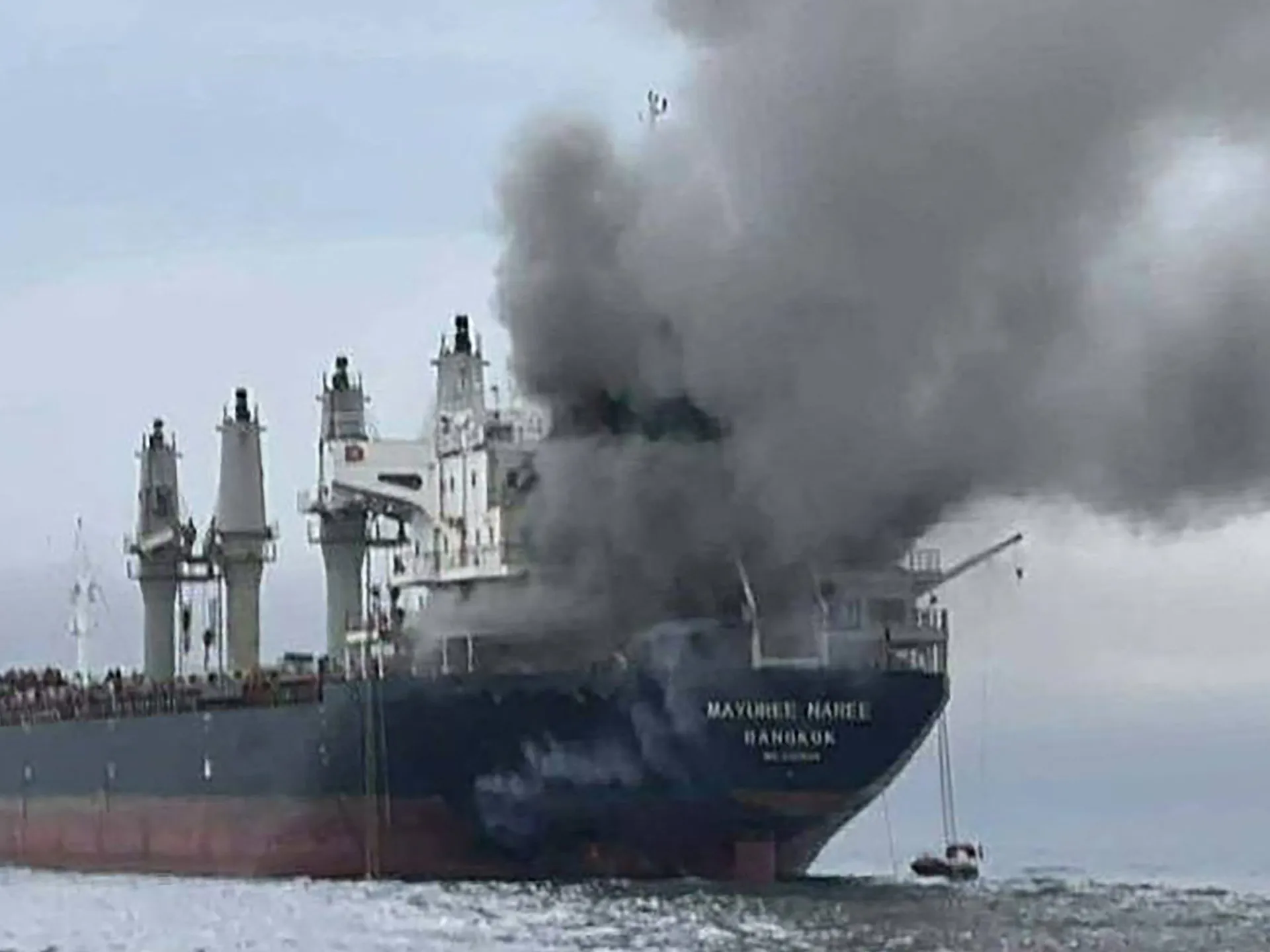
The Thai-flagged Mayuree Naree dry bulk vessel was struck by “two projectiles of unknown origin” while sailing through the strait earlier on Wednesday, causing a fire and damaging the engine room, the ship’s Thai-listed operator Precious Shipping said in a statement.
“Three crew members are reported missing and believed to be trapped in the engine room,” Precious Shipping said.
“The company is working with the relevant authorities to rescue these three missing crew members,” it said, adding that the remaining 20 crew members had been safely evacuated and were ashore in Oman.
Images shared by Thai news outlet Khaosod English showed what were reported to be crew members of the ship after their rescue by Oman’s navy.
The IRGC said in a statement carried by the semi-official Tasnim news agency that the ship was “fired upon by Iranian fighters”, suggesting the first direct engagement by the IRGC, who have previously fired missiles or drones.
The Japan-flagged container ship ONE Majesty also sustained minor damage on Wednesday from an unknown projectile 25 nautical miles (about 46 kilometres) northwest of Ras al-Khaimah in the United Arab Emirates, two maritime security firms said. Its Japanese owner Mitsui OSK Lines and a spokesperson for Ocean Network Express, its charterer, said the vessel was struck while at anchor in the Gulf, and an inspection of the hull revealed minor damage above the waterline.
All crew are safe, they said, adding that the vessel remains fully operational and seaworthy. The owner said the cause of the incident remained unclear and was under investigation.
A third vessel, a bulk carrier, was also hit by an unknown projectile approximately 50 nautical miles (about 93km) northwest of Dubai, maritime security firms said.
The projectile had damaged the hull of the Marshall Islands-flagged Star Gwyneth, maritime risk management company Vanguard said, adding that the vessel’s crew were safe. Owner Star Bulk Carriers said the ship was hit in the hold area while it was anchored. There were no crew injuries and no listing.
The US Navy has refused near-daily requests from the shipping industry for military escorts through the Strait of Hormuz since the start of the war on Iran, saying the risk of attacks is too high for now, sources familiar with the matter told Reuters.