‘Young Sherlock’ explores a friendship between Sherlock and Moriarty
LONDON — Sherlock Holmes and James Moriarty are notorious literary foes, but in “Young Sherlock” the duo make the unlikeliest of friends. The Prime Video series premiering Wednesday reimagines the fictional detective’s early years as he investigates a murder case that originates at Oxford, where he first meets his eventual antagonist. Their relationship is the basis of the first season, and in the hands of actors Hero Fiennes Tiffin and Dónal Finn, it’s particularly electric.
“I was always interested in the Moriarty character because he’s a hugely iconic villain,” says showrunner Matthew Parkhill. Guy Ritchie, who directs and is an executive producer on the series, tapped him to expand on an idea for a show that revealed Sherlock’s evolution into the detective we know and love.
“He’s mentioned in four books, but he’s only ever in one,” Parkhill adds, speaking from London’s Rosewood Hotel during a press day in late February. “Why are these guys such great enemies? If a great friendship turns sour, it can become a great rivalry. But the story is basically going to be how this incredible friendship unravels.”
Tiffin, who previously worked with Ritchie in 2024’s “The Ministry of Ungentlemanly Warfare,” auditioned to play Sherlock while on vacation in Thailand. Parkhill responded to the “sense of innocence and wonder” Tiffin brought to the long-established character, who is 19 during the events of this season. After being cast, he did a series of chemistry reads with several actors up for Moriarty. Finn had been one of the last tapes Parkhill had watched, but the showrunner was immediately captivated by his “magnetism and intensity and charm.”
“Very quickly it became apparent that there was this energy and the chemistry they had together,” Parkhill says. “For me, they’re two sides of the same coin. What we’ll explore if we get to carry on even more is why one chooses one path and one chooses another. Dónal had a charm and these flashes of darkness.”

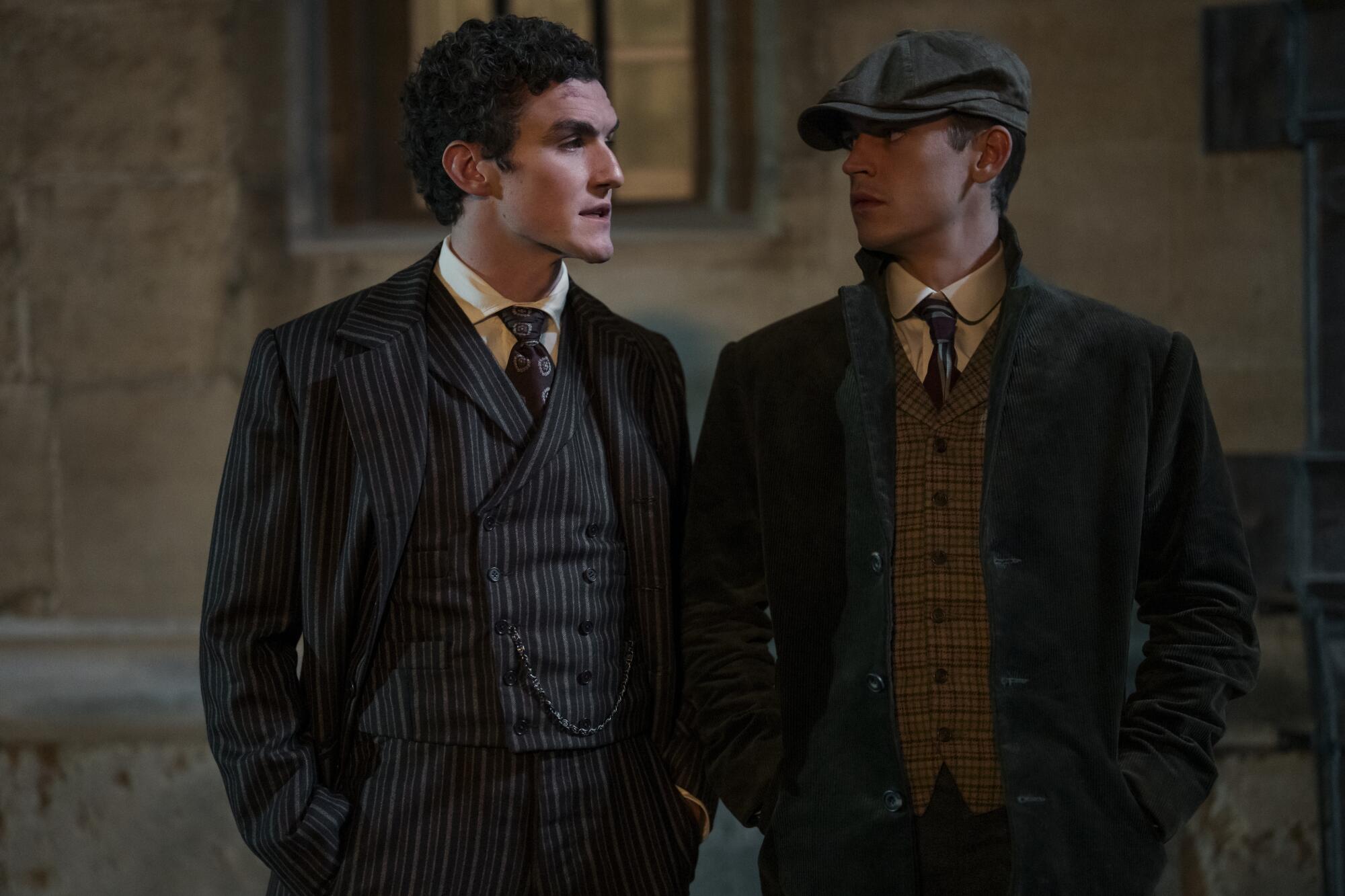
In “Young Sherlock,” Moriarty (Dónal Finn), left, and Sherlock (Hero Fiennes Tiffin) become friends at Oxford.
(Daniel Smith / Prime)
Both actors could feel it as well. “When Dónal came in within 2½ seconds I realized I need to bring my A-game because he was going to make me look bad otherwise,” says Tiffin, 28, speaking alongside Finn at the Rosewood later that day. “Once we started filming, we were on the same wavelength. We weren’t coming in and trying to go toe-to-toe and test each other, but we were collaborating and working towards the same goal.”
“The most dramatic version of this show was if an unstoppable force meets an immovable object and there’s an equality in what they do,” adds Finn, 30. “That required both of us to make each other look as good as we could.”
“Young Sherlock” is inspired by but not based on Andrew Lane’s “Young Sherlock Holmes” book series. Although it sees Ritchie returning to the world of Sir Arthur Conan Doyle, the show is not a prequel to the director’s 2009 film “Sherlock Holmes” nor its 2011 sequel, which starred Robert Downey Jr. as the titular character.
“This is a different universe,” Parkhill confirms. “They are cousins in terms of tone. But Guy’s not the same director he was when he made those. The things he was interested in exploring now were also different. But we wanted the show to have that same irreverence.”
He adds, “The most basic thing for me was: What makes him become this person? He’s on the cusp of trying to find his place in the world and his sense of self, which makes it an interesting period of his life to explore.”

“When Dónal came in within 2½ seconds I realized I need to bring my A-game because he was going to make me look bad otherwise,” says Tiffin, right, posing with Finn.
(Evelyn Freja / For The Times)
The eight-episode series opens with a flashback to Sherlock’s childhood, revealing the loss of his sister Beatrice. Her death has sent a ripple effect through his family — his mother, Cordelia (Natascha McElhone), is in an asylum and his father, Silas (Joseph Fiennes), has departed. Sherlock himself has been incarcerated, much to the dismay of his older brother Mycroft (Max Irons), a civil servant who pulls a few strings to get Sherlock out of prison. Sherlock accepts a job as a servant at Oxford, where he meets Moriarty. The pair investigate a murder at the university involving Princess Gulun Shou’an (Zine Tseng), which eventually is far more complex than they could have imagined.
“The plot has got to be clear enough that the audience can go on this journey with us, but difficult and mysterious enough that Sherlock doesn’t guess it straight away,” Finn says. “I have a great admiration for Matthew for managing that, and also giving each character a role to play in that journey.”
One of those characters is Silas, Sherlock’s adventuring father who doesn’t appear until the end of Episode 4. Parkhill approached Fiennes, Tiffin’s uncle, to play the role.
“When I sat down with Matthew, I thought, ‘Oh, God, is this a gimmicky thing of getting family members?’” says Fiennes in a separate interview. “But I quickly felt, ‘No, it’s not.’ It felt very natural and it’s a gift to play family members with family. Actors are always trying to research and unearth and unpack to get to that state, but we could walk on set and already have that.”
Tiffin and Fiennes hadn’t previously worked together, but they found a rhythm quickly when Fiennes arrived a few months into production in Wales. Episode 5, a chapter of the saga that pits Sherlock against his father and reckons with their history, felt like a real moment of collaboration.

Joseph Fiennes plays Sherlock Holmes’ father, Silas, in “Young Sherlock.” The actor is Tiffin’s uncle: “It felt very natural and it’s a gift to play family members with family.”
(Daniel Smith / Prime)
“We were four months into shooting, so I’d built this confidence up, and then Joe comes in and I shrunk back into the shell of myself,” Tiffin says. “I’d love to put it down to acting, but that’s definitely my relationship with Joe seeping through. It’s good because Silas has been absent in Sherlock’s life for a while, and Sherlock wants to please and impress him too.”
He describes an “unspoken, innate, really deep, almost inaccessible thing” between himself and his uncle. “When I opened the doors at the end of Episode 4 and see Joe, I’ve opened my front door at my parents’ house when he’s come over for dinner when I’m 6 years old,” Tiffin says.
Ritchie directed the first two episodes and then handed off the reins, but his signature style is infused through the series. It has a contemporary bent despite the 1870s setting, with modern music used as the soundtrack. It’s full of action and momentum, much like Ritchie’s “Sherlock Holmes” films, but here the character is still finding his footing. When we meet Sherlock, he’s not an established detective and he has no idea how to properly fight.
“I do have to admit from watching Robert Downey Jr. in Guy Ritchie’s movies, especially as a young boy, he was the epitome of cool,” Tiffin says. “So it was a complete surprise to me that my Sherlock was not just going to not be able to fight, but was terrible at defending himself. ”
Moriarty, however, is far better equipped, teaching Sherlock how to defend himself. Finn relished working with Ritchie, whose fight scenes are a signature of his work.
“They’re brilliant, but he knows that we see fight sequences every day and wants to make them special,” Finn says. “He knows how to sprinkle them with humor or to film them in a way you don’t expect.”

“I do have to admit from watching Robert Downey Jr. in Guy Ritchie’s movies, especially as a young boy, he was the epitome of cool,” says Tiffin about the “Sherlock Holmes” films.
(Evelyn Freja / For The Times)
“They’re also not one-dimensional,” Tiffin adds. “The fight always informs something. It’s never just two people fighting.”
Tiffin had a lot of previous iterations of Sherlock to draw from, as well as the novels themselves. He visited the Sherlock Holmes Museum in London ahead of shooting. He pulled from his longtime love of Downey’s portrayal, but he wanted to make the character his own.
“A big thing for us was making sure that our characters show signs of becoming the characters who are fully developed in Conan Doyle’s works,” he says. “They need to be close enough, but still have room to grow. Sherlock hasn’t been exposed to the hardships of the world yet, so he still has this youthful energy. If we get more seasons, we will see Sherlock lose that.”
There are fewer cinematic touchpoints for Moriarty, although Andrew Scott famously played him in the BBC’s adaptation alongside Benedict Cumberbatch. Finn had a photograph of Scott on his wall during drama school.
“It’s hard not to be inspired by what people have done before you, but you also have to draw the line somewhere,” Finn says. “And these aren’t iterations of the characters we’ve seen before. We have the opportunity to map out what events or what choices they make that shape the person we know.”
There are nods to the more established versions throughout the series, including Sherlock picking up his iconic hat in a shop and Moriarty rejecting it. Several of Sherlock’s famous lines from the novels are actually spoken first by Moriarty, who repeatedly emphasizes that he is not a sidekick but an equal.
“There are these great moments when these characters have left a mark on each other,” Finn says. “If you’re a fan of the Sherlock Holmes canon, you’ll notice them.”
“Its so fun and interesting planting those seeds,” Tiffin adds. “Not only is it fun to explore in our story, but it makes you understand Conan Doyle’s works in a different way and enriches that. Everything about the idea of Moriarty and Sherlock being enemies is enriched by the idea that they were once friends.”

“There are these great moments when these characters have left a mark on each other,” Finn says. “If you’re a fan of the Sherlock Holmes canon, you’ll notice them.”
(Evelyn Freja / For The Times)
There are a few glimmers of Moriarty’s future sensibility, although for the most part Sherlock and Moriarty remain steadfast pals. For Fiennes, this “bromance” is the heart of the story alongside the familial dynamic between Sherlock and Silas.
“You get these two incredibly intelligent misfits who are out of joint with the social world that they’re in,” Fiennes says. “Oxford, the mothership of intellect, is devoid of spirituality, and these two misfits have this spirit we love. We want to hang with them because of their mischievous nature. We know it will all come crashing down and feed into the characters we know later.”
“They are both looking for some sense of connection,” Finn adds. “And so it makes the friendship a really true friendship. It’s rare for both of these characters to feel that they find someone who is an intellectual match. It enriches the idea that when there is a rivalry it’s not just because of opposing moral views. What if it’s driven by revenge or heartbreak or betrayal?”
Parkhill has mapped out several potential future seasons of “Young Sherlock.” The finale concludes with a cliffhanger and a possible new mystery. The showrunner plans to take the show as far as 1887’s “A Study in Scarlet,” the first of Doyle’s novels, and then pass the baton back to literature.
“We will never go past that book, which psychologically gave me a freedom I needed to do this series,” Parkhill says. “We’re aware of the stories, but we used them as a playground in which to play instead of drawing from them directly.”
“We’ve shown signs of them eventually being able to become these more developed characters that Doyle established, but we need to document that journey,” Tiffin adds. “I will never feel complete until I can finish that journey and arrive at 221b Baker Street and meet John Watson and draw a line through the word ‘young.’”