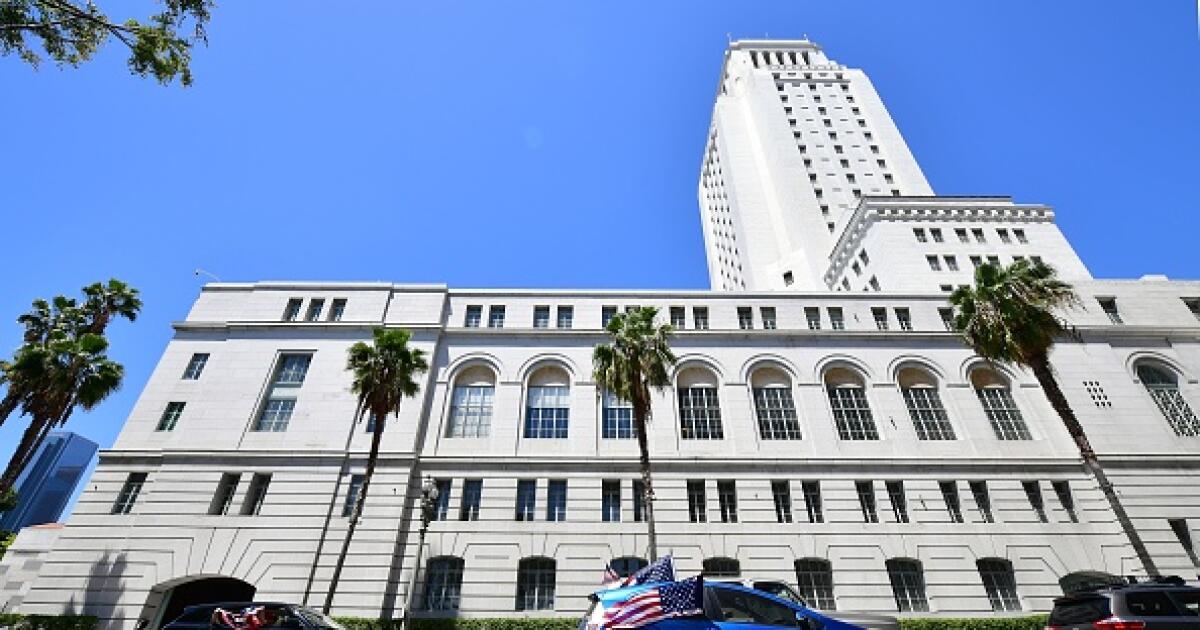
Good morning, and welcome to L.A. on the Record — our City Hall newsletter. It’s David Zahniser, with an assist from Noah Goldberg and Melissa Gomez, giving you the latest on city and county government.
It’s long been the Holy Grail for the reform crowd that tracks L.A. city government: expanding the size of the City Council.
The idea of giving L.A. more council members was endorsed by the city’s redistricting commission in 2021. Two years later, the concept was debated at length by a council committee focused on reform. After that panel failed to reach a decision, the idea was assigned to the city’s Charter Reform Commission, which endorsed the change, saying the council should have 25 members, up from 15.
Yet even after that five-year journey, the council voted Wednesday to push a proposed ballot measure on that topic off to the future, sending the idea to a new reform committee for more deliberations.
So what happened this time around?
You’re reading the L.A. on the Record newsletter
Sign up to make sense of the often unexplained world of L.A. politics.
By continuing, you agree to our Terms of Service, which include arbitration and a class action waiver. You agree that we and our third-party vendors may collect and use your information, including through cookies, pixels and similar technologies, for the purposes set forth in our Privacy Policy such as personalizing your experience and ads.
For one thing, the 13-member citizens commission that recommended the idea didn’t offer a lot of specifics on how the change would work.
The commission recommended 10 additional council members, a move that would cause each district to shed more than 100,000 residents, leaving each member with about 159,000 constituents.
But it never explained whether that decrease should be accompanied by a similar reduction in a council member’s salary, now nearly $245,000 a year.
“That’s one of the reasons why [council expansion] is slated for further study,” Councilmember Bob Blumenfield said in an interview. “While the commission might have had a nice discussion and a negotiation among themselves, what we need to have in front of us to vote responsibly is context and information.”
A councilmember’s pay could be a major sticking point for voters during a campaign over council expansion — especially if an opposition campaign arose to defeat it.
Blumenfield said the commission failed to vet other issues, including the number of council aides needed for each district if a district is smaller.
Councilmember Tim McOsker expressed a similar view.
“I think there were gaps in what the commission proposed — substantive gaps,” he said.
Backers of council expansion have argued that an increase in the number of districts would make the council more responsive and more diverse. Opponents said bigger does not necessarily mean better representation.
Raymond Meza, who chaired the Charter Reform Commission, acknowledged that pay, staffing and the cost of each council office didn’t come up during his panel’s deliberations. Those questions should have fallen to the council, which reviews and approves the city budget each year, he said.
“They would need to figure this out through the budget process, like they figure out most other things in the city,” he said.
Meza said he believes that, in the end, council members didn’t want to dilute their own power. Former City Councilmember Mike Bonin offered a similar take, saying elected officials generally don’t want to risk changing the system that got them into office.
“They are in power because of the way the system is structured,” said Bonin, who now runs the Pat Brown Institute for Public Affairs at Cal State LA.
Before sidelining the expansion proposal, Council President Marqueece Harris-Dawson said a larger council would shift the balance of power at City Hall, giving the mayor greater authority and the council less of it.
In the end, none of these delays may end up mattering. No one at City Hall expected council expansion to happen until 2032 anyway, since the change would require a new round of redistricting — the process of drawing new boundaries for each council district. Redistricting won’t happen until after the release of results from the 2030 U.S. Census.
In other words, there’s still time for voters to act.
What happened to the City Hall misconduct measure?
Here’s another proposal that got shunted to the sidelines during the council’s eight-hour marathon meeting: what to do about city elected officials who are charged with serious crimes.
Charter reform was, in part, a reaction to a string of corruption scandals. Among them: three sitting council members who were charged with felonies between 2020 and 2023.
In each case, council members had to decide whether to use their power, spelled out in the City Charter, to suspend colleagues accused of wrongdoing — stripping away their duties until their criminal cases were resolved.
The council moved swiftly to suspend then-Councilmember Jose Huizar in 2020, taking action the day he was arrested, before he even pleaded “not guilty” to racketeering and other charges. The council suspended then-Councilmember Mark Ridley-Thomas in 2021 after a lengthy floor debate, with some saying he was being denied his due process rights. (Ridley-Thomas, who was found guilty of seven felonies, is fighting his conviction.)
A few years later, the council decided not to suspend Councilmember Curren Price, allowing him to step off of his council committees but preserving his other council duties as he contests charges of embezzlement, perjury and conflict-of-interest violations.
Although the case is still ongoing, Price is back on various city committees.
Each of those cases put the council in a bind. Voting in favor of suspension can mean depriving a council member’s constituents of representation. It also runs counter to the idea that a colleague is innocent until proven guilty.
Voting against suspension has its own set of dangers, such as undermining trust in city government. It could also allow an elected official accused of wrongdoing to continue taking part in decisions about contracts, real estate development and other matters where the potential for corruption exists.
Under the current system, a council member can be suspended with just eight votes. Harris-Dawson, who supported the suspension of Huizar but opposed it for Ridley-Thomas, said early on that he wanted the Charter Reform Commission to look at the process for disciplining elected officials accused of wrongdoing.
The Charter Reform Commission offered its answer two months ago, recommending that the council retain the power to suspend, but only with a three-fourths vote — 12 out of 15. That safeguard was meant to guard against potential abuses of power, said Meza, the former commission chair.
The council declined to put that idea on the ballot, saying it needs more study.
Asked about that decision, Harris-Dawson said he has long had serious problems with the idea that “one set of elected officials could suspend another set of elected officials.” He suggested that a third party in another branch of government — not the council — determine whether a member merits suspension.
Under that arrangement, the council could initiate the process but leave it to a judge or other party to make the final call, he said.
“I personally think that we have checks and balances in government that should be respected,” Harris-Dawson said.
A last-minute union threat
One ballot proposal that did survive this week’s gauntlet of votes was a plan to increase, not decrease, the council’s power. That proposal, backed by Councilmember Hugo Soto–Martínez, would give the council the authority to set policy at the Los Angeles Police Department.
But even that proposal may be in danger, thanks to a dispute that has erupted between the city’s labor negotiators and the Los Angeles Police Protective League, the union representing rank-and-file officers.
Union leadership said this week that the league was not formally asked by management to meet and confer over various charter proposals dealing with the LAPD, including the one focused on policy. That step is legally required before such measures can be sent to voters, the union said.
City Administrative Officer Matt Szabo, the city’s chief labor negotiator, told council members on Monday that his office sent three emails to various employee units asking if they wanted to confer over the charter changes. He said his office received no response from the police union.
A day later, after learning of Szabo’s remarks, the league fired back.
In a letter to council members, the union said it only received emails about charter reform that had nothing to do with policing. Those emails did not constitute a formal invitation to meet and confer about potential changes at the LAPD, the union said.
The city “did not follow the law and did not formally contact us,” union President Ricky Mendoza said in a statement.
The council voted to draft the change in LAPD policy making, pending a confidential report from the city attorney on whether the city first has to bargain with the police union. Council members cast that vote even after the union demanded that they suspend any further consideration of the proposal for the Nov. 3 ballot.
If the city attorney concludes that the LAPD ballot proposal does not require further talks, the Police Protective League will file a lawsuit to protect its members’ legal rights, union officials said.
On Wednesday, Szabo said the proposal to give the council power over LAPD policy decisions doesn’t require collective bargaining.
The proposal to give council say over policy at the LAPD wasn’t the only one focused on that department. Another measure discussed by the council would have given the police chief power to terminate alleged problem officers.
The council sent it to a committee for more study. The union said that proposal also would have required a meet and confer process.
State of play
— CITY CHARTER GRAB BAG: As noted earlier, the council voted to draft an assortment of charter amendments for the Nov. 3 ballot, including one to allow the council to give noncitizen residents the right to vote in local elections. The council also ordered up a measure doubling the amount of money allocated for the Department of Recreation and Parks, discarding an alternative plan that would have increased it by 50%. Other measures would switch the city to a two-year budget process and require a five-year plan for maintaining and upgrading city infrastructure.
— KNOWING ME, KNOWING ULA: Looking to boost apartment construction, the council backed a surprise plan to rewrite Measure ULA, the tax on high-end property sales passed by voters in 2022 and sometimes called the mansion tax. The council voted 9-5 to instruct the city’s lawyers to draft a measure exempting apartment buildings sold within 10 years of construction from having to pay the tax. Another vote will be needed to get it on the ballot.
— ZOO STORY: Membership at the Los Angeles Zoo has fallen by 23% over the past year, dropping from 36,914 in April 2025 to 28,440 in February, according to a report issued by the Los Angeles County civil grand jury. That report urged the city to create a new public-private partnership to run the facility, saying such a move will be critical for the zoo’s long-term survival.
— SHERIFF SUBPOENAS: L.A. County’s Civilian Oversight Commission is suing the Sheriff’s Department, asking a judge to order the release of records on three use-of-force incidents involving its deputies. The commission issued three subpoenas to the agency in February 2025, but according to the suit, the department has declined to fully comply.
— UNION DUES AND DON’TS: A former high-level officer with L.A.’s firefighter union has been accused of stealing more than $82,000 from a charity for injured firefighters to pay for his online gambling, his mortgage and other personal expenses. Adam Walker, former secretary of United Firefighters of Los Angeles City Local 112, was charged with one count each of grand theft and forgery, prosecutors announced Wednesday.
— DOG DISASTER: The Los Angeles Police Department is facing a public outcry after its officers shot and killed the dog of a woman celebrating the New York Knicks’ NBA championship in Canoga Park. Video on social media showed the dog’s owner sobbing and hugging her dog, who was wearing a Knicks T-shirt, as several LAPD officers stood nearby.
— BASS WEIGHS IN: The Canoga Park incident prompted Mayor Karen Bass to issue a statement promising a thorough and transparent investigation into the death of Jameson, the dog killed by the LAPD. “Every life lost to violence is a tragedy, and we know that the devastating loss of Jameson will be felt by his family forever,” she said. “I have spoken directly to the Chief to ensure a full investigation and accountability for any wrongdoing.”
— OFFICE FIRE: A fire broke out at a building in Pacific Palisades where former mayoral candidate Spencer Pratt maintained an office for his crystals company. Pratt, whose home burned in the 2025 Palisades fire, called the latest blaze “very suspicious.” The fire department said it’s investigating.
QUICK HITS
- Where is Inside Safe? The mayor’s signature program to address homelessness went to a stretch of Silver Lake Boulevard that passes under the 101 Freeway. That area is represented by Soto-Martínez.
- On the docket next week: The council meets Wednesday to take up the massive 4th & Central project, which calls for offices, retail space and nearly 1,600 units of housing on a 7.6-acre site in downtown.
Stay in touch
That’s it for this week! Send your questions, comments and gossip to LAontheRecord@latimes.com. Did a friend forward you this email? Sign up here to get it in your inbox every Saturday morning.