Seoul shares plummet over 7 pct on Middle East conflict fears; won sharply down

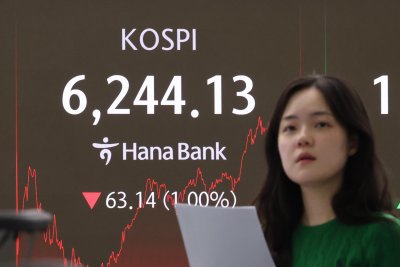
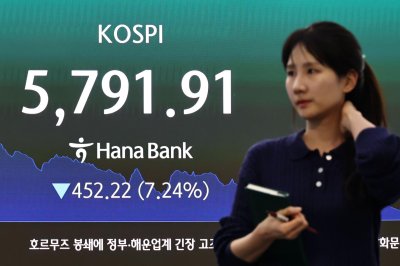
This photo taken on Tuesday shows the trading room of Hana Bank in central Seoul, with the benchmark Korea Composite Stock Price Index down 7 percent to close below the 5,800-point mark. Photo by Yonhap
South Korean stocks plunged more than 7 percent Tuesday to close below the 5,800-point mark as investor sentiment was dampened by escalating geopolitical concerns triggered by the ongoing Middle East conflict. The Korean won lost sharply against the U.S. dollar.
The benchmark Korea Composite Stock Price Index (KOSPI) tumbled 452.22 points, or 7.24 percent, to close at 5,791.91, marking the lowest closing price since Feb. 20, when the index finished at 5,808.53.
It marked the largest-ever daily drop.
The country’s main bourse operator, the Korea Exchange (KRX), issued a sell-side sidecar for 5 minutes around noon, suspending the selling of KOSPI futures.
Trade volume was heavy at 1.2 billion shares worth 52.5 trillion won (US$35.8 billion). Losers sharply outnumbered winners 840 to 73.
Foreign and institutional investors led the daily sell-off, dumping a net 5.1 trillion won and 891.1 billion won, respectively. Retail investors, on the other hand, went bargain hunting and snapped up a net 5.8 trillion won.
Coordinated U.S. and Israeli air strikes on Iran over the weekend roiled global markets from the start of this week, but the Korean market closed on Monday in observation of the March 1 Independence Movement Day holiday.
“The main index experienced expanded volatility as the Middle East risk was realized after a long weekend,” Roh Dong-gil, an analyst at Shinhan Securities, said. “The stock market is expected to be affected by oil prices and interest rates as the situation develops.”
Most shares closed bearish.
Market bellwether Samsung Electronics tumbled 9.88 percent to 195,100 won, and its chipmaking rival SK hynix plummeted 11.5 percent to 939,000 won.
Top automaker Hyundai Motor dived 11.72 percent to 595,000 won, and leading battery maker LG Energy Solution sank 7.96 percent to 393,000 won.
Travel shares were among the biggest losers as flag air carrier Korean Air nosedived 10.32 percent to 25,200 won and major travel agency Hana Tour Service lost 6.65 percent to 44,900 won.
KB Financial Group, a leading banking group, fell 3.46 percent to 153,500 won, and Celltrion, a major pharmaceutical firm, dropped 5.66 percent to 225,000 won.
However, oil refinery and defense shares were bullish.
Leading refinery firm SK Innovation rose 2.51 percent to 130,900 won, and S-Oil, whose largest shareholder is Saudi Aramco, shot up 28.45 percent to 141,300 won.
Defense giant Hanwha Aerospace soared 19.83 percent to 1.43 million won, and LIG Nex1 surged 29.86 percent to 661,000 won.
The Korean won was quoted at 1,466.1 won against the U.S. dollar at 3:30 p.m., down 26.4 won from the previous session’s close. It marked the lowest since Feb. 6, when the won-dollar rate was 1,469.5 won.
Bond prices, which move inversely to yields, closed sharply lower. The yield on three-year Treasurys increased 13.9 basis points to 3.180 percent, and the return on the benchmark five-year government bonds declined 14.6 basis points to 3.424 percent.
Copyright (c) Yonhap News Agency prohibits its content from being redistributed or reprinted without consent, and forbids the content from being learned and used by artificial intelligence systems.