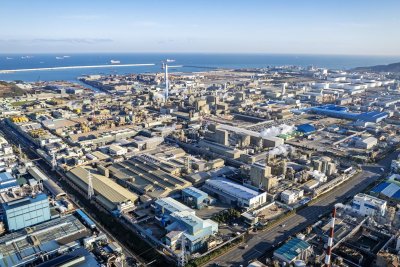
A smelter of Korea Zinc. The company is scheduled to hold a high-stakes shareholders’ meeting Tuesday. Photo by Korea Zinc
SEOUL, March 20 (UPI) — Korea Zinc’s incumbent management and its major shareholder, Young Poong, are locked in a fierce showdown ahead of a regular shareholders’ meeting Tuesday.
The world’s largest non-ferrous metal producer said Friday that it posted record sales and profits last year, which led to high dividends and other shareholder-friendly policies.
Citing the strong performance, Korea Zinc has called for the leadership continuity, as the 2026 shareholders’ meeting would select at least five board members out of 15 seats. The term of Chairman Yun B. Choi is also set to expire.
“We believe that our continued efforts to improve corporate governance and expand shareholder returns have laid the foundation to steadily grow our business and operate our organization in a stable manner,” the firm said in a statement.
But, Young Poong argued that proxy advisers and the National Pension Service, another key Korea Zinc shareholder, have effectively supported its position by opposing the reappointment of Choi as an inside director.
According to Young Poong, such decisions suggest that “this is no longer merely a management control dispute, but judgment over potential structural flaws in corporate governance and failures of oversight.”
Since early 2025, Korea Zinc has been fighting to repel an aggressive takeover bid from Young Poong, which has teamed up with the country’s leading private equity firm, MBK Partners.
The battle came to a head at the March 2025 shareholders’ meeting, and another high-stakes clash is looming at this month’s gathering.
Each side reportedly controls roughly 40% of the voting shares, while NPS holds a 5.2% stake.
Meanwhile, the labor union at Korea Zinc expressed strong support for the current board, urging the NPS to immediately reverse its decision.
“We will fight to the end to prevent the dark hand of speculative capital from tainting our sacred workplace at this shareholders’ meeting,” the union said in a statement.
“If our warning is ignored and the company is undermined, we will mobilize all possible means, including a general strike, to wage an all-out struggle,” it said.
Walt Disney Co. installed Josh D’Amaro as chief executive Wednesday, beginning a new chapter for the storied Burbank entertainment giant.
Bob Iger passed the reins during Disney’s virtual annual meeting of shareholders, completing the company’s high-stakes and tightly choreographed changing of the guard. After spending two decades molding Disney into a media colossus, Iger segued into a senior advisory role, which will run through December when he officially retires.
The leadership shift comes amid an upheaval in Hollywood as traditional companies wage a desperate battle for survival.
D’Amaro, in his first address to shareholders, pointed to Disney’s signature storytelling as its competitive edge.
“While others in our industry are consolidating just to compete, or struggling to be relevant in a fragmented and disrupted world, Disney is in a category of one,” D’Amaro said during a video segment at the meeting. “This next chapter will be driven by staying focused on world-class creativity, enhanced by technology, bringing unforgettable stories to audiences wherever they are.”
D’Amaro, 55, becomes the ninth leader in Disney’s 102-year history. He was selected last month by Disney board members after a two-year internal bake-off among high-ranking division leaders. Board members were impressed with his business acumen, charisma and his deep love for Disney and its fabled history.
D’Amaro inherits a company that is beloved by millions. It generates $94 billion a year in revenue and employs 230,000 people.
He faces enormous challenges as he steers the ship through a turbulent media environment and tense geopolitics. The war in Iran prompted a sharp increase in fuel costs, which could become a drag on Disney’s critically important tourism business. Executives already have signaled “headwinds” in international visitation at its U.S. theme parks this year.
Lingering Middle East tensions also could weigh on Disney’s plans for a new Persian Gulf waterfront theme park and resort near Abu Dhabi.
D’Amaro, who served as parks and experiences chief until Wednesday, got his corporate start at Disneyland 28 years ago.
“Like so many of you, my connection to Disney goes back to my childhood, long before I began my career here,” D’Amaro told shareholders. “I grew up in a Disney family. We watched ‘The Wonderful World of Disney’ on Sunday nights. I was 10 years old when my family visited Disneyland for the first time. … Disney has always been a place of imagination, innovation and infinite potential.”
Disney previously announced a $60-billion, 10-year expansion program, which D’Amaro has led. But executives must strike a balance by keeping attractions true to their nostalgic core. In Anaheim, the expansion could result in at least $1.9 billion of development.
Disney also must continue to grow its animation business and manage revenue declines from its traditional linear television channels, including ESPN and ABC. It needs to turbocharge its streaming services with compelling movies and TV shows to remain competitive with Netflix and other leaders in the field.
Disney teased upcoming fan favorites, including the May release of Lucasfilm’s “Star Wars: The Mandalorian & Grogu,” a “Bluey” feature film (the kids show featuring an animated puppy, a blue heeler) and a sequel to a “Lilo & Stitch” film for 2028.
Streaming is key to Disney’s future, D’Amaro said.
“Disney+ will continue to evolve beyond a traditional streaming service to become the digital centerpiece of our company,” D’Amaro said, calling the service “a portal that connects our stories, experiences, games, films, and more in entirely new ways.”
The company plans to unify Disney+ and Hulu later this year.
Disney also must continue to incorporate technology while safeguarding its characters and franchises.
“We will continue to develop and embrace new technologies to empower our storytellers — but never at the expense of our characters and worlds, our creative partners, or the trust people place in us,” D’Amaro said. “Because Disney at its core is a company that celebrates human creativity.”
Wednesday also marked a reorganization of the company, configured by Iger, D’Amaro and Disney’s board.
Board members recognized that D’Amaro, who has spent most of his career in the parks division, lacks deep connections among Hollywood’s writers and producers. They elevated longtime television executive Dana Walden, who had been vying for the top job, to the newly formed role of chief creative officer and the company’s first woman president.
ESPN will continue to be managed by Jimmy Pitaro and Disney Entertainment, Studios chairman Alan Bergman will remain in his influential role overseeing film studios including production, marketing and distribution, and sharing oversight for streaming programming with Walden.
D’Amaro’s total compensation package is valued at about $40 million a year, including a $2-million annual base salary, $26.2 million in annual long-term stock incentives, a cash bonus and a one-time promotion award of $9.7 million.
“Josh is a wonderful choice to lead the Walt Disney Co.,” Iger said in a pre-recorded video. “He has passion for our businesses and brands, respect for our people, and he appreciates what makes this company so unique.”
Iger is wrapping up an unprecedented 52-year career at ABC and Disney.
He first stepped into the CEO role in 2005; his first 15 years were almost magical.
Iger led acquisitions of Pixar Animation, Marvel Entertainment and Lucasfilm, the studio behind “Star Wars,” that turned Disney into a blockbuster machine. Sports king ESPN spawned staggering profits, and Disney’s theme parks set industry standards.
Disney’s former Chief Executive Bob Iger will stay on through the end of the year as a senior advisor.
(Jay L. Clendenin / Los Angeles Times)
His decision to buy much of Rupert Murdoch’s 21st Century Fox, a $71-billion deal that closed in 2019, boosted Disney’s television production, refreshed its TV executive bench, and provided a controlling stake in general entertainment streaming service Hulu. The acquisition also gave Disney access to fan-favorite franchises, including “Deadpool,” “The Simpsons,” and James Cameron’s “Avatar.”
But the purchase left Disney saddled with debt just as the COVID-19 pandemic prompted production shutdowns and closures at theme parks and sports venues. It would take several years for Disney to recover.
Iger initially passed the CEO baton to Bob Chapek in February 2020. Iger, then chairman, retired the following year but came back in November 2022 to a mess. At the time, the company was losing billions of dollars on its shift to streaming but that unit is now profitable.
Iger spent the next three years focusing on four business pillars, including improving the quality and profitability of its film studios.
During the last two years, Disney has produced five franchise films that racked up more than $1 billion in worldwide ticket sales, including “Inside Out 2,” “Zootopia 2,” and “Avatar: Fire and Ash.”
The company is banking this year on several other films with blockbuster potential, including Disney and Pixar’s “Toy Story 5,” “Star Wars: The Mandalorian & Grogu” and Marvel Studios’ “Avengers: Doomsday.”
“I would want to be known as someone who was given the keys to this kingdom and brought it to a place that even Walt would be proud of — more storytelling, more innovation, more risk‑taking, and more creation of happiness,” Iger said during a “The Rest is History” podcast last year.
During the meeting, Iger appeared in a prerecorded video that celebrated his numerous career highlights. Shown were clips from his cub years when Iger was a newscaster with bushy black hair. His journey was depicted, including his orchestration of multi-billion-dollar acquisitions that strengthened Disney with more characters and franchises.
Iger, 75 and now gray, ended by thanking shareholders “for the trust you placed in me, for the memories we created together, and for allowing me the honor of serving,” he said. “It has meant more to me than I can say.”
Animated pixie dust twinkled on the screen, courtesy of the fairy, Tinker Bell.
“Bob, on behalf of our employees, cast members, shareholders, and fans around the world, thank you so much for your tremendous leadership, your steadfast support, and your countless contributions to The Walt Disney Co.,” D’Amaro said, as the hand-off was complete.
“You’ve set an incredible example for all of us. … You will be missed,” D’Amaro said.
There was little fanfare during the business portion of the investor meeting.
The company’s slate of board directors were elected with 93% of the vote. Shareholders also approved executive compensation packages with about 85% of votes.
Shareholder-led proposals to compel reports on charities eligible for Disney’s gift-matching program, a review of the company’s accessibility practices in its theme parks for disabled guests, and a push for cumulative voting at future meetings all failed to muster support.
Disney shares closed at $99.41, down roughly 1% on the day.
Edison International boosted the pay of its top executives last year despite their responsibility for the safety of the company’s power lines before the devastating Eaton fire, which destroyed a wide swath of Altadena and killed 19 people.
Although the company cut cash bonuses for its senior executives, citing the wildfires, their overall compensation went up substantially as the utility’s profit soared in 2025.
Pedro Pizarro, chief executive of the parent company of Southern California Edison, received $16.6 million in cash, stock and other compensation last year, up 20% from 2024, according to a new company filing.
Steven Powell, president of Southern California Edison, received compensation totaling $6.5 million last year, up from $3.9 million in 2024 — a jump of more than 65%.
The utility’s transmission equipment is suspected of igniting two wildfires on Jan. 7, 2025, including the Eaton fire, which left thousands of families homeless.
The Times earlier detailed how Edison fell behind in performing maintenance on its aging transmission lines — work that it had told state utility regulators was needed. County prosecutors are investigating whether Edison should be criminally charged for its actions before the fire.
The government investigation into the cause of the fire has not been released and Edison has denied that it acted negligently. Pizarro has said a leading theory is that a century-old transmission line, which the company had not used for 50 years, may have briefly reenergized, igniting the fire.
A state law championed by Gov. Gavin Newsom in 2019 protects utilities from paying for the damage due to fires sparked by their equipment. When it passed, Newsom touted the law’s requirement that utilities must tie executive compensation to their safety record, saying it would keep them accountable.
The law said that a utility “may” consider tying 100% of executive bonuses to safety performance and “denying all incentive compensation in the event the electrical corporation causes a catastrophic wildfire that results in one or more fatalities.”
Edison said in the new filing that the company’s board members who determine executive compensation decided to decrease the cash bonuses of Pizarro, Powell and Jill Anderson, the utility’s chief operating officer, because of the 2025 wildfires.
Pizarro’s cash bonus was cut by more than $1 million while Powell’s was trimmed by $442,000, according to the filing. Anderson lost out on $244,000.
The company, based in Rosemead, said its decision to cut the three executives’ cash bonuses “was not a reflection of the performance of the company or these executives.”
Despite those cuts, the executives’ total pay of salary, bonuses, stock and other compensation rose, according to the filing. That’s because Edison ties most executive compensation not to safety, but to the company’s financial performance.
And last year, Edison’s profit jumped more than 200% — from $1.3 billion in 2024 to $4.5 billion — despite the Eaton disaster.
The profit increase resulted from the protections from wildfire damage provided to Edison by the 2019 law, as well as a 13% hike in customer electricity rates in October.
The utility attributed the higher electric bills to several increases that it successfully lobbied the California Public Utilities Commission to approve. All five members of the commission were appointed by Newsom.
Scott Johnson, an Edison spokesman, said Tuesday that Pizarro and other company executives holding stock took a financial hit after the fires when the price plummeted.
Before the January fires, Edison International’s stock price was about $80. It fell to $50 the next month. It has recovered much of its value, closing on Tuesday at $72.92.
Edison is facing hundreds of lawsuits by victims of the fire. The suits claim it acted negligently, including by failing to remove the old, dormant transmission line in Eaton Canyon.
The lawsuits also blame Edison for not preventatively shutting down its transmission lines Jan. 7, 2025, despite the dangerous Santa Ana winds.
Pizarro has said the winds didn’t meet the company’s threshold in place at the time for turning off those high-voltage wires.
“Our deepest sympathies remain with all those affected, and this loss reinforces our commitment to public safety and wildfire risk mitigation,” Pizarro and Peter Taylor, chairman of the parent company’s board, wrote in a letter to shareholders that was released with the details on executive compensation.
The two executives added that the company’s “long-term objective remains unchanged: to significantly reduce wildfire risk while improving safety, reliability and affordability of electric service.”
Edison is now offering to compensate Eaton fire victims, including those who lost their homes, family members, businesses and apartments. The offer requires the victims to give up their right to sue the utility. Many survivors say the utility’s offer falls short of what they lost.
Pizarro and Taylor wrote that as of March 4, more than 2,500 claims had been submitted through the program. So far, Edison has extended offers to roughly 600 victims submitting claims and made payments totaling $31 million to 212 of those people, they wrote.
The utility also has begun settling claims of property insurers that covered Altadena homes that were destroyed or damaged, paying out hundreds of millions of dollars. The settlements will help cover the insurance companies’ losses.
Edison has told its shareholders that it expects most or all of those payments to victims and insurers to be covered by a $21-billion state wildfire fund that Newsom and lawmakers created as part of Assembly Bill 1054, which became law in 2019.
Critics say the law went too far, allowing a utility to allegedly spark a deadly wildfire without financial consequences to the company or its executives.
“The predictable outcome of continuing to protect shareholders and executives from the consequences of their own negligence is not theoretical. It is observable. More catastrophic fires,” Joy Chen, executive director of the Eaton Fire Survivors Network, wrote in an email to state wildfire fund administrators this year.
Johnson responded, saying,”Our motivation to prevent fires and any incidents is to be good neighbors and provide affordable and resilient energy. There is nothing more important than safety.”
Taylor was on the board committee that approved the compensation package for Pizarro and other top executives. For his work chairing the board, Taylor received cash and stock compensation of more than $500,000.
Johnson said Taylor’s compensation was based on “typical board chair pay” at other utilities.
The new filing said Pizarro’s total compensation of $16.6 million was 75 times the median Edison employee’s total compensation of $220,000.
The present value of Pizarro’s pension is more than $19 million, the report said.
The company is facing a challenge from one of its shareholders — John Chevedden of Redondo Beach, according to the filing.
Chevedden is asking the company’s shareholders to vote to approve his proposal that would require Pizarro and other Edison executives to hold at least 25% of the stock they had received as compensation until they reach retirement age.
He said that requiring utility executives to hold a significant portion of their stock until retirement would focus their efforts on the company’s long-term success.
Chevedden pointed to “unfavorable news reports,” including the U.S. Department of Justice’s lawsuits against Edison for the Eaton fire and 2022 Fairview blaze, which killed two people in Riverside County.
Edison’s board urged shareholders to vote against Chevedden’s proposal before the company’s annual meeting April 23.
The board said the company already had guidelines that “closely align the interests of officers with the long-term interests of our shareholders.”
Young Poong’s refinery in South Korea. The company is embroiled in a new controversy with its shareholder KZ Precision. Photo courtesy of Young Poong
SEOUL, March 5 (UPI) — South Korean zinc producer Young Poong has become embroiled in a new controversy with shareholder KZ Precision, which manufactures hydraulic equipment.
Young Poong, a major shareholder of the world’s largest non-ferrous metals producer Korea Zinc, said Wednesday that it has brought KZ Precision, an affiliate of Korea Zinc, to court.
Young Poong accused KZ Precision of deliberately creating an illegal cross-shareholding structure during the Korea Zinc management control dispute ahead of Korea Zinc’s shareholders’ meeting early last year.
Young Poong alleged that KZ Precision sold its shares in Young Poong to an Australian-based Korea Zinc subsidiary with the aim of restricting Young Poong’s voting rights over Korea Zinc.
Over the past year, Korea Zinc has sought to fend off a takeover bid from Young Poong, which has joined with Korea’s top private equity firm, MBK Partners.
“We have filed a damages lawsuit against KZ Precision as our shareholder value was harmed by an unlawful restriction of voting rights,” Young Poong said in a statement.
“As the largest shareholder of Korea Zinc, we will keep playing a responsible role in normalizing the company’s corporate governance and enhancing shareholder value,” it added.
Meanwhile, KZ Precision criticized Young Poong’s management.
“Young Poong’s corporate value, reputation and internal control system have been damaged to an irreparable extent, resulting in adverse effects on shareholder value,” KZ Precision said in a statement.
“The current management of Young Poong was hesitant to make capital investments, which caused the corporation to lose competitiveness in its core smelting business and accumulate losses,” it said.
Young Poong has suffered from operating losses over the past few years, totaling $50 million in 2021, $74 million in 2022, $97 million in 2023, and $60 million in 2024. The Seoul-based company has yet to disclose last year’s results.
KZ Precision also took issue with the environmental concerns involving Young Poong, whose smelter operations in Korea were suspended for two months last year after discharging polluted wastewater without approval.
In response to Young Poong’s claim that it has channeled hundreds of millions of dollars to improve the environment around its smelter, KZ Precision argued that there may be accounting irregularities, which are reportedly under investigation by regulators.
Paramount Skydance is betting its future on its streaming business, as gains at the media and entertainment company’s Paramount+ platform helped boost earnings for the fiscal fourth quarter of 2025.
On Wednesday, Paramount reported $8.1 billion in revenue for the three-month period that ended Dec. 31, up 2% compared to the previous year’s quarter. That was due to growth in its streaming business, which saw a 10% increase in quarterly revenue to $2.2 billion, as well as gains at Paramount’s filmed entertainment segment, which reported revenue of $1.3 billion,an increase of 16% compared to the previous year.
The company’s TV media business, however, had a tougher quarter.
That segment reported revenue of $4.7 billion, down 5% compared to last year, as traditional broadcast networks continue tolose subscribers. Paramount also cited a 10% decrease in advertising, partially due to a drop in political spending and not having the Big 10 championship as it did in 2024.
Paramount reported an operating loss of $339 million, which included $546 million in restructuring and transaction-related costsattributed to its merger with Skydance last year. Diluted losses per share totaled 52 cents, compared to a loss of 33 cents during the prior year.
Chief Executive David Ellison praised the company’s progress under his tenure, noting that investments in the film studio, original series, UFC and tech upgrades to Paramount+’s streaming platform and advertising would build momentum in the coming years.
“It’s been six months, but we really do feel good about the work the team has done to date,” he said during an earnings call with analysts Wednesday afternoon. “You can expect that to accelerate into the future quickly.”
The company said it expects total revenue of $30 billion for 2026, which would mark a 4% increase compared to 2025. Paramount signaled the primary driver of that growth will be its streaming business, though the company also anticipates a boost from its studio segment.
Company executives declined to answer questions on the call about Paramount’s bid to acquire rival Warner Bros. Discovery.
The only mention of the ongoing fight was in Paramount‘s letter to shareholders, which noted that the company was “confident” in its standalone strategy and growth trajectory, but that adding Warner would be an “accelerant to achieving these goals more quickly” and in a way that would be “economically compelling” for Paramount’s shareholders.
Paramount submitted a higher bid Monday offering $31 a share in cash to Warner Bros. Discovery investors. Previously, the offer was $30 a share.
The company also agreed to pay $7 billion to Warner should the deal fail to clear various regulatory hurdles. That was a $2 billion increase. (The previous commitment was $5 billion.)
Paramount reaffirmed that it would cover the $2.8 billion termination fee that Warner would owe Netflix if Warner abandoned its deal with the streamer.
Paramount also said it would pay a so-called ticking fee sooner. Now, the company said it would pay an additional $0.25 per quarter to shareholders after Sept. 30 until a Paramount-Warner transaction closed. It also agreed to cover Warner’s potential $1.5 billion in financing costs associated with a planned debt exchange offer.
Additionally, Paramountsaid it “agreed to an obligation to contribute additional equity funding to the extent needed to support the solvency certificate required by PSKY’s lending banks.” That provision was offered because Warner board members have expressed concerns that Paramount may not be able to round up sufficient financing to close such a gargantuan deal.
But the company’s earnings — and the declines its facing in its own TV business — raised concerns about the potential Warner acquisition, John Conca, analyst at Third Bridge, wrote in an email.
“It is becoming questionable why leadership is aggressively pursuing [Warner], a deal that would effectively double their exposure to dying linear networks while also creating even more massive integration headaches,” he said.