‘The Shards’ and ‘Sterling Point’ review: Stylistically miles apart
If we are lucky enough to survive into our 20s, and have attained some degree of adult consciousness, we all will have lived a coming-of-age story. It’s a powerful, relatable basis for fiction or memoir or some combination of the two. Poignant. Piquant. It might be hilarious or depressing or, probably, both at once. Stories of first times, of big feelings imperfectly grasped, of life coming into focus for better or worse. Engaging with them as a reader or viewer, we look back on who we were, who we wanted to be, who we wish we hadn’t been. I get a little misty remembering my own clumsy progress through that flower-filled minefield. Remind me never to tell you about it sometime.
Television likes a coming-of-age story, and has logged some great ones — “My So-Called Life,” “Never Have I Ever,” “Freaks and Geeks,” “Everybody Hates Chris” — along with … some other ones. Premiering Wednesday are two series focusing on characters in their late teens; while stylistically, and one would say morally, miles apart, they nevertheless cover some of the same ground. There are things you can’t avoid growing up, wherever your life is set.
A rich-kids drama with a side of serial murder set in 1981 Los Angeles, FX‘s “The Shards” plants itself at the intersection of Bret Easton Ellis, whose 2023 “autofictional” novel it’s based on, and co-creator Ryan Murphy, in one of his bloodier moods, amplifying each other’s taste for the sensational and surfaces. Set on a lake in Canada, Prime Video’s “Sterling Point,” from Megan Park (“My Old Ass”), unrolls like a leisurely indie film; there will not be blood.

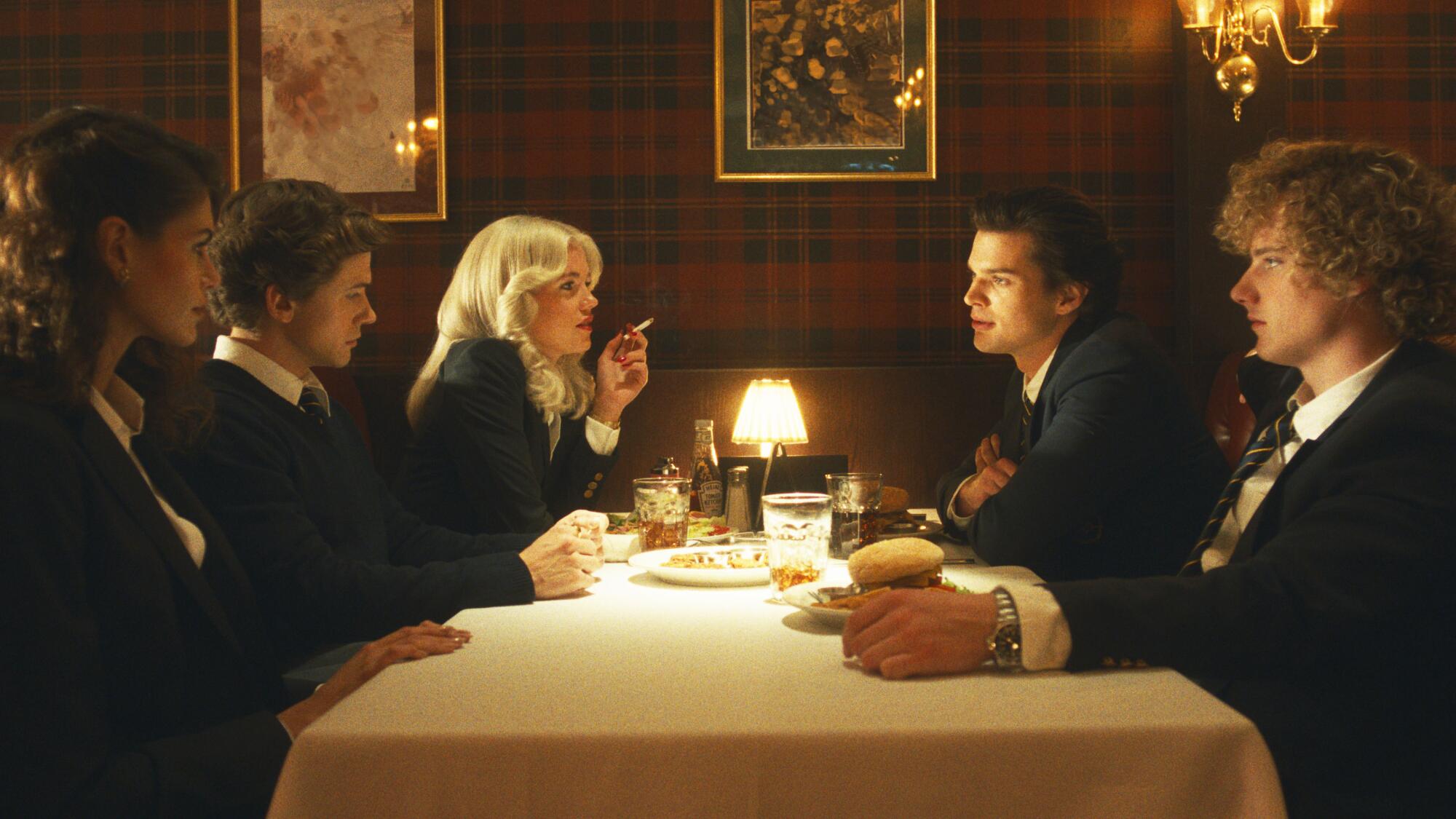
Kaia Gerber, from left, Igby Rigney, Hayes Warner, Homer Gere and Graham Campbell in FX’s “The Shards.”
(FX)
Igby Rigney plays Ellis in “The Shards,” narrating from the future. Bret shares with his authorial namesake an avocation and a love for Joan Didion (“Like all aspiring writers of my generation, I wanted to write like Didion. With restraint, economy and total control. If i could write like that, I could be like that. Or so I thought.”), as well as a manuscript titled “Less Than Zero,” though here it’s a screen treatment rather than the 1985 novel that made the author famous at 21. (One character will call it “brilliant.”)
As did Real Bret, TV Bret attends the private Buckley School in Sherman Oaks, where he is one in a small clique of rich, beautiful cool kids: Susan Reynolds (Kaia Gerber, daughter of Cindy Crawford and Rande Gerber) and Debbie Schaffer (Hayes Warner) in contrasting shades of Veronica and Betty; and Susan’s jock boyfriend, Thom (Graham Campbell). Debbie is Bret’s girlfriend, though he is also actively, if secretly gay, and has a kind of thing for Susan. They are shallow, if sad, nostalgic for their own untrammeled youth; they still have a little innocence left to lose. Because Bret is kind to marginal characters, beneath the notice of his friends, from whom he mentally distances himself by virtue of observing them (he’s Nick Carraway in Wayfarers), he reads as slightly more sympathetic, if no less tedious, and possibly more problematic. “I told myself I was only going to chronicle the decadence,” says narrator Bret, “an excuse I’d return to many times in my career.”
Into this shakily ordered universe comes handsome, charismatic, mysterious new kid Robert Mallory (Homer Gere, son of Richard, with Carey Lowell), whom Bret remembers seeing at a screening of “The Shining” a year before, though Robert denies having been there. Soon he has cast a spell over Bret’s friends, stirring in Bret twin feelings of obsession and competition: “I smelled him before I saw him — it was cedar and sandalwood as if he had just walked through a forest of citrus,” but also, “He was up to something and it was up to me to find out exactly what that was.”
Around the same time that Robert arrives, a serial killer, eventually dubbed the Trawler, comes to town. (Happily, we see only the elaborately staged, possibly satanic results of their work, not the process.) Who this person is, and what less than random reasons might explain the murders, remains a mystery at least through the nine out of 10 episodes available to review. But Bret points a finger so often at Robert that, by the mathematics of television drama, one can only believe him innocent. Still, no idea.
It’s a world from which adults are almost entirely missing, and when they are not, they are disappointing, or trouble. Significantly, there are Wes Bentley as Debbie’s skeezy movie producer father and Evan Rachel Wood as Debbie’s mother, a narcotized failed actor straight out of “Valley of the Dolls.” Jordan Roth plays Bentley’s somewhat sinister, sometimes helpful right hand kitted out post-glam Bowie style.
To be perfectly honest, if one set out to create a show I would be constitutionally disposed not to care for, this is it, though I allow that this is also exactly a show some people would be born to love. It’s often absurd and always melodramatic — not in itself a criticism — but if you’re in the market for a slick miniseries about cocaine-sniffing kids (and adults), murder, animal mutilation, sex and sports cars in New Wave L.A., with cameos from Hamburger Hamlet and Orange Julius and an excellent selection of period songs on the soundtrack, you can’t do better than this.

Ella Rubin, left, and Bo Bragason in Prime Video’s “Sterling Point.”
(Sabrina Lantos / Prime Video)
“Sterling Point,” on the other hand, is just my cup of Canadian Maple Syrup Soda. (It’s a thing.)
Ella Rubin plays Annie Jacobson, and like the kids in “The Shards,” we meet her suspended between her junior and senior years of high school, facing a summer she had planned to fill with more school. “You’re 17,” says her knuckleheaded, yet strangely perceptive twin brother Connor (Keen Ruffalo, son of Mark), “you act like you’re 30,” suggesting instead a period of “just going bug wild.”
Then a letter from a lawyer arrives, and it transpires that their maternal grandfather, whom they never knew, has left them, among other things, an island in Ontario’s Muskoka Lakes district. (Their mother died when the twins were 2.) Annie leaves their father (Jay Duplass) a misdirecting Post-It note — she knows he’s been lying to her about her grandfather — and scurries off to pierce the heart of this mystery, which comes from an incomplete instruction to “find her.” (She’s a rich girl. Scurrying from New York to rural Canada doesn’t require a second thought.)
Arriving by seaplane, Annie meets Ellis (Jacob Whiteduck-Lavoie), a townie working for Jeffrey Dean Morgan’s marina owner, Joe, who carries himself like a man with a secret. Ellis, a sweet guy not averse to skimming a little off the top when dealing with moneyed customers — it’s a summer getaway for the rich — takes an immediate shine to Annie. This will be complicated by the coincidental appearance of Rory (Daniel Quinn-Toye), a former piano prodigy Annie knows from New York, who’s in residence with his mother (Missi Pyle, ever a treat to see), who always seems just a little bit drunk and thinks nothing of pouring one out for the kids. (Adult presence is minimal.) There are posh parties, through which some of the young characters pass, though no one is doing cocaine or getting murdered. (There is pot and underage drinking.)
The crew is filled out by Oona (Bo Bragason), a sort of seafaring vagabond who lives on a boat with her 12-year-old sister Maple (Mabel Strachan), and Ramona (Amélie Hoeferle, terrific) an angry local returning after some time away, and possibly presenting the answer to a riddle.
What makes “Sterling Point” work so beautifully is its rare, real, unhurried sense of of time; it stretches out the way days do when you’re young, a sense heightened by the fact that Annie speaks twice as fast and as much as anyone else in the series. (It’s that New York energy.) Though there are some low-key melodramatic plot points, the show feels diaristic. It isn’t that the stakes are low, or that conflict is nonexistent, but that the drama is driven by issues of connection, identity, love and longing. (As in “The Shards,” there’s a scene in which someone who likes someone discovers them liking someone else — but who hasn’t been there.)
The series emanates a sense of urgency without cooking up abnormally dramatic situations. There is a lot of conversation, which, indeed, is what takes up a large portion of teenage life. One couldn’t exactly call “Sterling Point” unglamorous, since this is an attractive green and blue world — all that water makes the show refreshing to watch in a heat wave — and the cast is good-looking, in interesting ways, chosen, I would guess, not for perfection but for soulfulness. Who wouldn’t want to live here?