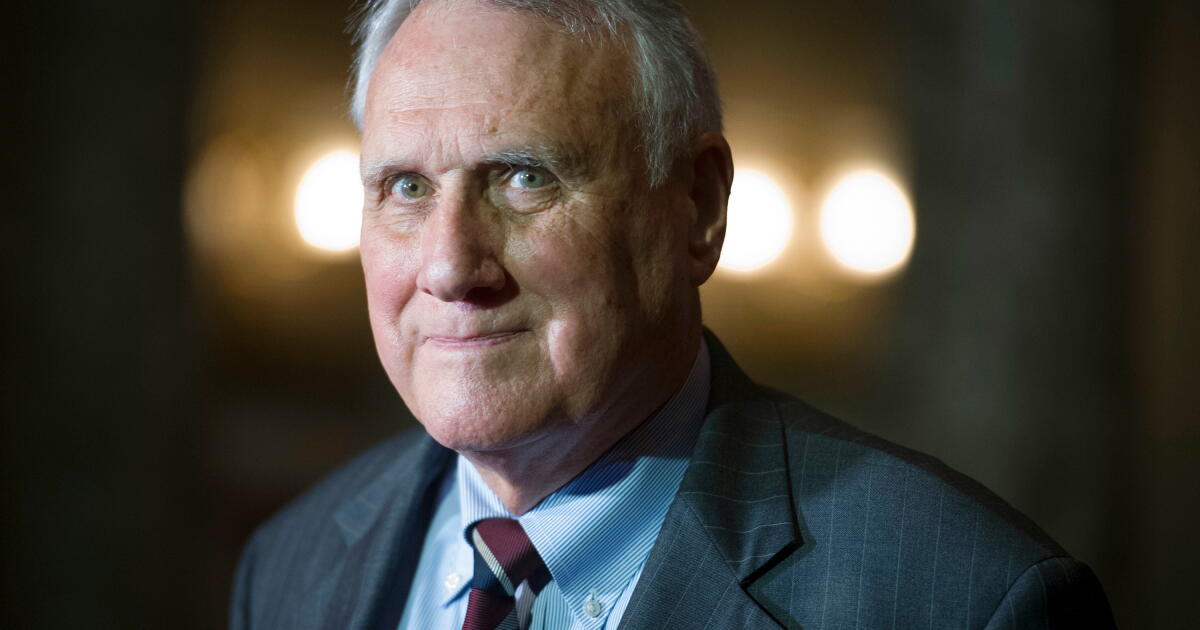
PHOENIX — Former U.S. Sen. Jon Kyl, a longtime Republican lawmaker from Arizona who shaped landmark water policies in the U.S. West and guided the confirmation of Supreme Court Justice Brett Kavanaugh, has died. He was 84.
Kyl died Wednesday night from a neurological disorder, said Gordon James, a communications professional who is a longtime friend of the Kyl family. Kyl had withdrawn from public life in December 2025 after announcing he had been diagnosed with dementia.
Kyl spent almost three decades in Congress, serving in both chambers, and watched his party undergo a drastic transformation, with his career spanning Ronald Reagan’s presidency to President Trump’s first term.
Former Republican Arizona Gov. Doug Ducey, who considered Kyl a mentor, described the former senator in a February 2025 interview with the Associated Press as a true statesman and a “workhorse” among Washington, D.C.’s “showhorses.”
“If you saw him on the plane, he was sitting in the aisle, in coach, and he was reading,” Ducey said. “And he was reading potential bills or Senate business.”
Kyl returns briefly to Senate to fill McCain seat
Kyl rose to a leadership position during his last full term in the Senate, when his Republican colleagues selected him as minority whip. After retiring from politics in 2013 and becoming a lobbyist, Kyl returned to Congress briefly in 2018, when Ducey appointed him to fill the vacancy left by the late U.S. Sen. John McCain.
His appointment drew high praise from Trump, who said he was looking forward to working with “the extraordinary senator.” Kyl stayed for less than four months before rejoining lobbying firm Covington and Burling.
“At the federal level, and I regret to say that this is the case, but probably a lot of my better achievements were in preventing bad things from happening (rather) than forcing good things to happen,” Kyl said in a 2012 conversation with former U.S. Supreme Court Justice Sandra Day O’Connor.
Lawyer with expertise in water gets elected
Kyl was born in Oakland, Nebraska, on April 25, 1942, and grew up in a rural farming district in Iowa that his father represented in the U.S. House. At 18, he headed southwest to attend the University of Arizona, where he met his wife, Caryll, and earned a law degree.
Before being elected for the first of his four terms in the House in 1987, Kyl was a key participant in shaping Arizona’s 1980 groundwater code as a lawyer representing a large water utility. The first-of-its-kind code created a regulatory framework for managing groundwater in the drought-stricken state, largely centering on the state’s population centers, including Phoenix and Tucson.
In 2004, Kyl authored legislation that provided one of the largest tribal water rights settlements, which, after a decades-long battle, gave the Gila River Indian Community enough water to fill nearly 313,500 Olympic-sized swimming pools annually. Republican U.S. Sen. Mitch McConnell of Kentucky, who later served as majority leader, called Kyl’s work ethic “legendary” in a 2012 floor speech and said Kyl had labored mostly behind the scenes for 15 years to advance the settlement.
“It was one of the hardest things I’ve ever done, but I was in a position to be the catalyst,” Kyl told the Phoenix New Times in a 2006 interview. “There wasn’t anybody else who could do that water deal. And it had to be done.”
Arizona State University’s Kyl Center for Water Policy takes its name from him. Its director, Sarah Porter, said Kyl was generous with his time and an effective member of the state’s congressional delegation who took a practical approach to water policy. “He’s always sort of cared about the public good and been able to think about, ‘What will this mean for the generations to come?’” Porter said, adding that Kyl remained “quite a dynamo” until recent years, as his wife battled health problems.
‘Giant’ in the Senate kept Republican caucus together
Ducey said Kyl was a “giant” in the Senate, further describing him as serious, engaging, forthright and thoughtful. His biggest impacts, Ducey said, came from the way he kept the Republican caucus together in opposition to Obamacare and his staunch support of Israel.
Kyl also backed legislation to authorize construction of a fence stretching hundreds of miles along the U.S.-Mexico border. He later joined with Democrats to support a bill that would provide a path to citizenship and temporary guest-worker status for those in the U.S. without authorization. The proposal ultimately failed.
As a lobbyist, Kyl helped guide the confirmation of Trump-picked U.S. Supreme Court Justice Brett Kavanaugh. When Kyl returned to the halls of Congress in 2018, he was known as Kavanaugh’s chief Sherpa — an informal but widely known term for a nominee’s guide to the political tundra in the Senate.
In a statement disclosing his dementia diagnosis, Kyl harkened back to the words of Reagan, when the former president revealed his own Alzheimer’s diagnosis and said he was starting a journey that would lead him to the end of his life.
Kyl said he shared Reagan’s confidence for Arizona and the nation’s future, and that despite his diagnosis, he was a “very fortunate man.”
Billeaud writes for the Associated Press. Former Associated Press writer Sejal Govindarao contributed to this report.
Jason Heyward didn’t give Freddie Freeman the heads up that he’d secured a job in the Dodgers’ front office. He hadn’t told any of his former Dodger teammates. But Freeman, who’s known Heyward for two decades, now says he’d heard rumblings. He was just going to let his longtime friend break the news himself.
On May 13, midway through a home series against the Giants, Freeman walked into the food room at Dodger Stadium, and, to his surprise and confusion, there was Heyward.
“What are you doing here?” a slack-jawed Freeman asked.
“Well, I’m working,” Heyward said.
No text. No call.
“He waited to tell me in person,” Freeman said.
Heyward technically started his job as a special assistant at the beginning of May, but he was on site for the first time a couple of weeks later. That game against the Giants, with Heyward looking on as a Dodgers special assistant for the first time, Freeman stole a base — a rarity in recent years.
“I wanted to ask him, what was my grade?” Freeman said. “What do you give me, a 70 on the 20-80 (scouting) scale?”
Freeman chuckled. Though he has long been an adept baserunner, it’s never been because of his speed — not even in high school, when teams were scouting him for the 2007 MLB draft.
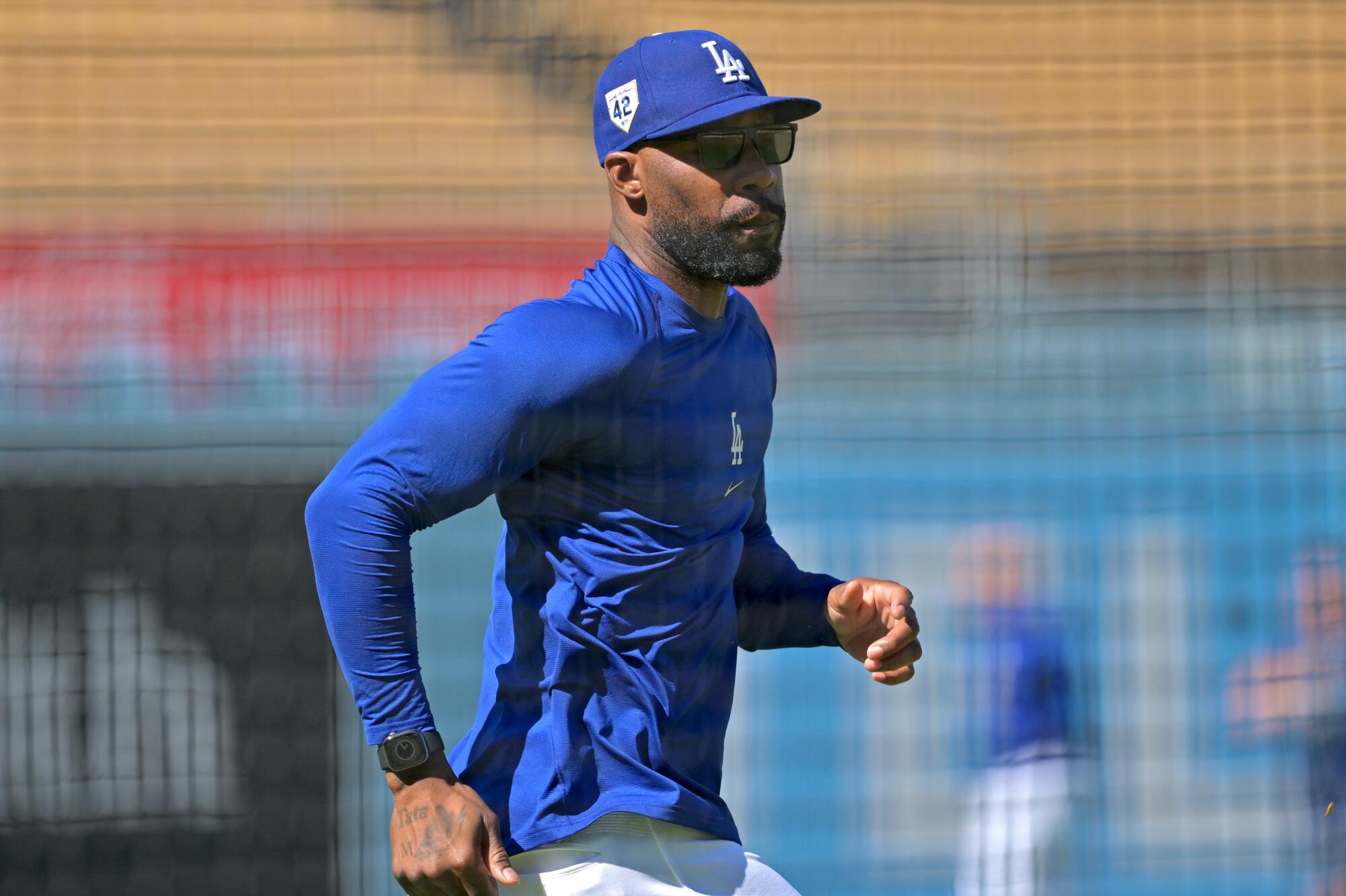
Jason Heyward, who joined the Dodgers as a special assistant earlier this season, stands on the field before a game against the Seattle Mariners at Dodger Stadium last month.
(Jayne Kamin-Oncea / Getty Images)
That’s when Freeman and Heyward first met, the summer before their senior year. They had no way of knowing that they’d go on to experience baseball and life milestones together for the next two decades and counting.
They were both drafted by the Braves, Heyward in the first round (No. 14 overall), and Freeman in the second (No.78). They became roommates and teammates, debuting in the same year.
Over the course of two long and decorated MLB careers — which includes Heyward’s five Gold Gloves, Freeman’s 10 All-Star selections, and five World Series rings between the two of them — their paths diverged and reconnected multiple times.
In this most recent chapter, Heyward has ventured into the front office, Freeman is adding to his Hall of Fame candidacy, and they’re once again on the same team.
“To see us now, it’s crazy,” Freeman said. “It really is.”
Strangers
It’s rare for friends of 20 years to be able to pick out the details of their first encounter. Over the decades, fond memories start to jumble and fade.
But not for Freeman and Heyward.
Without hesitation they’ll bring up August 2006, when they were both 16 and played on opposing teams in the Aflac All-American Classic, held that year in San Diego. They really got to know each other during the down time that week, hanging out in the communal game room in the hotel.
When they met, Freeman was playing Pop-A-Shot.
“That’s where he was most of the time,” Heyward said.
The group could gravitate to another part of the room to “trade cards, sign autographs, talk a little shop,” and Freeman would somehow end up back at the Pop-A-Shot.
That, however, didn’t stop Freeman and Heyward from hitting it off.
On the surface, they were an opposites-attract kind of duo, in pretty much every category but height — listed as 6-foot-4 and 6-5 during that showcase. Heyward grew up in the Atlanta metropolitan area, playing on the East team, and Freeman was an Orange County native, representing the West.
Their priorities and aspirations pulled them together.
“You kind of look around and see all the other guys there and see what they’re doing, how they talk, how they act,” Freeman said. “And then you run into Jason, and then, I’m like, ‘That’s who I want to hang out with.’ He had everything figured out at such a young age.”
Heyward was the more hyped prospect, and the star of the East in that game, with four stolen bases, a pair of hits and two RBIs.
The second time Heyward reached first base, Freeman said to him, “You’re not going to steal again.” Heyward’s response: “I’m going again.”
“I looked down, he was kicking dirt on my shoes, all that,” Heyward said. “So, same guy who he is today on first base, that’s who he’s always been.”
Even in practice, Freeman’s competitiveness stood out to his new friend.
“One hundred percent competitive, but it was fun for him to be competitive,” Heyward said. “Not competitive in like, ‘Get off me,’ [stuff] like that. He welcomed me.”
Though they became fast friends, and ran into each other on the showcase circuit throughout their senior year, who knows what would have happened if the 2007 draft had played out differently?
Dodgers first baseman Freddie Freeman takes his shoes off after batting practice during spring training at Camelback Ranch in Phoenix in February.
(Eric Thayer / Los Angeles Times)
Draftees
Freeman was scheduled to take a final exam the day he was drafted.
That year, the draft made its television debut. The first round — including the Braves selecting hometown kid Jason Heyward — was broadcast on ESPN2. Heyward’s selection wasn’t a surprise — “We know the Braves have a history of drafting young players from the area,” he said.
But Freeman would have to be in front of a computer to track the subsequent rounds. He finagled permission to go home until he was selected, and then return to school.
“We were going along, and I had some other teams calling for me as a pitcher,” Freeman said. “And I was like, ‘I don’t want to pitch, let me hit first.’”
Eventually the Braves called, with their second pick of the second round approaching. Freeman, wasting no time, kicked off the conversation with: “I don’t want to pitch.”
“And they’re like, ‘Good, because we don’t want you to,’” Freeman recalled.
Finally. The excitement began to set in.
Even after the Braves drafted Freeman, it wasn’t a done deal on his end.
He’d committed to Cal State Fullerton, the alma mater of his father, Fred Freeman. And Freddie had his sights set on becoming a CPA and taking over his dad’s business.
A couple days after the draft, at 2 or 3 a.m., Freddie knocked on Fred’s bedroom door with a decision.
“Dad, I don’t want to go to college,” he said. “I want to play baseball.”
They talked for a while. And though Fred had wanted his son to pursue an education, he softened his stance, supporting Freddie’s dream. They agreed, Freddie remembers, that if he didn’t make it to the big leagues in four years, he’d quit to follow the original plan.
“Back then, I was like, ‘Oh, yeah, that’s fine,” Freeman said. “And now you think about it — that was crazy to think, right? Four or five years in the minor leagues, that’s what the norm is. … We didn’t know any better.”
That set Freeman and Heyward on course to reunite, this time as teammates.
Heyward, poised to sign for above slot value, had to wait until mid-August to sign his contract ($1.7-million bonus). So, when he finally joined the Gulf Coast League, for all of eight games before finishing the season with rookie-ball Danville, he remembers Freeman greeting him with a disgruntled, “Hey, man, I’ve been waiting on you. I’ve been here, it’s been hot.”
“My bad,” Heyward said. “I couldn’t control it.”
Freeman broke into laughter.
After the instructional league that fall, Freeman and Heyward decided to room together in spring training. And though the accommodations changed throughout the years, they’d remain roommates through 2010, their debut season in the majors.
Roommates
Outfielder Jason Heyward, left, and infielder Freddie Freeman celebrate before the start of a spring training game against the Toronto Blue Jays in March 2010.
(Al Messerschmidt / Getty Images)
There’s no better way to quickly learn a person’s idiosyncrasies than living with them.
In terms of morning routines, Heyward and Freeman were on far ends of the spectrum. If Heyward was going to start getting ready at 12:30, Freeman was waiting until 12:48 — and it was always something that specific too. Extremely structured to this day, if something throws off Freeman’s schedule, his “robot mind,” as he puts it, malfunctions.
While Heyward would marvel at how close Freeman was willing to cut it, Freeman would give Heyward grief for how long he’d take to get ready.
“In the minor leagues, we had to shave, had to keep it low,” Heyward said. “And I’ve been, at that time, shaving since I was 15. So sometimes I had to shave twice a day, otherwise it was just freaking uncomfortable.
“So, yeah, if I may take a long time to get ready, ‘You’re rocking with what you’re rocking with; you can just get out of bed, literally wet your hair, and then go.’”
On the road, Freeman still jokes, Heyward’s BlackBerry phone came into play. The team would put the players up in hotel rooms with two beds, subjecting Freeman to the incessant clicking of Heyward texting.
“Anybody can nitpick something, but if I complain about a BlackBerry texting, that’s not really anything,” Freeman said. “‘Sorry, I had friends,’ he would say.”
Freeman and Heyward were inseparable. They’d hit back-to-back in the lineup, and then get on the bus for a 13-hour ride and sit right next to each other.
They rose quickly through the farm system, one after another, sharing the highs and lows.
“There was some irony in the fact of how he was treated in the South, versus how I’m treated in the South, even though I’m from there,” said Heyward, who is Black. “And that goes back to even in the minor leagues.”
A road trip to Savannah, Ga., in 2008 immediately came to mind for Freeman, who is white. From first base Freeman could hear everything the crowd said to Heyward in right field — including the racial slur a fan yelled in the middle of a game.
“It was the first time I ever heard the N-word,” Freeman said. “It was crazy to me. And I was almost in tears. I wanted to run into the stands.”
In fact, he started walking over there, before Heyward stopped him.
“For me, obviously, that’s been my whole life, especially growing up where I grew up,” Heyward said. “But it’s just a good perspective on him not hearing it before. And I think that’s it.
“But, yeah, if anybody would have tried him on anything, I’m fighting them too. … What’s understood didn’t have to be explained there.”
The fact that Heyward could remain so calm was eye-opening for Freeman. The pair came away from that incident, and more subtle slights (like having to wait 20 minutes to be seated in a mostly empty restaurant), with a better understanding of each other.
“For an 18-year-old to have that be a normal thing is even more saddening,” Freeman said. “To this day, it’s hard to even talk about. That those kids, or young adults [in the stands] grew up thinking that was an OK thing to say, it’s just baffling to me.”
Teammates
Heyward’s highly anticipated MLB debut came on April 5, 2010, opening day at Turner Field. And in his first major league at-bat, he smoked a three-run home run to right field.
Freeman, on the other hand, started the season in triple A. But that didn’t split up the roommates. Freeman made the 35-minute drive northeast to Gwinnett, and Heyward headed south for 15 minutes.
By late August, it was obvious Freeman would be among the Braves’ call-ups when rosters expanded on Sept. 1.
Sure enough, Heyward and Freeman both headed south that day — still driving separately because of their differing morning routines.
Freddie Freeman, left, Jason Heyward, center, and Brian McCann chat during a workout at spring training in Kissimmee, Fla., in 2011.
(Phelan M. Ebenhack / Associated Press)
“I walked into Turner Field, and saw my name in the lineup, hitting sixth, and I almost threw up,” Freeman said.
Seeing familiar faces helped. Freeman knew many of the coaches and his new teammates from major league spring training the past two years. And, of course, there was Heyward.
“Just a special day,” Freeman said. “I didn’t get any hits, but I didn’t care.
“Jason got all the hits for us, he went four for four. He was so happy I was there. He took all my hits.”
As Freeman went through his big-league firsts, he appreciated having Heyward, who’d already checked them off for himself, by his side.
Freeman looks back fondly on their plane rides. He and Heyward would sit together, eating Chick-fil-A.
Raising the level of decadence, the next year, Freeman had his first “show dinner” with Heyward and veterans such as Eric Hinske and Chipper Jones at a steakhouse in Seattle called El Gaucho.
“I was like, this is the coolest thing ever,” Freeman said.
“Those were both of our ‘college years,’” Heyward said. “So seeing the real world a little bit, spending time on flights, clubhouse, dinners, enjoying teammates, becoming young adults.”
Jason Heyward, right, high-fives teammate Freddie Freeman after scoring off a single by Justin Upton in the first inning of a June 2013 game against the Arizona Diamondbacks.
(David Goldman / Associated Press)
They were also playing well. Heyward and Freeman finished No. 2 in NL rookie of the year voting in consecutive years. And they started filling up their own individual trophy cases, while the Braves made it to the postseason three times in five years.
“Everyone has fun playing baseball,” Freeman said, “but to experience the big leagues with your best friend, I don’t know if you can get much better than that.”
Rivals
As soon as the Braves were eliminated from the 2014 postseason chase, the team fired general manager Frank Wren. Plunging into a rebuild, new president of baseball operations John Hart’s first big move was to trade Heyward to the Cardinals for pitching.
“That was the first time I saw the business side of baseball,” Freeman said. “Sad day. But it opened my eyes to, this isn’t just fun all the time. The fun has to end at some point.”
Freeman and Heyward kept in touch and celebrated each other’s successes. But it wasn’t the same.
“That was like, ‘Alright, this is becoming more of a job,” Heyward said.
Heyward leveraged that platform season in St. Louis into an eight-year free agent contract with the Cubs worth $184 million, setting a franchise record.
The Braves extended Freeman. Then when he finally hit free agency after the 2021 season, he became the first infielder to sign a $100-plus million deal with the Dodgers, signing a contract for six years and $162 million.
For eight years, Heyward and Freeman played for opposing NL teams. Then, an unexpected turn of events set the ball rolling for a reunion.
In early August 2022, when Heyward had already been on the injured list for over a month with what the Cubs called right knee inflammation, president of baseball operations Jed Hoyer announced that the team intended to release the veteran right fielder from the final year of his contract after the season.
Freeman saw an opportunity. And for the rest of the year, he didn’t let Dodgers president of baseball operations Andrew Friedman or general manager Brandon Gomes walk by without hearing his pitch for Heyward.
“I’ll shoot you straight,” Freeman told them. “I don’t know what you’re going to get from the baseball player Jason Heyward, but I know what you’re going to get from the person Jason Heyward, and what he would mean inside of a clubhouse, and what he can do to young guys and help them. There’s no one better to be in this clubhouse than how you are envisioning clubhouse culture and chemistry than to bring this guy in.”
Friedman doesn’t have an exact count on the number of times Freeman mentioned Heyward to him in those months, “but it was definitely a lot.”
Friedman and Gomes were intrigued enough to have their group dig into the evolution of Heyward’s swing. But they still had questions, like how open was he going to be to diving into adjustments with their staff?
Soon after he was officially released, the Dodgers set up a Zoom.
“He was all-in,” Friedman said, “in terms of open-mindedness, desire to change some of the recent narrative, and he was excited about the prospect of working with our guys and doing what he could to help us win games, both on and off the field.”
Heyward said he heard from the Dodgers three times before he heard from any other team in free agency.
“That was how persistent they were,” he said.
Jason Heyward, left, celebrates a run with Freddie Freeman against the Texas Rangers in June 2024.
(Ronald Martinez / Getty Images)
Heyward signed a minor-league deal with the Dodgers in early December. He spent time in Southern California over the offseason to get a head start on overhauling his swing. And he met Freeman in Newport Beach, to hang out, hit and work out together.
Heyward’s efforts paid off. He made the team out of spring training. And he and Freeman were officially teammates again.
“It was so fun,” Heyward said.
Their reunion on the field was brief — the Dodgers re-signed Heyward for the 2024 season and then, his first half derailed by injuries, released him in August — but it was still sweet.
“You go from sitting together on a bus coming from Rome, Ga., going to Wilmington, Delaware — and like now you’re on a first class flight with the L.A. Dodgers, and traveling from West Coast to East Coast, wearing the jumpsuits, all that stuff,” Heyward said. “That was a very cool experience coming from being 16-years-old, Aflac All-Americans, to now sharing a World Series ring.”
Co-workers
Heyward finished 2024 with the Astros and spent the next season with the Padres. He trained this past offseason to be ready for spring training if a team gave him an offer. But in the final weeks, he also started laying groundwork for a post-playing career in case the phone never rang.
“This year I said, ‘If we get a Super Bowl weekend, that’s it, and I’m content,’” Heyward said. “Not complacent; I’m content. I let it run its course, and now I have clarity to go do whatever else it is.”
He said he reached out to the Cubs first about a non-playing role, and had cursory conversations with the White Sox. He exchanged texts with Friedman, reviving conversations they’d had in his stint with the Dodgers. In many ways, it came down to timing.
Heyward had already been planning on meeting up in spring training with Dodgers manager Dave Roberts, a former player, to pick his brain about the transition.
They went to dinner, with both their wives, and stayed for six hours.
“I basically was just honest with him, in telling him that, No. 1, I think it’s great that he wants to stay in the game,” Roberts said. “But No. 2 is that when you’re a player, you look at certain things in a certain lens, but for him to be good at this job in the front office, he’s got to be really open-minded to learn.”
Roberts came away from the conversation excited by how earnestly Heyward embraced that message. And he mentioned to Gomes: “Someone with his character that has his desire to work could be a huge asset for us.”
Two and a half weeks later, Heyward stopped by Dodgers camp at Camelback Ranch to catch up with old friends and teammates.
“I was here for two years, and it felt like I was here for 10,” Heyward said. “And that’s family included — my family, my kids, my wife … So, what I thought was going to be natural, this was even more organic.”
Friends
Dodgers outfielder Jason Heyward, right, congratulates Freddie Freeman after bringing him home on an eighth-inning sacrifice fly against the Colorado Rockies at Dodger Stadium in a June 2024 game.
(Robert Gauthier / Los Angeles Times)
Life changes dramatically between the ages of 16 and 36.
“Single guys trying to make it, to married with many kids,” said Freeman, who turns 37 next month. “And we’re still as close as ever, which is really, really special for me.”
Then, he added: “This is going to be friends forever.”
Their wives, Chelsea Freeman and Vedrana Heyward, are close too. The Freeman’s middle children are just a little over a year older than the Heywards’ eldest. And the families’ newest additions were both born months apart.
Freeman and Heyward are already coordinating family schedules and travel — the Heywards are based in Chicago — to all get together in California this offseason.
They’re no longer those high schoolers bonding between rounds of Pop-A-Shot. In June, Freeman surpassed 2,500 career MLB hits.
“The way Free’s done it, winning is all over it,” Heyward said. “I think that’s one of those unique abilities, to this guy is playing the game first, winning first, and then he’s getting a result, then he’s having the big at-bat, doing it obviously in the postseason. So I’m just happy to see him get the recognition that he’s earned the time he put into it. I’m happy to see his stubbornness pay off.
“It’s not easy to do. It’s much easier said than done.”
Heyward, moving on from a 16-year major-league playing career, would love to be a general manager one day. But he’s keeping an open mind. He took Roberts’ advice to heart and is using his first year as a special assistant to learn and explore the possibilities.
Heyward has been around the major-league team for a handful of series in Los Angeles and Chicago (even giving Freeman advance notice before the White Sox series to make up for his May drop-in).
Trying his hand at player evaluation, he sat in the stands during the Southeastern Conference tournament. And as he pops in on affiliates, the Dodgers also see the time he spends with their outfield prospects — the biggest strength of their farm system — as invaluable.
“Whatever he wants to be in the front office, he’s going to be it, because that’s just who he is,” Freeman said. “Because he is a special man, he works hard, he cares, he wants to be the best.”
Freeman has already seen Heyward manifest his dreams once — and vice versa.
Being drafted, making it to the majors, winning championships, those were just dreams 20 years ago this month, when they both wandered into the communal activities room between All-American Classic obligations.
“That week in San Diego,” Freeman said, “obviously we’ll never forget it.”
LOS ANGELES — U.S. immigration officials worked with Iran to deport Iranians in 2025, newly released emails show, revealing a working relationship between the U.S. and Iranian governments despite tensions mounting between the countries.
Hundreds of emails exchanged between U.S. immigration officials, which were obtained by the National Iranian American Council and made public Tuesday, offer the most transparent play by play yet of how the two countries worked together to arrange for more than 100 Iranians to be flown back to Iran on three separate immigration flights in September and December 2025 and January 2026.
The emails show that Iranian officials had some influence over which Iranian immigrants in the U.S. were sent back to their home country, and U.S. Immigration and Customs Enforcement officials apparently heeded some last-minute changes to deportation lists at the request of Iran.
“Per request from the Iran Embassy I added a few cases,” one unnamed ICE official wrote in late August, a month before the first deportation flight in September. Just over a week later, someone with the same job title moved to make another, unspecified change to the deportation list after they said they met with the “Director at the Iranian Embassy.”
“Iran has requested that I amend the previous manifest and expedite the removal process,” the official wrote.
In a Sept. 26 email, just three days before the deportation flight left U.S. soil, an ICE official said in an email that the Iranian Embassy was still making requests for three additional Iranians on the flight. It’s not clear who ended up on the flight, which ended up being much smaller than initially planned. Iranian officials were still making requests the day the flight departed, although one official wrote that those requests were denied.
Coordination of the flights remained a high priority even as ICE officials acknowledged internally that Iranians were fleeing Iran amid the deadly 12-day war with the U.S. and Israel in June 2025, emails show. The flights departed just months after the U.S. and Israel agreed to a ceasefire with Iran.
The new emails highlight a clear departure from a decades-long practice by the U.S. of welcoming Iranian dissidents, exiles and others since the 1979 Islamic Revolution forced a large number of Iranians to flee.
The deportation of Iranians to a country whose government has a pattern of violent persecution against women, religious minorities and political dissidents has drawn significant criticism from human rights activists.
The Department of Homeland Security did not offer comment in response to an emailed request sent Tuesday afternoon.
Some deportees were handpicked by Iranian officials, emails show
Iranian officials acknowledged in September 2025 that as many as 400 Iranians could be returned under an agreement with the Trump administration. They said most of the Iranians had crossed into the U.S. from Mexico illegally, while some faced other immigration issues.
It is not clear from the emails how frequently U.S. immigration officials had direct contact with the Iranian government. Sometimes messages were conveyed through Qatari officials, who helped charter the deportation flights through Doha, but other times officials reference regular meetings with the “Iranian delegation,” the “Director at the Iranian Embassy” and other unnamed Iranian officials.
It is not clear whether the people Iran put on the list had volunteered to repatriate or if they were forced. Previous reporting from The New York Times revealed that asylum-seekers were among those deported to Iran, while others said they were deported against their will.
At least one person was deported who wasn’t supposed to be, emails showed.
“An Iranian not included on the final manifest we sent to the Qatari MOI was boarded on the flight,” an unnamed U.S. official wrote.
In response, another unnamed U.S. official wrote, “I have no idea how the case/person got through on the plane.”
U.S. prioritized deportation efforts during war
Emails suggest that pressure to carry out the Iranian deportations came from the highest levels of the Trump administration, even when U.S. and Israel were exchanging strikes with Iran in a 12-day conflict between June 13 and June 24, 2025.
Just days after Trump’s June 16 warning on social media that “Everyone should immediately evacuate Tehran!” the former acting director of ICE, Todd Lyons, called the repatriation of Iranian immigrants a “priority” in an email sent to the agency’s head of removal operations Marcos Charles and a number of unnamed staff.
Shortly after Lyon’s email, Charles forwarded the message to a group of officials whose names are redacted. An unnamed ICE official responded, warning that “removal will prove difficult” amid the ongoing conflict because Iran wasn’t issuing the travel documents for Iranians eligible for deportation. On top of that, the Iranian airspace was closed to all flights during the bombings and Iranians were fleeing the country.
Charles was unfazed, telling staff in a subsequent email to make a plan to deport 58 Iranians with final removal orders in ICE custody at the time.
“We need a plan forward ASAP,” Charles wrote. Another official, who name was redacted, urged colleagues to “identify a solution for this White House priority.”
Jamal Abdi, the president of the National Iranian American Council, said the emails undermine Trump’s assertions that the U.S. is at war with Iran to save ordinary Iranians from a repressive regime.
“It demonstrates that the top priority here was to kick out as many people as possible by whatever means necessary,” Abdi said.
Iranian officials had access to immigration detainees
On several occasions, the emails show ICE officials arranging for Iranian officials to meet for unspecified reasons with people detained in the U.S., echoing testimony from Iranian asylum-seekers in an unrelated lawsuit filed by an unaffiliated Iranian interest group in July.
Eleven Iranians in immigration detention said they were forced to meet with Iranian government officials while in ICE detention. Those Iranian authorities knew intimate details about their asylum claims, according to the sworn declarations filed in a Washington, D.C., court in July.
The lawsuit alleges that U.S. immigration agencies have been illegally sharing confidential information about Iranian asylum-seekers with the Iranian government.
The U.S. government is allowed to work with government officials of foreign countries to coordinate deportation logistics. However, federal regulations passed in the late 1990s prohibit the government from sharing information that could reveal that the person getting deported applied for asylum.
DHS vehemently disputed the lawsuit’s allegations.
“These allegations that ICE shared asylum application records with the Iranian government are FALSE,” DHS said in a statement in July.