L.A.’s Shakespeare Bridge turns 100 — and there’s a party
There is no love like municipal infrastructure love.
It was late in the 20th century when my wife, Mary Frances, and I moved into Los Feliz. Quickly we learned that our corner of the neighborhood was known as Franklin Hills, and that just about every eastward outing would take us across a funny little bridge with eight pointy turrets. That bridge was the Shakespeare Bridge.
As a teacher at nearby Ivanhoe Elementary, Mary Frances crossed the bridge twice every school day for more than 20 years. As a student there, our daughter Grace crossed it for six years, usually with me as chauffeur.
We’ve crossed it at all hours in every kind of weather, on foot, on bikes and in cars, talking about school, work, family and, lately, the fractured state of the nation and world.
Now that bridge on Franklin Avenue at St. George Street is near its 100th anniversary and an Oct. 10 neighborhood celebration is in the works, complete with a street party and procession. As the day approaches, I keep thinking about how large a funny little bridge can become in the lives of its neighbors.

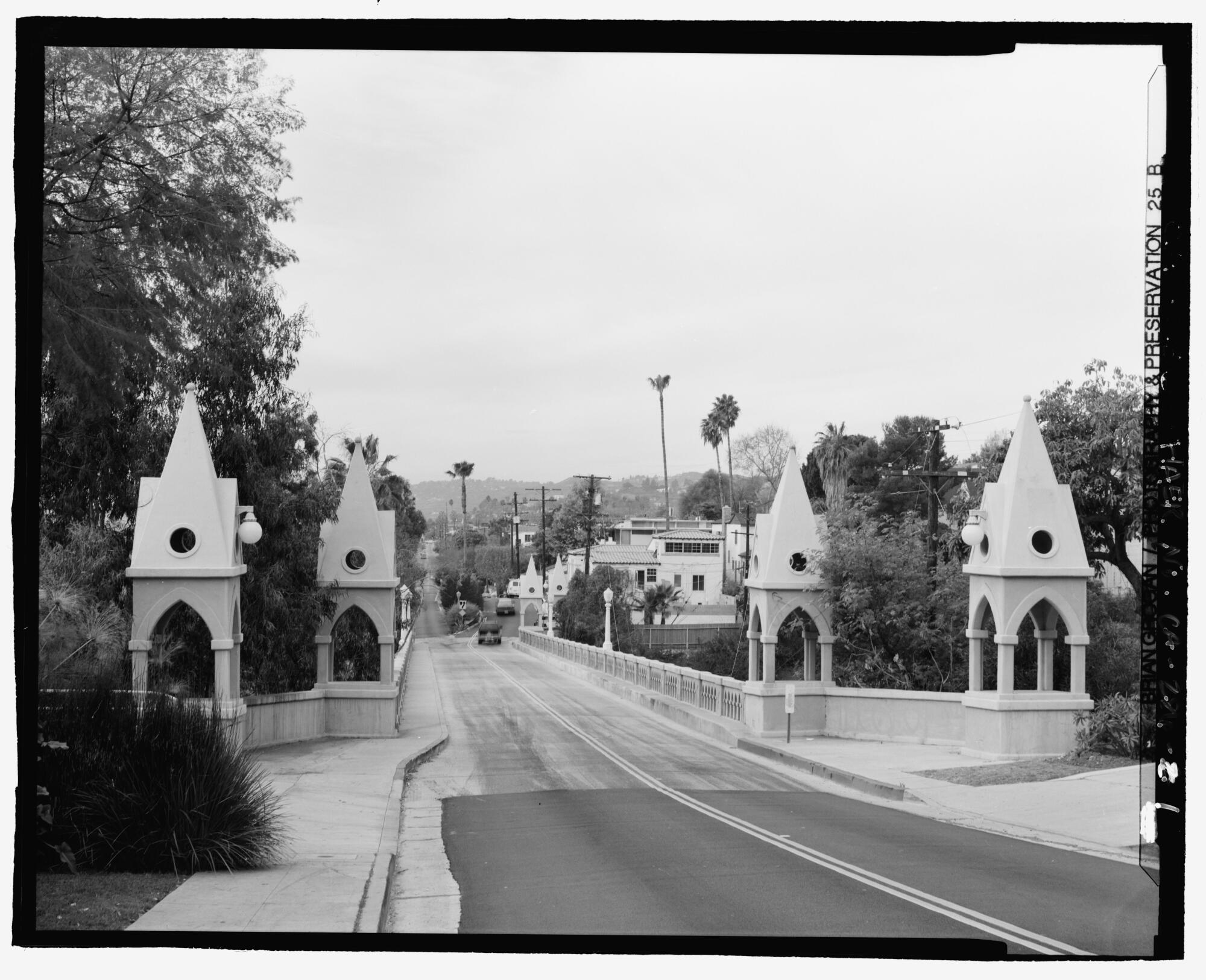
This view looks westward across L.A.’s Franklin Avenue Bridge, also known as the Shakespeare Bridge.
(Library of Congress)
Originally it was the Franklin Avenue Bridge, designed by J.C. Wright of the city’s civil engineering department in the mid-1920s, when a twenty-something cartoonist named Walt Disney was new to the neighborhood and the Vitagraph Studios, a block away, were transitioning from silent films to talkies.
Paid for by a controversial city assessment of neighbors, the bridge is 262 feet long and 30 feet wide — a pipsqueak compared with landmarks like Pasadena’s Colorado Street Bridge or the 6th Street Bridge between Boyle Heights and downtown L.A.’s Arts District. Its three open-spandrel arches were made using Portland cement.
Nobody knows where the Shakespeare nickname came from, but city officials designated the bridge as L.A.’s Historic-Cultural Monument No. 126 in 1974 and retrofitted it in the 1990s to better withstand earthquakes. Crucially, city staffers preserved those charming and entirely unnecessary turrets, which deserve their own sonnet, if you ask me.
“Back then, people put some thought into these things,” City Council aide Tom LaBonge told this newspaper in 1988, years before he became councilman (2001-15) for the district that includes the bridge.
Since 2017, neighbors have tended a Shakespeare Bridge Garden beneath the span. The neighbors (a.k.a. the Franklin Hills Residents Assn.) also pay to keep up the landscaping on the nearby traffic island.
When the bridge went up, L.A. “was becoming a city,” said Alison Wallace, president of the FHRA. “We were trying to look legit, and people were adding all of these amazing public works.”
The result, Wallace said, was a span that eased connections between neighborhoods and “helped us become a community.”

This view looks from below the Franklin Avenue Bridge, also known as the Shakespeare Bridge.
(Library of Congress)
Many architectural sources call its style Gothic Revival. Some see Moorish influence. Researcher Tiger Shankman has hailed its “perky, anachronistic beauty.” In “An Architectural Guidebook to Los Angeles,” authors David Gebhard and Robert Winter suggest that the ornate ends of the bridge “cry out for sculptured saints.”
Instead of saints, however, the bridge has seen a lot of actors and film crews. The bridge turns up in the movies “Dead Again” (1991) and “I Love You, Man” (2009), the Netflix series “Nobody Wants This” (in 2025) and the HBO series “I Love L.A.” (also 2025). My favorite clip is a chase sequence from a 1971 “Mannix” episode — excruciatingly slow-paced by 2026 standards, and shot long before the FHRA tore out the city’s blacktop median and planted greenery.
Given all of its neighborhood fame, it surprised me to hear how few Angelenos know about the bridge. When Charlie Ryan and Thom Vest started offering LA Explained walking tours early this year, they expected the Disney history would be a popular part of their Los Feliz itinerary, but the bridge quickly emerged as another central element.
Because most of those who sign up for the Los Feliz tour live elsewhere, they have never crossed the bridge “and don’t know it’s there,” Ryan said. “Out of all the tours that I do, it’s the one that brings the most surprise to people.”

An aerial view of the Shakespeare Bridge, formally known as the Franklin Avenue Bridge, in the Franklin Hills area of Los Feliz.
(Allen J. Schaben / Los Angeles Times)
But plenty of those who live nearby have deep connections with the bridge, including Charley and Shirley Mims, who got married there on Oct. 21, 2000.
To open the ceremony, Shirley strolled from the west end of the bridge to the east, where Charley was waiting. (They still live in the neighborhood and plan to be at the centennial party.)
“When you see the bridge and cross it,” my neighbor Dave McDonald said the other day, “you feel like you’re home. It’s like a welcoming beacon.”
“It’s a real local’s way of getting around,” said Matteo Chizzola, who moved to Los Angeles four years ago and settled in Los Feliz two years ago. Last year, when Chizzola decided to start selling matcha from a sort of grown-up street-corner lemonade stand, he chose a patch of sidewalk at Franklin Avenue and Talmadge Street, two blocks from the bridge.

A jogger crosses the Shakespeare Bridge.
(Allen J. Schaben / Los Angeles Times)
“It is beautiful and it’s weird. If you go at the right time of day, at sunset, it’s an incredible view,” he said.
Chizzola said he isn’t getting rich running the stand, Fridays through Sundays, but “it has become something that puts a huge smile on my face.”
He’ll be on hand for the bridge’s centennial parade, along with invited local luminaries including Victor the fruit guy (who worked a corner near Marshall High School for more than a decade) and Dora Herrera of the much-loved Yuca’s restaurant on Hillhurst Avenue.

A pedestrian crosses the Shakespeare Bridge,which was completed in 1926.
(Allen J. Schaben/Los Angeles Times)
Sometimes, when Mary Frances and I are on a neighborhood walk, we stop mid-span. In the distance to the south, you see the downtown skyline. In the arroyo below the bridge (officially the Arroyo de Sacatela) you see the private homes and yards along Monon Street and Myra Avenue. You also see the Los Feliz campus of the International School of Los Angeles (1960), the only school designed by modernist architect John Lautner.
Then there are the decorations. Every few months, in a tradition started by departed neighbor Chris Boutelle, Mary Frances joins a team of FHRA board members and other volunteers who put up hearts for Valentine’s Day, shamrocks for St. Patrick’s Day, Pride and Juneteenth flags in June, American flags and bunting in the lead-up to July 4, and so on.
Most of these costume changes are seamless. But in June 2023, someone tore down the Pride flags. Neighbors quickly replaced them. They came down again. Neighbors replaced them again. The back-and-forth went on for weeks. A suspect was arrested, released, then re-arrested.

Shakespeare Bridge in Los Feliz was the site of controversy in June 2023, when someone repeatedly stole Pride flags from a bridge display. Neighbors replaced the flags and police made an arrest.
(Gary Coronado / Los Angeles Times)
“It was almost every day for a month. People really came together,” said Wallace. The vandal surely didn’t mean to, but Wallace contends that he wound up uniting the neighborhood as never before.
The Oct. 10 bridge celebration, organized by the FHRA, will begin with a noon procession to the bridge from Marshall High School (another neighborhood Gothic Revival landmark), featuring a marching band, several vintage cars and a costumed dog parade.
At the end of that short walk, there’s a party planned from 1-5 p.m. at the end of Monon Street , right under the bridge. There will be snacks, drinks, live music, kid crafts, a bouncy house, a handful of actors in Shakespearean garb and scads of neighbors being neighborly.
I’ll be there for all of it. In times like these, every bridge needs celebrating.

Shakespeare Bridge, formally known as the Franklin Avenue Bridge, spans a ravine in the Franklin Hills with downtown Los Angeles in the background.
(Allen J. Schaben/Los Angeles Times)