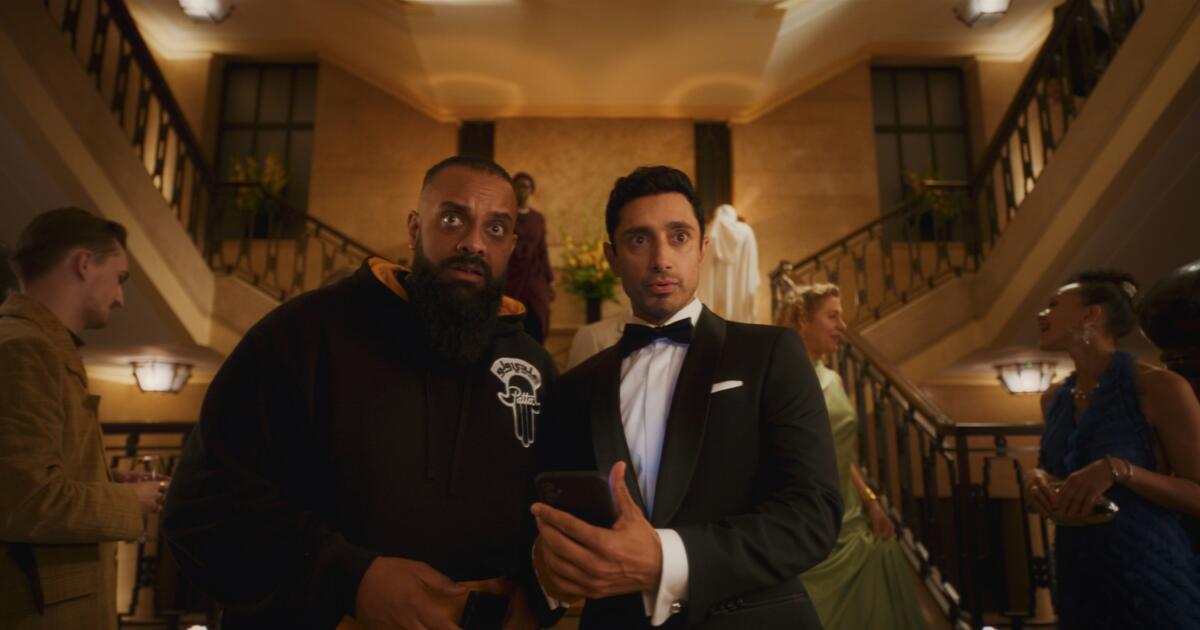
Riz Ahmed has created and stars in a marvelous new series, “Bait,” premiering Wednesday on Prime Video. There are no worms in it, though viral video plays a part, and fame — the pursuit of which is a subject — is a lure.
But what’s in a name? A comedy by any other name would be as funny — if it was funny, and this one very much is, in a way that’s crazy and serious and human, built around a character in crisis who refuses to believe his life is out of control and is so invested in putting up a front that he’s begun to believe his own lies. Almost. It’s a series in which hallucinations, dreams, magical realism and memories, which punctuate and interfere with the “normal” business of the story, all amount the same thing, and in which the style of the filming shifts with the action.
Ahmad plays Shah Latif, a British Pakistani actor, who, owing to the exertions of his faithful, often frustrated agent, Felicia (Weruche Opia), is improbably auditioning to be the next James Bond. But he repeatedly forgets his line when his scene partner, a girl with a gun, asks, “Tell me, when it’s just you all alone, how do you live with yourself? Do you even know who you are?” establishing a theme. (The line he can’t recall: “I don’t live with myself, I live with whoever you need me to be.” Spies and actors!)
Leaving the audition, he contrives to be photographed by one of the paparazzi lurking outside, sniffing for a Bond scoop; his picture is published, which creates a stir and some racist blowback, culminating in a package thrown through the front window of his parents’ home. (It is not a window that opens.) What’s inside the package I’ll leave for you to discover, but it will play a part through the rest of the show.
The recurring question of who will be the next James Bond generates a lot of pop cultural heat in our world; just type “next James Bond” into your search engine of choice. At one point, you may recall, Idris Elba was regularly bruited as a potential 007, which occasioned enough anti-Black reaction that he officially took himself out of the unofficial running. It may have been on Ahmed’s mind here — Shah claims high purpose for his Bondean aspirations, that he wants “to show them that this too is what British looks like.”
On the one hand, Shah has had enough of a career to have been made into a “limited edition collectible action figure,” starred in a well-regarded but underseen small film, played “the translator in ‘Homeland’ series seven” and earned a rising star award from some French festival; on the other, he is, professionally speaking, no Idris Elba — not a nobody, but not too many rungs above it. (He’s not Dev Patel, either, with whom he’s repeatedly confused.)
At the top of the second episode, Shah is seemingly being interviewed on a podcast, “Sir Chatwick Stewart, with me, Sir Patrick Stewart” — played by the man himself, whom we hear but never see — about his ambitions, though it’s soon clear that Stewart is a mental projection, an inner critic and inquisitor. He’ll stick around through the series, offering barbed commentary and something like support: “If I humiliate you, it’s to save you from the bigger humiliation of remaining as you are.”
As a protagonist continually getting in his own way, Shah is a classic sort of comic character. He creates opportunities only to squander them; finds himself voiceless after forcing himself onstage at a black-tie gala or in an underground club (he was once a politically provocative MC). After a newsworthy mishap, his agent advises him to lie low, which is impossible for him to do; there is no itch he won’t scratch, and no good advice he’ll actually follow. Apart from a rival actor (Himesh Patel) he’s a protagonist without antagonists, excepting himself. He’s insufficiently grateful to the people he owes, and insufficiently apologetic to those he’s wronged.
Shah’s self-involvement will be challenged by ex-girlfriend Yasmin (Ritu Arya), encountered first by accident, then sought out — a writer, she has published an op-ed headlined, “No, Shah Latif, We Don’t Need a Brown Bond” — in which she accuses him of “exchanging his political art for vanilla distraction.” His family, whom he neglects to visit for months, includes warm-hearted cousin Zulfi (Guz Khan), who has started a Muslim ride share company; a no-nonsense sister (Aasiya Shah) — the name of her character is rendered as “Q” on IMDb and elsewhere, but in the series itself she’s called Ainy — doting mother Tahira (Sheeba Chaddha); and his skeptical father, Parvez (Sajid Hasan), who has not been keeping his doctor appointments and asks Shah, “What do you even do? I watch TV all day — you’re never on it.”
Appropriate to a character who lives for being onscreen, “Bait” plays with the language of film — gritty procedural, a burst of Bollywood, romantic comedy — though not necessarily to the usual ends. Frame-filling titles identify the London neighborhoods where the action takes place — Wembley, Kentish Town, Brick Lane, Ladbroke Grove — as Paris, Moscow and Mexico City might appear in an international thriller. The series is at once satirical and celebratory; “Bait” feels abundant, both in its presentation of a culture, which has the ring of documentary truth, and as a beautifully realized work of art.
Rastriya Swatantra Party, founded just four years ago, set to dominate new parliament with near two-thirds majority.
Published On 12 Mar 202612 Mar 2026
Share
A political party led by a rapper-turned-politician has won a sweeping parliamentary majority in Nepal, official results show, capping one of the most dramatic elections in the country’s recent history.
The Rastriya Swatantra Party of Balendra Shah, a 35-year-old former civil engineer and hip-hop artist known simply as “Balen”, secured 182 seats in the 275-member lower house of parliament, the Election Commission said on Thursday, with 125 won directly and a further 57 through proportional representation.
Recommended Stories
list of 2 itemsend of list
The Nepali Congress party finished in second place, with 38 seats. The Marxist party of veteran four-time Prime Minister Khadga Prasad Sharma Oli, whose government was ousted in a youth-led uprising last year, won just 25 seats.
Shah himself defeated the 74-year-old Oli in his own constituency.
Oli, who had dominated Nepali politics for years, congratulated his rival on X, wishing him a “smooth and successful” term.
The September 2025 protests that reshaped the country’s political landscape were initially set off by a government ban on social media, but rapidly swelled into a mass movement against corruption and economic stagnation, leaving at least 77 people dead.
Shah, whose music had long targeted those same grievances, emerged as a figurehead of the unrest, his song Nepal Haseko, or Nepal Smiling, accumulating more than 10 million YouTube views during the turmoil.
His path to likely prime minister, from engineer to rapper to Kathmandu’s first independent mayor in 2022, reflects a generational shift in a country where more than 40 percent of the nearly 30 million population is under 35, yet whose established party leadership has long remained in its 70s.
Shah said his victory was a signal of refusal to take “the easy way out” and a reckoning with the “problems and betrayals that have affected the country.”
The RSP, founded the same year as his mayoral win, ran a highly organised campaign backed by diaspora funding, particularly from Nepali communities in the United States.
Nepalese journalist Pranaya Rana described Shah to Al Jazeera as embodying “the outsider spirit that many young Nepalis are looking for to shake up the status quo.”
India’s Prime Minister Narendra Modi called the vote a “proud moment” in Nepal’s democratic journey, pledging close cooperation with the incoming government.
Under Nepal’s constitutional process, parties must now submit names to fill proportionally allocated seats before parliament is formally summoned by the president. A new prime minister, who will need the support of at least half of all members, is not expected to be confirmed for several days.
Balendra Shah (C), former mayor of Kathmandu, appears poised to become Nepal’s next prime minister after his party scored a landslide victory in national elections. Photo by Narendra Shrestha/EPA
March 8 (UPI) — Former rapper Balendra Shah appears poised to be Nepal’s next prime minister, after his party won the general election by a landslide.
Shah’s Rastriya Swatantra Party, or RSP, captured 117 out of the 165 directly-voted seats in the Federal Parliament of Nepal and is currently leading in eight more contested seats. Final results, including seats appointed by proportional representation, are expected to be announced in the coming days.
Shah, 35, transitioned from a rapper to a politician in 2022, when he was elected mayor of Kathmandu.
The former musician became a figurehead of the September 2025 movement that saw young people take to the streets to protest Nepalese Prime Minister Sharma KP Oli’s law banning social media use. The protests expanded into criticism of government corruption and the country’s political system as a whole.
A government crackdown on the protests resulted in the deaths of 19 protesters, and led to public unrest resulting in 70 deaths and the resignation of Oli’s government.
Shah’s party has pledged to create 1.2 million jobs, reduce forced migration, raise the per capital income from $1,447 to $3,000 and provide social safety nets including health insurance.
For decades, Iranian novelist and memoirist Shahrnush Parsipur wrote under the threat of her country’s oppressive laws. Parsipur was imprisoned for her work four separate times: once under the shah, who ruled Iran before the Islamic Revolution of 1979, and three times under the regime that took power that year.
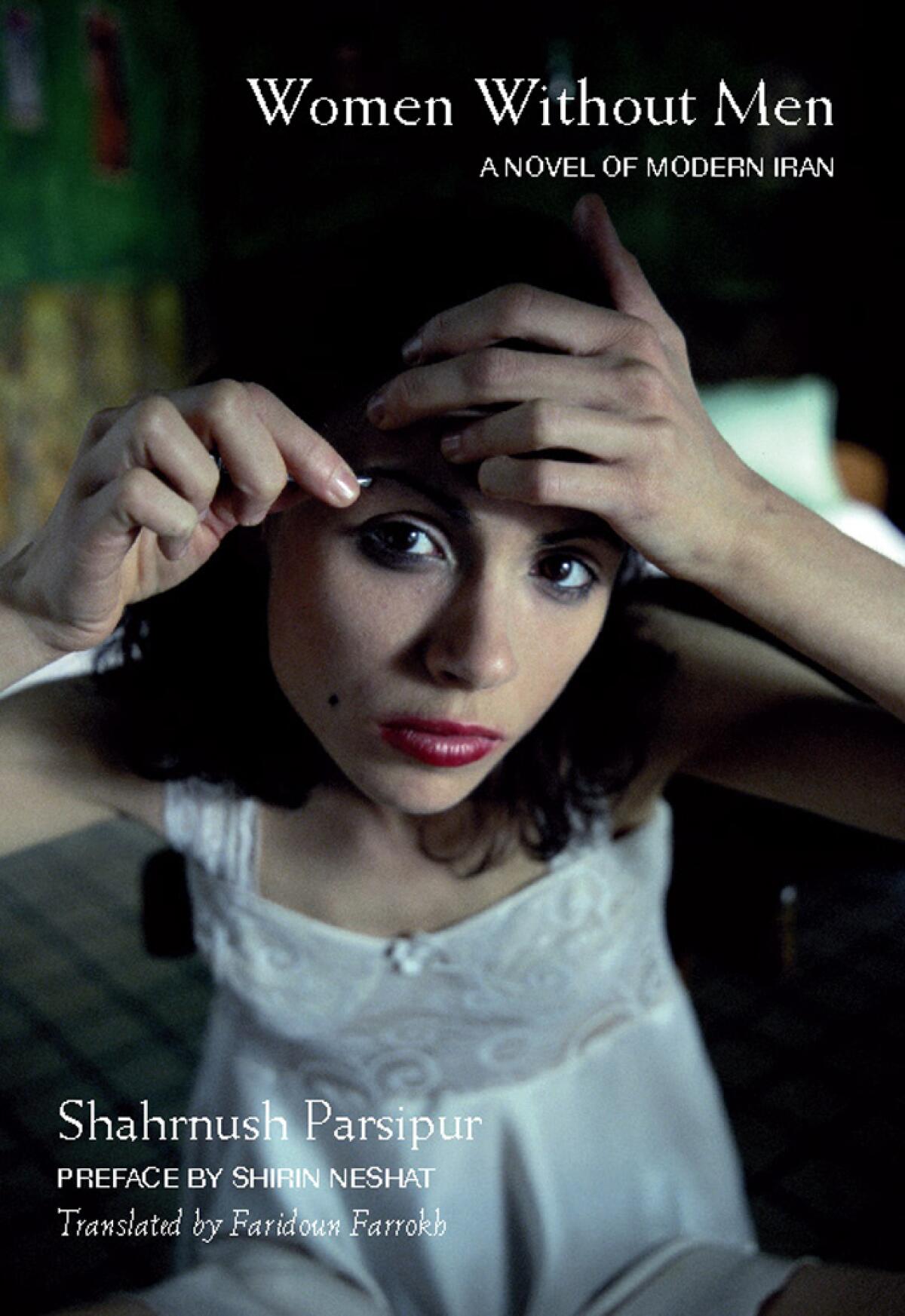
Despite this Damoclean sword hanging over her, she managed in 1989 to publish “Touba and the Meaning of Night,” a sweeping historical novel that lays bare Iran’s crushing patriarchal culture. In 1990, she wrote “Women Without Men,” a book of connected stories that trace the lives of five women, including a sex worker and schoolteacher, in search of liberation and self-actualization.
You’re reading Book Club
An exclusive look at what we’re reading, book club events and our latest author interviews.
Shortly after the book’s publication, the Iranian government threw Parsipur in prison for a fourth time, where she remained for over four years.
Flash forward 36 years, and an English translation of “Women Without Men” has published in the U.K. for the first time. (The first U.S. English translation was published by Feminist Press in 2011.)
Now, the U.K. book has been nominated for this year’s International Booker Prize. In an email exchange, Parsipur, who presently lives in exile in Northern California, expounded on her career, Iran and the recent developments there.
✍️ Author Chat
(The L.A. Times may earn a commission from bookshop.org links.)
Women Without Men was longlisted for the 2026 International Booker Prize
(The Feminist Press)
What is your feeling about the U.S. air attack against Iran?
I am very sorry for my country. People suffer and the country becomes ruined. I will never forgive Israel and the U.S. I am an American also and as an American I want to stop the war. I do not think that Americans and Israelis can bring liberty to Iran. The people of Iran must try for themselves.
The government threw you in prison shortly after you published “Women Without Men.”
I was never a political activist and they did not torture me. But one time they put me in a grave for two months in Ghezel Hesar Prison. There, we always had to sit without speaking and our eyes were closed by a cover and we listened to Islamic slogans.
So it was solitary confinement?
We were sitting in a space the size of a grave and there was a wooden wall between every grave, so you could not see anything except your grave.
Did you write in prison?
Yes, I began to write my novel “Touba and the Meaning of Night.” I wrote half of it and suddenly they took it and after one year the men of Ayatollah Montazeri came to prison and they gave me the novel. They had destroyed two pages that were about the killing of a girl. I thought the virginity of my book was ruined. So I burned it. I wrote my memoirs when I came to the U.S.
So you burned the book and then rewrote it?
When my prison term finished I wrote “Touba” again.
Do you still have family in Iran?
Yes, I have some family in Iran and I cannot contact them. The internet does not work and mobiles are silent.
Do you think change in Iran will come soon? Will the U.S. help to liberalize the country?
The Islamic laws must change and a country like Israel cannot do that. So, the Iranian must change the situation. All my books are banned in Iran, except ones that they change themselves. But “Women Without Men” is published in more than 30 countries. The Booker International Prize is an English prize and if they give it to me there is no relation with banning the book in Iran. I am not surprised about the situation.
(This Q&A was edited for length and clarity.)
📰 The Week(s) in Books
“‘Second Skin’ is more sociological than sexy; more anthropological than animalistic,” writes Meredith Maran.
(Los Angeles Times illustration; book jacket from Catapult)
Julia M. Klein is fascinated by Loubna Mrie’s memoir “Defiance,” which, she writes, “offers a prism on Syria’s authoritarian society before the 2011 uprising and subsequent civil war, and vivid snapshots of the devastation that the war unleashed.”
Mark Athitakis considers two books that tackle the old “New Hollywood” of the late ’60s and early ’70s: Paul Fischer’s “The Last Kings of Hollywood,” which spotlights the Coppola, Lucas and Spielberg pantheon, and Kirk Ellis’ “They Kill People,” about the making of “Bonnie and Clyde.” Athitakis calls Ellis’ history “a meaty yet accessible book that captures the lightning-in-a-bottle nature of the generation’s ur-text,” while Fischer’s book “has a gift for highlighting the ways that moments that we now accept as inevitable were often the product of dumb luck.”
Diane Garrett has a chat with Elizabeth Arnott about her novel “The Secret Lives of Murderers’ Wives,” which she calls “an empathetic and at times bracing mystery tale about unlikely crime solvers circa 1966.”
Finally, Costa Beavin Pappas considers Brian Raftery’s curiously titled “Hannibal Lecter: A Life,” which is really a biography of Lecter’s creator, author Thomas Harris. “For fans of true crime, Raftery has written a fascinating biography and origin story about one of pop culture’s most emblematic serial killers, and his lasting bite on society,” writes Pappas.
📖 Bookstore Faves
Taschen Beverly Hills sells eye-catching artistic works
(TASCHEN)
Taschen Beverly Hills may well be the most gorgeous bookstore in Los Angeles, all gleaming, polished wood and ambient light illuminating the store’s lavishly illustrated art and design books. The shop opened over two decades ago as a showcase for the German publisher’s catalog, and it remains a popular destination for tourists and Taschen cultists who collect the company’s highly collectible titles. I spoke with Taschen Executive Director Creed Poulson about what’s selling right now.
What is the store’s clientele?
At the risk of sounding like a marketing manager, we have something for everyone, because our price points range from $10 up to thousands of dollars. Which allows us to have a mixed clientele in the store.
I know there is a kind of Taschen cult, folks who will buy your books because of your reputation.
That comes from our owner Benedikt Taschen, who is a collector and understands the mindset of a collector. Our books become collectible, regardless of the cost.
Lately, there has been a turn among Gen Z into all things analog. Have you seen younger customers come into the store?
Yes, absolutely. I’m seeing a lot of the younger generation coming, especially during our annual sales — fans that are migrating away from just looking at images online, into book collecting. They want a tactile object they can hold and feel, and they want something they can enjoy as an object.
Kathmandu, Nepal – Facing thousands of raucous supporters, 35-year-old Balendra Shah lifted his signature black rectangular sunglasses, asked his audience to look him in the eye, and said: “I love you.”
It is a sentiment that millions of young Nepalis appear to reciprocate.
Recommended Stories
list of 4 itemsend of list
Balen – as he is popularly known – was a nobody until 2013, when he almost overnight became a rap sensation. Nearly a decade later, in May 2022, he stunned Nepal’s deeply entrenched mainstream political parties by winning the post of mayor of Kathmandu, the country’s capital, while contesting as an independent.
When the Himalayan nation of 30 million people erupted in popular protests against the government of then-Prime Minister KP Sharma Oli in September 2025, Balen emerged as a high-profile backer of the protesters. He was the first choice of many Gen Z activists to take over as interim leader after Oli was forced to resign. But he instead supported former Supreme Court Chief Justice Sushila Karki for the post. It is now that this was a tactical move.
As Nepal heads to its first election since the protests last year, and Karki’s brief term ends, Balen is positioning himself as the future prime minister the country needs. And true to style, he is doing it with a bang: He is contesting the parliamentary elections from Jhapa-5, a seat about 300km (186 miles) southeast of Kathmandu, against Oli, the man protesters deposed just five months ago.
On the surface, the odds appear stacked against him. The region is a stronghold of Oli and the Communist Party of Nepal – Unified Marxist Leninist (CPN-UML), which the former prime minister heads. Balen is contesting as a candidate of the Rastriya Swatantra Party (RSP), a centrist party formed less than four years ago, which won 10 percent of the national vote in the last elections in 2022.
Balen’s volatile public communication – he has abused mainstream parties, India, China and the United States, and threatened to burn down symbols of power in Nepal – has sparked criticism and questions over whether he is ready for high office.
But Balen defied the pundits when he won the Kathmandu mayoralty. And observers and analysts say that for many Nepalis, he represents a breath of fresh air in a country where more than 40 percent of the population is under the age of 35, but where the leadership of all major parties is in its 70s.
“Young Nepalis see him as a decisive actor, who is not beholden to traditional political or business interests,” Pranaya Rana, a journalist who writes for the Kalam Weekly newsletter, told Al Jazeera. “Many admire his macho public persona and his willingness to take on entrenched political patronage networks.”
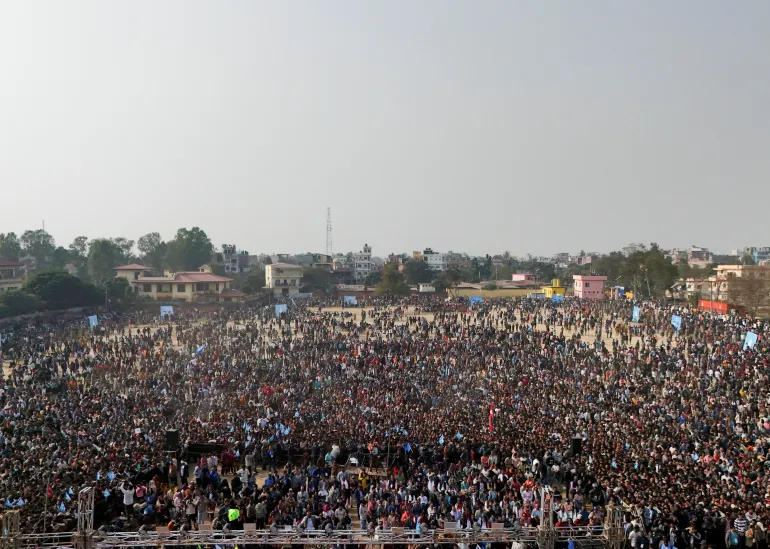
Supporters of Balendra Shah, a former Kathmandu mayor popularly known as ‘Balen’, gather for a campaign rally in Janakpur, Nepal, January 19, 2026 [Navesh Chitrakar/Reuters]
The craze
If young Nepal burned with anger in September, when protesters clashed with security forces and attacked senior politicians after a crackdown by authorities under Oli, Balen was still seething with rage two months later.
In a midnight post on Facebook in November, he lashed out: “F*** America, F*** India, F*** China, F*** UML, F*** Congress, F*** RSP, F*** RPP, F*** Maobaadi. You Guys all Combined can do nothing”, venting against the popular political parties and even nations that have close ties to Nepal. Being the Kathmandu mayor at the time, he deleted the post less than half an hour later.
Then in January, he quit as mayor and joined the RSP, one of the parties he cursed in the Facebook post. More recently, after Oli called on Facebook for a public debate among prime ministerial candidates of major parties, Balen rejected the suggestion and asked the ex-prime minister to take responsibility for the dozens of civilians killed during the Gen Z protests in September. He asked Oli to acknowledge that he was a “terrorist”.
Over the top? Not to many Nepalis.
The rapper-turned-politician’s confrontational style and rhetoric appear to have only endeared him to large sections of the youth. His beard and dandy, all-black clothing style – he occasionally wears the traditional Newari dress of the ethnic inhabitants of the Kathmandu valley – coupled with his trademark dark glasses, have become fashion symbols.
Kathmandu shops once ran out of the kind of black rectangular glasses he wears. Many online stores, including Daraz, the most popular seller in Nepal, still carry multiple choices of these shades, calling them “Balen Shah glasses”.
Unlike traditional politicians, Balen mainly stays away from mainstream media. Instead, he communicates with the wider public through podcasts, television shows where he is a judge, or through his favourite platform: social media. His 3.5 million followers on Facebook, 1 million on Instagram, 400,000 on X and nearly 1 million on YouTube give him an online audience unmatched in Nepal.
This is valuable capital with a generation constantly on their phones.
Yet Balen first made waves not as a politician, but as an upstart musician who shook Nepal.
Balendra Shah, a rapper-turned-politician and the prime ministerial candidate for the Rastriya Swatantra Party (RSP), along with Rabi Lamichhane, RSP president, takes part in an election campaign in Kirtipur, Kathmandu, Nepal, February 28, 2026 [Navesh Chitrakar/Reuters]
Big cars, bigger songs
The youngest of four siblings, Balen was born in 1990 in Kathmandu. Balen’s father, Ram Narayan Shah – who passed away in December – was a government practitioner of ayurveda, the ancient Hindu healing system.
In an interview with Al Jazeera in September – three months before his death – Shah recalled Balen as a “bright and simple” child. The father’s work took him away from home frequently, but one clear memory from Balen’s childhood stuck out for Shah: “He wrote poems. I remember that, because I also wrote poems.”
Balen graduated with a civil engineering degree from Himalayan Whitehouse International College in Kathmandu and received a postgraduate degree in structural engineering from Visvesvaraya Technological University (VTU) in Karnataka, India.
Then, in 2013, he engineered his first major career transition. The setting was a popular rap battle in Nepal, called Raw Barz, in which two contestants face-off live against each other. One of the organisers of the competition, who requested anonymity, told Al Jazeera that Yama Buddha, a popular rapper who has since passed away, recommended Balen to him.
Balen won the rap battle, gaining instant popularity. “More than a rapper, he was a poet. He was very good lyrically, and talked about suppressed [people],” the contest organiser recalled.
In 2021, Shah announced his candidature for the mayoral election and revealed that he had been plotting the run for at least two years. He swept the election, winning 61,767 votes, defeating candidates from the major political parties, the Nepali Congress and Communist Party of Nepal (UML), who received 38,341 and 38,117 votes, respectively.
As mayor, according to his aide and press coordinator, Surendra Bajgain, Shah would arrive at his office at the Kathmandu Metropolitan City (KMC) at about 10am. He would first meet all the department heads, go through files, “seek clarity” on questions he had, and then sign files, Bajgain told Al Jazeera.
He would wear his trademark black jacket and pants, and black shades, every day to the office. He would remove his glasses inside the office, Bajgain said. “But you’ll see him in those glasses when taking pictures or in public,” he added.
As a mayor, he lived in government-provided accommodation in the heart of Kathmandu with his wife and an infant daughter. A gym regular, he preferred lunch at home, but would sip on endless cups of tea and coffee in the office.
To get away from the public gaze, Balen “loves to go on long rides outside the valley, because here, people surround him very often in public,” Bajgain said.
His passion for cars also landed him in controversy, widely circulated online, when he was seen driving an expensive Land Rover Defender worth 40 million Nepali rupees ($275,0000) in January, while campaigning in Jhapa 5, his electoral constituency, for the March 5 election.
Given his strong anticorruption image, the sight of him in a high-end luxury vehicle drew heightened scrutiny. Critics accused him of a lack of transparency over the vehicle’s ownership and use, while some pointed out that, despite promoting modesty in public office, he rarely used public transport as the mayor. The car, it turned out, had been given to him by a wealthy businessman for use during his campaign.
Balen is now also pursuing a PhD in traditional infrastructure at Kathmandu University. But he is far from a reluctant public figure, nor is he an ivory-tower researcher.
Balen’s songs, which mock political parties, criticise corruption and talk of the sacrifices of everyday Nepalis, have been the soundtrack to the efforts by Nepal’s Gen Z to reshape the country’s politics in recent months.
One song, Nepal Haseko (Nepal Smiling), became an anthem during last year’s protests, and already has more than 10 million views on YouTube. In the song, children sing in the chorus: “I want to see Nepal smiling; I want to see Nepalis living happily.”
Another song, Balidan (Sacrifice) has 14 million views on YouTube. It talks about impunity and corruption. On the Discord server “Youth Against Corruption”, where Gen Z protesters picked the country’s interim leader after Oli’s resignation in September, the name “Balen” was mentioned 16,328 times — far more than anyone else’s.
But Balen also has his critics.
Balen plays a ‘damru’ percussion instrument during an election campaign in Janakpur, Nepal, on January 19, 2026 [Navesh Chitrakar/Reuters]
‘Set on fire’
In 2023, when Balen was mayor, his wife was in his official vehicle when a traffic policeman stopped it. Balen was not in the car. The government-plated vehicle was being used on a public holiday, which gives traffic personnel the right to ask the purpose of the vehicle use and whether the driver has a permit for it.
On social media, Balen blew up about the incident: “If any of our KMC vehicles are stopped by the government from tomorrow, I will set the Singha Durbar on fire. Remember, you thief government”. Singha Durbar houses many administrative offices along with the Prime Minister’s Office.
The Oli government initially wanted to charge him for the incendiary statement, but backed off – Balen’s comment on social media had drawn support. It was a sign of things to come. During the Gen Z uprising in September, Singha Durbar was severely damaged after being set on fire.
In another instance, in 2023, after India installed a mural of “Akhand Bharat” (a Greater India) – encompassing many of its neighbours – Shah hung a “Greater Nepal” map in his office, including territories that once belonged to Nepal but now lie within India’s borders.
The move instantly escalated into a diplomatic hurdle. Shah was accused of going beyond his mandate as a municipal leader and stoking nationalist sentiment for political gains. His supporters, however, hailed his move as an assertive counter to foreign dominance.
In 2023, Balen also banned the screening of Indian films in Kathmandu, alleging that an Indian movie had suggested that Sita, one of Hinduism’s most revered goddesses, was born in India. In fact, she was born in present-day Nepal according to Hindu scriptures.
As Kathmandu mayor, Balen bulldozed illegal structures and ordered rubbish to be dumped outside government offices. He temporarily halted waste collection from Singha Durbar. The move was a riposte to what he argued was the central government’s failure to coordinate with the city to address Kathmandu’s chronic waste management crisis.
Yet to many belonging to the generation most hungry for change in Nepal, Balen has an allure no one else appears to have.
Balen meets supporters during an election campaign rally in Jhapa, Nepal, on February 23, 2026 [Umesh Karki/ AP Photo]
‘Shake up the status quo’
Aayal Sah, a 20-year-old first-time voter, is a resident of Janakpur – where Sita, the Hindu Goddess, is believed to have been born. He took three of his friends to see Balen’s first public appearance after joining the RSP. “I cannot directly vote for Balen as he is not contesting from our area, but I’ll surely vote for his party,” he told Al Jazeera.
Rana, the journalist at Kalam Weekly, said that for many, Balen “embodies the outsider spirit that many young Nepalis are looking for to shake up the status quo”.
Yet, Rana acknowledged, questions over Balen’s ability to lead Nepal linger as the country heads to elections. “A primary concern for most critics is Balen’s immaturity and his refusal to engage with the public. During his time as mayor, he gave no interviews to local media and did not answer any questions,” Rana told Al Jazeera.
After Oli quit office, when Gen Z protesters voted most for Balen to take over as interim leader on Discord, the then-mayor was not available on the phone when the youth movement’s leaders tried to reach him to see if he would take charge of the nation.
That, say analysts, was yet another example of Balen’s communication style: It is always one way, at his time and place of choosing.
But for many young Nepalis like Sah, the Janakpur resident, none of these chinks in Balen’s public life matter. “It’s the trust he has gained among the young people,” Sah said.
“He is the only one who can take the country forward.”