sexual harassment

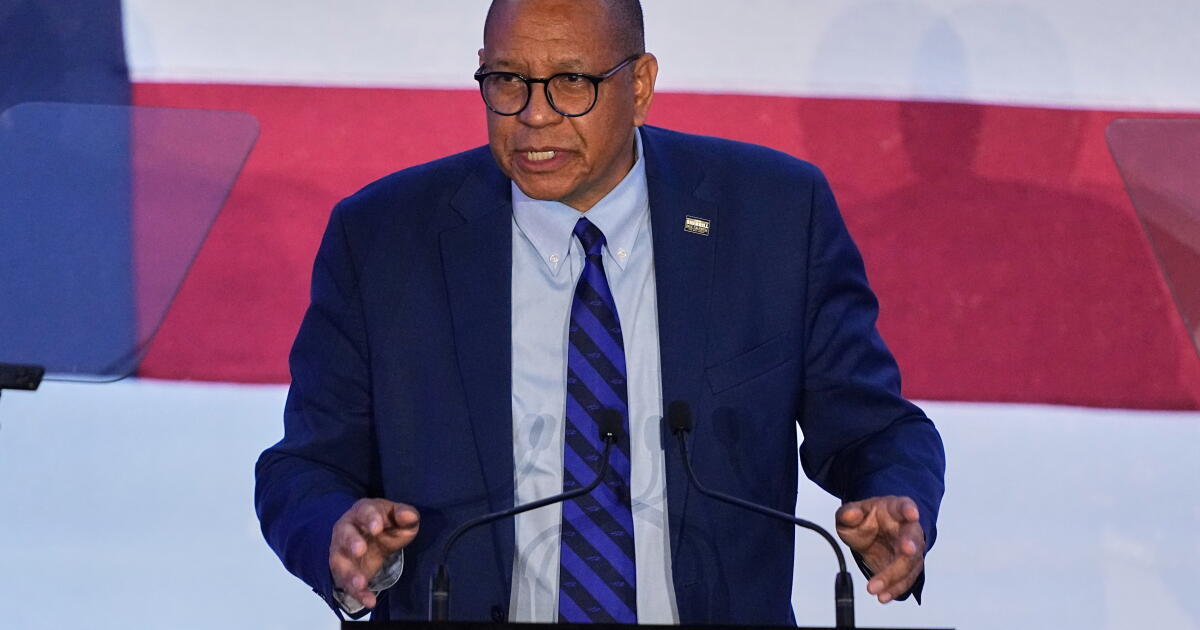
New Jersey’s lieutenant governor resigns after harassment complaints

Mike Catalini and Philip Marcelo

New Jersey ’s Democratic lieutenant governor has resigned after the governor demanded he step down over sexual harassment allegations and ethical lapses involving his relationships with women.

Gov. Mikie Sherrill had given Lt. Gov. Dale Caldwell an ultimatum that he resign by Friday, though she lacked the power to remove him if he said no. Sherrill announced the resignation at a news conference that afternoon.

“His decision will allow us to move forward with important work serving the people of our state,” she said. “In my administration we are committed to doing what is right, not what is politically expedient.”

Sherrill picked Caldwell, a Methodist pastor and former president of Centenary University, to be her running mate last year. They were elected together and took office in January, but within four months, Caldwell had become the subject of an anonymous complaint about his behavior with women.

In New Jersey, a governor can’t fire the lieutenant governor, as the post is independently elected. But lieutenant governors can be impeached and removed from office by the Legislature. A governor can strip a lieutenant governor of nearly all duties and responsibilities, effectively sidelining them from the administration.

Sherrill hired the law firm of a former New Jersey attorney general, Christopher Porrino, to investigate.

In a report released Thursday, the lawyers said Caldwell had committed several violations of state policy. It said Caldwell, 66, had made an advance toward a staff member’s friend and when he was rebuffed told the staffer, “you young women are looking for young sperm.”

The report also said Caldwell had tried to get a promotion for a state employee he was dating and brought personal guests to the opera and other ticketed events without paying for them, as required by ethics rules.

Caldwell denied any misconduct and said in a letter included in the report that he suspected his relationships with women were being subjected to extra scrutiny because he was a single Black man.

His lawyer, Thomas Calcagni, said Caldwell never made the sperm statement or used his position to further his romantic life. Caldwell did recommend a female friend for a promotion, Calcagni said, but only because he thought she would be a good candidate for the job. Caldwell denied ordering anyone to promote her or knowingly violating ethics rules by failing to disclose their personal relationship when he recommended her.

Sherrill had said Caldwell needed to resign because he committed “serious, repeated violations of state policy,” despite multiple warnings and trainings.

Besides being the first in line to become governor if Sherrill were to die, be removed from office or become incapacitated, Caldwell also had served as New Jersey’s appointed secretary of state. In that role, he had a supervisory role over the state’s elections.

In neighboring New York, a similar impasse has played out over the last year between Democratic Gov. Kathy Hochul and her estranged Lt. Gov. Antonio Delgado, who launched a caustic primary challenge to unseat her only to withdraw from the race as the election neared.

Hochul is running for reelection in November with Adrienne Adams, the former speaker of the New York City Council, as her replacement lieutenant governor nominee.

Catalini and Marcelo write for the Associated Press. Marcelo reported from New York.

Source link

Former employee sues Activision Blizzard, claiming sexual harassment and discrimination

A former employee of Activision Blizzard is suing the Santa Monica-based game company, alleging she was sexually harassed and subject to retaliation.

In a lawsuit filed in Los Angeles County Superior Court on Wednesday, the woman, filing anonymously as Jane Doe, says the game giant “fostered and tolerated a pervasive ‘frat boy’ workplace culture,” where male employees and supervisors “openly objectified women, viewed and displayed pornography” and made demeaning sexual remarks in her presence.

She is seeking unspecified compensatory damages, including for lost wages, benefits and earning capacity.

“We take these allegations seriously. We strive to maintain a respectful and inclusive workplace, and we do that through best-in-class policies and systems designed to prevent and address harassment, discrimination, and retaliation, and by holding employees accountable for their behavior,” said a Blizzard spokesperson in a statement to The Times.

The woman, who said she worked for the company for 14 years beginning in 2009 in its sound department, accuses 10 men of subjecting her variously to harassment, physical assault, inappropriate touching and inappropriate comments.

Between 2011 and 2012, she alleges, one co-worker lured her to his apartment, where he repeatedly touched her leg and “blocked her exit, threaten[ing] her with physical violence and attempted to rape her.” He continued to demand dates and spread sexual rumors about her calling her a “bitch” and “slut” in front of co-workers and a male manager, according to the suit.

Over five years starting in 2010, Jane Doe says that she was “repeatedly sexually harassed” by another man, a re-recording mixer with whom she worked with, and who told her that she would “be risking her career if she reported him,” the complaint states.

She further alleges that a third man, Blizzard’s audio director, “repeatedly touched” her leg “in a sexual manner without her permission” and when she rejected his advances he “retaliated against her by sabotaging her work and ensuring that she was denied a promotion.”

According to the suit, Jane Doe’s complaints and reports to her supervisors and human resources about her alleged treatment were dismissed and they “failed to take timely or effective corrective action.”

Further, the former employee says that she was “required to work excessive and unsafe hours” and told not to report overtime.

As a result of the harassment, the employee says in her complaint, she suffered suffered depression “and was required to seek ongoing psychiatric care” before being discharged in April 2024.

A year earlier, Activision Blizzard and California’s Civil Rights Department reached a roughly $50-million settlement agreement to resolve an employment discrimination and equal pay lawsuit. .

The Civil Rights Department sued Activision Blizzard in 2021, alleging that women at the company were regularly subjected to sexual harassment, paid less, denied promotions and met with retaliation when they raised concerns with managers.

For the record:

11:19 a.m. Sept. 11, 2026An earlier version of this story incorrectly described the amount Activision agreed to pay to compensate women who worked for the company in California from Oct. 12, 2015, to Dec. 31, 2020.

As part of the agreement, Activision Blizzard agreed to pay up to $45.75 million to compensate women who worked for the company in California from Oct. 12, 2015, to Dec. 31, 2020. The company also agreed to pay $9.1 million to cover the Civil Rights Department’s attorneys fees and costs.
Activision Blizzard also settled a case with the federal Equal Employment Opportunity Commission. As part of that 2022 settlement, the company agreed to establish an $18-million fund for workers who experienced sexual harassment or discrimination, among other types of workplace misconduct.

Activision Blizzard has denied all wrongdoing.

Source link

House lawmakers return to Washington with a stopgap funding bill atop the list of priorities

House lawmakers return to Washington on Monday with a short to-do list after five weeks back in their home districts. The first order of business is likely a vote on a stopgap spending bill designed to keep the federal government fully funded through early December, removing the possibility of a shutdown before the midterm elections.

With election season getting underway, votes are also expected on measures designed to amplify the GOP’s messaging strategy going into November, most notably a resolution condemning socialism. Republicans are trying to tie the Democratic Party in general to the democratic socialist candidates who have succeeded this year in running for office.

Another item that could make its way onto the agenda is a Senate-passed bill that imposes sanctions on key segments of the Russian economy and allows President Donald Trump to impose steep tariffs on goods imported from countries that buy the vast majority of Russian oil and gas. The effort led by the late Sen. Lindsey Graham aims to deprive Russian President Vladimir Putin of revenue used to finance the war against Ukraine.

The bill passed 86-11 in the Senate. House passage would send the bill to Trump’s desk for his signature. However, some key House Democrats oppose the bill. The bill grants Trump sweeping new tariff authorities that some lawmakers fear could be used to punish allies rather than foes.

A vote on the bill is not scheduled this week, but proponents are working to have it taken up before lawmakers leave Washington to focus solely on their reelection campaigns.

The return to Washington also brings a renewed focus on improper behavior by lawmakers as the House will have its first chance to act on a recommendation from the House Ethics Committee to censure Rep. Chuck Edwards, R-N.C., for engaging in persistent unprofessional and inappropriate conduct toward two young female aides in his congressional office.

Edwards implores colleagues to reject censure vote

Edwards has disputed the committee’s conclusion that he failed to adhere to the spirit of the rules prohibiting sexual harassment and unwanted advances to House staffers. He points to the committee’s conclusion that found no evidence he “engaged in sexual activity or explicitly propositioned any individual under his employ.”

Edwards said he was not asking lawmakers to approve of every gift, compliment or social interaction, but to distinguish between conduct that someone might find unconventional and conduct that actually establishes sexual harassment.

“Individual acts that were not themselves prohibited were gathered together, assigned the most damaging possible interpretation, and then used collectively to support a conclusion far more serious than the underlying evidence,” Edwards wrote in a letter to colleagues first reported by NOTUS.

The committee said Edwards provided the two staffers with lavish and recurrent gifts, made comments regarding their dress and appearance, invited them to intimate dinners and vacations, sent notes regarding his effusive affection and invited them to other activities as a way to spend time together.

A vote to censure registers the House’s deep disapproval of a lawmaker’s conduct that does not meet the threshold for expulsion. Edwards dropped his reelection plans after the committee’s report came out.

Avoiding another shutdown

House Speaker Mike Johnson is expected to tee up the funding bill early in the week. The bill underwent some significant changes in the Senate, which made it more palatable for Democrats. It delays a proposed rule from the Office of Management and Budget that would give political appointees more power over the distribution of federal grants. It also includes language to ensure the administration can’t transfer funds to the Border Patrol.

But a provision that delays for one month a federal ban on intoxicating hemp THC products has prompted criticism from many GOP lawmakers. As a result, GOP leaders will likely place the bill on a fast-track process that avoids a separate procedural vote. Suspension bills require a two-thirds vote to pass, meaning a significant number from both parties need to support the measure for it to pass and advance to Trump’s desk.

Lawmakers are anxious to avoid the possibility of a shutdown as voters weigh their options going into November. The funding bill passed by a 90-6 vote in the Senate, showing that lawmakers from both political parties want to avoid a repeat of the two historic shutdowns that occurred this past year.

Freking writes for the Associated Press.

Source link