settlements

Could Israel really build settlements in Gaza? | Israel-Palestine conflict News

Israeli Prime Minister Benjamin Netanyahu and his far-right Finance Minister Bezalel Smotrich have offered the clearest signal yet that they are considering the establishment of new Jewish settlements on what remains of the Gaza Strip after almost three years of their country’s genocidal war against Palestinians in the enclave.

Last Monday, Smotrich, who made his continued participation in the ruling coalition conditional on being granted increased control over Israel’s settlement enterprise, told reporters that his ministry had prepared plans for three settlements in northern Gaza, and that all that was needed to move forward was the green light from Netanyahu.

Recommended Stories

list of 4 itemsend of list

The following day, Netanyahu came close to providing it. Speaking on Israel’s staunchly right-wing Channel 14, he refused to rule out the prospect of settlements in Gaza.

“The question is whether you prefer to do or to talk,” the prime minister replied cryptically when asked whether the establishment of settlements was a possibility. “And yes, I prefer not to address it.”

Israel’s current settlements – in the occupied West Bank and occupied East Jerusalem – are illegal under international law.

In clearing the way for any future settlements in Gaza – and for what Netanyahu euphemistically told Channel 14 viewers was the “voluntary migration” of its remaining population, a process widely characterised by international jurists as ethnic cleansing – Israel has killed more than 73,000 of its occupants.

At the same time, Israel has been accused by United Nations-backed experts of deliberately imposing a famine on survivors in Gaza and, most recently, of furthering its genocide in Gaza through the deliberate targeting of children.

The degree to which preparations are under way for the physical establishment of any settlements in Gaza – which previously had 21 illegal settlements before the Israeli government decided to dismantle them in 2005 – is difficult to ascertain. The area north of Gaza City has been largely razed by Israel, with its deliberate campaign to demolish Palestinian homes and institutions, destroying almost everything not hit with bombs from the air.

Supporters of settlements in Gaza see that now empty land as a perfect opportunity to cement a buffer between Israel and Gaza.

With elections due in Israel, it is beneficial for politicians such as Smotrich and Netanyahu to insinuate that this is now the plan.

“The Israeli public has been subjected to almost endless incitements to genocide since October 7,” said Neve Gordon, an Israeli professor at Queen Mary University of London. “People who watch legacy media in Israel have no understanding of the level of destruction in Gaza, or the kind of suffering that has gone on there.

“There are even spots, tourist spots, where some people in Israel go to watch the bombing. This is the constituency that statements like Smotrich’s are designed to appeal to. These are the people who would like to see more settlements in Gaza, but that doesn’t mean we shouldn’t take it seriously ” he said. “[But] this isn’t just rhetoric. There is a definite and consistent push from across much of Israel’s politics to resettle the Gaza Strip.”

A history of ethnic cleansing

A growing number of hardline religious Israelis have been seeking to resettle the Gaza Strip since the 2005 disengagement. Since then, analysts and historians have described concerted efforts by those supporting settlements to capture the institutions of Israeli public life, gaining dominant voices in the education system, the media and other areas of government.

KIBBUTZ NIR AM, ISRAEL - APRIL 22: Right-wing Nachala movement settlers march near the Gaza border, advocating for the resettlement of the Gaza Strip, near Kibbutz Nir Am as Israelis observe Yom Ha'atzmaut, National Independence Day on April 22, 2026 near Kibbutz Nir Am, Israel. (Photo by Erik Marmor/Getty Images)
Right-wing Nachala movement settlers march near the border, advocating for the resettlement of the Gaza Strip [File: Erik Marmor/Getty Images]

Organisations such as the far-right settler group Nachala have openly championed the resettlement of the enclave. Months into Israel’s genocidal war, Nachala held a conference explicitly promoting Israel’s return to Gaza, entitled ”Settlement Brings Security and Victory”. It was attended by numerous government ministers, including Smotrich and National Security Minister Itamar Ben-Gvir.

Despite what critics describe as his success in establishing settlements on a scale unparalleled since the 1990s, Smotrich continues to struggle in the polls. His Religious Zionist party may not secure enough votes in the next election – which must be before the end of October – to meet the minimum threshold to get into parliament. That perhaps explains why Smotrich is eager to inflate the prospects of settlements in Gaza and attract more support from the Israeli right-wing.

Political advantage

The irony is curious for observers such as Orly Noy, the editor of the Hebrew-language Local Call magazine.

Smotrich “has been the most effective member of the cabinet in promoting the interests of the settlers in the West Bank”, she said. “He has really made a revolution in that sense,” referring to the judicial, economic, and infrastructure overhauls initiated under Smotrich’s watch, that he appears to be receiving little credit for among his base.

The stakes for Netanyahu are potentially more dramatic, analysts pointed out. Currently on trial on multiple corruption charges, the PM faces a jail sentence if found guilty.

Similarly, anger over his apparent determination not to hold an independent inquiry into his own government’s failings in the October 7 attack runs high, perhaps giving him a reason to suggest that he will move forward with building settlements and expelling Palestinians from Gaza.

Israeli politician Ofer Cassif, centre, holds a Palestinian flag
Israeli Knesset member and the only Jewish politician expected to resist potential settlement in Gaza, Ofer Cassif [File: Ahmad Gharabli/AFP]

“Look, if you want to distinguish yourself from the rest of the field ahead of the election, your time is now,” political analyst Ori Goldberg said. “This is your moment, and, if you want to propose imposing further hardship onto Palestinians, there is absolutely no Jewish member of [parliament] – apart from the [left-wing member of parliament] Ofer Cassif – who is going to oppose you.

“People don’t care anymore,” he said of the chances of the settlement of Gaza receiving any resistance from Israelis. “There’s just nothing [on the suffering in Gaza]. People have grown indifferent. There’s just a big black hole.”

Complicity

While the Israeli government may have no domestic qualms when it comes to building settlements in Gaza, it does have to contend with the international backlash – and that may be why the project does not move beyond the planning stage.

But would Israel face any real lasting consequences from building settlements in Gaza?

In the eyes of many, the Israeli government’s freedom to act comes from the unwavering diplomatic and military support of the US, as well as the financial support of Europe which, despite its occasional criticism, remains Israel’s foremost trading partner.

“In terms of international reaction,” author and fellow at the European Council on Foreign Relations, Hugh Lovatt said of the prospect of settlement in Gaza, “from 2023 onwards we’ve seen the greatest expansion of settlements since the [1990s] Oslo Accords, as well as plans to render the two-state solution obsolete”.

“And, while there’s been some criticism, there’s been very little action,” Lovatt said. “I don’t know if that would be any different were it to happen in Gaza. It’s true that Gaza has been the focus of a great deal of international – and specifically US – attention since the ceasefire that the West Bank has not.”

However, whether that attention would act as a check on Israel’s attempts to expand its settlements is unclear.

“Would Israel risk such a blatant move to block Trump’s Gaza plan? I’m not sure,” he said of the US president’s plan for Gaza, which while heavily criticised for allowing Israel to continue its presence in the Palestinian territory, makes no mention of Israeli settlements.

“And while Europe has a very poor track record so far, an expansion of Israeli settlements to Gaza could push European states to act,” he said.

Source link

Inside the ‘unacceptable’ UK fair selling property in Israeli settlements | Israel-Palestine conflict News

London, United Kingdom – Activists who gained access to the widely condemned Great Israeli Real Estate Event in London have shared photos with Al Jazeera that show property in illegal settlements being marketed.

The invite-only event, held at Edgware United Synagogue, was part of a roadshow promoting the sale of land and property in Israel, but in reality, these included homes in areas such as Givat Zeev and Tivuch Shelly in the occupied West Bank, as well as settlements in East Jerusalem.

Recommended Stories

list of 4 itemsend of list

“Exciting new project just 10 minutes from Jerusalem!” read a leaflet advertising homes, “some with pools!” in Maale Adumim, a West Bank settlement illegal under international law.

Maale
Activists saw leaflets marketing homes in illegal Israeli settlements at the controversial property fair [Courtesy of Jewish Anti-Zionist Action group]

Isabel, a member of the Jewish Anti-Zionist Action group who spoke to Al Jazeera on condition of anonymity, said that the mood at the fair was peaceful and heavily protected, including by plainclothes men fitted with body cameras.

She did not hear any participants mention Palestinians, she said, adding that when it came to the occupied Palestinian territory, real estate agents spoke of “Anglo-communities” where English-speaking people from the United States, the UK and South Africa could relocate to.

She said a popular selling point used by real estate agents was that due to the war on Gaza, it was a good time to buy property in Israel, as prices had dropped and they might be willing to offer a discount.

The atmosphere reminded her of the opening week of university with social chatter, stalls and strangers pushing flyers at attendees.

“Unlike outside the synagogue, where there was lots of protests, it was calm inside with a heavy police presence, [security] people even wearing body cams. The room was all set up with stalls, in what I would describe as like freshers’ fair. On the tables were free pens, chocolates.”

Great Israeli Real Estate Event
Brochures offered people information about buying homes in ‘the heart of Israel’ [Courtesy of Jewish Anti-Zionist Action group]

When Isabel spoke with representatives from the Israeli real estate company Harey Zahav, she was shown advertisements for properties in Jerusalem as well as Netanya, a resort city in central Israel.

More than 100 British legislators, including members of Prime Minister Keir Starmer’s Labour Party, had signed a letter on Friday urging the government to “uphold its obligations under international law” and ensure the event “promoting illegal activities does not proceed”.

Layla Moran, a British MP of Palestinian descent and one of the letter’s signatories, described the sales as “unacceptable”.

Gaza war could mean discounts, said participants

When Isabel told participants she was interested in something a little quieter, they said in hushed tones that they also had a portfolio of properties in “Judea and Samaria”, the Israeli term for the occupied West Bank.

One representative said that organisers asked them not to advertise properties in these locations. When asked why, he said it was due to these “crazy times” when people wanted to stop purchasing property in Israel.

He said they had all the information packs for those properties, but requested her details so he could send them to her afterwards.

People from pro-Palestinian activist groups gather outside the Edgware United Synagogue, during a demonstration against the "Great Israeli Real Estate Event" organised by real-estate agency, 'My Home in Israel', which markets property in Israeli settlements in the occupied West Bank, in London, Britain, June 14, 2026. REUTERS/Toby Shepheard REFILE - CORRECTING TIMELINE FROM "AFTER A DEMONSTRATION" TO "DURING A DEMONSTRATION".
Pro-Palestine protesters, MPs and several rights groups had called on the UK to ban the event [Toby Shepheard/Reuters]

At the stand of Tivuch Shelly, another Israeli real estate company, Isabel said representatives were more reticent to discuss properties in the occupied West Bank, but were openly advertising properties in Givat Hamatos and Ramat Eshkol, two settlements in occupied Jerusalem, on their flyers.

An activist with Jewish Anti-Zionist Action at one point shouted out that “this event sells property on illegally occupied stolen Palestinian land” before he was removed by security.

But the overall mood inside the fair was in sharp contrast to the protests and tense atmosphere outside the event.


In the buildup, rights groups, including Amnesty International, as well as the mayor of London, Sadiq Khan, slammed the event for openly advertising the sale of land in illegal Israeli settlements.

Outside, hundreds of protesters shouted slogans and held posters reading, “Stop Israel’s illegal sale of stolen Palestinian land” and “Thou shalt not steal”.

The Metropolitan Police said 15 people were arrested during the demonstrations “for a range of offences, including public order matters”.

Green Party leader Zack Polanski has written to Khan, calling for the event to be investigated by the Metropolitan Police.

Khan earlier said he had discussed the event with the London police force and had been told that any allegations of criminality relating to the potentially unlawful sale of property at the fair would be assessed by the Met as part of a probe.

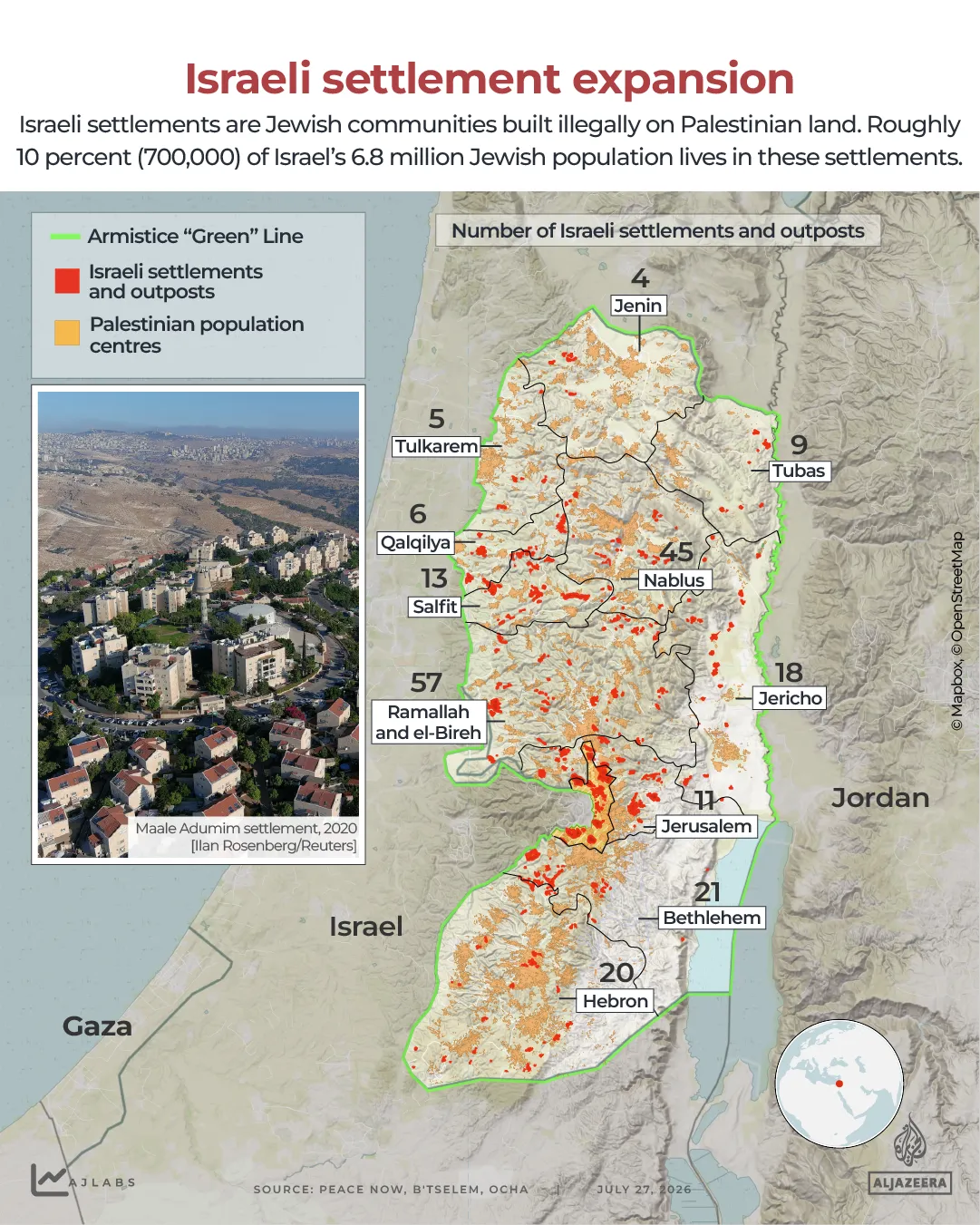
Israeli settlement expansion

Israeli settlers are Israeli citizens who live illegally on Palestinian land.

Israel started building illegal settlements after capturing the West Bank, East Jerusalem and the Gaza Strip in the June 1967 Six-Day War, and now, more than 700,000 settlers – 10 percent of Israel’s population – live in 150 illegal settlements and 128 outposts spread across the occupied West Bank and East Jerusalem.

The government has openly funded and built settlements, and Israeli authorities give their settlers in the occupied West Bank about $5.6m a year to monitor, report and restrict Palestinian construction in Area C, which is administered solely by Israel and comprises more than 60 percent of the West Bank.

United Nations bodies and most countries view the West Bank settlements as illegal, citing international conventions.

But the US has provided diplomatic cover to Israel for decades, with Washington consistently using its veto power at the UN to protect Israel from diplomatic censure.

A police officer stands guard near counter-protesters as people from pro-Palestinian activist groups gather near the Edgware United Synagogue, during a demonstration against the "Great Israeli Real Estate Event" organised by real-estate agency, 'My Home in Israel', which markets property in Israeli settlements in the occupied West Bank, in London, Britain, June 14, 2026. REUTERS/Toby Shepheard
A police officer stands guard near counterprotesters, as people from pro-Palestine groups gathered near the Edgware United Synagogue for a demonstration against the property fair organised by real-estate agency My Home in Israel, which markets property in illegal Israeli settlements in the occupied West Bank, in London, June 14, 2026 [Toby Shepheard/Reuters]

Source link