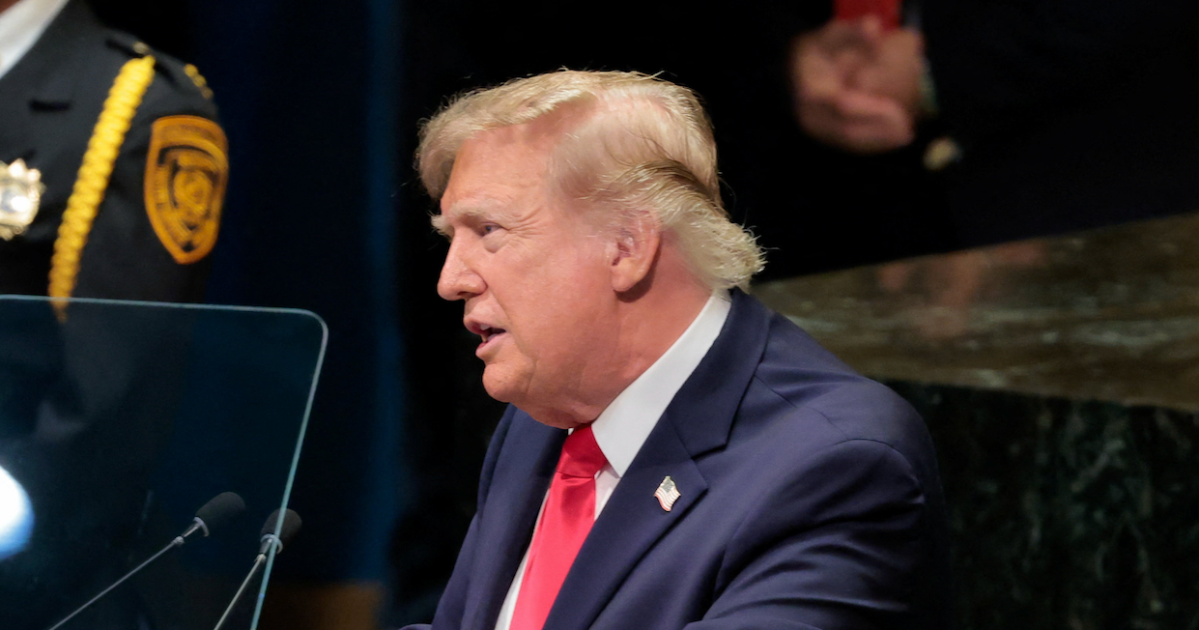
Speaking at the UN General Assembly, US President Donald Trump claimed he helped end the war in Gaza, bring home all remaining hostages, and settle eight wars since taking office. He said trade, tariffs and his relationships with world leaders were key to securing the settlements.
California Atty. General Rob Bonta and Paramount Skydance Chief Executive David Ellison have reached an agreement to end the state’s antitrust fight, paving the way for Ellison to complete his $111-billion purchase of Warner Bros. Discovery, said a person familiar with the matter.
The two sides have agreed to resolve antitrust claims that Bonta and 11 other state attorneys general brought in late July, said the source, who was not authorized to comment publicly on the settlement.
As part of the deal, Paramount agreed to pay a penalty if the company fails to make good on a promise to distribute 30 films per year in theaters and to spend $1.5 billion on film production in Hollywood over the next five years, said the source who was not authorized to comment.
Representatives of Paramount and Bonta did not respond to a request for comment.
A federal judge must approve the agreement. Paramount would then be poised to quickly finalize its purchase of Warner Bros. Discovery — a blockbuster combination that will reshape Hollywood by collapsing two historic film studios with rights to Batman, Harry Potter, “Top Gun,” and Bugs Bunny and by combining the HBO Max and Paramount+ streaming services.
In addition to CBS, Paramount would own dozens of cable television channels, including CNN, TBS, HGTV, Food Network and Comedy Central.
The road to a resolution was fraught. Bonta abruptly canceled a negotiation session with Paramount in late August after potential deal terms leaked. Then, after talks restarted and the settlement began taking shape, several powerful Bonta allies, including New York Atty. Gen. Letitia James and Connecticut Atty. Gen. William Tong, signaled their displeasure with proposed deal terms.
They felt the deal points didn’t go far enough to mitigate the potential clout Paramount would wield over the film and television industries if it was allowed to swallow its larger industry rival, according to three people familiar with the matter but not authorized to comment.
Ellison’s goal had long been to complete the Warner takeover by the end of September — before midterm Congressional elections and prior to a key deadline for Paramount to increase its payout to Warner Bros. Discovery shareholders. Ellison received a boost from California Gov. Gavin Newsom, Los Angeles Mayor Karen Bass and Xavier Becerra, the Democratic nominee for California governor, who pressed Bonta to end the dispute rather than take the case to trial in Oakland in March.
Newsom said he took “seriously” Paramount’s threat to leave the state. He advocated for a settlement behind the scenes, according to two people close to the matter who were not authorized to comment.
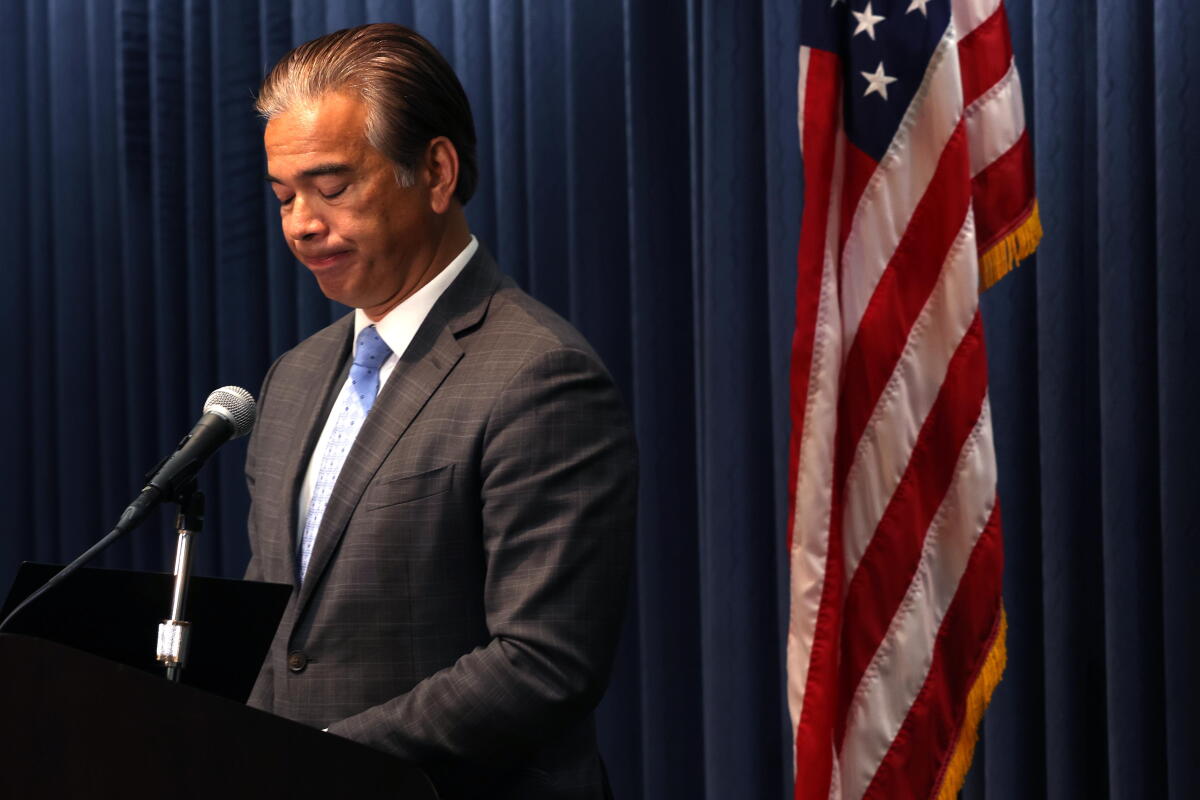
State Attorney General Rob Bonta in 2025. (Genaro Molina/Los Angeles Times)
(Genaro Molina/Los Angeles Times)
Ellison was highly motivated to strike a deal because his company’s expenses will soon accelerate. Beginning Oct. 1, Paramount is on the hook to pay Warner investors a “ticking fee” of 25 cents per quarter, per share until the deal closed. That obligation is expected to add $7 million a day to the cost of the $31 a share that Paramount agreed to pay Warner shareholders when it won the bidding war back in February.
Paramount’s takeover will be heavily leveraged. The company’s bankers have lined up nearly $80 billion in debt to finance the merger. Ellison’s father, billionaire Larry Ellison, late last year agreed to backstop the $47-billion in equity needed to complete the acquisition. Royal families from Saudi Arabia, Qatar and Abu Dhabi have agreed to chip in $24 billion for an equity stake by assuming some of Ellison’s financial commitments.
Late last week, the Federal Communications Commission approved Paramount’s request to allow the foreign investors to own nearly 50% of the merged company. The Ellison family, however, will retain its voting control.
Paramount has promised Wall Street that it would make more than $6 billion in cost cuts. A recent Los Angeles County economic report predicted the merger could lead to an estimated 4,500 workers in the Los Angeles region losing their jobs as Ellison works to combine the two companies.
The truce comes after Paramount received clearances from regulators around the world, including the European Commission, Canada and the U.S. Justice Department.
Larry Ellison separately announced plans to switch the headquarters of his software behemoth Oracle to Nashville from Austin, Texas (after Oracle relocated from Silicon Valley six years ago).
Paramount also enlisted major Hollywood unions, the Directors Guild of America and the International Alliance of Theatrical Stage Employees, and prominent cinema chains to drop their opposition to the deal.
Bonta’s suit had leaned heavily into potential harms to theatrical distribution and lawyers for the states had been banking on theater executives’ testimony at trial.
The parties also were facing a key court hearing Thursday. Paramount was poised to ask U.S. District Judge Araceli Martínez-Olguín in Oakland to make the states and the Writers Guild of America post a $1.88-billion bond that would cover some of Paramount’s delay-related deal costs should the company eventually prevail.
The states and the WGA, which also sued to block the merger, have balked at the request, which was designed by Paramount to create fissures within the coalition of states by raising doubts about the strength of their case.
Paramount’s high-profile lobbying campaign reached a crescendo in late August after Paramount called out activist-actor Mark Ruffalo, accusing him of resorting to “antisemitic tropes” to argue against the merger.
Prominent Jewish groups rushed to Paramount’s aid. Ruffalo, who frequently works with HBO, denied the allegation, saying he had a 1st Amendment right to speak against the deal as well as Oracle’s business ties to Israel. Numerous Jewish artists came to Ruffalo’s defense, saying his free speech rights were being squelched.
Bonta abruptly canceled a settlement conference, accusing Paramount of leaking confidential information.
“If you want to have an adult, legitimate, serious settlement discussion — no problem,” Bonta said during an Aug. 25 appearance in Los Angeles. “But if you want to play games, we’ve got better things to do.”
The states’ 37-page lawsuit, filed in the U.S. District Court for Northern California, claimed the Paramount-Warner combination would violate the U.S. Clayton Act, a century-old antitrust law to prevent mergers that weaken competition and raise costs for consumers.
The states, which also included Nevada, Colorado, Oregon, Washington, New Jersey and New Mexico, had argued the tie-up of two legacy movie studios would give Paramount-Warner too much marketshare in two categories — wide-release movies and potential blockbusters.
Paramount Skydance CEO David Ellison has pressed to get his blockbuster deal done before his company must make higher payouts to Warner Bros. Discovery shareholders and before the mid-term elections, which could change the makeup in Congress.
(Mark Schiefelbein / Associated Press)
The states also said Paramount-Warner would control nearly 30% of the cable television channel space with more than 50 networks.
Paramount has been facing a June 4 deadline to complete the deal — or owe Warner Bros. Discovery a $7-billion breakup fee. Paramount has already paid $2.8-billion to cover a termination fee paid to Netflix after the streamer withdrew from the auction in February.
Europe’s central banks now have a working bridge into tokenised markets.
ADVERTISEMENT
ADVERTISEMENT
Launched on Monday, Pontes lets wholesale transactions in tokenised assets, meaning stocks, bonds and other instruments recorded as digital tokens on distributed ledgers, to settle in the safest form of money available — reserves held at the central bank itself.
It matters because the absence of a risk-free settlement asset has been one of the main barriers holding blockchain technology back. Without it, tokenised trades have typically settled in commercial bank money or stablecoins, carrying credit risk that large institutions are reluctant to accept.
“The Eurosystem is working to enable a more integrated, innovative and resilient European financial market in the digital age,” said ECB President Christine Lagarde.
Thirteen institutions have completed onboarding and are ready to use the system immediately, including Deutsche Bank, Santander, Société Générale, KfW and the European Investment Bank, alongside four ledger operators including Clearstream.
The ECB also intends to become a user itself.
In a separate announcement, it said it has begun preparatory work to invest a small portion of its own funds in tokenised securities, with purchases settled through Pontes.
The initial focus will be euro-denominated debt issued by euro area governments, regional authorities, agencies and European supranational institutions.
The own-funds portfolio sits outside monetary policy and generates income to cover the bank’s running costs. No amount was specified, and the Executive Board will decide on timing once the groundwork is done.
“Pontes brings tokenised markets another step closer to the core of the euro area’s financial infrastructure,” said Richard Baker, founder and CEO of Tokenovate, which builds technology to help financial institutions automate post-trade processing, collateral management and tokenised settlement.
Baker noted the service will initially run within existing market hours, but that “the longer-term opportunity is to support more continuous, potentially 24/7, settlement.”
That gap is where Europe is playing catch-up.
American markets have moved faster as the New York Stock Exchange is building a blockchain-based venue for trading tokenised shares and funds around the clock, and BlackRock has run a tokenised money market fund since 2024.
Pontes itself will only reach full capability, with longer operating hours and enhanced features, by 2028.
The two sides are also taking different routes.
Washington, under US President Donald Trump, abandoned plans for a Federal Reserve digital currency and backed privately issued stablecoins instead. On the other hand, Frankfurt is betting that public central bank money should sit at the centre.
Where the digital euro stands
Pontes is aimed at banks and markets, not consumers. The retail equivalent, the digital euro, would let the public make everyday payments directly in central bank money.
That project is further from reality.
The European Parliament’s economic committee approved its position in June, opening negotiations with member states, and final legislation is targeted for the end of this year.
If that holds, a pilot involving 36 payment providers will begin in September 2027, with first issuance possible in 2029.